Direct Tax requires conceptual clarity as well as the correct legal position. Even when you understand a provision, an amendment or a change in applicability can affect how you answer an examination question. Organised notes help you revise provisions, remember exceptions and practise applying the law without repeatedly searching through lengthy study material.
Use these notes as a revision framework, not as a substitute for the latest ICAI study material. Direct Tax amendments depend on the assessment year, Finance Act and examination attempt. Confirm the applicable Finance Act, statutory updates, corrigenda and ICAI announcements before relying on any summary.
Confirm the applicable Finance Act
Begin by identifying the examination attempt and the Finance Act or assessment-year coverage specified by ICAI. Do not assume that notes prepared for a previous attempt remain suitable. Rates, limits, deductions and reporting provisions may change, and applicability can depend on the facts stated in a question.
Write the applicable Finance Act and assessment-year coverage at the top of your notes. Maintain an amendment tracker with the provision, change, applicability and verification source. This makes it easier to distinguish current provisions from older examples.
Organise notes chapter by chapter
Follow the chapter sequence in the ICAI material. For every chapter, prepare a short overview, key provisions, conditions, exceptions, relevant limits or rates and one or two examples. Keep detailed working notes separately where a provision needs a longer explanation.
Do not shorten a rule so much that its conditions disappear. The difference between a general rule and an exception may decide the answer. Use compact language, but preserve statutory conditions and facts that trigger a particular treatment.
Create an amendment register
Use columns for topic, earlier position, amended position, effective date or applicability, exam relevance and source. When a change affects a rate or threshold, highlight the exact figure and the conditions under which it applies.
Update the register only after checking an authoritative source. Use ICAI study material and updates applicable to your attempt, along with official statutory or government material where necessary. If two notes disagree, trace each statement to its source instead of combining them casually.
Summarise provisions consistently
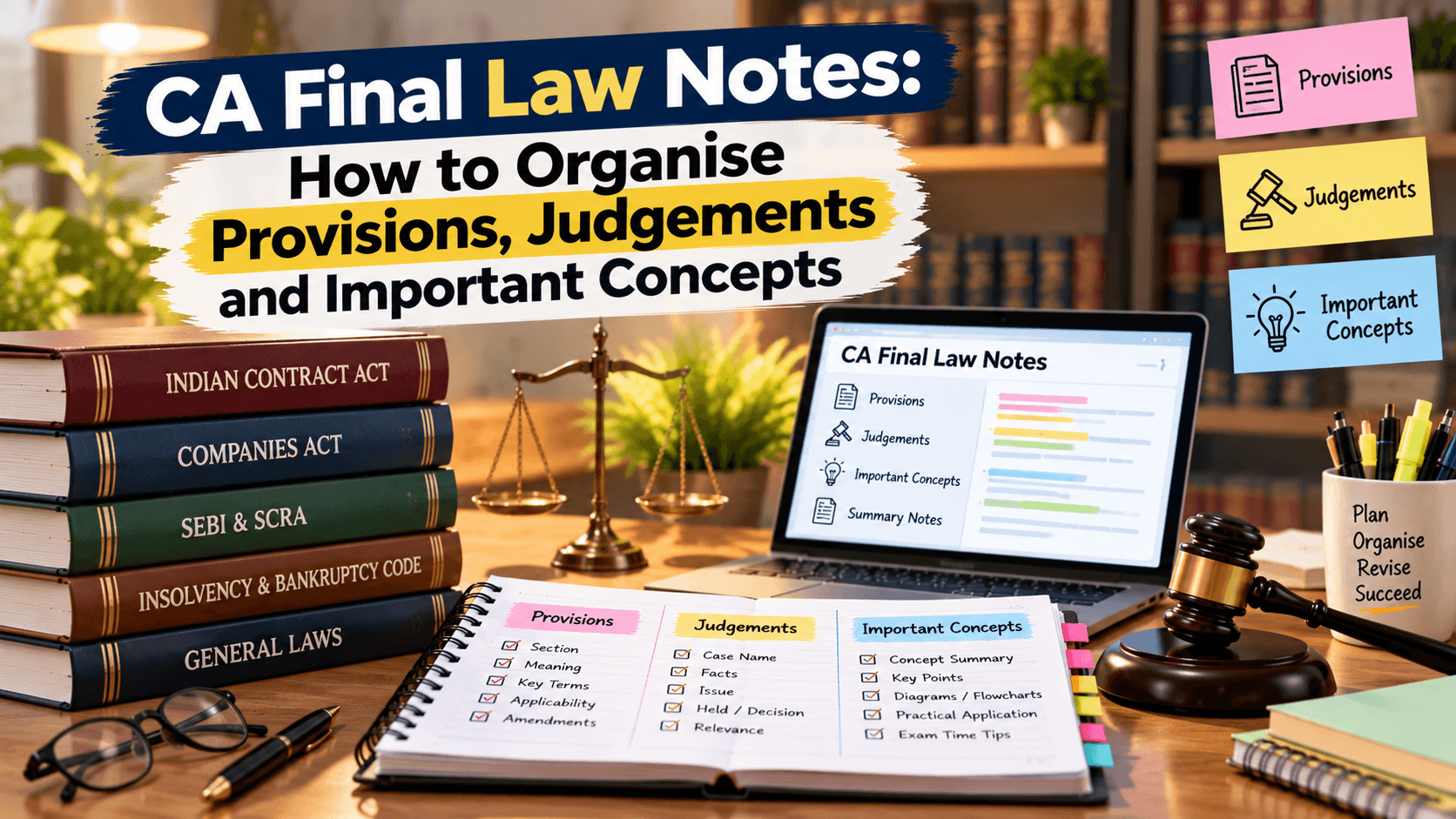
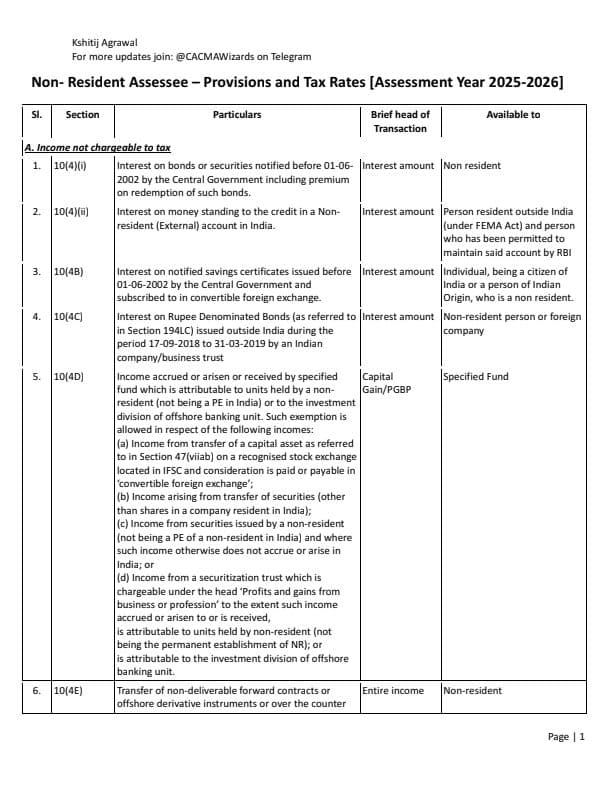
For each provision, record who or what it applies to, the conditions, the tax treatment, exceptions and a short example. This format helps you compare similar provisions and reduces the risk of remembering only a headline rule.
For calculations, write the steps in the order you would use in an examination answer. Label each adjustment and explain why it applies. A formula without assumptions can be misleading when question facts change.
Use comparison tables
Some Direct Tax topics contain provisions that look similar but differ in eligibility, timing, thresholds or consequences. Build side-by-side tables showing the relevant conditions and distinctions. Limit the table to points prescribed and useful for exam answers.
Review the comparison by covering one column and recalling it from memory. Then attempt a question requiring you to choose between provisions. This turns a reference table into an active revision tool.
Practise computation and interpretation
After revising a topic, solve questions without looking at the solution. Show your working clearly and explain why a provision or adjustment applies. Direct Tax preparation requires both knowledge of provisions and the ability to apply them to facts.
Record the cause of every error: forgotten condition, wrong assessment year, missed fact or calculation mistake. Revisit the underlying rule before attempting another question on the same topic.
Prepare concise revision sheets
Closer to the examination, prepare short sheets containing key provisions, amendment points, important conditions, commonly confused rules and mistakes from practice. Avoid copying full chapter summaries into these sheets; the purpose is quick recall.
Use a consistent layout and mark amendment-sensitive points clearly. Verify them again against the material applicable to your attempt. Do not add a new figure unless you have confirmed its applicability and source.
Use Studycaller strategically
Studycaller can be an additional support resource for structured revision and practice. Use selected notes or tests alongside official ICAI material, and check that they align with your attempt’s applicable Finance Act and amendments.
After a practice test, review both the marks and the quality of your reasoning. Track weak chapters, amendment-related errors and calculation mistakes. A resource is most useful when it helps you identify what to revise next.
Build a weekly revision cycle
Set aside one session for learning or refreshing a chapter, one for amendment review and one for question practice. At week’s end, revisit errors and test whether you can explain provisions without opening your notes.
Keep the plan realistic. If time is limited, prioritise syllabus coverage, current ICAI material and practice on topics where you repeatedly lose marks. Avoid spending the entire week formatting notes instead of using them.
Avoid amendment-related mistakes
Do not rely on undated PDFs, assume every change applies to every assessment year or memorise a rate without its conditions. Another risk is using a correct provision in the wrong context because the question refers to a different year or taxpayer situation.
Before finalising an answer, check the relevant year, facts, conditions and provision. Make amendment checking a separate revision task rather than assuming that reading a chapter once has updated your understanding.
How Studycaller Can Support Your Revision
Studycaller can be used as an additional revision and practice resource alongside the applicable ICAI study material. Choose content aligned with your examination attempt, and verify syllabus coverage, amendments and examination instructions through official ICAI sources.