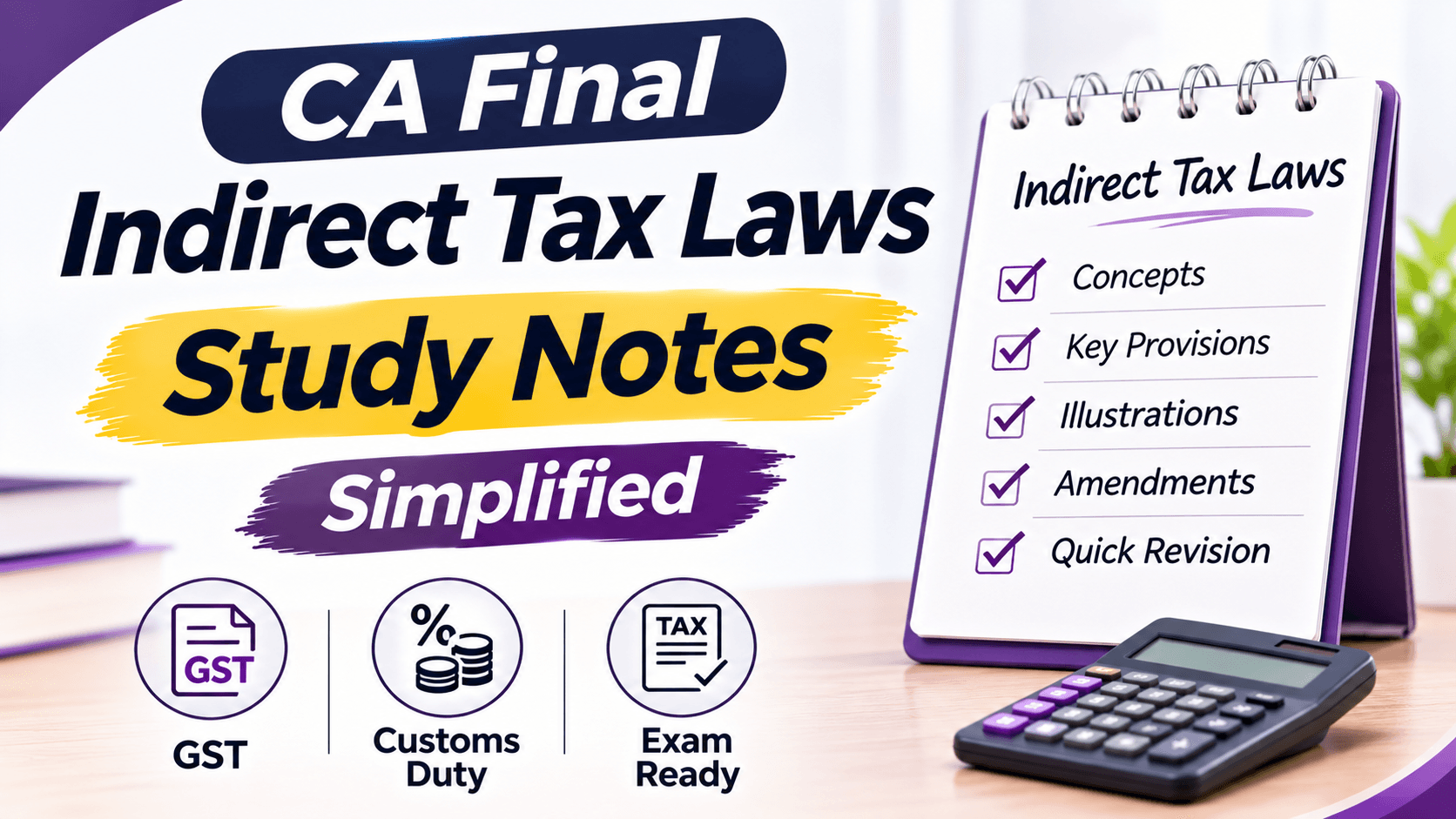
Simplified CA Final Indirect Tax Laws Study Notes
Organise CA Final Indirect Tax Laws revision with simplified concept summaries, provision maps, case-based practice, amendment checks and a practical error-review system.
In this article(13 sections)ShowHide
Indirect Tax Laws can feel extensive because students need to understand provisions, remember conditions and exceptions, and apply rules to case-based questions. Simplified notes can make revision manageable when they preserve the meaning of the law instead of reducing every topic to disconnected keywords.
Use this approach alongside the official material and amendments applicable to your CA Final attempt. Tax law details can change, so verify provisions, rates, limits, and syllabus coverage before relying on any summary.
What simplified tax notes should achieve
A useful summary should clarify the purpose of a provision, who or what it covers, the conditions, exceptions, and practical effect. It should help you find the relevant rule quickly while preserving enough detail to apply it accurately.
Close your notes after this topic and check what you can recall or apply independently. Record any gap and schedule a follow-up review rather than marking the topic complete based only on reading.
Confirm the current syllabus and amendments
Check the official material relevant to your examination session. Separate updated provisions from older notes and mark session-specific changes clearly. Do not assume an online summary is current merely because its title matches your subject.
Close your notes after this topic and check what you can recall or apply independently. Record any gap and schedule a follow-up review rather than marking the topic complete based only on reading.
Organise each provision in a standard format
For each topic, use a repeatable template: concept, applicable rule, conditions, exception, practical example, and common confusion. A consistent structure makes notes easier to scan and helps you compare related provisions.
Close your notes after this topic and check what you can recall or apply independently. Record any gap and schedule a follow-up review rather than marking the topic complete based only on reading.
Use flowcharts for procedures
A flowchart can show the order of steps or questions that determine which treatment applies. Keep it simple and verify every branch against the source. If it removes a necessary condition or exception, it may be misleading.
Close your notes after this topic and check what you can recall or apply independently. Record any gap and schedule a follow-up review rather than marking the topic complete based only on reading.
Compare related provisions
Create comparison tables when rules look similar but differ in scope, conditions, timing, or consequences. Write the distinguishing feature in plain language and add a small example where useful.
Close your notes after this topic and check what you can recall or apply independently. Record any gap and schedule a follow-up review rather than marking the topic complete based only on reading.
Practise case-based application
Read the facts, identify the legal issue, determine the relevant provision, check the conditions, and apply the facts in a clear sequence. Explain why the rule applies instead of copying a provision without connecting it to the question.
Close your notes after this topic and check what you can recall or apply independently. Record any gap and schedule a follow-up review rather than marking the topic complete based only on reading.
Use recall prompts
Turn headings into questions: what is the rule, which conditions apply, what exceptions matter, and how does it affect the facts? Answer before checking your notes. This tests whether the summary supports recall rather than recognition.
Close your notes after this topic and check what you can recall or apply independently. Record any gap and schedule a follow-up review rather than marking the topic complete based only on reading.
Keep an amendment register
Record the topic, verified update, applicable context stated in official material, and the part of your notes that needs correction. Verify technical details against the applicable source instead of relying on informal summaries.
Close your notes after this topic and check what you can recall or apply independently. Record any gap and schedule a follow-up review rather than marking the topic complete based only on reading.
Review errors by category
Classify mistakes as missing rule, forgotten condition, outdated detail, wrong provision, misread facts, or incomplete application. Reattempt similar questions later to check whether you can apply the correction.
Close your notes after this topic and check what you can recall or apply independently. Record any gap and schedule a follow-up review rather than marking the topic complete based only on reading.
Prepare a final revision pack
Keep provision maps, comparison tables, amendment reminders, and recurring mistakes together. Avoid adding several new sources near the examination. Verify the pack against current official material and focus on recall and question practice.
Close your notes after this topic and check what you can recall or apply independently. Record any gap and schedule a follow-up review rather than marking the topic complete based only on reading.
Use timed tests to evaluate application
Topic tests show whether you can apply a rule after studying it. Mixed and timed practice later checks whether you can select the relevant provision without a topic label. Analyse the reasoning behind errors, not just the score.
Close your notes after this topic and check what you can recall or apply independently. Record any gap and schedule a follow-up review rather than marking the topic complete based only on reading.
Include Studycaller in a structured routine
Use relevant Studycaller resources alongside official material, amendment verification, and case-based practice. The aim is to make revision clearer while preserving technical accuracy.
Close your notes after this topic and check what you can recall or apply independently. Record any gap and schedule a follow-up review rather than marking the topic complete based only on reading.
Quick Revision Table
| Note format | Include | Use |
|---|---|---|
| Provision map | Rule, conditions, exceptions | Quick recall |
| Flowchart | Decision steps or procedure | Understand sequence |
| Comparison table | Differences between similar rules | Avoid confusion |
| Amendment register | Verified update and affected topic | Session-specific accuracy |
| Error log | Mistake and corrective action | Targeted revision |
CA Final notes students love
Free notes from the Studycaller library, picked for this article.
 Summary
CA Final · Others
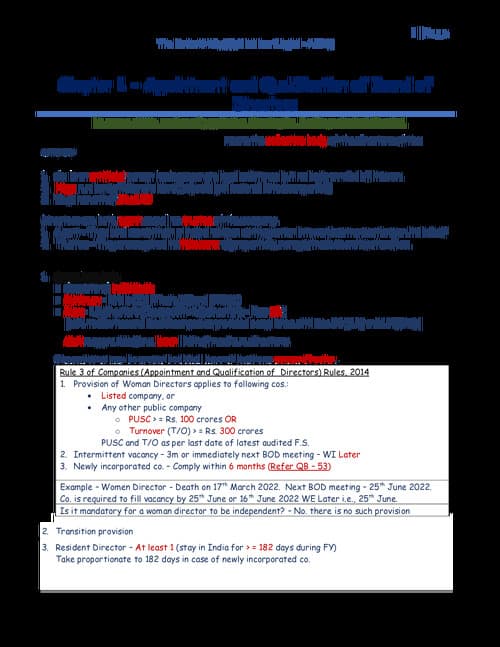
Company Law Summary Notes Set A - Appointment and Qualification of Directors
Nikita AgrawalLikes 40Views 32.5k Detailed Notes
CA Final · Integrated Business Solutions
Shubham Singhal Law Book SPOM
RahulLikes 32Views 19.6k Summary
CA Final · Others
SPOM Set A Notes: SEBI Act, FEMA, FCRA, IBC and Companies Act Summary Notes
A LalLikes 16Views 17.2k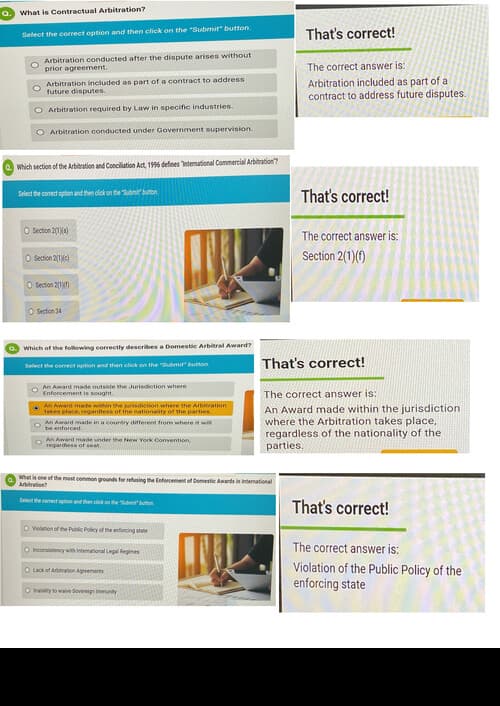 MCQs
CA Final · Others
MCQ for set c (Arbitration and conciliation act)
Nikita AgrawalLikes 12Views 24k
Frequently asked questions
How can I simplify CA Final IDT notes?
Use a consistent structure: concept, rule, conditions, exceptions, example, and common confusion. Keep summaries concise but verify that they preserve the legal meaning and applicable technical details.
Can I use old IDT notes?
Use older notes only after checking them against official material and amendments relevant to your attempt. Clearly mark outdated details.
Are flowcharts useful for indirect tax laws?
They can clarify procedures and decision points when accurate. Verify every branch and retain important conditions and exceptions that may not fit neatly into a diagram.
How should I revise amendments?
Maintain a register of verified updates and note which topics or summaries they affect. Use official material for technical details rather than relying only on informal summaries.
How do I improve case-based answers?
Identify the issue, select the applicable provision, check its conditions, and apply the facts in a clear sequence. Explain why the rule applies.
Should I memorise every line of the law?
Understand the provision and accurately recall its essential requirements, conditions, and exceptions. Follow the syllabus and prescribed material for the expected level of detail.
How do I compare similar provisions?
Make a table showing scope, conditions, timing, exceptions, and consequences. Add a brief example and solve questions where you must decide which provision applies.
When should I start mock tests for IDT?
Begin with topic tests after revising a section. Move to mixed and timed tests as coverage improves, leaving enough time to review incorrect answers.
What should my final revision pack contain?
Include concise provision maps, verified amendment reminders, comparison tables, and recurring errors. Keep it aligned with current official material and use active recall and question practice.
How can Studycaller help with IDT preparation?
Use relevant Studycaller resources alongside prescribed material, verified amendments, and independent case-based practice. Analyse errors and revisit provisions you cannot yet apply confidently.