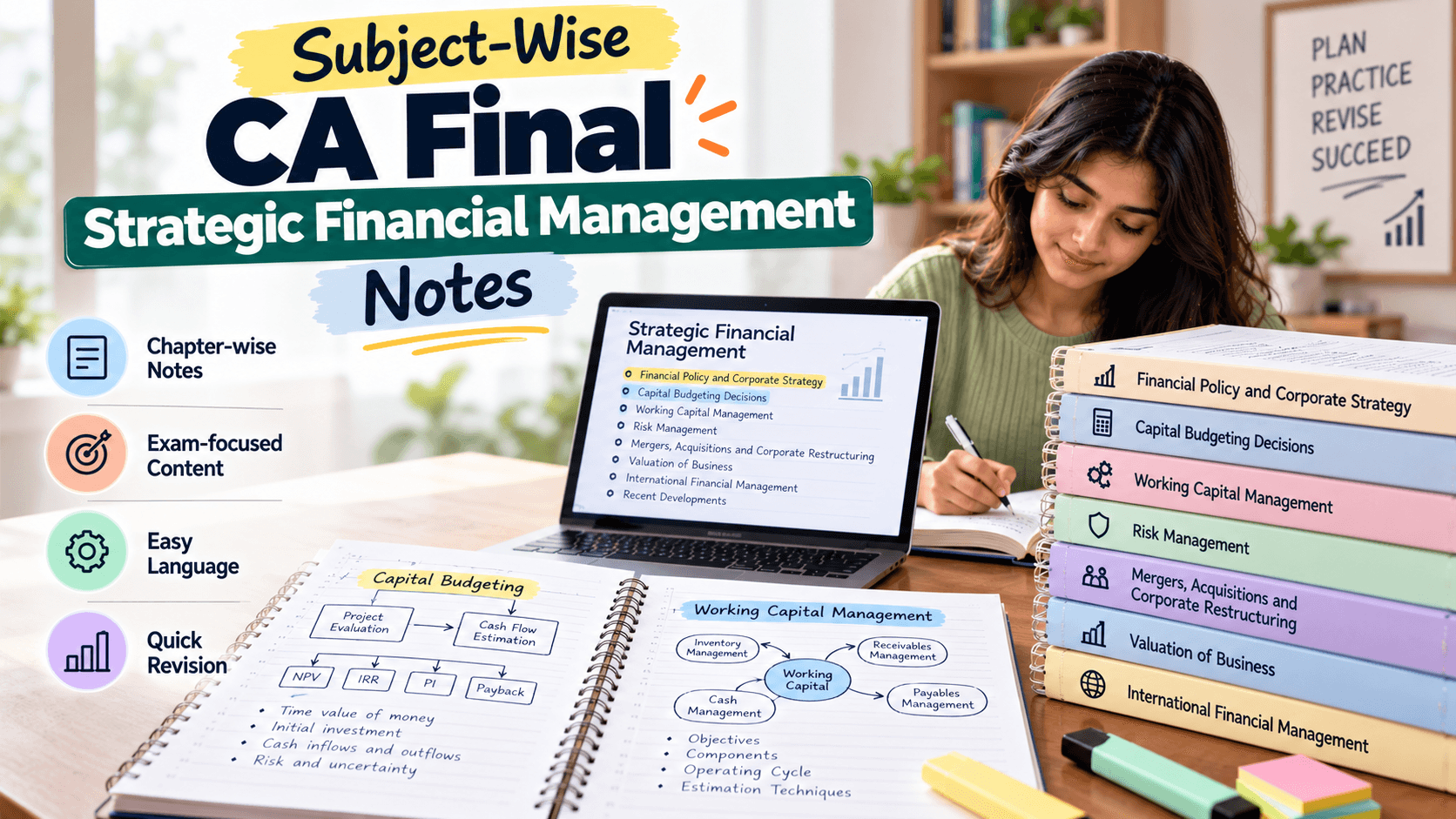
Subject-Wise CA Final Strategic Financial Management Notes
Organise CA Final Strategic Financial Management notes topic by topic with formulas, assumptions, solved illustrations and an error log for effective revision and…
In this article(11 sections)ShowHide
Strategic Financial Management requires more than remembering formulas. Students must identify the model that fits the question, select the correct inputs, follow the calculation steps and interpret the result in context. When revision material is scattered, it can become difficult to locate the right method under time pressure.
Subject-wise CA Final Strategic Financial Management notes can bring formulas, assumptions, question types and common errors into one organised system. Build them around the syllabus for your attempt and use them alongside current ICAI study material, illustrations and timed question practice.
How to structure SFM notes by topic
Create a separate section for each chapter or topic in the current syllabus. Within each section, use the same order: concept, formula, meaning of variables, assumptions, solution steps, one representative example and common mistakes. This consistency reduces the effort needed to find information during revision.
Keep a master index of topics and page numbers. If the subject includes related methods, add a comparison table explaining when each method is appropriate. Avoid putting every formula on one crowded sheet without explaining the conditions for using it.
Build a formula sheet that explains the method
A formula is useful only when you know what each variable represents and when the formula applies. Write the formula, define every symbol, state relevant assumptions and add a reminder about units or timing. For example, distinguish annual and periodic rates where relevant and clarify whether cash flows occur at the beginning or end of a period.
Keep a separate list of formulas you frequently confuse. Next to each one, note the clue in a question that tells you to use it. This trains you to select a method based on the facts rather than trying formulas at random.
Notes for risk, return and portfolio concepts
For topics involving risk and return, record the meaning of each measure, the inputs it requires and how the result should be interpreted. Include a short worked illustration showing each calculation step. Where a question uses probabilities, expected values or multiple assets, organise the data in a table before calculating.
Do not learn the final numerical answer as a pattern. Change one input in a practice question and solve it again. This reveals whether you understand the relationship between variables and helps catch errors caused by copying a method without checking the assumptions.
Notes for capital budgeting and investment decisions
Capital budgeting questions often involve several cash flows and adjustments. Your notes should remind you to establish the relevant timeline, identify initial and subsequent cash flows, apply the required discounting method and check the treatment of working capital, taxes or other adjustments where required by the question and syllabus.
Show intermediate workings rather than jumping directly to a final figure. A clear timeline helps prevent a cash flow from being placed in the wrong period. After calculating a result, write a short interpretation consistent with the method used and information given in the question.
Notes for cost of capital and financing decisions
Organise financing notes around the purpose of each measure, required inputs and assumptions behind the calculation. Distinguish the different costs and weights used in a problem, and record whether the question requires a component calculation or a combined measure. Keep symbols consistent throughout your notes.
Practise questions that require you to choose between methods. The key skill is not simply to calculate; it is to recognise the relevant information and apply the method in the way the question expects. Your notes should help you make that choice quickly.
Forex and international finance revision
Where the syllabus includes foreign exchange calculations, write the quotation convention and the perspective of the party involved before selecting a rate. A small note identifying whether you are buying or selling a currency can prevent a direction error. Keep the question’s stated convention visible throughout the working.
Build a checklist for identifying the applicable rate and checking the final answer. Practise a variety of scenarios and explain why the selected rate is appropriate. Do not rely on a memorised rule without reading the wording carefully.
Derivatives and hedging: make the decision visible
For derivatives-related topics, note the objective of the hedge, the exposure being managed, the instrument considered and the direction of the position. A diagram or timeline can help you see how the position responds to a change in the underlying variable.
After solving a question, check whether the result is consistent with the stated risk-management objective. If the task asks you to compare alternatives, present the calculation and the reasoning behind the recommendation. Keep assumptions visible rather than hiding them inside a formula.
How to practise from your notes
Use a three-pass routine. First, learn the concept and work through an illustration. Second, solve a new question with notes available only for checking formulas. Third, attempt a timed question without notes. Review each error and classify it as concept selection, formula choice, input extraction, arithmetic, time management or presentation.
Maintain an error log and revisit the questions you got wrong after a gap. Re-solving a question after understanding the error is more useful than merely reading the correct solution. Add a concise reminder to your notes when the mistake reflects a recurring issue.
A revision timetable for CA Final SFM
Plan revision around the time remaining and the topics that need the most attention. Reserve regular sessions for numerical practice, formula recall and mixed-topic tests. Include older chapters in weekly practice so that performance does not depend on studying a topic immediately before attempting it.
As the examination approaches, use timed practice and review applicable official question resources. Your final notes should be compact enough to revise in a short session, while your practice record should identify topics that still need work.
How to keep notes accurate and exam-ready
Write the applicable attempt or syllabus version on your notes and cross-check content against current ICAI resources. If a formula or method is updated in your course material, correct the master note and any summary sheet that uses it. Keep one trusted final version rather than several conflicting copies.
Use neat workings, clear headings and consistent notation. In numerical subjects, layout is part of the reasoning: it allows you to inspect assumptions, trace calculations and identify where an error occurred.
Using Studycaller as part of SFM preparation
Studycaller can fit into your broader preparation system as a revision and practice support resource. Use practice results to decide which topics deserve another review, but return to prescribed material whenever you need to verify a concept, method or syllabus point.
Judge your notes by whether they help you solve an unfamiliar question accurately and explain the steps. A formula list without application practice is incomplete; a strong system combines concept notes, worked examples and repeated problem-solving.
CA Final Financial management notes
Free notes from the Studycaller library, picked for this article.
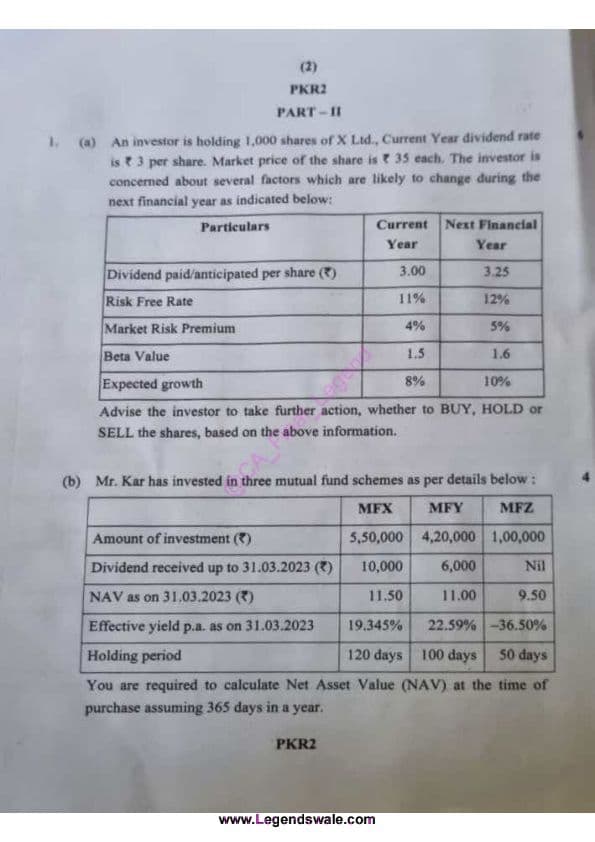 Past papers
CA Final · Advanced Financial Management
🔠 CA Final || Advanced Financial Management AFM | Question Paper of May24 Exam 💥
SurbhiLikes 5Views 6.8k Charts
CA Final · Advanced Financial Management
Advanced Financial management last mile referencer
ParthLikes 2Views 10.2k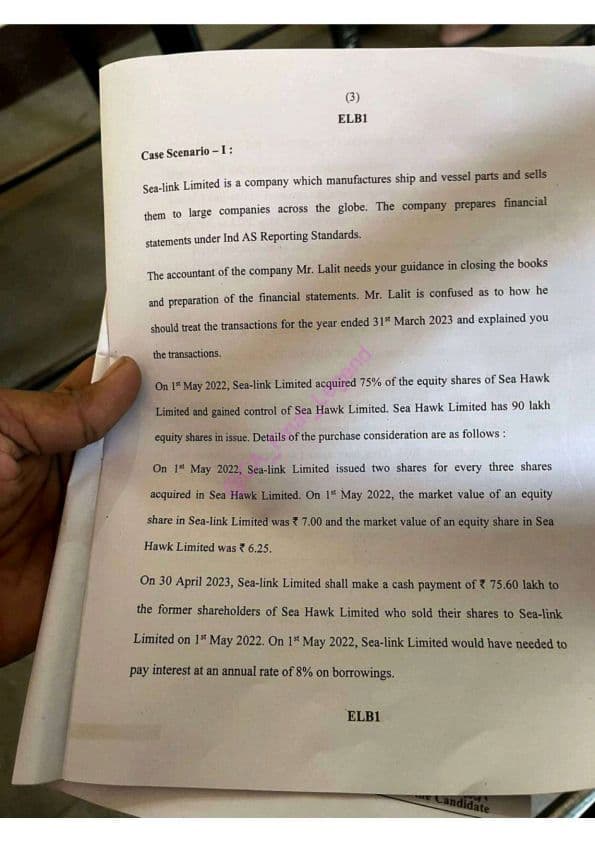 Past papers
CA Final · Financial Reporting
🔠 CA Final || Financial Reporting FR | Question Paper along with MCQs | of May 24 Exam 💥
SurbhiLikes 10Views 6.9k Questions
CA Final · Financial Reporting
CA Final Financial Reporting Last Day Revision (LDR) Questions Index
PareekLikes 4Views 18.1k
Frequently asked questions
What should CA Final SFM notes contain?
Include concepts, formulas, variable definitions, assumptions, worked examples, question cues and common mistakes.
Is a formula sheet enough for SFM?
No. A formula sheet supports recall, but you also need to understand method selection and practise full questions.
How should I revise SFM formulas?
Use active recall, solve short application questions and revisit formulas at spaced intervals.
Should I make chapter-wise SFM notes?
Yes. Chapter-wise notes make it easier to connect methods with the topics and question types where they apply.
How can I reduce calculation mistakes in SFM?
Show intermediate steps, check units and timing, and review recurring errors after each practice set.
What is the best way to practise SFM?
Combine concept learning, solved illustrations, independent practice and timed mixed-topic tests.
Can I use old SFM notes?
Only after verifying that the methods and coverage match the current syllabus and attempt.
How do I choose the right formula in an exam?
Identify the question objective, extract relevant inputs and compare them with the assumptions of the method.
How often should I revise SFM?
Use short recall sessions regularly and include mixed practice every week to retain older topics.
How can Studycaller help with SFM revision?
Use Studycaller as one part of a structured practice plan, while confirming syllabus details with official ICAI resources.