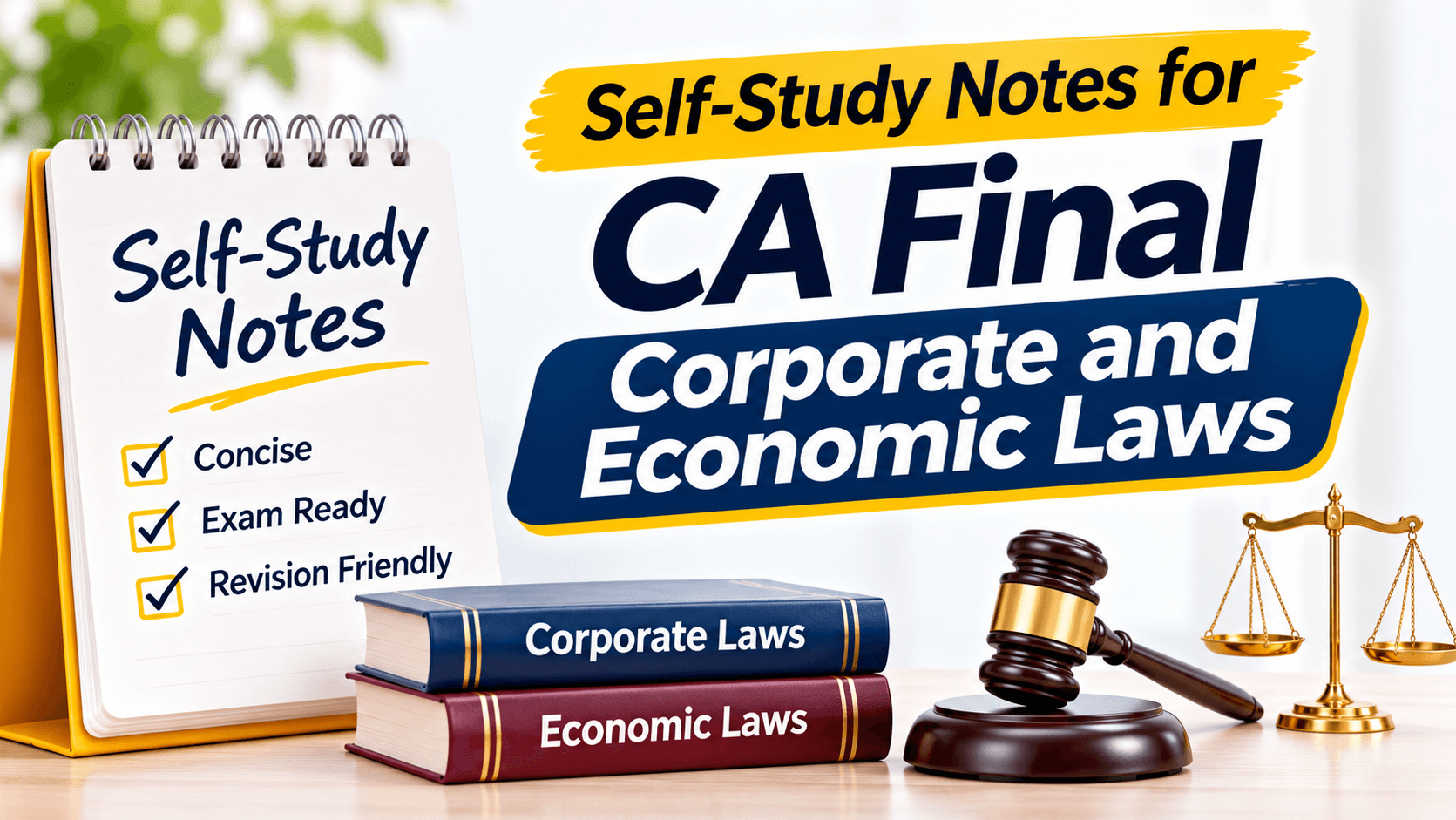
Self-Study Notes for CA Final Corporate and Economic Laws
Build an effective self-study system for CA Final Corporate and Economic Laws with chapter notes, provision tracking, amendment checks and exam-oriented practice.
In this article(11 sections)ShowHide
Preparing Corporate and Economic Laws through self-study requires a planned approach. Students must understand legal provisions, connect related concepts, keep track of applicable amendments and develop the ability to apply rules to examination questions. Without a clear note-making method, it is easy to collect large amounts of information but struggle to revise it efficiently.
Self-study notes should make the prescribed material easier to understand and revisit. They should not replace the official ICAI content or current legal updates. This guide explains how to organise notes, track provisions and build a consistent preparation routine for CA Final Corporate and Economic Laws.
Plan self-study before making notes
Begin by mapping the applicable syllabus into chapters and smaller topics. Estimate the time required for first reading, note preparation, question practice and revision. A plan should cover every paper component while allowing additional time for topics that are difficult for you.
Set a clear purpose for each study session. For example, complete a defined topic, understand a provision, prepare a one-page summary or solve a set of questions. Specific tasks make it easier to measure progress than a broad target such as studying law for three hours.
Use the current official material
Use the ICAI study material and official announcements applicable to your examination attempt as the primary reference. Confirm the relevant syllabus, amendments and updates before preparing notes. Legal subjects can change, so older notes should never be assumed to remain fully applicable.
Keep a source note or date beside material that may be updated. When a provision or rule is amended, revise the relevant section of your notes and remove outdated wording so that you do not retain two conflicting versions.
Create a consistent provision format
For each important provision, use a repeatable structure: subject, purpose, persons or entities covered, key requirements, conditions, exceptions and consequences where prescribed. Add the relevant time limits or procedural steps only after verifying them from current official material.
This format helps you understand a provision as a connected rule rather than a paragraph to memorise. It also makes comparison easier when two provisions deal with related subjects but impose different requirements.
Do not force every provision into the same number of bullet points. Some rules need detailed explanation or a sequence of steps. Keep the structure flexible while retaining the same core headings.
Organise connected legal topics
Corporate and Economic Laws often contain concepts that are easier to understand when related topics are studied together. Create cross-reference notes showing how one concept connects with another, but keep the requirements of each provision separate.
Use comparison tables for similar terms, flowcharts for procedures and short concept maps for relationships. A cross-reference should tell you where to find the detailed explanation rather than repeat entire chapters in several places.
During revision, test whether you can explain both the relationship and the distinction. Knowing that two topics are connected does not mean their conditions or legal consequences are identical.
Track amendments and updates
Maintain a separate amendment tracker with the topic, nature of change, date or applicability information provided by the official source and the section of your notes that needs updating. This reduces the risk of overlooking a change during final revision.
Check the official material and notifications relevant to your examination session. Do not rely only on social media summaries or forwarded amendment lists. Where an update affects a concept, revise the explanation and practise a question based on the updated position.
Before the examination, use a final checklist to confirm that your notes reflect the applicable cut-off and instructions. The relevant date and scope should be verified from the current ICAI guidance.
Use case-based learning
Legal provisions become easier to apply when you practise with situations. After studying a rule, create or solve a short scenario that tests its conditions. Identify the issue, the applicable provision, the relevant facts and the conclusion.
Do not memorise a model answer without understanding why the provision applies. Change one fact in a practice scenario and ask whether the result changes. This encourages flexible understanding rather than recall of a single example.
Keep case notes short. Record the legal issue and the reasoning pattern, then refer back to the full provision when necessary.
Prepare concise revision notes
Once a topic is understood, prepare a compact revision sheet with the main concepts, provision framework, exceptions and common areas of confusion. The sheet should act as a prompt for recall, not as a replacement for the detailed material.
Use active recall by covering the notes and reconstructing the framework. Mark any point that you cannot explain accurately and return to the official source. Revisit difficult topics after a gap to check retention.
Keep your notes organised by chapter and version. Remove duplicate pages and outdated content so that the final revision set remains manageable.
Practise answer writing independently
Self-study should include written practice from the beginning. Attempt short answers after completing a topic, then move to longer questions and case-based applications. This helps you identify whether you can express legal reasoning clearly without a teacher's prompt.
Structure answers around the question's requirement. Explain the relevant principle, apply it to the facts where needed and provide a clear conclusion. Avoid unnecessary background information that does not help answer the question.
Compare your response with suggested answers or reliable guidance. Record missing legal points, weak application and presentation issues, then practise a similar question after revising the topic.
Review progress and common errors
At the end of each week, review syllabus coverage, note quality, amendment tracking, question practice and revision. Identify which tasks were completed and which were delayed. Adjust the next week's plan based on the actual reasons.
Common self-study problems include collecting too many resources, making notes before understanding the topic, forgetting to update amendments and postponing answer writing. Correct these by keeping one primary source, using a consistent note format and scheduling practice.
Studycaller can be considered as a supplementary practice resource where relevant CA Final papers and tests are available. Use structured practice and performance review alongside official ICAI material; independent study and current legal verification remain essential.
Quick Reference Table
| Self-study tool | What it should contain | Purpose |
|---|---|---|
| Chapter map | Syllabus topics and progress status | Track coverage |
| Provision tracker | Purpose, requirements, conditions and exceptions | Understand legal rules systematically |
| Amendment log | Official update and affected notes | Keep material current |
| Case practice sheet | Issue, rule, facts and conclusion | Improve application |
| Revision sheet | Key points and recall prompts | Support quick revision |
| Error log | Mistake and corrective action | Improve answer quality |
How Studycaller Can Support Your Preparation
Studycaller can be considered as a supplementary learning and practice resource where relevant CA course material or tests are available. Check the current course coverage and use any practice feedback alongside the applicable ICAI study material. Supplementary notes and tests do not replace official content, amendment verification or independent revision.
CA Final Company law notes
Free notes from the Studycaller library, picked for this article.
 Handwritten
CA Final · Others
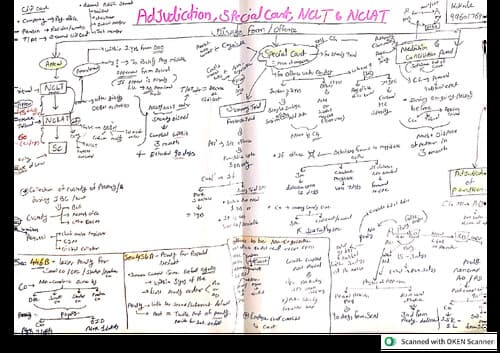
Chp 9 of company act - Adjudication, Special court, NCLT & NCLAT Useful for Revision purpose in spom set A exam
ShubhamLikes 2Views 15.7k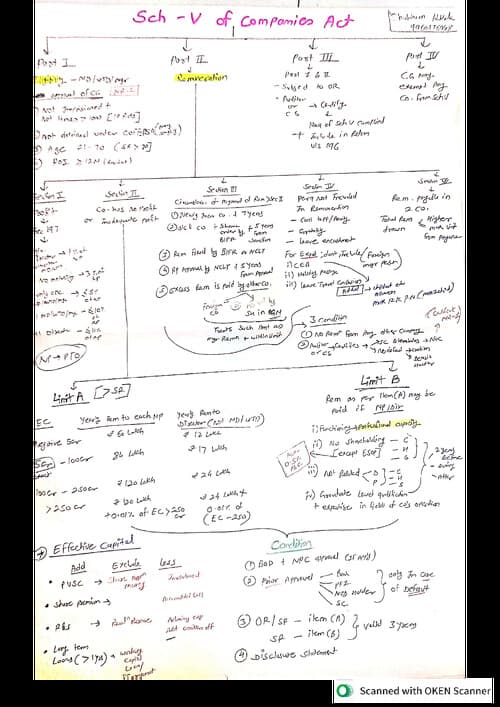 Handwritten
CA Final · Others
Schedule 5 of company Act Useful for SPOM set A exam & revision purpose
ShubhamLikes 1Views 16.5k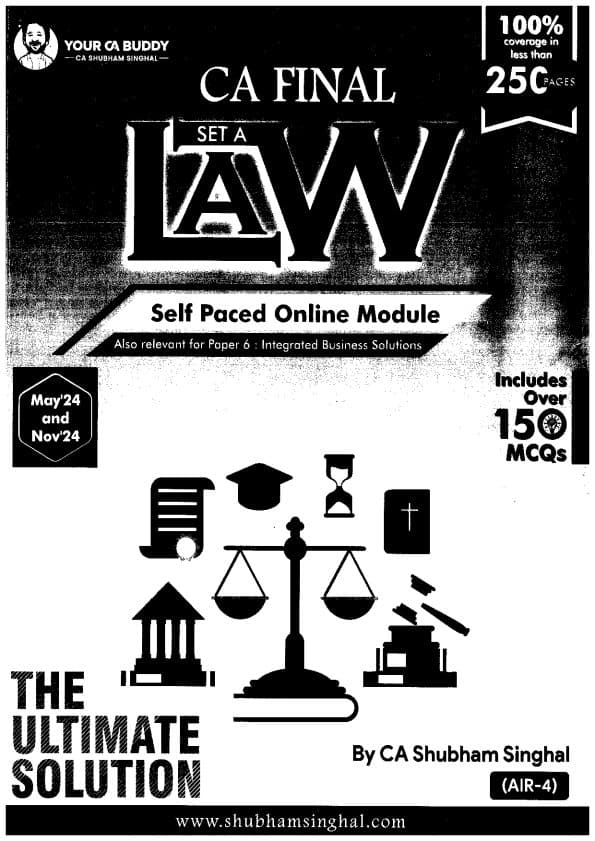 Detailed Notes
CA Final · Integrated Business Solutions
Shubham Singhal Law Book SPOM
RahulLikes 32Views 19.6k Summary
CA Final · Others
SPOM Set A Notes: SEBI Act, FEMA, FCRA, IBC and Companies Act Summary Notes
A LalLikes 16Views 17.2k
Frequently asked questions
Can I prepare CA Final Corporate and Economic Laws through self-study?
Self-study can work with a clear plan, current official material, reliable doubt support, amendment tracking, regular revision and written practice. Review your progress often to identify gaps early.
What should CA Final law self-study notes contain?
Include the provision's subject, purpose, persons covered, requirements, conditions, exceptions and relevant procedures. Add cross-references, examples and concise revision prompts where they improve understanding.
How do I keep Corporate and Economic Laws notes updated?
Maintain an amendment tracker and verify changes through official ICAI material and relevant official notifications. Record the affected topic and update or remove outdated wording in your notes.
Should I make notes while reading or after completing a chapter?
Make brief learning notes while studying concepts, then prepare a concise revision sheet after understanding the chapter. This avoids copying large portions before you know which points are important to retain.
How can I understand legal provisions instead of memorising them?
Break each provision into its purpose, conditions, requirements and consequences. Apply it to short case situations and explain why the rule applies to the facts.
How often should I revise CA Final Corporate and Economic Laws?
Use weekly revision and return to difficult provisions more frequently. Include active recall, amendment checks and case-based questions so that revision tests both memory and application.
How can I practise case-based law questions?
Identify the legal issue, select the relevant provision, connect its requirements with the facts and give a reasoned conclusion. Review the answer to see whether your application is complete.
Can I rely on coaching notes for CA Final law?
Coaching notes may help explain or condense topics, but verify them against current official material. Check syllabus coverage and amendments, and do not use any summary as your only source.
What is the best way to track law preparation progress?
Use a chapter tracker showing understanding, revision, amendment status and question practice. Maintain an error log for forgotten conditions, incorrect application and incomplete answers.
How can Studycaller help with CA Final law preparation?
Studycaller can be considered as a supplementary test and practice resource where relevant CA Final papers are available. Use it alongside official material, amendment verification and independent answer writing.