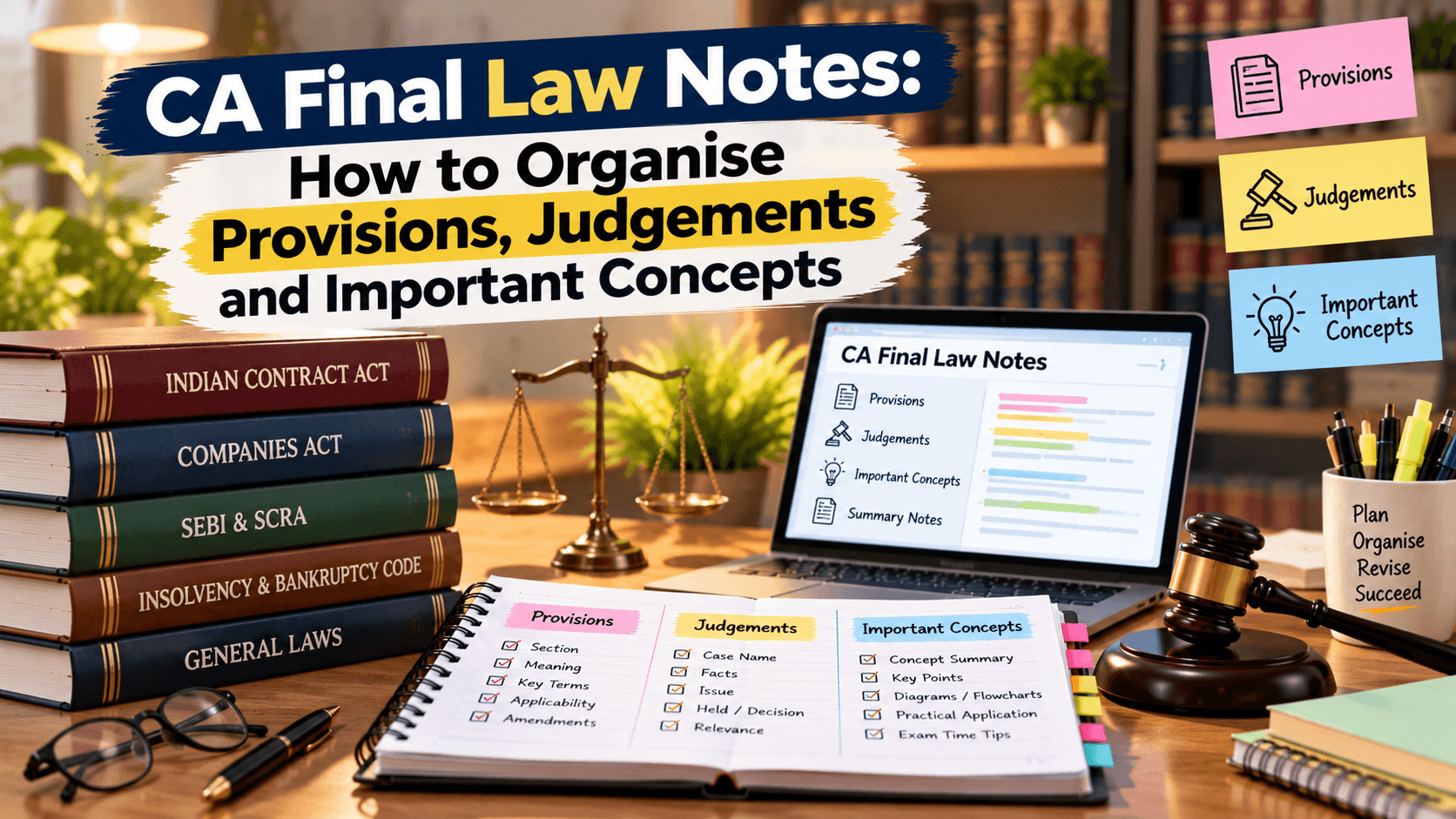
CA Final Law Notes: How to Organise Provisions, Judgements and Important Concepts
Learn how to organise CA Final Law notes with clear provisions, relevant judgements, concept maps, comparison tables and revision sheets for effective exam preparation.
In this article(14 sections)ShowHide
CA Final Law can feel demanding because students must understand legal provisions, remember important conditions and apply the law to a set of facts. Notes become difficult to use when sections, case references and explanations are mixed together without a clear structure.
A useful set of CA Final Law notes should help you understand the concept, locate the relevant provision, connect it with any applicable judgement and apply it to a question. Build your notes around the current ICAI study material and the syllabus applicable to your examination attempt, rather than relying on old summaries alone.
1. Start with a Chapter-Wise Framework
Before writing detailed notes, create a contents page for each paper or major part of the syllabus. Use the chapter names and sequence in your applicable ICAI material. Under every chapter, reserve space for core concepts, provisions, explanations, judgements where relevant, exceptions, practical application and common errors.
Keep a small index with the chapter name, note page or digital file, date last reviewed and question-practice status. This helps you return to a topic quickly during revision and shows which chapters need more work.
Use the same format across chapters. Familiar headings make your notes easier to scan and reduce the chance of forgetting important parts of a topic.
2. Write Provisions in a Clear, Repeatable Format
Do not turn every section into a long paragraph. For each important provision, identify its purpose, applicability, key requirements, exceptions and consequences. Record the relevant section or rule reference, then explain the meaning in straightforward language without changing its legal effect.
A useful provision template is: **Purpose:** what the provision addresses; **Applicability:** when it is relevant; **Requirements:** the conditions or steps; **Exceptions:** situations that alter the general rule; **Consequence:** the legal result; **Exam cue:** facts in a question that point towards the provision.
Preserve technical terms where they matter. A simplified explanation should make the provision easier to understand, not replace legally significant wording. When a provision is complex, include a short explanation of each condition rather than compressing everything into one sentence.
3. Separate the Main Rule from Exceptions
Many legal mistakes happen when a student remembers the general rule but overlooks a proviso, exception, explanation or condition. Give these a visible place in your notes. Put the main rule first, followed by conditions and exceptions in a separate subsection or table.
Where two provisions appear similar, compare them side by side. A comparison table can show their scope, persons covered, requirements, timelines, exceptions and legal consequences. Add only the distinctions that help you choose the correct rule in a question.
Use labels such as 'general rule', 'exception', 'condition' and 'effect' in words. Do not rely on colour alone, since printed pages and screens may display colours differently.
4. Organise Judgements Around the Legal Principle
Case law notes are most useful when they explain why a judgement matters. Avoid copying a full case summary unless your study material specifically requires that detail. Instead, capture the legal issue, essential facts, principle established or applied, decision and relevance to the syllabus.
Use a consistent case-note format: **Case name**, **Issue**, **Key facts**, **Principle**, **Decision**, and **Use in an answer**. Keep the facts brief and focus on the principle that helps you understand or apply the relevant law.
Do not attach a judgement to a provision simply because the topics sound related. Confirm the connection through your current ICAI study material or another reliable legal source. If the syllabus identifies a particular case or principle, use the prescribed treatment and terminology.
Where several cases address a similar point, make a short comparison chart. Note what each case contributes and whether the facts or principle differ. This is more effective than memorising case names without understanding their relevance.
5. Build Concept Maps for Connected Topics
Some chapters are easier to understand as a sequence than as separate definitions. A concept map can show how a legal requirement leads to a process, decision, consequence or remedy. Use arrows and short labels to show the relationship between ideas.
For a process-based topic, create a flow from the triggering event to the required action, responsible person, relevant time limit and outcome. Add exceptions beside the step where they apply. Keep the map simple enough to revise in a few minutes.
Concept maps should supplement detailed notes, not replace them. Use them to see the structure of a topic, then return to the provision for exact conditions and terminology.
6. Use Comparison Tables for Similar Concepts
Tables help when concepts have similar names but different legal effects. Choose columns that directly support recall—for example, concept, applicability, key requirements, exception and consequence. Avoid making a table so dense that you need to reread a full paragraph in every cell.
Add a short 'how to distinguish' line beneath difficult comparisons. It should identify the decisive fact or condition that changes the answer. This is especially helpful when practising case-based questions that test the application of more than one provision.
Review comparison tables after solving questions. If you repeatedly confuse two concepts, add a simple trigger phrase or a short example to show the difference.
7. Connect Each Concept with a Practical Question
Law becomes easier to apply when notes include a small fact pattern. After explaining a provision, write a two- or three-line example that asks whether the rule applies and why. Then add the relevant conditions and a concise conclusion.
Use this sequence when reviewing a case-based question: identify the legal issue, locate the relevant provision, check the conditions and exceptions, consider the relevant judgement if prescribed, apply the rule to the facts and state a reasoned conclusion.
Do not write a conclusion before checking the facts against each important condition. A question may contain distracting details, and one missing condition can change the result. Practise separating relevant facts from background information.
8. Keep Amendments and Study-Material Updates Traceable
Law notes can become unreliable when information from different attempts is mixed together. Maintain an update log for each chapter. Record the topic changed, source checked, applicable period or attempt, date reviewed and the page or file that was updated.
Mark superseded material clearly rather than leaving two competing versions beside each other. In digital notes, move old content to an archive folder. In a printed notebook, add a clear update marker and remove or cross-reference the outdated page when appropriate.
Before the exam, check official ICAI announcements and the study material or statutory updates specified for your attempt. Do not assume that a judgement, amendment or summary from an earlier attempt remains relevant without verification.
9. Create Short Revision Sheets Without Losing Meaning
Use three layers of notes. Detailed notes support learning; chapter revision sheets capture core provisions and connections; final recall sheets contain tricky distinctions, judgement principles and mistakes you often make. This prevents the final revision material from becoming another full textbook.
Each revision sheet should answer a few questions: What is the concept? Which provision governs it? What conditions matter? Is there a prescribed judgement or exception? What mistake should I avoid? If a note cannot answer these questions, revisit the detailed chapter notes.
Try active recall by covering the page and explaining the provision aloud or writing its structure from memory. Check your answer against the notes and correct gaps. Familiarity from rereading is not the same as being able to recall and apply the rule independently.
10. Use a Judgement and Provision Index
A separate index is useful when a question reminds you of a principle but you cannot remember where you recorded it. List each important provision or judgement, its topic, the key principle and the page or file where the full note appears.
Keep case names and legal references accurate. If your prescribed material uses a particular spelling or citation, copy it carefully and verify it before finalising the index. Do not add cases just to make the notes appear comprehensive; relevance and accuracy matter more than volume.
Use the index for quick review, but learn the underlying principle as well. In an answer, a case name alone does not explain how the law applies. Your reasoning should connect the principle with the facts given in the question.
11. Review Notes Through Question Practice
After completing a topic, solve questions from the relevant study material and exam-oriented practice sources. Then identify whether a mistake came from forgetting a provision, overlooking an exception, confusing two concepts, misusing a judgement or writing an unsupported conclusion.
Add the correction to the right page and the error to a separate mistake log. Write what you should do next time, such as checking a particular condition before reaching a conclusion. Avoid vague entries like 'revise law again'.
Mock tests and structured practice can help you check timing, answer organisation and application. Use feedback to refine your notes, while continuing to rely on the prescribed material and attempt-specific updates.
12. A Practical Weekly Note-Making Routine
At the beginning of the week, choose a manageable chapter or topic group. Read the prescribed material first, mark the core concepts and prepare the provision framework. Add judgement notes only where they are relevant to the topic and syllabus.
Next, make one comparison table or concept map for the hardest area and solve a set of questions. Update your notes based on mistakes, then create a compact revision sheet. At the end of the week, test whether you can explain the key provisions without reading the page.
Measure progress by accuracy and recall, not by the number of pages completed. The purpose of notes is to help you locate the rule, explain its meaning and apply it correctly under exam conditions.
Conclusion
Strong CA Final Law notes organise provisions, exceptions, judgements and concepts in a consistent format. Keep legal principles connected to the relevant rules, use comparison tables for confusing topics and record updates so old material does not mislead you. Most importantly, practise applying the law to facts and refine your notes based on mistakes. Always verify content against the ICAI material applicable to your attempt.
Quick Reference: Building Useful Law Notes
| Element | What to record | Why it helps |
|---|---|---|
| Provision | Purpose, conditions, exceptions and consequence | Accurate application |
| Judgement | Issue, principle, decision and syllabus relevance | Understand case law |
| Concept map | Connections, sequence and outcomes | See the overall structure |
| Comparison table | Scope, requirements and differences | Avoid confusing similar rules |
| Update log | Source, change, applicable attempt and date | Keep notes current |
| Mistake log | Error, correction and next action | Target revision |
CA Final Company law notes
Free notes from the Studycaller library, picked for this article.
Handwritten Notes · CA Final Others
Chp 9 of company act - Adjudication, Special court, NCLT & NCLAT Useful for Revision purpose in spom set A exam
Shubham 2 15.5k
Handwritten Notes · CA Final Others
Schedule 5 of company Act Useful for SPOM set A exam & revision purpose
Shubham 1 16.4k
Detailed Notes · CA Final Integrated Business Solutions
Shubham Singhal Law Book SPOM
Rahul 32 19.6k
Summary Notes · CA Final Others
SPOM set A Law Notes
A Lal 16 17.2k
Frequently asked questions
How should I make CA Final Law notes?
Use a consistent chapter structure with concepts, provisions, conditions, exceptions, relevant judgements, practical examples and common mistakes. Base your notes on the current ICAI material and keep a short revision sheet for each major topic.
How do I remember legal provisions for CA Final?
Understand the purpose of each provision, break it into conditions and exceptions, and practise recalling the structure without looking. Short examples and spaced revision help you remember how the rule applies rather than memorising words alone.
What is the best way to make case law notes?
Record the case name, legal issue, essential facts, principle, decision and relevance to the syllabus. Keep the summary concise and verify the case and its treatment against your prescribed study material.
Should I memorise every judgement in Law?
Prioritise judgements and principles included or emphasised in the material applicable to your attempt. Focus on understanding the legal point and its application. Avoid collecting cases from unrelated sources without checking their relevance to the syllabus.
How can I distinguish similar legal provisions?
Create a comparison table showing scope, applicability, requirements, exceptions and consequences. Add a short example or trigger fact that shows which provision fits a question. Revise the table after practising case-based questions.
Are concept maps useful for CA Final Law?
Yes. Concept maps help show how connected ideas, legal steps and consequences fit together. Keep them simple and use them alongside detailed provisions, because maps alone may not preserve all conditions or legal wording.
How often should I update Law notes?
Review notes whenever the official material or applicable updates for your attempt require a change. Keep an update log with the topic, source, applicable period and date, and clearly mark superseded content.
Should I write provisions in my own words?
You can use plain language to explain a provision, but preserve legally significant terms and conditions. When paraphrasing may change the meaning, retain the key wording and add a simpler explanation below it.
How can I improve answers to case-based Law questions?
Identify the issue, select the relevant provision, check its conditions and exceptions, consider any prescribed judgement, apply the rule to the given facts and write a reasoned conclusion. Practise this sequence consistently.
Are short notes enough for CA Final Law revision?
Short notes are useful for quick recall but should not replace the prescribed study material, question practice or applicable updates. Prepare them after understanding the chapter and use them to test your recall regularly.