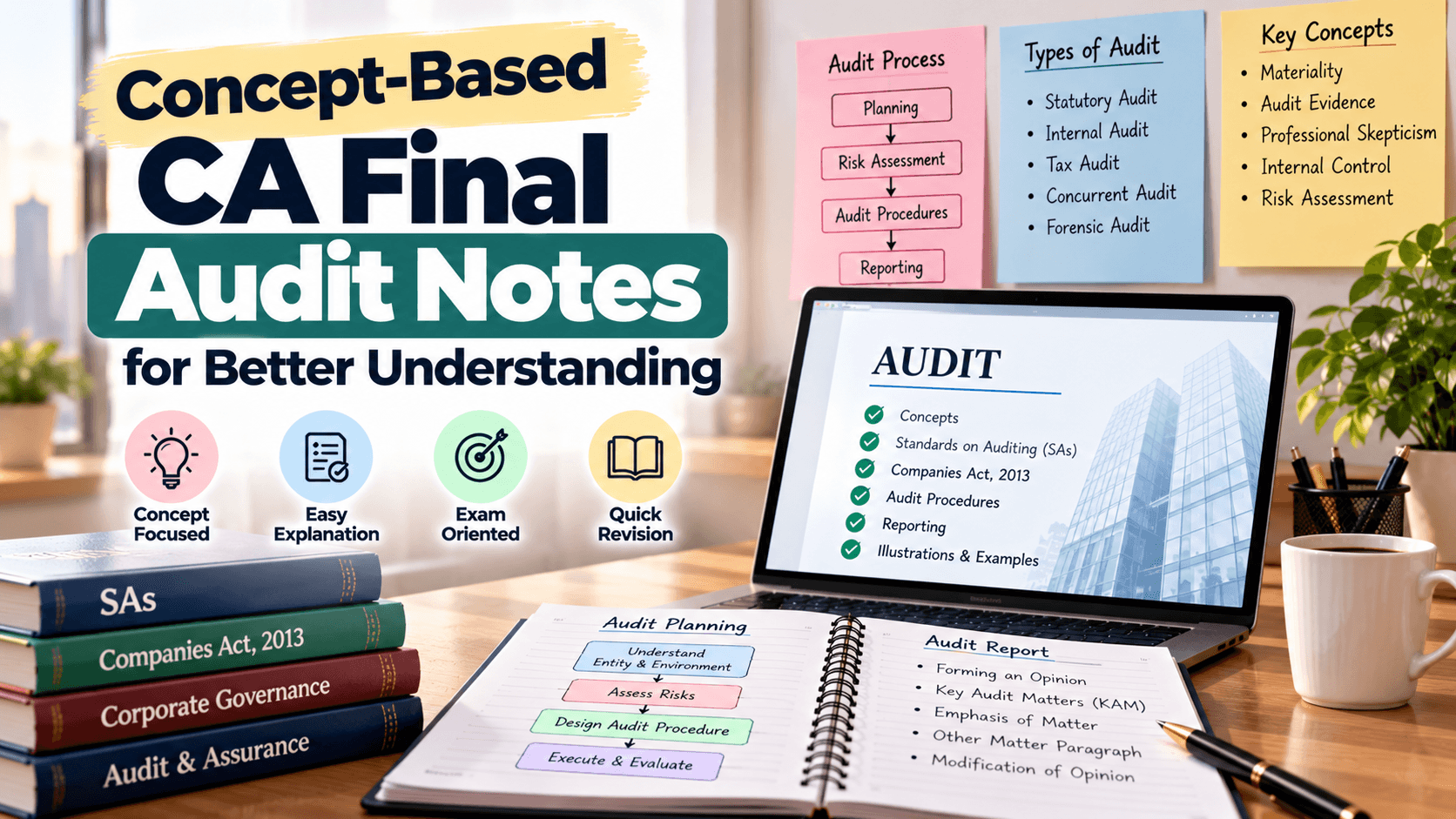
Concept-Based CA Final Audit Notes for Better Understanding
Improve CA Final Audit revision with concept-based notes, standards summaries, practical illustrations, answer-writing practice and a structured error log aligned with…
In this article(11 sections)ShowHide
Audit can be difficult to revise when notes focus on memorised phrases without explaining the reason behind a requirement. A concept-based approach connects the purpose of an auditing standard with auditor responsibilities, evidence and conclusions. This makes material easier to understand and apply in case-based questions.
Use the applicable ICAI study material and standards for your CA Final attempt as the main reference. Standards, guidance and examination coverage can be updated, so verify the version and applicability before relying on older notes.
Start with the purpose of a topic
Before memorising a requirement, ask what risk or problem it addresses. Consider why an auditor needs sufficient appropriate evidence, why documentation matters or why professional scepticism is important. Understanding purpose makes individual requirements easier to connect and remember.
Write a short purpose statement at the beginning of each topic. Add the key requirements and a practical illustration from the prescribed material. This creates a logical structure: purpose, requirement, application and conclusion.
Organise notes around standards
Follow the applicable ICAI study material and standards. For each standard or major concept, record its objective, scope, responsibilities, procedures or requirements, documentation expectations and exceptions where prescribed.
Use official wording where a technical term matters. A plain-English explanation can help you understand the concept, but should not replace a required term or distort the standard. Cross-check summaries against the source during revision.
Distinguish similar concepts
Some auditing concepts overlap in everyday language but have different technical meanings. Make comparison tables for concepts you often confuse, using the definitions and distinctions in prescribed material. Include purpose, when it applies and the practical consequence.
Test the comparison by explaining it without notes. Then answer a short question requiring you to identify the relevant concept. If you cannot explain why one concept applies, revisit the standard rather than relying on a phrase you remember.
Connect requirements to cases
Case-based questions may describe a situation and ask what the auditor should consider or do. Identify the relevant risk, responsibility or requirement before drafting the answer. Avoid writing every audit point you remember if only a few are relevant.
Use a simple structure: identify the issue, state the applicable requirement, apply it to the facts and conclude. Use technical terms from the prescribed material and explain the connection to the scenario.
Make standards-based tables
A revision table can include the standard or concept, objective, key requirements, documentation or evidence points and common exam traps. Do not overload the table with every sentence from the standard; keep detailed explanations in your main notes.
Where a standard has been amended or revised, mark the applicable version and check ICAI material for your attempt. Do not merge old and updated wording without confirming what applies.
Practise answer writing
Audit answers need more than a remembered phrase. Practise concise responses that explain the relevant principle and apply it to the facts. Use headings where they improve clarity, but avoid filling the answer with unrelated definitions.
After checking a suggested answer, identify whether you missed a requirement, used an imprecise term, lacked application or reached an unsupported conclusion. Record these categories and review them before the next practice session.
Use active recall
Close your notes and write the main objective and requirements of a standard from memory. Compare your answer with the source and fill gaps. Repeat after a short interval and later in the week.
Repeated reading can create familiarity without ensuring that you can explain a concept in the examination. Active recall exposes missing links between a requirement and its purpose, important for scenario-based questions.
Build a revision tracker
Divide the syllabus into topics and record whether each one has been studied, revised, recalled and practised. Mark topics that remain conceptually weak even if you have read them several times. Measure what you can do, not just pages covered.
At the end of each week, choose weak topics for deeper review. Use a fresh question to check whether the correction worked. If the same mistake appears again, simplify the explanation or add a comparison example.
Use Studycaller for practice
Studycaller can support revision through additional notes and practice resources when they match the applicable CA Final syllabus and ICAI material. Use it to supplement official resources rather than as the sole authority for standards or examination applicability.
Analyse practice results by topic and answer quality. A score shows that improvement is needed, while an error classification tells you what to do next: revise the concept, practise application and compare your response with prescribed material.
Prepare final revision
Prioritise standards summaries, concept comparisons, key requirements and questions that exposed gaps. Practise short and case-based questions under time limits. Keep notes concise and avoid rewriting entire chapters when you should be testing recall.
Verify that your revision material reflects the applicable syllabus and updates. Focus on explaining why a requirement applies, how it connects to the facts and what conclusion follows, rather than memorising disconnected phrases.
How Studycaller Can Support Your Revision
Studycaller can be used as an additional revision and practice resource alongside the applicable ICAI study material. Choose content aligned with your examination attempt, and verify syllabus coverage, amendments and examination instructions through official ICAI sources.
CA Final Audit notes
Free notes from the Studycaller library, picked for this article.
 Detailed Notes
CA Final · Advanced Auditing, Assurance and Professional Ethics
CA Final Advanced Auditing GOAT notes by CA RAM HARSHA
BkjLikes 7Views 18.8k Handwritten
CA Final · Advanced Auditing, Assurance and Professional Ethics
Audit Sa Handwritten Charts By Kapil Goyal Sir, Notes By Aakash Gupta
Atish ToradmalLikes 7Views 9.4k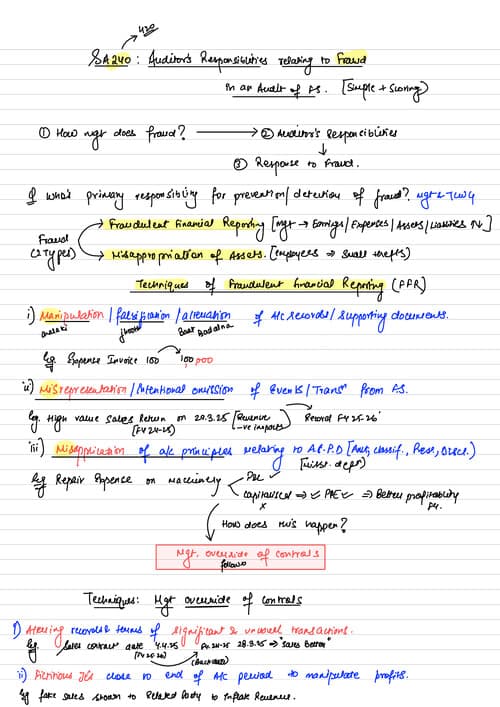 Handwritten
CA Final · Advanced Auditing, Assurance and Professional Ethics
SA 240 subham keshwani
PareekLikes 6Views 20.3k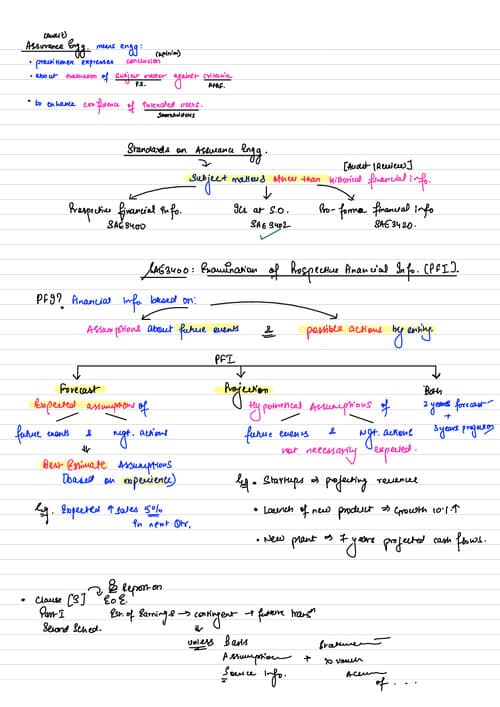 Handwritten
CA Final · Advanced Auditing, Assurance and Professional Ethics
SAE 3400-3402-3420 subham keshwani
PareekLikes 5Views 7.6k
Frequently asked questions
How do I make concept-based Audit notes?
For each topic, record purpose, key requirements, practical application and relevant exceptions. Follow the applicable ICAI material and keep a separate summary for quick recall.
Are memorised definitions enough?
Memorisation alone may not help with case-based questions. Understand why a requirement exists and practise applying it to facts using technical terms.
How should I revise auditing standards?
Use concise standard-wise summaries, comparison tables and active recall. Verify version and applicability against ICAI material for your attempt.
How can I improve Audit answer writing?
Identify the issue, state the applicable requirement, apply it to facts and give a supported conclusion. Avoid unrelated points.
Should I use examples in my notes?
Yes. Short examples connect requirements to practical situations when they accurately reflect prescribed material and do not replace the rule.
What is an Audit error log?
It records the topic, mistake, reason and corrective action. Common categories include missed requirements, imprecise terminology and weak application.
How often should I revise standards?
Use repeated short recall sessions and revisit weak standards later in the week. Add questions to check whether you can explain and apply requirements.
Can I use older Audit notes?
Only after checking them against the applicable syllabus, standards and ICAI updates. Older notes may not suit your attempt.
Can Studycaller support Audit preparation?
Studycaller can provide additional revision resources when aligned with your syllabus. Verify standards and applicability through official ICAI material.
What should I focus on near the exam?
Revise concept summaries, requirements, comparisons and mistakes from case-based questions. Practise applying the right principle to facts.