
CA Reporting Hierarchy Design: Building Efficient Financial Reporting Structures
Learn how CA reporting hierarchy design helps businesses create clear reporting structures, improve accountability, enhance financial reporting, and support better decision-making.
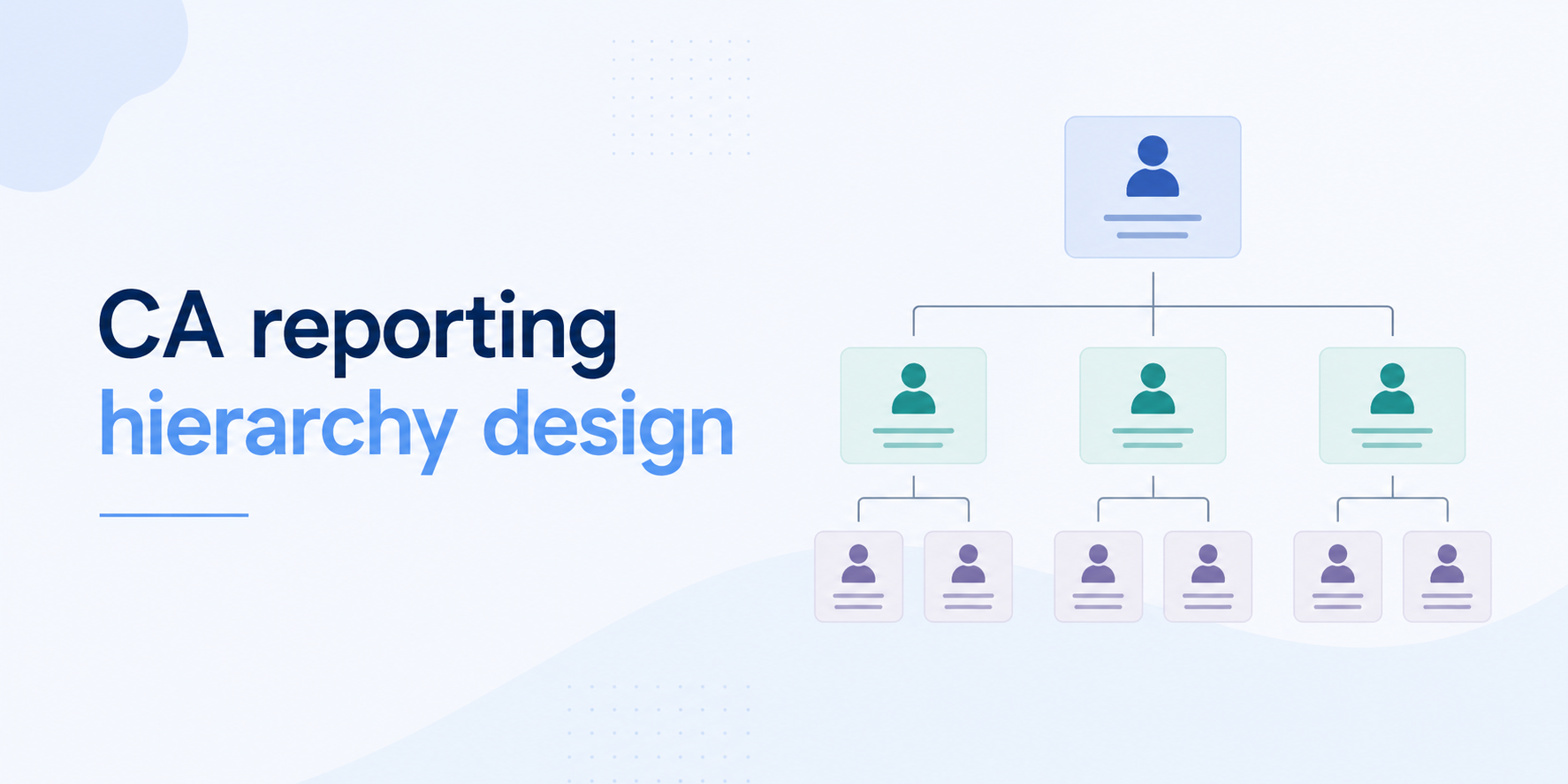
Table of Content
- What Is CA Reporting Hierarchy Design?
- Why Reporting Hierarchy Is Important
- CA Reporting Hierarchy Design Improves Organizational Accountability
- Financial Reporting Becomes More Efficient
- Clear Reporting Channels Reduce Confusion
- Better Internal Control Systems
- Management Reporting for Better Decision-Making
- Reporting Hierarchy Supports Business Growth
- Technology Enhances Reporting Systems
- Governance and Compliance Benefits
- Continuous Review of Reporting Structures
- Conclusion
As businesses grow, managing information becomes increasingly complex. Financial data, operational reports, departmental performance, and compliance updates flow from different teams to senior management every day. Without a well-defined reporting structure, important information can be delayed, duplicated, or misinterpreted, leading to poor decision-making and operational inefficiencies. A structured reporting hierarchy ensures that the right information reaches the right people at the right time.
This is where CA reporting hierarchy design plays a significant role. Chartered Accountants help organizations develop effective reporting frameworks that improve financial transparency, accountability, and management control. By designing systematic reporting structures, CAs enable businesses to streamline communication, strengthen internal controls, and provide leadership with accurate financial insights for strategic planning. A well-designed reporting hierarchy supports both operational efficiency and long-term business growth.
What Is CA Reporting Hierarchy Design?
CA reporting hierarchy design refers to the process of creating a structured reporting framework that defines how financial and operational information moves across different levels of an organization.
The objective is to establish clear reporting responsibilities, improve information flow, and ensure that management receives accurate and timely reports for decision-making. A properly designed hierarchy strengthens governance while reducing confusion and reporting delays.
Why Reporting Hierarchy Is Important
Every organization generates large amounts of financial and operational data. Without a structured reporting system, management may struggle to identify important trends, monitor performance, or respond quickly to business challenges.
An effective reporting hierarchy improves coordination between departments and ensures accountability at every organizational level. It also supports faster and more informed business decisions.
CA Reporting Hierarchy Design Improves Organizational Accountability
One of the key benefits of CA reporting hierarchy design is improved accountability across business functions. Clearly defined reporting relationships ensure that every department understands its responsibilities and reporting obligations. This structured approach helps organizations:
- Improve responsibility allocation
- Strengthen financial controls
- Enhance reporting accuracy
- Reduce duplication of work
- Improve decision-making
- Increase operational transparency
Greater accountability leads to stronger organizational performance.
Financial Reporting Becomes More Efficient
Timely and accurate financial reporting is essential for effective business management. Chartered Accountants design reporting systems that ensure financial information is prepared systematically and submitted to management without unnecessary delays. Efficient financial reporting may include:
- Monthly financial statements
- Budget reports
- Cash flow reports
- Profitability analysis
- Expense monitoring
- Performance dashboards
Reliable reporting supports better financial planning and strategic decisions.
Clear Reporting Channels Reduce Confusion
In organizations with unclear reporting structures, employees may be uncertain about whom to report to or how information should be communicated. This often leads to delays, inconsistent reporting, and decision-making challenges.
Chartered Accountants help establish clear reporting channels that define responsibilities at every level of management. Structured communication improves coordination and operational efficiency.
Better Internal Control Systems
A strong reporting hierarchy supports effective internal control mechanisms. Chartered Accountants design reporting systems that improve monitoring, approval processes, documentation standards, and financial oversight. Internal control improvements may include:
- Approval workflows
- Financial authorization limits
- Department reporting systems
- Compliance monitoring
- Documentation procedures
- Exception reporting
These controls reduce financial risks and strengthen governance practices.
Management Reporting for Better Decision-Making
Senior management requires concise and accurate reports to evaluate business performance. Chartered Accountants help design management reporting frameworks that present meaningful financial information in an organized format. Management reports may include:
- Revenue analysis
- Cost reports
- Budget comparisons
- Department performance
- Key performance indicators
- Business forecasts
Well-structured reports support faster and more effective strategic decisions.
Reporting Hierarchy Supports Business Growth
As businesses expand, organizational structures become more complex. A properly designed reporting hierarchy ensures that communication remains efficient even as departments, employees, and business units increase.
Scalable reporting systems help organizations maintain financial discipline while supporting expansion and operational growth. Good reporting structures reduce management complexity during business scaling.
Technology Enhances Reporting Systems
Modern reporting structures increasingly rely on digital accounting systems and business intelligence tools. Chartered Accountants use technology to automate reporting and improve information accessibility across the organization. Technology supports:
- Real-time reporting
- Automated dashboards
- Financial analytics
- Compliance tracking
- Department reporting
- Performance monitoring
Digital reporting systems improve accuracy and reduce manual reporting efforts.
Governance and Compliance Benefits
Well-defined reporting hierarchies contribute significantly to corporate governance and regulatory compliance. Accurate reporting systems improve documentation, audit readiness, and compliance with statutory requirements.
Organizations with strong reporting structures are better equipped to meet regulatory expectations while maintaining transparency and accountability. Governance practices become stronger through systematic reporting processes.
Continuous Review of Reporting Structures
Business requirements change over time due to expansion, restructuring, regulatory changes, and technological advancements. Therefore, reporting hierarchies should be reviewed periodically to ensure they continue supporting organizational objectives effectively.
Chartered Accountants regularly assess reporting frameworks and recommend improvements based on changing business needs. Continuous improvement helps organizations maintain efficient communication and financial management.
Conclusion
CA reporting hierarchy design is an essential advisory service that helps businesses establish clear reporting structures, improve accountability, strengthen financial controls, and enhance management decision-making. By creating organized reporting frameworks supported by technology and governance practices, Chartered Accountants enable organizations to manage information more effectively and support sustainable growth. In an increasingly data-driven business environment, a well-designed reporting hierarchy provides the foundation for transparency, operational efficiency, and long-term organizational success.

FAQs
What is CA reporting hierarchy design?
CA reporting hierarchy design is the process of creating structured reporting systems that improve financial communication, accountability, and management decision-making within an organization.
Why is reporting hierarchy important for businesses?
A reporting hierarchy ensures clear communication, timely information flow, improved accountability, better financial reporting, and stronger organizational control.
How do Chartered Accountants design reporting hierarchies?
They evaluate organizational structure, reporting requirements, internal controls, management needs, and financial processes to create efficient reporting frameworks.
Can reporting hierarchy improve financial reporting?
Yes. A structured reporting hierarchy improves reporting accuracy, reduces delays, enhances transparency, and supports better financial analysis.
How does reporting hierarchy improve internal controls?
It establishes approval systems, reporting responsibilities, documentation procedures, and financial oversight that strengthen organizational control mechanisms.
Does reporting hierarchy support management decision-making?
Yes. Well-designed reporting structures provide timely financial and operational information that supports informed strategic and operational decisions.
Can MSMEs benefit from reporting hierarchy design?
Absolutely. MSMEs can improve financial management, accountability, communication, and operational efficiency through structured reporting systems.
How does technology support reporting hierarchy design?
Technology enables automated reporting, real-time dashboards, financial analytics, compliance monitoring, and improved information sharing across departments.
Why should reporting structures be reviewed regularly?
Regular reviews ensure that reporting systems remain aligned with business growth, regulatory changes, technological advancements, and organizational objectives.
What is the biggest benefit of CA reporting hierarchy design?
The biggest benefit is creating a structured reporting framework that improves financial transparency, accountability, governance, and overall business decision-making.