Why Students Fail in CA Exams: Common Mistakes & Practical Reasons
Explore why students fail in CA exams and learn the real reasons behind low success rates. Avoid common mistakes and improve your chances of clearing CA exams.
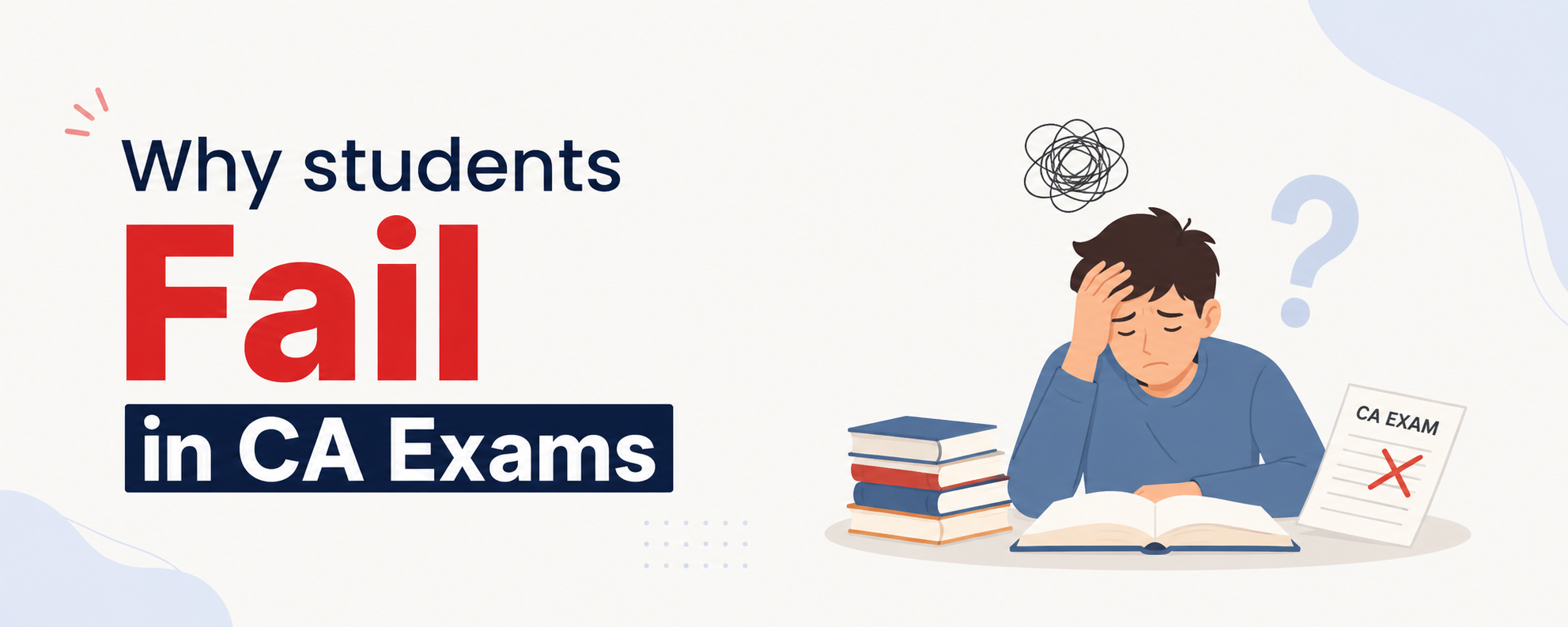
Table of Content
- Lack of Conceptual Clarity
- Inconsistent Study Routine
- Ignoring Practice and Revision
- Poor Time Management During Preparation
- Fear of Practical Subjects
- Overdependence on Coaching
- Poor Exam Strategy
- Lack of Proper Revision Before Exams
- Stress and Lack of Confidence
- Selective Study Approach
- Not Solving Previous Year Papers
- Key Takeaways
- Summary
The Chartered Accountancy course, conducted by the Institute of Chartered Accountants of India, is known for its low pass percentage and great difficulty level. Every year, a large number of students appear in CA Foundation, Intermediate, and Final exams, but only a small percentage manage to clear them.
However, the question is not just about difficulty. The real concern is why students fail in CA exams despite studying for months or even years. The answer lies in a combination of preparation mistakes, lack of strategy, and poor exam execution. Understanding these reasons is essential because most failures are not due to lack of intelligence but to avoidable errors.
Lack of Conceptual Clarity
One of the biggest reasons why students fail in CA exams is weak conceptual understanding. CA exams are not designed to test memorization. Instead, they focus on application-based questions.
Students who rely on rote learning often struggle when questions are twisted or presented differently. When concepts are not clear, even simple questions become difficult. A strong base is non-negotiable in CA preparation.
Inconsistent Study Routine
Many students start preparation with full motivation, but fail to maintain consistency. Studying irregularly or taking long breaks leads to poor retention and incomplete syllabus coverage. The CA syllabus is vast, and without daily discipline, it becomes difficult to revise and practice properly. Consistency matters more than intensity.
Ignoring Practice and Revision
Preparation without practice is incomplete. Students often spend too much time reading and very little time solving questions. CA exams require speed, accuracy, and presentation skills, all of which improve only with practice.
Revision is equally important. Without revision, even well-studied topics are forgotten during exams.
Poor Time Management During Preparation
Time mismanagement is another critical reason behind failure. Some students spend excessive time on one subject while ignoring others. This leads to imbalance and weak areas in the exam. A structured study plan is necessary to cover all subjects effectively.
Fear of Practical Subjects
Subjects like Accounts, Costing, and Taxation often create fear among students. Instead of practicing regularly, students avoid these subjects, which ultimately becomes a major reason for failure. Practical subjects require daily problem-solving, not last-minute preparation. Avoidance leads to weakness, and weakness leads to failure.
Overdependence on Coaching
Coaching can help, but it cannot replace self-study. Many students depend entirely on classes and do not revise or practice on their own. This creates a false sense of preparation. Understanding comes from self-effort, not just lectures.
Poor Exam Strategy
Even well-prepared students fail due to poor exam strategy. Starting with difficult questions, mismanaging time, or leaving questions incomplete can reduce scores significantly. Knowing the subject is one thing; attempting the paper correctly is another.
Lack of Proper Revision Before Exams
The last few days before the exam are crucial. Students who do not revise properly struggle to recall concepts in the exam hall. Revision helps in strengthening memory and improving confidence. Without revision, preparation remains incomplete.
Stress and Lack of Confidence
Mental pressure is a hidden but powerful factor. Students often panic during exams, which affects their performance. Self-doubt reduces efficiency, even when the preparation is sufficient. Confidence comes from preparation, but mindset plays an equal role.
Selective Study Approach
Some students prepare only selected topics, hoping that those questions will appear in the exam. This strategy is risky and often backfires. CA exams can cover any part of the syllabus. A selective study reduces the overall chances of passing.
Not Solving Previous Year Papers
Ignoring past papers is a major mistake. Previous year questions help in understanding exam patterns, important topics, and difficulty level. Students who skip this practice often feel unprepared during the actual exam.
Key Takeaways
If we summarize why students fail in CA exams, it is not because the exam is impossible, but because:
- Concepts are not clear
- Practice is insufficient
- Revision is weak
- Strategy is missing
- Consistency is lacking
Correcting these areas can significantly improve results.
Summary
The reality is simple: most students fail in CA exams not due to a lack of capability, but due to avoidable mistakes. The CA journey demands discipline, clarity, and smart work. Students who understand their weaknesses and work on them systematically have a much higher chance of success. Failing once is not the end, but repeating the same mistakes without correction is.

FAQs
Why do most students fail in CA exams?
Most students fail in CA exams due to a lack of conceptual clarity, poor time management, insufficient practice, and weak revision. These factors directly impact performance despite long study hours.
Is the CA exam failure due to the difficulty level only?
No, failure is not only due to difficulty. Many students fail because of poor preparation strategies, inconsistency, and a lack of proper exam approach, rather than the exam’s toughness.
Does lack of revision affect CA exam results?
Yes, lack of revision is a major reason why students fail in CA exams. Without proper revision, students forget important concepts and struggle to recall them during the exam.
How does poor time management lead to failure?
Poor time management leads to incomplete syllabus coverage and weak subjects. This imbalance reduces overall performance and increases the chances of failing in CA exams.
Can students fail even after studying hard?
Yes, students can fail despite hard work if they lack strategy, practice, and proper revision. Smart study methods are equally important along with effort.
Why is conceptual clarity important in CA exams?
Conceptual clarity helps students solve application-based questions. Without understanding concepts, students cannot handle tricky or practical questions effectively.
Does a selective study cause failure in CA exams?
Yes, a selective study is risky. CA exams can include any topic, and ignoring parts of the syllabus reduces the chances of scoring sufficient marks.
How important is practice for CA exams?
Practice is extremely important as it improves speed, accuracy, and confidence. Without solving questions, students may struggle during the actual exam.
Why do students fear practical subjects?
Students fear practical subjects due to a lack of regular practice. Avoiding these subjects makes them weaker, which ultimately affects overall performance.
How does exam strategy affect results?
A poor exam strategy can lead to incomplete papers and loss of marks. Managing time and attempting questions smartly is crucial for success.