How to Write Practical Answers in CA Exams? Know About the Concept
Learn how to write practical answers in CA exams with effective presentation techniques, working notes, time management, and answer-writing strategies to score higher marks.
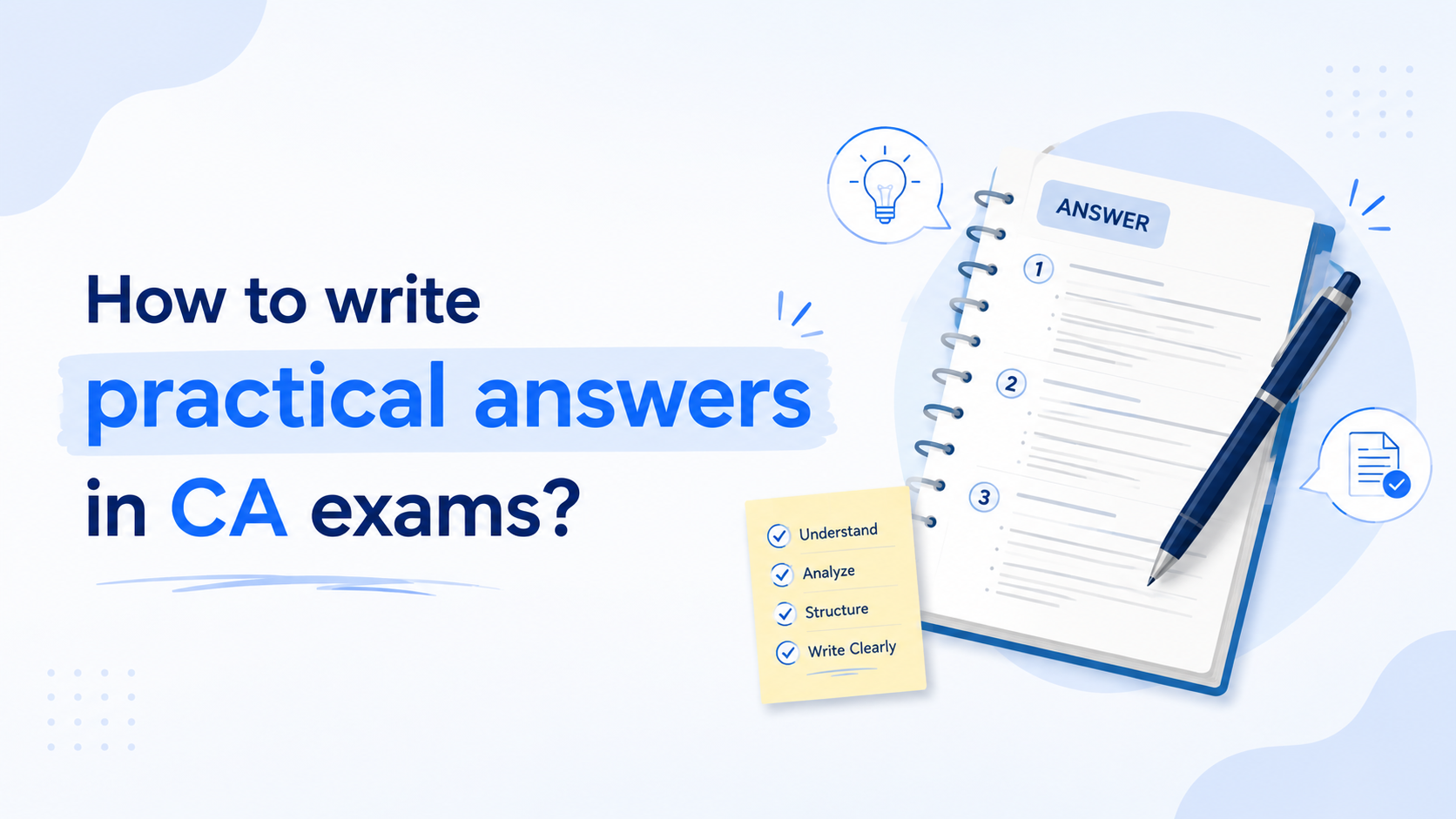
Table of Content
- Read the Question Carefully Before Starting
- Plan Your Solution Before Writing
- How to Write Practical Answers in CA Exams with Proper Working Notes
- Present Calculations Step by Step
- Maintain Proper Formats Wherever Required
- Show Every Adjustment Clearly
- Write Neatly and Leave Proper Space
- Do Not Ignore Units and Symbols
- Manage Time Effectively
- Practice ICAI Questions Regularly
- Revise Formulae and Important Concepts
- Stay Calm During Difficult Questions
- Conclusion
Practical subjects form a significant part of the Chartered Accountancy examination, and they often determine a student's overall performance. Subjects such as Financial Reporting, Advanced Accounting, Cost and Management Accounting, Taxation, and Financial Management require not only conceptual understanding but also the ability to present solutions systematically under examination conditions. Many students know the correct concepts but still lose marks because of poor presentation, missing working notes, or improper calculations.
The question "How to write practical answers in CA exams?" is therefore extremely important for every CA aspirant. Practical papers are not only about arriving at the correct final answer; they are also about demonstrating logical thinking, proper calculation methods, and professional presentation. Students who present their solutions in a structured and organized manner often score better because their answers are easier for examiners to evaluate.
Read the Question Carefully Before Starting
Many students lose marks because they begin solving a question without reading it properly. Every practical question contains specific instructions regarding assumptions, adjustments, calculations, or presentation requirements. Missing even one instruction can lead to an incorrect solution. Before writing the answer, students should carefully identify:
- Required calculations
- Given assumptions
- Applicable adjustments
- Special instructions
- Marks allotted
Understanding the question completely helps avoid unnecessary mistakes.
Plan Your Solution Before Writing
Students often start calculations immediately without deciding the sequence of the solution. A few seconds spent planning the answer can improve presentation significantly. Identify the steps involved and decide the logical order before writing. This habit reduces overwriting, improves clarity, and creates a professional appearance throughout the answer. Organized thinking leads to organized presentation.
How to Write Practical Answers in CA Exams with Proper Working Notes
Working notes are one of the most important parts of practical papers. Even if the final answer is incorrect, proper working notes may help students secure partial marks because they demonstrate the calculation process. Working notes should be:
- Clearly numbered
- Properly titled
- Logically arranged
- Easy to understand
- Linked with the final answer
Students should never skip working notes unless specifically instructed. Professional presentation of calculations increases scoring opportunities.
Present Calculations Step by Step
Many students perform multiple calculations mentally and directly write the final figure. This approach increases the risk of losing marks if the final answer is incorrect. Instead, calculations should be presented step by step so that the examiner can follow the entire process. Even if one calculation is incorrect, correct methodology may still fetch partial marks. Systematic calculations also reduce personal errors during the examination.
Maintain Proper Formats Wherever Required
Certain practical questions require answers in prescribed formats. For example:
- Balance Sheets
- Profit and Loss Statements
- Cash Flow Statements
- Cost Sheets
- Ledger Accounts
- Journal Entries
Students should present these formats neatly with proper headings, columns, and totals. Correct formatting reflects professionalism and improves readability.
Show Every Adjustment Clearly
Practical questions often contain multiple adjustments that affect the final answer. Students should clearly indicate each adjustment in the working notes instead of combining everything into one calculation. Separate presentation helps the examiner understand the logic behind each figure and reduces confusion. Clear adjustments also make revision easier if students need to recheck their answers later.
Write Neatly and Leave Proper Space
Presentation plays an important role even in practical papers. Students should maintain:
- Readable handwriting
- Proper spacing
- Clear columns
- Straight calculations
- Adequate margins
- Clean corrections
A neat answer sheet creates a positive impression and helps the examiner evaluate answers more efficiently. Professional presentation reflects disciplined preparation.
Do Not Ignore Units and Symbols
Many students lose marks by forgetting to mention units, percentages, or currency symbols. Students should clearly indicate:
- ₹ signs where required
- Percentages
- Ratios
- Units
- Totals
- Subtotals
These small details improve accuracy and presentation quality. Professional answers always include proper financial notation.
Manage Time Effectively
Time management is one of the biggest challenges during practical examinations. Students should allocate time according to the marks assigned to each question and avoid spending excessive time on difficult problems. If a question becomes too lengthy, move to the next one and return later if time permits. Completing the entire paper usually results in better overall scores than leaving questions unanswered.
Practice ICAI Questions Regularly
The best preparation for practical papers comes from solving ICAI questions under timed conditions. Students should regularly practice:
- ICAI Study Material questions
- Previous Year Papers
- RTPs
- MTPs
- Mock Tests
Repeated practice improves speed, confidence, and familiarity with examiner expectations. Consistent practice also strengthens conceptual understanding.
Revise Formulae and Important Concepts
Many practical questions depend on accurate application of formulas and accounting principles. Students should prepare short revision sheets containing:
- Formula lists
- Accounting standards
- Tax provisions
- Costing formulas
- Financial ratios
- Important adjustments
Quick revision before examinations improves recall and reduces calculation mistakes. Strong conceptual clarity supports accurate problem solving.
Stay Calm During Difficult Questions
Many students panic when they encounter an unfamiliar practical question. Instead of wasting valuable time worrying, they should attempt the portions they understand and apply logical reasoning wherever possible. Even partial solutions with proper workings can earn marks. Maintaining composure allows students to perform better under examination pressure and utilize available time efficiently.
Conclusion
The answer to "How to write practical answers in CA exams?" lies in combining conceptual understanding with systematic presentation. Students should read questions carefully, present calculations step by step, prepare proper working notes, maintain neat formatting, and manage time wisely throughout the examination. Regular practice through ICAI study material and mock tests further strengthens answer-writing skills and examination confidence. A professionally presented practical answer not only demonstrates knowledge but also increases the chances of securing higher marks in the CA examination.

FAQs
How to write practical answers in CA exams?
Students should read questions carefully, present calculations step by step, prepare proper working notes, maintain neat formatting, and manage time effectively during the examination.
Are working notes important in CA practical papers?
Yes. Working notes explain the calculation process and help students secure partial marks even if the final answer contains mistakes.
Should practical answers be written in a proper format?
Yes. Financial statements, ledger accounts, cash flow statements, and other practical answers should always follow the prescribed professional format.
Can presentation improve marks in practical papers?
Yes. Neat presentation, proper headings, systematic calculations, and clear working notes make answers easier to evaluate and improve scoring potential.
Why should calculations be shown step by step?
Step-by-step calculations demonstrate logical reasoning and may earn partial marks even if the final figure is incorrect.
How can students improve speed in practical exams?
Regular practice through ICAI study material, mock tests, RTPs, and previous year papers helps improve calculation speed and time management.
Should adjustments be shown separately in practical answers?
Yes. Separate working notes for adjustments improve clarity and help examiners understand the calculation process more easily.
What study material is best for practical paper preparation?
ICAI Study Material, RTPs, MTPs, previous year question papers, and mock tests are among the best resources for practical paper preparation.
Can students score well without writing working notes?
Skipping working notes may reduce marks because examiners cannot evaluate the calculation process. Proper workings improve scoring opportunities.
What is the biggest mistake students make in practical CA papers?
One of the biggest mistakes is writing only the final answer without proper workings, adjustments, or systematic presentation, leading to unnecessary loss of marks.