Top Mistakes Students Make While Selecting a CA Test Series
Discover the top mistakes students make while selecting a CA test series. Learn how to choose the right CA test series based on syllabus, exam pattern, evaluation, schedule, and preparation needs.
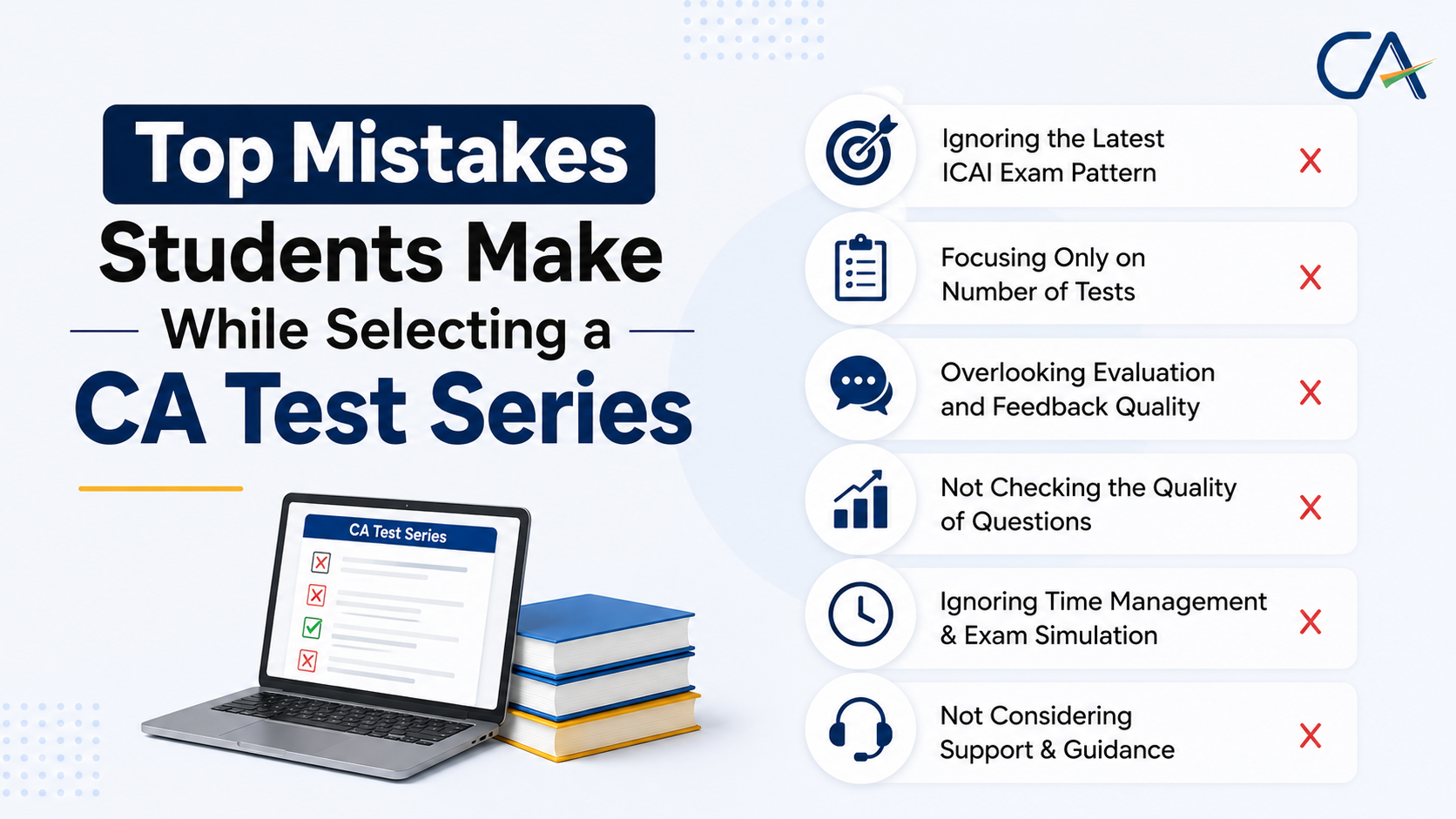
Table of Content
- Why Selecting the Right CA Test Series Matters
- Mistake 1: Choosing a Test Series Only Because Everyone Else Is Buying It
- Mistake 2: Looking Only at the Number of Tests
- Mistake 3: Ignoring the Applicable Syllabus
- Mistake 4: Selecting a Test Series Without Checking the Exam-Oriented Pattern
- Mistake 5: Buying a Test Series That Does Not Match Your Preparation Stage
- Mistake 6: Ignoring the Test Schedule
- Mistake 7: Not Checking Whether Evaluation Is Included
- Mistake 8: Choosing Based Only on Price or Discounts
- Mistake 9: Not Checking the Mode of Test Delivery
- Mistake 10: Expecting a Test Series to Replace Studying
- Mistake 11: Taking Too Many Tests Without Analysing Them
- Mistake 12: Ignoring Full-Length Mock Tests
- Mistake 13: Not Reading Student Reviews Carefully
- Mistake 14: Buying Multiple Test Series Because of FOMO
- Mistake 15: Ignoring Personal Weak Areas
- Studycaller: Helping Students Make Smarter Practice Decisions
- A Smart Checklist Before Selecting Any CA Test Series
- How to Get the Maximum Value From Your CA Test Series
- Final Thoughts: The Right Test Series Is the One That Fits You
Choosing a CA test series looks easy from the outside.
A student opens Google, searches for the best CA test series, compares a few websites, checks the price, looks at the number of tests, and finally purchases a package.
But a few weeks later, many students realise that they made the wrong choice.
Some purchased a test series that does not match their preparation level.
Some selected a package with too many tests and ended up attempting only a handful.
Some ignored the evaluation process.
Others focused entirely on discounts and later discovered that the test format was not suitable for their study style.
The truth is that selecting a CA test series is an important preparation decision.
A test series can influence how you practise, revise, manage time, and evaluate your performance before the actual examination.
The right test series can become one of the most useful parts of your preparation.
The wrong one can become another unused resource sitting in your dashboard or study folder.
CA students already deal with an overwhelming number of choices. There are lectures, books, revision batches, question banks, scanners, notes, mock papers, RTPs, MTPs, and multiple online platforms.
More options do not always make decisions easier.
In fact, too many options can make students choose based on advertisements, discounts, peer pressure, or fear of missing out.
Why Selecting the Right CA Test Series Matters
Before discussing the mistakes, it is important to understand why this decision deserves attention.
A CA test series is not simply a set of question papers.
When used properly, it can help you:
- Measure your preparation.
- Identify weak subjects.
- Improve time management.
- Develop answer-writing skills.
- Practise under examination conditions.
- Analyse repeated mistakes.
- Build confidence before exams.
However, these benefits depend on choosing a test series that actually fits your requirements.
Every CA student has a different situation.
One student may have completed 80% of the syllabus.
Another may have just started preparation.
One student may be studying full-time.
Another may be managing articleship.
One may need strict deadlines.
Another may require flexible test scheduling.
This is why there is no single test series that is automatically perfect for everyone.
The right choice depends on the student's current preparation stage and learning requirements.
Mistake 1: Choosing a Test Series Only Because Everyone Else Is Buying It
This is one of the most common mistakes.
Students often hear about a particular test series through:
- Friends.
- Telegram groups.
- WhatsApp groups.
- YouTube videos.
- Instagram advertisements.
- Coaching recommendations.
Then they assume:
“If everyone is buying it, it must be the best.”
But preparation is personal.
A test series that works for your friend may not work for you.
For example, your friend may be a full-time student who can attempt two tests every week. You may be managing articleship and only have weekends available.
Your friend may have completed the syllabus. You may still be studying major topics.
The same product may suit one student and frustrate another.
How to Avoid This Mistake
Before purchasing, ask:
- Does this match my preparation stage?
- Can I follow the schedule?
- Do I need evaluation?
- Does the test format suit me?
- Will I realistically attempt these tests?
Recommendations are useful, but your own requirements should come first.
Mistake 2: Looking Only at the Number of Tests
Students often compare packages like this:
“Platform A offers 15 tests.”
“Platform B offers 30 tests.”
“Platform C offers 50 tests.”
Then they automatically assume the package with 50 tests is better.
But quantity does not guarantee quality.
Ask yourself honestly:
Will you attempt all 50 tests?
Will you analyse them?
Will you revise your mistakes?
A student who properly attempts and analyses 10 high-quality tests may gain more than someone who quickly completes 30 tests without learning anything from them.
What Matters More Than Quantity?
|
Instead of Checking Only |
Also Check |
|
Number of tests |
Quality of questions |
|
Number of subjects |
Depth of coverage |
|
Number of mocks |
Relevance to preparation |
|
Large package |
Ability to complete it |
|
More questions |
Quality of analysis |
The best test series is not necessarily the biggest one.
It is the one you can use effectively.
Mistake 3: Ignoring the Applicable Syllabus
This is a serious mistake.
Students sometimes purchase test material without carefully checking whether it aligns with their applicable syllabus and examination attempt.
CA preparation requires focused effort.
Spending time on irrelevant content can create confusion and waste valuable revision time.
Before selecting a test series, check:
- Applicable syllabus.
- Examination attempt.
- Subject coverage.
- Paper structure.
- Updated content.
Older questions can still be useful for conceptual practice, but your primary test preparation should remain relevant to your applicable examination requirements.
Simple Syllabus Check
|
Question |
Why It Matters |
|
Is the syllabus applicable to my attempt? |
Ensures relevance |
|
Are all required topics covered? |
Avoids gaps |
|
Is the content updated? |
Reduces confusion |
|
Are removed topics excluded? |
Saves preparation time |
Never assume that all CA test series are automatically updated.
Always check.
Mistake 4: Selecting a Test Series Without Checking the Exam-Oriented Pattern
Some students select tests based purely on difficulty.
They believe:
“The tougher the test, the better the preparation.”
This is not always true.
A test can be extremely difficult and still not provide meaningful examination practice.
The goal of a CA test series should be balanced preparation.
Students should get exposure to:
- Basic conceptual questions.
- Moderate application questions.
- Practical problems.
- Analytical questions.
- Examination-oriented situations.
A good test series should help you prepare for different levels of questions rather than only overwhelming you with unusually difficult problems.
Balanced Practice Approach
|
Question Level |
Purpose |
|
Basic |
Strengthen fundamentals |
|
Moderate |
Improve application |
|
Advanced |
Test deeper understanding |
|
Exam-oriented |
Build real exam readiness |
Do not confuse unnecessary difficulty with quality.
Mistake 5: Buying a Test Series That Does Not Match Your Preparation Stage
This is where many students lose both money and motivation.
Imagine a student who has completed only 30% of the syllabus but purchases a package containing only full-length mock examinations.
The student may attempt the first paper, realise that most of the syllabus is incomplete, and then stop using the test series.
Similarly, a student close to the examination may waste time on basic chapter-level tests when they actually need full-paper practice.
Your testing requirements should evolve with your preparation.
Match the Test Type With Your Stage
|
Preparation Stage |
Suitable Test Type |
|
Beginning |
Chapter-wise tests |
|
Syllabus in progress |
Topic-wise tests |
|
Major portion complete |
Subject-wise tests |
|
Revision stage |
Mixed-topic tests |
|
Final preparation |
Full-length mock tests |
Choose based on where you are today, not where you wish to be next month.
Mistake 6: Ignoring the Test Schedule
Students often focus on the content but forget to check the schedule.
After purchasing, they discover that:
- Tests begin immediately.
- Multiple tests are scheduled every week.
- Deadlines are strict.
- The series ends before their examination.
- The schedule clashes with their revision plan.
This can be particularly difficult for students managing articleship, college, or work.
Before purchasing, understand the complete testing calendar.
Ask:
- When do tests start?
- How often are tests conducted?
- Are deadlines compulsory?
- Can missed tests be attempted later?
- Is the schedule flexible?
Different Students Need Different Schedules
|
Student Situation |
Suitable Schedule |
|
Full-time preparation |
Regular scheduled tests |
|
Articleship |
Flexible or weekend-based |
|
College student |
Adjustable schedule |
|
Working student |
Self-paced access |
|
Final revision |
Intensive mock schedule |
A schedule is only useful if you can follow it.
Mistake 7: Not Checking Whether Evaluation Is Included
For descriptive papers, evaluation can play an important role.
Many students know the correct concept but struggle with:
- Answer structure.
- Presentation.
- Missing key points.
- Excessive writing.
- Incomplete answers.
- Incorrect application.
Simply checking the model answer may not always reveal these problems.
Before selecting a test series, understand the evaluation process.
Check:
- Are answer sheets evaluated?
- Is feedback provided?
- Are marks explained?
- Is a suggested answer available?
- Can you identify your mistakes?
Why Evaluation Matters
|
Problem |
What Evaluation Can Reveal |
|
Low marks |
Where marks were lost |
|
Weak presentation |
How answers can improve |
|
Missing points |
What was overlooked |
|
Poor structure |
Better answer organisation |
|
Repeated mistakes |
Topics requiring revision |
A score tells you your result.
Good feedback can help you understand your result.
Mistake 8: Choosing Based Only on Price or Discounts
Every CA student understands the importance of managing expenses.
Preparation can involve significant costs.
However, selecting a test series only because it is the cheapest option can sometimes lead to disappointment.
Similarly, assuming that the most expensive package must be the best is also a mistake.
The correct approach is value comparison.
Ask:
“What am I getting for the price?”
Compare:
- Number of relevant tests.
- Quality of questions.
- Evaluation process.
- Access duration.
- Flexibility.
- Subject coverage.
- Support features.
Price vs Actual Value
|
Price Factor |
Better Decision Factor |
|
Cheapest package |
Useful package |
|
Highest discount |
Relevant features |
|
Most expensive |
Actual preparation value |
|
Maximum tests |
Tests you can complete |
A discounted test series that remains unused is still wasted money.
Mistake 9: Not Checking the Mode of Test Delivery
Students have different preferences.
Some prefer writing answers on paper.
Some are comfortable with digital submissions.
Some want online timed tests.
Others prefer downloading question papers and creating their own exam environment.
Before purchasing, understand how the test series works.
Possible formats include:
- Online examination.
- PDF question papers.
- Digital answer submission.
- Physical test papers.
- Hybrid formats.
Choose According to Your Study Style
|
Test Mode |
Best For |
|
Online |
Digital-first students |
|
Paper-based |
Traditional answer writers |
|
PDF format |
Flexible self-study |
|
Hybrid |
Students wanting multiple options |
Do not ignore your comfort level.
If you dislike the delivery format, you may avoid using the test series.
Mistake 10: Expecting a Test Series to Replace Studying
This is one of the biggest misconceptions.
Some students purchase a test series and believe that regular testing alone will improve their preparation.
A test series is a practice tool.
It cannot replace:
- Lectures.
- Self-study.
- Conceptual understanding.
- Revision.
- ICAI study material.
- Regular question practice.
Think of testing as a diagnostic tool.
It tells you where you stand.
But you still need to fix the weaknesses it identifies.
The Correct Preparation Cycle
Study → Practise → Test → Analyse → Revise → Test Again
This cycle is far more effective than simply attempting test after test.
Mistake 11: Taking Too Many Tests Without Analysing Them
Some students become obsessed with completing tests.
They proudly say:
“I have attempted 25 tests.”
But when asked:
“What mistakes do you repeat?”
They do not know.
The number of tests is less important than what you learn from them.
After every test, ask:
- Which topics caused problems?
- Did I lose marks because of weak concepts?
- Did I make careless mistakes?
- Did I manage time properly?
- Did I leave questions incomplete?
Create a mistake tracker.
Sample Mistake Tracker
|
Test |
Subject |
Mistake |
Reason |
Action |
|
Test 1 |
FR |
Wrong treatment |
Weak concept |
Revise |
|
Test 2 |
Audit |
Missing points |
Poor recall |
Make notes |
|
Test 3 |
FM |
Calculation error |
Carelessness |
Practise |
|
Test 4 |
DT |
Incomplete answer |
Time issue |
Timed practice |
This simple habit can dramatically improve the value you get from testing.
Mistake 12: Ignoring Full-Length Mock Tests
Some students are comfortable solving individual questions.
They may practise chapter-wise questions every day.
But they avoid sitting for a complete examination.
This can create a problem.
The actual examination is not chapter-wise.
You need to maintain concentration, speed, and accuracy for the complete duration.
Full-length mock tests help students experience:
- Mental fatigue.
- Time pressure.
- Long calculations.
- Multiple topics.
- Question selection.
- Examination stress.
If a test series does not provide adequate full-length practice during the final stage, students should consider whether it matches their examination requirements.
Mistake 13: Not Reading Student Reviews Carefully
Reviews can help, but students should not blindly trust every rating.
A generic review saying:
“Best CA test series!”
does not provide much information.
Look for detailed feedback about:
- Question quality.
- Evaluation.
- Scheduling.
- Difficulty.
- User experience.
- Support.
- Overall usefulness.
Detailed reviews usually provide more practical insights.
However, remember that another student's experience may not perfectly match yours.
Use reviews as supporting information, not the final decision.
Mistake 14: Buying Multiple Test Series Because of FOMO
Fear of missing out can be expensive.
Students often see multiple promotions and think:
“What if the other test series is better?”
So they purchase several packages.
Then something predictable happens.
They become overwhelmed.
Instead of practising, they start deciding:
“Which test should I give today?”
Multiple resources can create more confusion.
For most students, one structured test series followed consistently is enough.
Use additional resources only when you have a clear reason.
Mistake 15: Ignoring Personal Weak Areas
Every student has different weaknesses.
One student may struggle with theory.
Another may struggle with calculations.
Someone may know the subject but have poor writing speed.
Another may panic during full-length papers.
Before selecting a test series, identify what you need.
Ask yourself:
- Do I need more practice?
- Do I need evaluation?
- Do I need time management training?
- Do I need full-length mocks?
- Do I need topic-wise testing?
Your weaknesses should influence your decision.
Do not purchase a generic package without considering your personal requirements.
Studycaller: Helping Students Make Smarter Practice Decisions
At Studycaller, we believe that CA preparation should be strategic.
Students already work extremely hard.
The goal should not be to add more resources to their preparation.
The goal should be to make every resource meaningful.
A good CA test series should help students move from uncertainty to clarity.
Instead of constantly wondering:
“Am I prepared?”
Students should be able to test themselves and identify the answer.
Instead of revising every subject randomly, they should understand which areas need more attention.
Instead of repeating the same mistakes, they should track and correct them.
At Studycaller, meaningful practice should always focus on improvement.
Because the purpose of a test is not simply to judge a student.
The purpose is to help the student become better prepared.
A Smart Checklist Before Selecting Any CA Test Series
Use this checklist before making a purchase.
|
Question |
Yes/No |
|
Does it match my CA level? |
|
|
Is the syllabus relevant to my attempt? |
|
|
Does the test pattern suit exam preparation? |
|
|
Are the test types suitable for my stage? |
|
|
Does the schedule work for me? |
|
|
Are full-length mocks included? |
|
|
Is evaluation available if needed? |
|
|
Can I realistically complete the tests? |
|
|
Does the format suit my preference? |
|
|
Does the price offer good value? |
If several answers are “No,” continue researching before making a purchase.
How to Get the Maximum Value From Your CA Test Series
Once you select the right test series, use it properly.
Schedule Tests Like Real Exams
Do not attempt tests only when you feel motivated.
Put them on your calendar.
Follow the Time Limit
A test without time pressure does not fully measure exam readiness.
Avoid Checking Notes
Be honest with yourself.
The purpose is to identify gaps.
Analyse Every Result
Spend time understanding your mistakes.
Revise Before the Next Test
Fix weaknesses before moving forward.
The Best Improvement Cycle
|
Step |
Action |
|
1 |
Study the topic |
|
2 |
Practise questions |
|
3 |
Attempt a test |
|
4 |
Analyse mistakes |
|
5 |
Revise weak areas |
|
6 |
Retest yourself |
This cycle creates continuous improvement.
Final Thoughts: The Right Test Series Is the One That Fits You
There is no universal CA test series that is perfect for every student.
Your preparation stage matters.
Your schedule matters.
Your weak areas matter.
Your preferred learning style matters.
The biggest mistake students make is choosing a test series based on what looks popular rather than what actually fits their preparation.
Do not buy something because your friend purchased it.
Do not choose based only on the number of tests.
Do not focus only on discounts.
Do not assume difficult questions always mean better preparation.
And most importantly, do not purchase a test series without a plan to use it.
At Studycaller, we encourage students to think of testing as part of their preparation strategy.
A test should provide information.
It should show you where you are strong.
It should reveal where you are weak.
It should help you improve before the actual examination.
The right CA test series can become a powerful preparation tool.
But only when selected carefully and used consistently.
Before making your next purchase, take a few minutes to evaluate your own needs.
Understand your preparation stage.
Look at your schedule.
Identify your weaknesses.
Compare the available features.
Then make an informed decision.
Because CA preparation is already challenging enough.
Your practice resources should reduce confusion, not create more of it.
Choose wisely, practise honestly, analyse your mistakes, and keep improving.
That is how a test series becomes more than a collection of question papers.
It becomes a meaningful part of your journey toward examination readiness.

FAQs
What are the biggest mistakes students make while selecting a CA test series?
Common mistakes include choosing based on popularity, focusing only on the number of tests, ignoring syllabus relevance, not checking evaluation, overlooking schedules, and selecting a series that does not match the student's preparation stage.
Should I choose a CA test series based on the number of tests?
No. The number of tests alone should not determine your decision. Question quality, relevance, evaluation, and your ability to complete the tests are more important.
How do I know if a CA test series matches my preparation stage?
Students in the early preparation stage may need chapter-wise tests, while students closer to examinations usually benefit more from subject-wise and full-length mock tests.
Is evaluation important in a CA test series?
Evaluation can be highly useful, especially for descriptive papers, because it helps students identify mistakes related to concepts, presentation, answer structure, and completeness.
Should I buy multiple CA test series?
For most students, one structured test series used consistently is better than purchasing multiple similar packages and becoming overwhelmed with too many resources.
Should I select the cheapest CA test series?
Price should be considered, but students should focus on overall value. Compare relevant tests, evaluation, flexibility, access duration, and features before making a decision.
Are full-length mock tests necessary for CA preparation?
Yes. Full-length mock tests help students practise concentration, time management, question selection, writing speed, and examination strategy.
Can a difficult CA test series guarantee better preparation?
Not necessarily. Extremely difficult questions may not always reflect examination requirements. A balanced test series should include basic, moderate, advanced, and exam-oriented questions.
How should I analyse my CA test performance?
Identify whether mistakes were caused by weak concepts, calculation errors, poor time management, question misinterpretation, careless mistakes, or answer presentation.
What should I prioritise while selecting a CA test series?
Prioritise syllabus relevance, examination-oriented questions, test structure, evaluation, full-length mocks, schedule flexibility, subject coverage, pricing, and compatibility with your preparation stage.