Hidden Reasons Why CA Students Fail: Complete Analysis & Solutions
Discover the hidden reasons why CA students fail and learn practical ways to avoid common mistakes. Improve your strategy, mindset, and preparation to increase your chances of success.
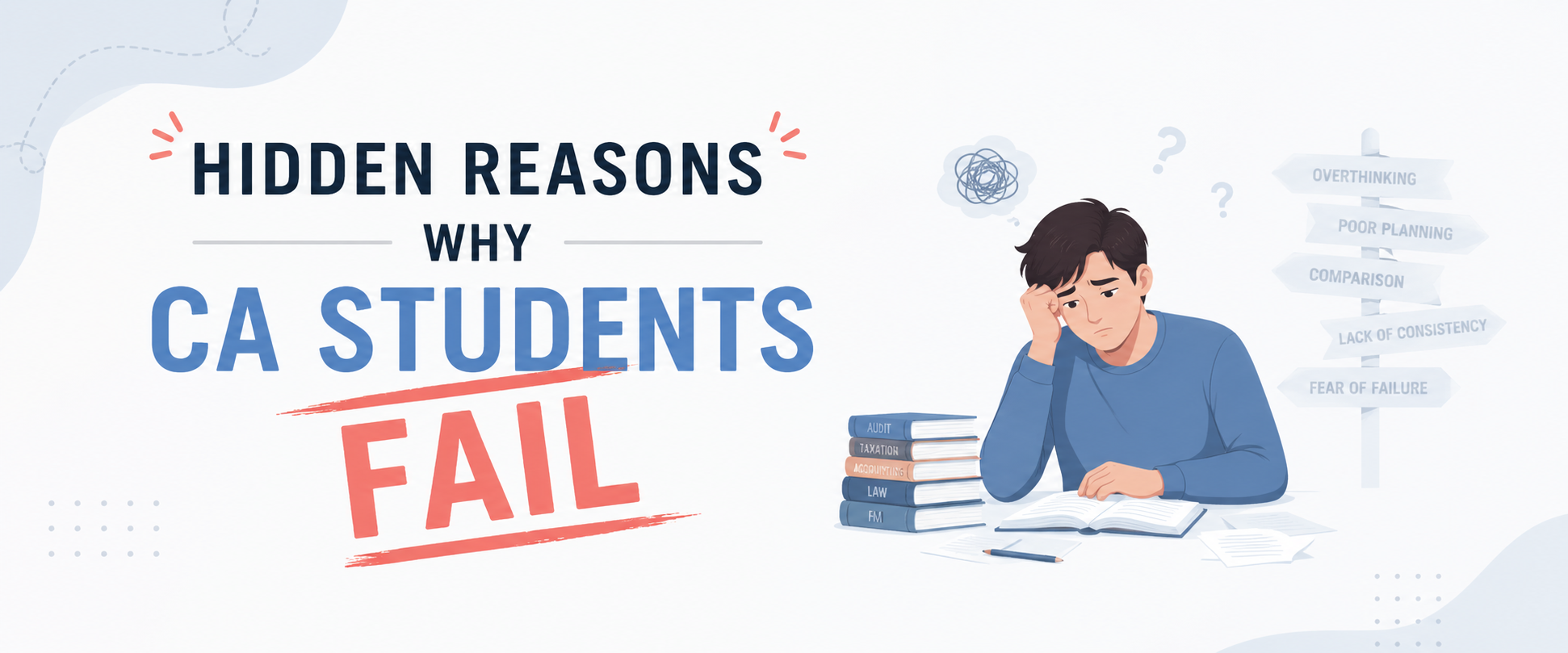
Table of Content
- Confusing Study with Progress
- Ignoring the Importance of Revision
- Lack of Conceptual Clarity
- Overconfidence After Limited Preparation
- Not Practicing Writing and Presentation
- Poor Time Management During Preparation
- Avoiding Difficult Topics
- Mental Fatigue and Burnout
- Lack of a Clear Strategy
- Fear and Self-Doubt During Exams
- Comparing Yourself with Others
- Conclusion
The CA journey is often described as one of the toughest academic paths, and for good reason. Every year, thousands of students put in long hours of study, sacrifice their social life, and still fail to clear exams. What makes it more frustrating is that many of these students are hardworking and sincere.
So the question is not whether students are working hard. The real question is why, despite that effort, they are not able to clear the exams.
If you look closely, the answer lies in the hidden reasons why CA students fail. These are not always obvious. They are not about intelligence or lack of effort. They are small mistakes, bad habits, and unnoticed gaps that slowly build up and affect performance.
Confusing Study with Progress
One of the most common hidden reasons is the illusion of productivity. Many students spend long hours with their books and feel satisfied at the end of the day. However, time spent does not always equal progress made.
Reading the same topic again and again can create a sense of familiarity, but it does not guarantee understanding or retention. Students often believe they have prepared well, only to realize during exams that they cannot recall or apply what they studied. Real progress comes from clarity and recall, not just time investment.
Ignoring the Importance of Revision
Another major reason behind failure is weak revision. Many students focus heavily on completing the syllabus but do not give equal importance to revising it. Without proper revision, even well-understood concepts fade from memory. When exams approach, students try to revise everything at once, which creates confusion and stress. Effective preparation requires consistent revision from the beginning, not just at the end.
Lack of Conceptual Clarity
CA exams are not designed to test rote learning. They are meant to evaluate your understanding of concepts. Students who rely only on memorization often struggle when questions are twisted or presented differently. When your concepts are not clear, even a simple question can feel difficult. On the other hand, strong conceptual clarity allows you to handle unexpected questions with confidence. This is why understanding should always come before memorization.
Overconfidence After Limited Preparation
Sometimes, failure is not due to lack of preparation but due to overconfidence. After completing a few chapters or scoring well in mock tests, students may assume they are fully prepared.
This leads to reduced effort, skipped revisions, and ignoring weaker areas. As a result, their preparation remains incomplete without them realizing it. Confidence is important, but it should always be backed by consistent effort and honest self-assessment.
Not Practicing Writing and Presentation
Many students focus only on studying theory and neglect answer writing. This becomes a problem during exams, where presentation plays a key role. Even if you know the answer, you need to present it in a structured and clear manner. Without practice, answers may become lengthy, unorganized, or incomplete. A simple improvement in writing practice can significantly improve your scores.
Poor Time Management During Preparation
Time management is not just about how many hours you study, but how effectively you use those hours. Some students spend too much time on one subject while ignoring others. This imbalance creates gaps in preparation. When exams come closer, these gaps become difficult to fill, leading to stress and poor performance. A balanced and planned approach is essential for covering the entire syllabus efficiently.
Avoiding Difficult Topics
It is natural to feel more comfortable studying topics you already understand. However, many students repeatedly revise strong areas while avoiding difficult ones. This creates a false sense of preparation. In reality, those untouched topics become weak points in the exam. Facing difficult topics early and working on them gradually helps in building confidence and reducing last-minute pressure.
Mental Fatigue and Burnout
CA preparation is a long journey, and continuous study without proper breaks can lead to burnout. When your mind is tired, your efficiency drops, and retention becomes weaker. Students often ignore their mental health, thinking that more hours will lead to better results. In reality, a tired mind cannot perform at its best. Taking regular breaks and maintaining a balanced routine is necessary for long-term productivity.
Lack of a Clear Strategy
Many students start their preparation without a clear plan. They study randomly, switch subjects frequently, and do not track their progress.
Without a structured approach, it becomes difficult to identify strengths and weaknesses. This leads to incomplete preparation and confusion closer to exams. A simple and consistent plan can make the entire process more organized and manageable.
Fear and Self-Doubt During Exams
Even well-prepared students sometimes fail because of fear and self-doubt. The pressure of CA exams can affect performance, especially if students panic during the paper.
When you start doubting yourself, your focus shifts from solving questions to worrying about results. This reduces accuracy and wastes time.
Confidence during the exam is as important as preparation before it.
Comparing Yourself with Others
Another hidden reason why CA students fail is constant comparison. Seeing others study more, complete faster, or score better can create unnecessary pressure.
This comparison shifts your focus away from your own preparation. Instead of improving your weaknesses, you start worrying about others. Every student has a different pace, and success comes from focusing on your own journey What Can Be Done Differently
Understanding the hidden reasons why CA students fail is only useful if you take steps to avoid them. Small changes in your approach can create a big difference in results. You do not need a perfect strategy, but you need a practical and consistent one.A better approach includes:
- focusing on understanding instead of memorizing
- Revising regularly instead of delaying it
- Practicing answer writing for better presentation
- maintaining a balanced study routine
These simple changes can improve both your preparation and confidence.
Conclusion
The truth is, most students do not fail because they are not capable. They fail because of small, unnoticed mistakes that affect their preparation over time.
Once you identify these hidden reasons why CA students fail, you can take control of your strategy and avoid repeating the same patterns. The journey may still be challenging, but it becomes much more manageable with the right approach.
Success in CA is not about studying harder than everyone else. It is about studying smarter, staying consistent, and believing in your preparation.

FAQs
What are the hidden reasons why CA students fail despite hard work?
Hidden reasons why CA students fail include a lack of revision, poor time management, and weak conceptual clarity. Even hardworking students fail when their preparation lacks structure and consistency.
Why do CA students fail even after completing the syllabus?
Many students fail because completing the syllabus is not enough. Without proper revision and recall practice, concepts are forgotten, which leads to poor performance in exams.
Is lack of revision a major reason for CA failure?
Yes, lack of revision is one of the main hidden reasons why CA students fail. Without repeated revision, retention becomes weak, and students struggle to recall concepts during exams.
How does poor time management affect CA exam results?
Poor time management leads to incomplete preparation and an imbalance between subjects. This becomes one of the hidden reasons why CA students fail despite putting in significant effort.
Can overconfidence lead to failure in CA exams?
Yes, overconfidence is one of the hidden reasons why CA students fail. It reduces effort, leads to skipped revisions, and creates gaps in preparation.
Why is conceptual clarity important in CA exams?
Lack of conceptual clarity is a key factor in the hidden reasons why CA students fail. Understanding concepts helps in answering application-based questions effectively.
Does avoiding difficult topics cause failure in CA exams?
Yes, avoiding difficult topics creates weak areas in preparation. This becomes one of the hidden reasons why CA students fail when those topics appear in exams.
How does mental stress impact CA exam performance?
Mental stress reduces focus and confidence, which affects performance. It is one of the hidden reasons why CA students fail despite good preparation.
Is writing practice necessary for CA theory subjects?
Yes, lack of writing practice is among the hidden reasons why CA students fail. Proper presentation improves answer quality and increases scoring potential.
How can students avoid the hidden reasons for CA failure?
Students can avoid the hidden reasons why CA students fail by following a structured plan, revising regularly, focusing on concepts, and maintaining consistency in preparation.