What Mistakes Should I Avoid in CA Foundation? Full Guide 2026
What mistakes should I avoid in CA Foundation? Discover the most common preparation and exam-day mistakes students make, and how to fix them before your attempt.
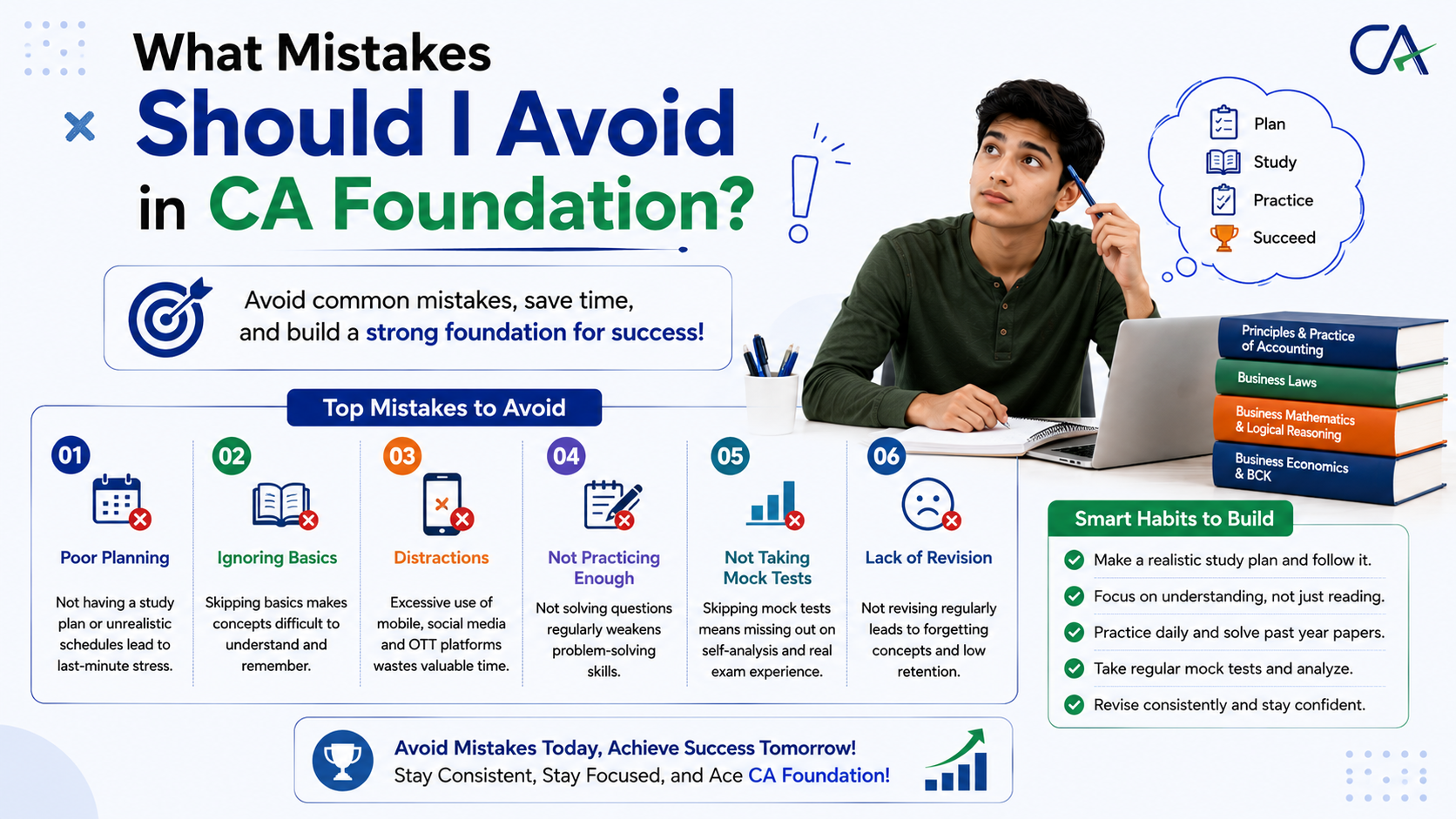
Table of Content
- What Mistakes Should I Avoid in CA Foundation?
- Mistake 1: Studying Without a Structured Plan
- Mistake 2: Ignoring ICAI Study Material
- Mistake 3: Relying on Memorization Instead of Conceptual Clarity
- Mistake 4: Neglecting One Subject in Favor of Others
- Mistake 5: Insufficient Mock Test Practice
- Mistake 6: Poor Time Management During the Exam
- Mistake 7: Overconfidence and Underestimating the Exam
- Mistake 8: Not Analyzing Your Mock Test Mistakes
- Mistake 9: Skipping Revision in Favor of New Topics
- Mistake 10: Neglecting Health and Exam-Day Preparation
- Mistake 11: Using Too Many Study Resources at Once
- Why CA Exams
- Conclusion
What Mistakes Should I Avoid in CA Foundation?
Most students who don't clear CA Foundation aren't short on intelligence, they simply fall into a handful of avoidable traps during preparation. If you're wondering what mistakes should I avoid in CA Foundation, you're already ahead of most aspirants, since recognizing these pitfalls early is one of the biggest factors separating a first-attempt pass from a repeat attempt. In this blog, we break down the most common CA Foundation preparation mistakes, from planning errors to exam-day slip-ups, so you can walk into your attempt with a clear, corrected strategy instead of learning these lessons the hard way. Whether you're just starting out or midway through your preparation, it's worth pausing to check whether any of these patterns sound familiar.
Mistake 1: Studying Without a Structured Plan
One of the most damaging habits is starting preparation without a clear roadmap. Many students dive straight into the syllabus without allocating time to each subject, which leads to uneven coverage and last-minute panic closer to the exam. A structured study plan that breaks the four-month preparation window into weekly and monthly targets, with fixed time for learning, practice, and revision, keeps your effort consistent instead of chaotic. Without this structure, students often complete some subjects thoroughly while barely touching others, which directly hurts the 40% individual paper requirement.
Mistake 2: Ignoring ICAI Study Material
Many students rely heavily on coaching notes or third-party reference books while sidelining the official ICAI study material. This is a costly mistake, since most exam questions are based directly on ICAI's concepts, illustrations, and language. Coaching notes and summarized guides are useful for quick revision, but they should never fully replace the depth found in ICAI's modules, especially for Accounting and Business Laws, where application-based questions often mirror illustrations from the official material almost exactly.
Mistake 3: Relying on Memorization Instead of Conceptual Clarity
CA Foundation is designed to test understanding, not recall. Students who memorize formulas, journal entries, or legal definitions without grasping the logic behind them often struggle the moment a question is framed differently from what they practiced. Building conceptual clarity means constantly asking why a concept works the way it does, rather than just accepting it as a fact to be reproduced. This single shift in approach is often what separates students who can solve twisted, application-based questions from those who freeze when a question doesn't look exactly like their notes.
Mistake 4: Neglecting One Subject in Favor of Others
It's natural to spend more time on subjects you enjoy, but CA Foundation requires a minimum of 40% in every individual paper, regardless of how well you score elsewhere. A common pattern is students from non-mathematical backgrounds developing an aversion to Quantitative Aptitude and giving it far less attention than Accounting or Law. This is dangerous, since neglecting even one paper can pull down your overall result even if the remaining three are strong. Every subject deserves consistent daily attention, not just the ones that feel comfortable.
Mistake 5: Insufficient Mock Test Practice
Completing the syllabus is only half the job. Many students under-invest in mock tests and previous year papers, assuming that reading and understanding concepts is enough. In reality, mock tests are where you discover time management issues, careless calculation errors, and gaps in application ability that theory alone never reveals. Students who skip timed practice often panic in the real exam simply because they've never attempted a full paper within the actual three-hour or two-hour limit before.
Mistake 6: Poor Time Management During the Exam
Even well-prepared students lose marks by spending too long on one difficult question in Accounting or Quantitative Aptitude, leaving insufficient time for questions they could have answered easily. A smart approach is to attempt straightforward entries or questions first, build confidence, and return to harder ones later. In Quantitative Aptitude specifically, skip lengthy calculations and come back rather than getting stuck, since every unanswered easy question costs the same as a difficult one you didn't attempt.
Mistake 7: Overconfidence and Underestimating the Exam
Some students assume their Class 12 knowledge is sufficient preparation for CA Foundation, which is a critical misjudgment. This exam demands application-based understanding well beyond board-exam-level recall, and underestimating it often results in inadequate revision and rushed practice. Staying humble about the exam's difficulty, regardless of how strong your school performance was, keeps your preparation disciplined instead of complacent.
Mistake 8: Not Analyzing Your Mock Test Mistakes
Attempting mock tests without reviewing where you went wrong defeats much of their purpose. Students who don't maintain an error log tend to repeat the same conceptual and calculation mistakes across multiple attempts. After every mock test, spend time understanding not just which answers were wrong, but why, whether it was a concept gap, a careless error, or a timing issue, since each requires a different fix.
Mistake 9: Skipping Revision in Favor of New Topics
Some students focus entirely on finishing the syllabus and leave insufficient time for revision, treating a single read-through as enough. CA Foundation rewards multiple revision cycles, ideally three: one for building concepts, one for practicing questions, and a final quick-recall pass using notes and formula sheets closer to the exam. Skipping this final stage is one of the most common reasons well-prepared students underperform on exam day.
Mistake 10: Neglecting Health and Exam-Day Preparation
Intense study schedules often push students to sacrifice sleep, meals, and breaks, which eventually hurts focus and retention rather than helping it. Maintaining a healthy routine, along with basic exam-day preparation like organizing your admit card, ID, and stationery in advance, prevents unnecessary last-minute stress that has nothing to do with how well you know the syllabus.
Mistake 11: Using Too Many Study Resources at Once
Trying to cover every available textbook, coaching module, and online resource simultaneously often creates confusion rather than clarity. Different sources sometimes explain the same concept slightly differently, and jumping between them wastes time that could go toward deeper practice. A more effective approach is to pick one or two reliable sources per subject, built around ICAI's official material, and stick with them consistently through your entire preparation, using additional references only to clarify specific doubts rather than as a primary study method.
Why CA Exams
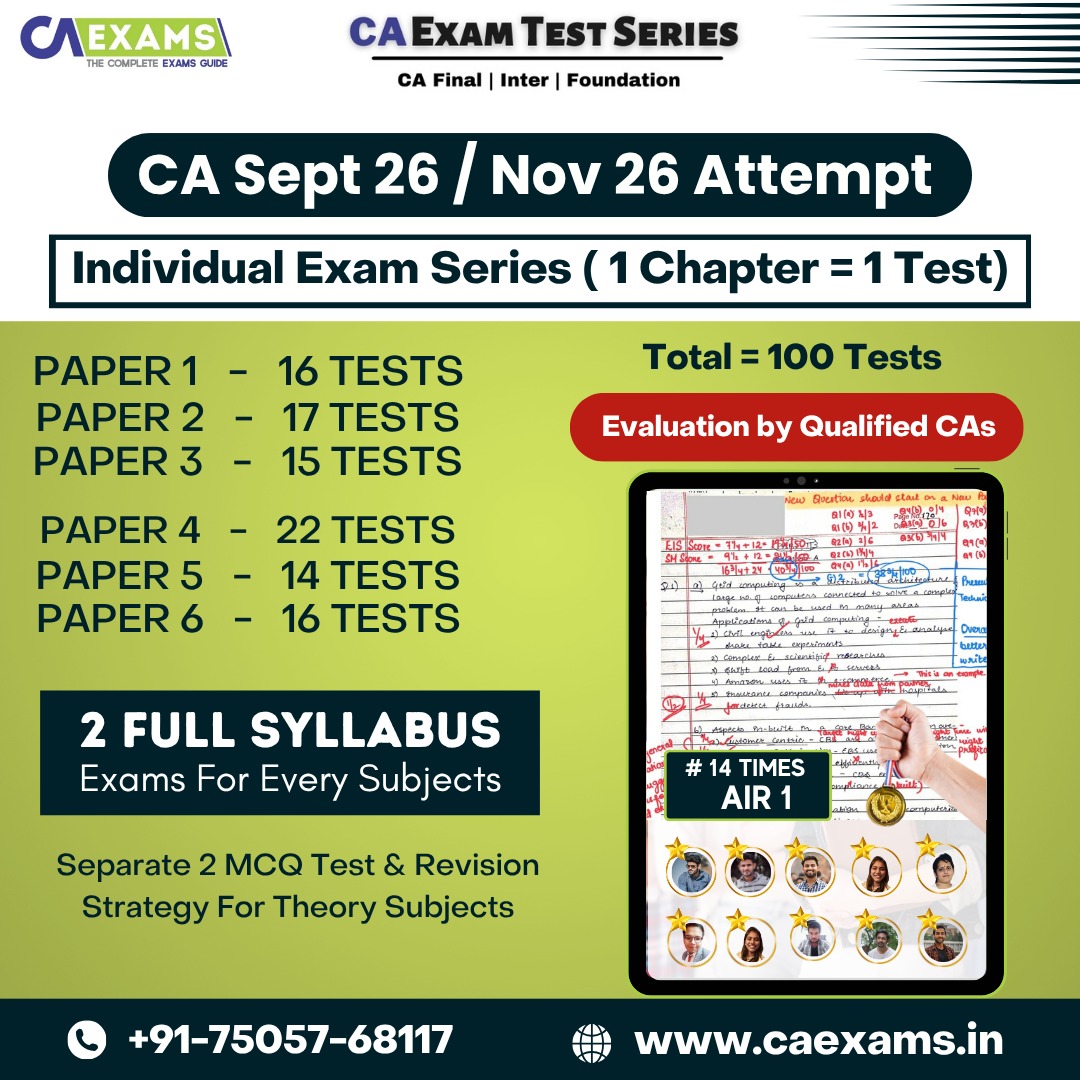
Avoiding these mistakes is far easier when you have structured, exam-aligned resources guiding your preparation. caexams.in is a trusted platform for CA Foundation, Intermediate, and Final aspirants, offering test papers designed strictly according to the latest ICAI exam pattern and syllabus for realistic, exam-like practice. Every test is created by experienced Chartered Accountants and subject matter experts who understand exactly where students tend to lose marks, whether through timing errors, conceptual gaps, or presentation mistakes. After each test, students receive a detailed, topic-wise evaluation along with a marking scheme and improvement suggestions, usually within 48 to 72 hours, helping you catch and fix these common mistakes well before the actual exam. CA Exams also provides personalized mentorship and a study planner tailored to each student's pace, making it easier to stay consistent instead of falling into the planning and revision traps that derail so many first-time attempts.
Conclusion
So, what mistakes should I avoid in the CA Foundation? From skipping ICAI material and neglecting weak subjects to under-practicing mock tests and ignoring revision, most CA Foundation setbacks trace back to a small, predictable set of avoidable errors. The good news is that every single one of these mistakes is fixable with awareness and a disciplined plan. Combine a structured study schedule, consistent mock test practice, and expert feedback from a platform like CA Exams, and you give yourself a genuinely strong shot at clearing CA Foundation without repeating the errors that trip up so many first-time aspirants. Preparation isn't just about how hard you study, it's about how honestly you catch and correct these patterns along the way.

FAQs
What is the biggest mistake students make in CA Foundation preparation?
Studying without a structured plan is one of the most damaging mistakes, since it leads to uneven subject coverage and last-minute panic before the exam.
Is it a mistake to skip ICAI study material?
Yes, ignoring ICAI study material in favor of only coaching notes or reference books is a common mistake, since most exam questions are based directly on official content.
Why is memorization considered a mistake in CA Foundation?
Memorization without conceptual clarity fails when questions are framed differently from what was practiced, since CA Foundation tests application, not just recall.
Can neglecting one subject really affect my overall result?
Yes, since a minimum of 40% is required in every individual paper, neglecting even one subject can fail your entire attempt regardless of strong scores elsewhere.
How important are mock tests in avoiding CA Foundation mistakes?
Mock tests are essential, as they reveal time management issues, calculation errors, and application gaps that simply reading theory does not expose.
What time management mistakes should I avoid during the exam?
Avoid spending too long on one difficult question; attempt easier questions first and return to harder ones later to avoid losing marks on questions you could answer.
Is overconfidence really a common mistake among CA Foundation students?
Yes, some students underestimate the exam based on strong Class 12 performance, which often leads to inadequate revision and rushed last-minute practice.
Why should I maintain an error log while preparing?
An error log helps you track recurring mistakes from mock tests, allowing you to fix conceptual gaps or timing issues before they repeat in the actual exam.
How many times should I revise before the CA Foundation exam?
Ideally, aim for three revision cycles, one for concepts, one for practice questions, and a final quick-recall revision using notes closer to the exam.
How can CA Exams help me avoid common CA Foundation mistakes?
CA Exams offers ICAI pattern-based mock tests, expert evaluation within 48 to 72 hours, and personalized mentorship, helping you identify and correct mistakes before your attempt.