Why Toppers Take a CA Test Series (The Real Reasons)
Why do CA toppers rely on a test series? The real reasons rank-holders test themselves — from step-wise feedback to presentation and consistency — and how you can do…
In this article(8 sections)ShowHide
Why Do Toppers Always Take a CA Test Series?
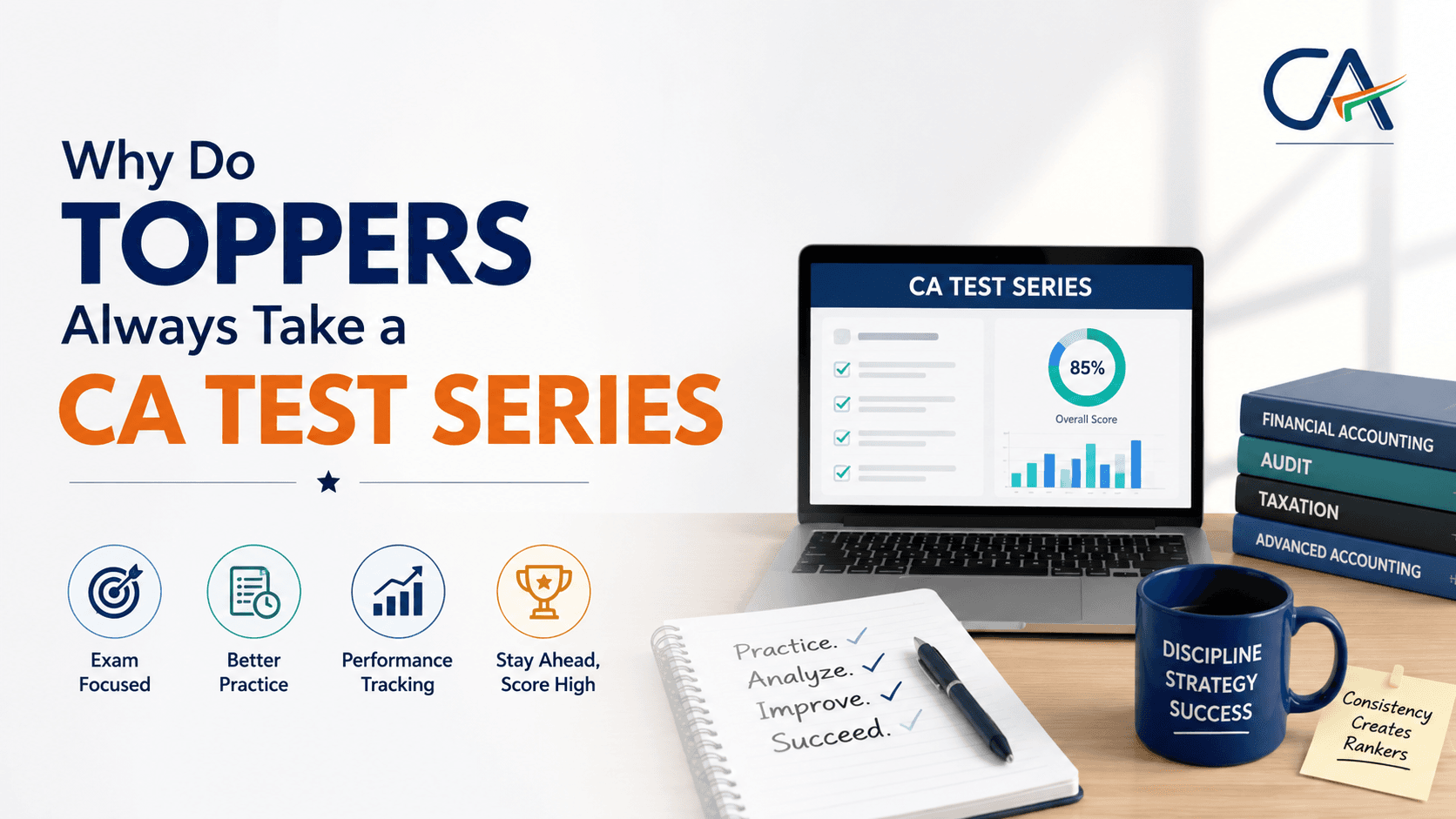
Look closely at how CA rank-holders prepare and a clear pattern emerges: they don't just study more than everyone else — they test more, and more seriously. While average students treat mocks as an afterthought, toppers build their whole strategy around evaluated practice. Why? Because they've grasped what the merit list actually rewards. This article breaks down the real reasons toppers rely on a test series, what they do differently with it, and how you can adopt the same habits to lift your own result.
The Mindset Difference: Toppers Study to Perform, Not Just to Know
The average student's goal is to finish the syllabus. The topper's goal is to perform well in the exam. That single shift in mindset explains almost everything about how they prepare.
Finishing the syllabus builds knowledge — necessary, but not sufficient. Performing in the exam requires a second skill set entirely: presenting answers the way examiners reward, finishing the paper in time, staying calm under pressure, and doing it consistently across every subject. Toppers know that these performance skills are trained through testing, not reading. So while others keep revising in the hope that knowledge alone will carry them, toppers spend their final weeks rehearsing the exam itself. A test series is the rehearsal.
Why Toppers Rely on a Test Series: 8 Real Reasons
1. They know ranks are won on execution, not knowledge
At the top of the merit list, everyone knows the concepts. What separates rank 1 from rank 500 is who loses the fewest marks to poor presentation, weak time management, and avoidable slips. Toppers use a test series because it's the only tool that measures and trains that execution — the exact thing the rank depends on.
2. They want honest, objective feedback — not self-assessment
Toppers distrust their own marking. When you assess your own answers, you give yourself the benefit of the doubt and miss the very errors the exam will punish. A test series with step-wise evaluation — the way ICAI examiners mark — gives them an objective, outside verdict on where they actually stand. Toppers would rather face a harsh truth in a mock than a pleasant illusion before the exam.
3. They hunt down invisible mark-loss
The marks that keep you off the merit list are the ones you don't know you're losing — two for a missing working note, three for a law answer in the wrong structure. Toppers use evaluated mocks specifically to make these invisible leaks visible, then close them one by one. That obsessive plugging of small gaps is what produces a big aggregate.
4. They perfect presentation deliberately
Toppers know presentation is often the single biggest score lever — that two students with the same knowledge can finish fifteen marks apart on structure and clarity alone. They use the feedback from each mock to refine their answer formats, working notes, and theory structure until presenting well is automatic. They're not just answering; they're answering the way examiners reward.
5. They master time management through rehearsal
Rankers finish the paper with time to review. Toppers don't leave this to chance — they rehearse full-length, timed papers repeatedly until pacing becomes instinctive, so they never lose a rank simply because they didn't reach the last question. Time management, for them, is a trained reflex, not a hope.
6. They eliminate every weak topic in advance
A rank has no soft spots. Toppers use regular testing to surface the specific chapters where they're leaking marks, early enough to fix them. Where an average student avoids their weak subject and hopes it won't come, a topper finds it, attacks it, and retests until it's solid.
7. They build consistency across every subject
A rank isn't one brilliant paper — it's high marks across all of them. Toppers use a series of mocks to turn a good performance into their normal performance, and they watch their trend across papers rather than obsessing over any single score. Steady, reliable output is the signature of a rank in the making.
8. They desensitise themselves to exam pressure
Nerves and time panic cost marks. Toppers sit so many full-length mocks that, by exam day, the hall feels routine — just another paper. That composure protects every mark their preparation has earned, while less-rehearsed students lose marks to anxiety on the day.
What Toppers Do Differently With a Test Series
It's not just that toppers test — it's how they test. The same test series produces very different results depending on how it's used:
| Average student | Topper |
| Attempts a few mocks casually | Builds the whole final phase around evaluated mocks |
| Marks their own papers | Insists on objective, step-wise evaluation |
| Looks at the score, moves on | Studies the feedback and fixes the cause |
| Avoids mocks in strong subjects | Tests every subject, including strong ones |
| Solves papers, never reviews | Analyses every paper and retests weak areas |
| Starts mocks late | Starts early, with time to act on feedback |
The lesson: a test series only produces topper results when used the topper way — as a diagnostic to act on, not a score to collect.
The Topper's Test-Series Routine, Step by Step
You don't need to be a topper to adopt a topper's routine:
- Start early. Chapter tests as you finish each topic; full mocks in the final 8–10 weeks — while there's still time to fix what they reveal.
- Simulate the exam every time. Three hours, no notes, no phone, handwritten if your exam is offline.
- Get every paper evaluated step-wise and study the feedback, not just the score.
- Fix the cause, not the symptom. Log each lost mark by reason — concept, calculation, presentation, time — and attack the biggest bucket.
- Retest to confirm. Re-attempt the weak area within a week to make sure the fix held.
- Track your trend. Aim for steady improvement across papers, peaking on exam day.
This study–test–learn–retest loop is the engine behind almost every rank.
"Do You Really Need a Test Series to Top?" — An Honest Answer
To be fair: not literally every topper uses a formal test series, and a rare few rank through pure self study with rigorous self-testing. But they're the exception, and even they replicate what a test series does — timed practice and honest evaluation — on their own.
For almost everyone else, a test series is the most reliable way to get objective feedback, because self-assessment simply can't see your own blind spots. So the honest takeaway isn't "you must buy a test series to top." It's "you must do what toppers do — test yourself relentlessly under real conditions and act on honest feedback — and a test series is by far the most practical way to make that happen.
Where CAEXAMS Fits In
If you want to prepare the way toppers do, the quality of your test series matters — because the whole value lies in the evaluation and feedback. CAEXAMS is a CA test series platform for CA Foundation, CA Intermediate, and CA Final students, built for exactly this kind of preparation. Papers follow the latest ICAI exam pattern, and your answer sheets are evaluated step-wise — the way examiners mark — so you get the honest, objective feedback toppers rely on: a detailed marking breakdown, specific comments to act on before your next paper, and mentorship plus a study planner to guide what to strengthen next. In other words, it gives you the exact toolkit behind the topper routine above — for whichever level you're preparing for. If you want to test like a topper, explore the CAEXAMS CA test series.
Final Word
Toppers rely on a test series for one simple reason: they know the exam rewards performance, not just knowledge, and testing is how performance is trained. They use evaluated mocks to see what they can't see themselves, perfect their presentation, master their pacing, eliminate every weak spot, and walk into the exam having already rehearsed it dozens of times. You don't need to be born a topper to prepare like one — start testing early, insist on honest feedback, act on every mark you lose, and do it consistently. That habit, more than any secret, is why toppers end up on the merit list — and it's available to you too.
CA Foundation notes students love
Free notes from the Studycaller library, picked for this article.
Amendment Notes · CA Foundation Business Economics
Full economics handwritten notes by CA Parag Gupta sir
Heet Hingrajiya 209 68.6k
Detailed Notes · CA Foundation Business Economics
"Hi guys! Maine kuch naya try kiya Economics me — ek alag andaaz, ek alag soch... Chapter 1: Nature & Scope of Business Economics – Unit 1 I
مُحَمَّد 126 14.7k
Chart Book · CA Foundation Business Laws
Chpter 3 the sale of goods act Unit. 1 only. Full of story line Concept clarity and funny stories punch lines
مُحَمَّد 118 14.2k
Amendment Notes · CA Foundation Business Laws
Nia 1881 story line pdf Coverage total 11 Concept
مُحَمَّد 117 12.5k
Frequently asked questions
Do CA toppers really use a test series?
Most do. While a rare few rank through pure self study with rigorous self-testing, the majority of rank-holders rely on a test series because it provides the objective, examiner-style feedback that self-assessment can't. Toppers use it to perfect presentation, time management, and consistency — the factors that decide ranks.
Why do toppers focus so much on mock tests?
Because toppers understand that ranks are won on execution, not just knowledge. Mock tests train presentation, speed, and composure and reveal where marks are leaking — the fine margins that separate a rank from a pass. So toppers build their preparation around evaluated mocks rather than treating them as an afterthought.
What do toppers do differently with a test series?
Toppers use mocks as diagnostics, not scores. They insist on step-wise evaluation, study the feedback rather than just the mark, test every subject including their strong ones, fix the cause of each lost mark, and retest to confirm. Average students often just solve papers and move on.
Can I become a topper by taking a test series?
A test series alone won't make you a topper — knowledge and effort come first — but it's one of the most powerful tools for improving your rank. Used the topper way, with honest evaluation and consistent follow-up, it can lift your score significantly by fixing execution.
How early do toppers start their test series?
Toppers start early — chapter tests as they finish topics, and full-length mocks in the final 8–10 weeks. Starting early gives them time to act on feedback, fix weaknesses, and retest. Leaving mocks to the final fortnight wastes their diagnostic value.
Is presentation really why toppers score higher?
It's a major reason. ICAI examiners reward structure, working notes, and clarity, and two students with identical knowledge can finish many marks apart on presentation alone. Toppers use test-series feedback to perfect presentation, which is often the single biggest score lever available.
Do toppers take mocks even in their strong subjects?
Yes. Toppers know that even strong subjects leak presentation and time-management marks you won't spot without testing. A rank requires strength across every subject, so they test all of them rather than only their weak ones.
How many mock tests do toppers usually attempt?
There's no fixed number, but toppers attempt enough evaluated full-length mocks — typically at least a few per subject, plus targeted chapter tests — to show a clear upward trend and iron out every weakness. For them, consistency across many well-analysed papers matters more than any single score.
Can self-study students prepare like toppers without coaching?
Yes. Self-study students can adopt the topper routine by pairing solid study with a test series for objective feedback. Since self-assessment misses your own blind spots, an evaluated test series is often the key ingredient that lets a self-study student prepare and perform like a topper.
Does CAEXAMS offer the kind of evaluation toppers rely on?
Yes. CAEXAMS evaluates submitted answer sheets step-wise — on accuracy, presentation, and structure, the way ICAI examiners mark — and returns them with a marking breakdown and specific feedback for CA Foundation, Intermediate, and Final students, giving you the objective feedback that toppers build their preparation around.