Is a Chartered Accountant Only for Tax Work: Understanding the Role of CAs
Discover why Chartered Accountants are not limited to tax work and how they support businesses through financial planning, advisory, compliance, and risk management.
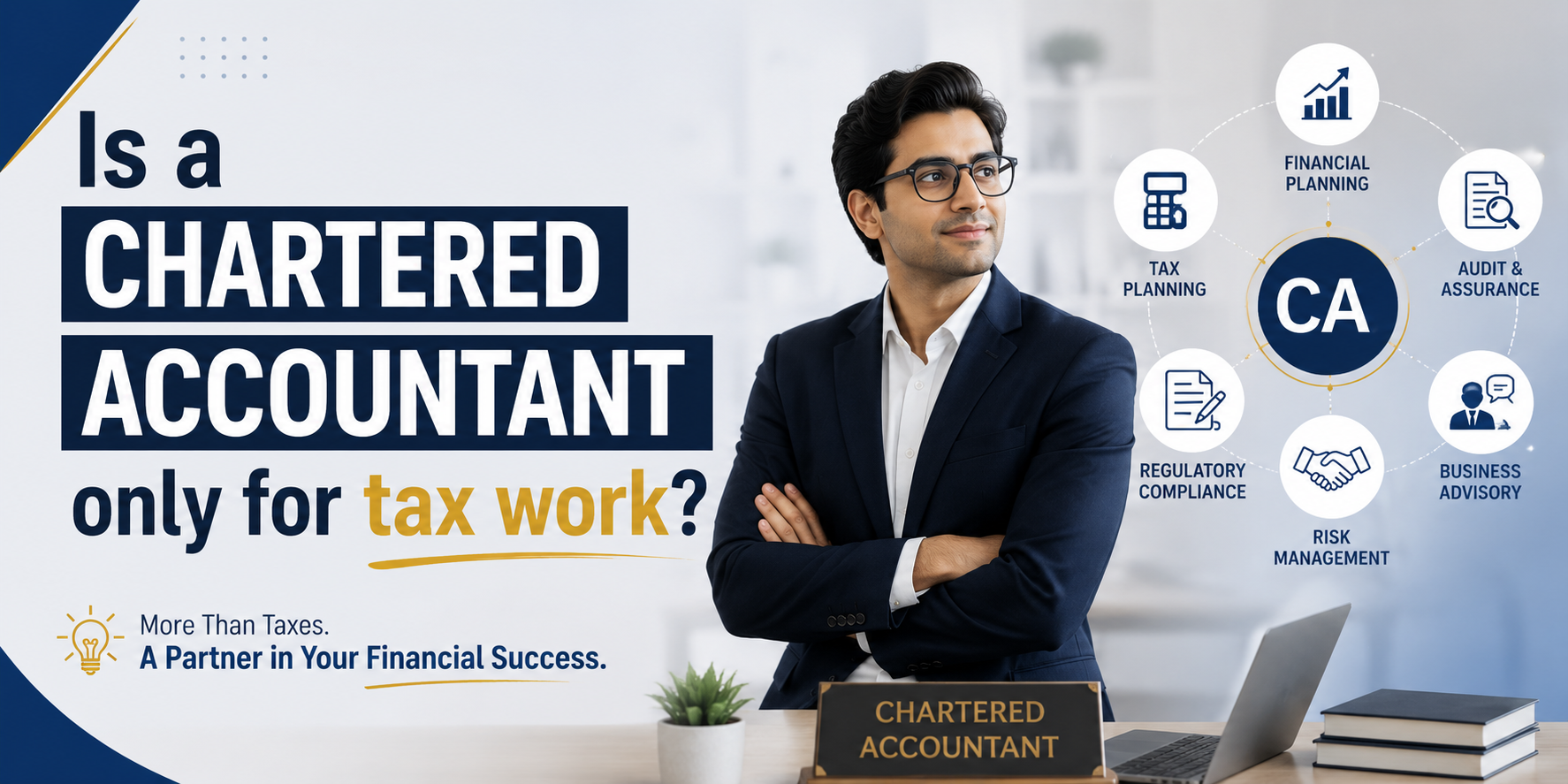
Table of Content
- The Traditional Image of Chartered Accountants
- Is a Chartered Accountant Only for Tax Work?
- Financial Planning and Business Strategy
- Chartered Accountants Help Improve Business Profitability
- Business Advisory Has Become a Major Practice Area
- Risk Management and Internal Controls
- Cash Flow and Working Capital Management
- Technology Has Expanded the Role of Chartered Accountants
- Chartered Accountants Support Startups and MSMEs
- Corporate Finance and Investment Advisory
- Virtual CFO Services Are Growing Rapidly
- Compliance Is Still Important but Not the Only Responsibility
- The Future of the Chartered Accountancy Profession
- Conclusion
For many years, people have associated Chartered Accountants primarily with income tax returns, GST filing, tax audits, and compliance-related activities. Whenever an individual or business receives a tax notice or approaches the tax filing season, the first professional they think of is usually a Chartered Accountant. While taxation remains an important area of practice, limiting the profession to tax-related services creates a very narrow understanding of what modern Chartered Accountants actually do. The profession has evolved significantly with changing business needs, technology, and global financial practices.
Today's business environment requires financial professionals who can contribute to strategic decision-making, improve profitability, strengthen governance, optimize business processes, and guide organizations through financial challenges. Chartered Accountants have adapted to these changing expectations by expanding their expertise far beyond taxation. They now serve as financial advisors, business consultants, compliance specialists, Virtual CFOs, risk management experts, and growth partners for businesses across industries. Their contribution extends into almost every aspect of financial and business management, making them one of the most valuable professionals in the corporate world.
The Traditional Image of Chartered Accountants
Historically, Chartered Accountants were widely recognized for handling tax filing, bookkeeping, auditing, and financial statement preparation. These responsibilities continue to be important, but they represent only a portion of the services that modern CAs provide.
As businesses become more competitive and financially complex, organizations require professionals who can provide strategic financial guidance rather than simply maintain compliance. This shift has significantly expanded the scope of the Chartered Accountancy profession.
Is a Chartered Accountant Only for Tax Work?
A Chartered Accountant is not limited to tax work. Modern CAs assist businesses with financial planning, budgeting, business consulting, risk management, internal controls, investment analysis, cash flow management, business restructuring, mergers, acquisitions, and strategic decision-making. Their expertise helps organizations improve operational efficiency while achieving long-term financial sustainability.
Financial Planning and Business Strategy
One of the most valuable roles performed by Chartered Accountants today is financial planning. They prepare budgets, forecasts, and long-term financial strategies that help businesses allocate resources efficiently and plan future expansion. Financial planning supports:
- Business growth
- Investment decisions
- Resource allocation
- Budget management
- Profitability improvement
- Long-term sustainability
Well-planned financial strategies help organizations achieve their business objectives more effectively.
Chartered Accountants Help Improve Business Profitability
Profitability depends on much more than increasing revenue. Businesses must control costs, optimize operations, improve pricing strategies, and strengthen financial management.
Chartered Accountants analyze business performance and recommend practical solutions that improve financial efficiency. Their advisory services often include:
- Cost optimization
- Margin analysis
- Expense control
- Budget reviews
- Business diagnostics
- Financial restructuring
These activities directly contribute to higher business profitability.
Business Advisory Has Become a Major Practice Area
The demand for business advisory services has increased rapidly in recent years. Companies seek professional guidance before making important business decisions involving expansion, investments, acquisitions, restructuring, or fundraising. Chartered Accountants provide advisory services such as:
- Business planning
- Financial forecasting
- Investment evaluation
- Working capital advisory
- Business restructuring
- Growth strategy planning
Their financial expertise enables management to make better strategic decisions.
Risk Management and Internal Controls
Every business faces financial and operational risks that can affect long-term performance. Chartered Accountants identify these risks and establish systems that improve governance and financial control. Risk management services include:
- Internal control review
- Compliance monitoring
- Fraud prevention
- Financial risk analysis
- Governance advisory
- Policy development
Strong financial controls reduce business risks and improve organizational stability.
Cash Flow and Working Capital Management
Many profitable businesses struggle because of weak cash flow management. Chartered Accountants help businesses improve liquidity by optimizing receivables, inventory, expenses, and payment cycles. Their working capital advisory includes:
- Cash flow planning
- Receivable management
- Inventory optimization
- Budgeting
- Liquidity analysis
- Financial forecasting
Better liquidity management supports smooth business operations and future expansion.
Technology Has Expanded the Role of Chartered Accountants
Digital transformation has changed the accounting profession significantly. Modern Chartered Accountants use advanced technology to provide real-time financial insights and improve business decision-making. Technology-driven services include:
- Cloud accounting
- Financial dashboards
- ERP advisory
- Business analytics
- Workflow automation
- Digital reporting
Technology enables CAs to provide faster and more strategic financial solutions.
Chartered Accountants Support Startups and MSMEs
Startups and small businesses often require financial guidance but may not have large finance departments. Chartered Accountants help entrepreneurs establish proper financial systems from the beginning. Their support includes:
- Business registration
- Financial planning
- Compliance management
- Fundraising support
- Budget preparation
- Investor reporting
Professional financial guidance improves business stability and long-term growth prospects.
Corporate Finance and Investment Advisory
Many Chartered Accountants work in corporate finance, where they advise companies on funding, investments, mergers, acquisitions, and financial restructuring. Their expertise helps organizations evaluate opportunities while minimizing financial risks. Corporate finance advisory may include:
- Capital raising
- Investment analysis
- Business valuation
- Financial due diligence
- Merger advisory
- Acquisition planning
These services create long-term value for businesses and investors.
Virtual CFO Services Are Growing Rapidly
Small and medium-sized businesses increasingly hire Chartered Accountants as Virtual CFOs instead of appointing full-time finance executives. Virtual CFO services include:
- Financial strategy
- Budget management
- Cash flow monitoring
- Management reporting
- Profitability analysis
- Business advisory
These long-term engagements help businesses strengthen financial management while controlling costs.
Compliance Is Still Important but Not the Only Responsibility
Taxation and compliance continue to be important responsibilities for Chartered Accountants. However, GST returns, Income Tax filing, TDS management, statutory reporting, and audits now represent only one part of a much broader professional role.
Businesses increasingly rely on Chartered Accountants for strategic guidance that supports growth and operational excellence. The profession has evolved from compliance management to business leadership.
The Future of the Chartered Accountancy Profession
Automation and artificial intelligence are gradually reducing manual accounting work. As routine compliance activities become more technology-driven, Chartered Accountants are focusing on advisory, consulting, analytics, and business strategy. Future opportunities include:
- Digital finance consulting
- ESG advisory
- Business transformation
- Financial analytics
- Risk advisory
- Strategic consulting
The profession is becoming more advisory-oriented than ever before.
Conclusion
The answer to Is a Chartered Accountant is only for tax work is a definite no. While taxation remains an important area of expertise, the role of Chartered Accountants has expanded into financial planning, business consulting, risk management, corporate finance, profitability improvement, cash flow management, technology advisory, and strategic decision-making. Modern businesses rely on CAs as trusted financial partners who contribute to long-term growth and organizational success. As the business world continues to evolve, Chartered Accountants will play an even greater role in shaping financial strategies and driving sustainable business performance.

FAQs
Is a Chartered Accountant only for tax work?
No. Chartered Accountants provide services related to financial planning, business advisory, compliance, risk management, corporate finance, and strategic decision-making in addition to taxation.
What services do Chartered Accountants provide apart from tax filing?
They offer financial planning, budgeting, business consulting, cash flow management, investment analysis, internal audits, compliance management, and profitability advisory.
Can a Chartered Accountant help businesses grow?
Yes. Chartered Accountants improve financial planning, optimize costs, strengthen governance, manage risks, and support strategic decisions that contribute to business growth.
Do Chartered Accountants provide business consulting services?
Yes. Modern Chartered Accountants offer consulting services related to business strategy, restructuring, working capital management, expansion planning, and financial analysis.
Can startups benefit from Chartered Accountant services?
Absolutely. Startups receive support in financial planning, compliance, fundraising, budgeting, investor reporting, and business structuring.
How do Chartered Accountants improve business profitability?
They analyze financial performance, optimize costs, strengthen budgeting, improve pricing strategies, and recommend operational improvements that increase profits.
Are Chartered Accountants involved in corporate finance?
Yes. Many Chartered Accountants specialize in investment advisory, mergers, acquisitions, business valuation, capital raising, and financial restructuring.
What is a Virtual CFO service provided by Chartered Accountants?
Virtual CFO services include financial strategy, budgeting, cash flow management, profitability analysis, management reporting, and business advisory for growing companies.
How has technology changed the role of Chartered Accountants?
Technology has enabled Chartered Accountants to provide cloud accounting, financial analytics, automation, ERP advisory, and real-time business insights.
What is the biggest role of a Chartered Accountant in modern business?
The biggest role is helping businesses make informed financial decisions through strategic advisory, financial planning, compliance management, profitability improvement, and long-term business guidance.