
How Does a Chartered Accountant Create Business Value? Complete Guide
Learn how a Chartered Accountant creates business value through financial planning, compliance, strategic advisory, cash flow management, and profitability improvement.
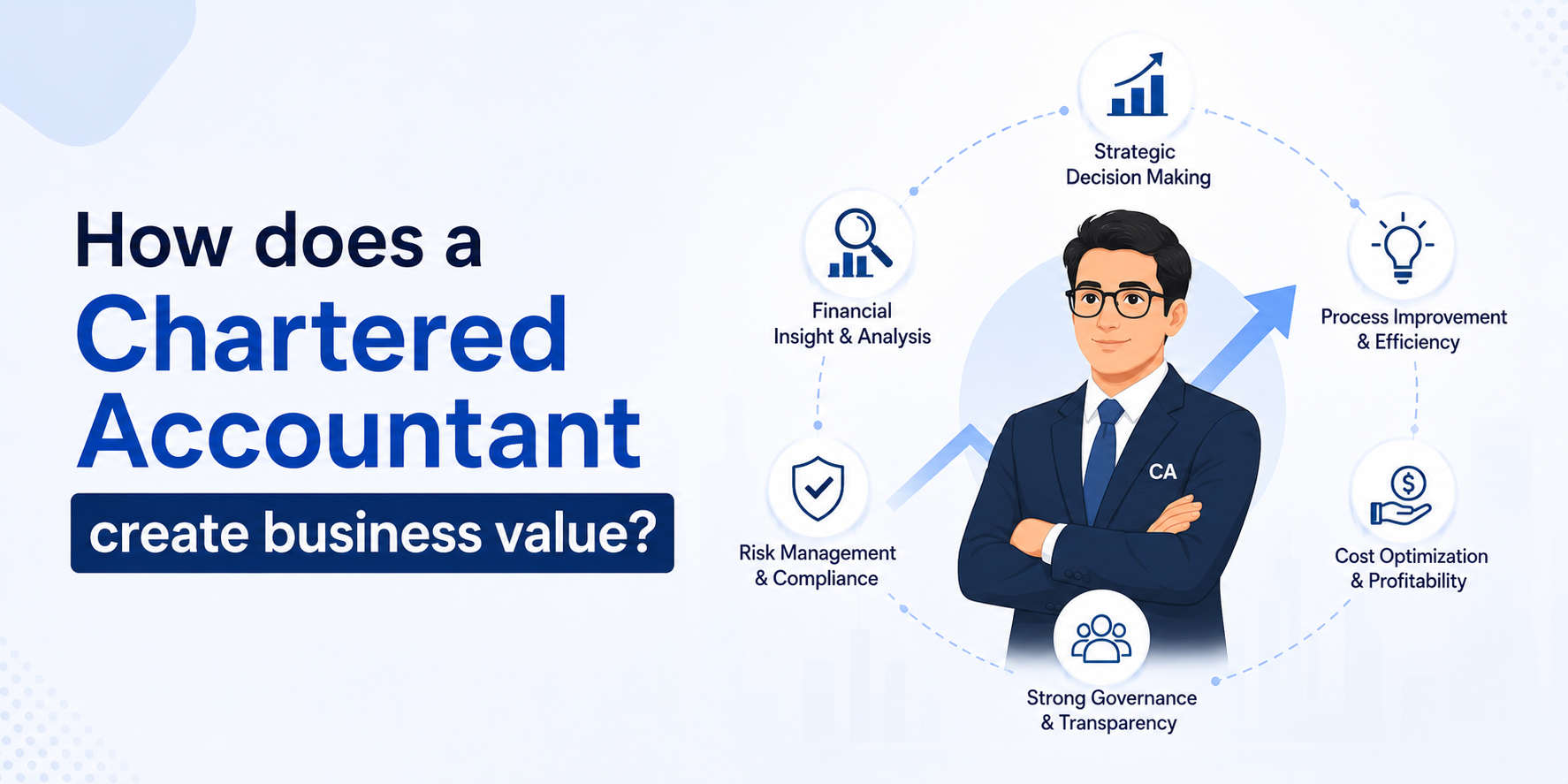
Table of Content
- A Chartered Accountant Is More Than an Accountant
- How Does a Chartered Accountant Create Business Value?
- Better Financial Planning Leads to Better Business Decisions
- Cash Flow Management Creates Financial Stability
- Business Value Through Compliance and Governance
- Improving Profitability Through Financial Analysis
- Strategic Business Advisory Creates Long-Term Value
- Risk Management Protects Business Assets
- Technology Has Expanded the Role of Chartered Accountants
- Supporting Business Growth and Expansion
- Building Investor and Stakeholder Confidence
- Advisory Services Are Creating the Future of the Profession
- Conclusion
Every business aims to increase profitability, improve operational efficiency, manage risks, and achieve sustainable long-term growth. However, reaching these objectives requires much more than simply increasing sales or reducing expenses. Businesses need strong financial systems, effective planning, regulatory compliance, strategic decision-making, and continuous performance monitoring. In today's competitive business environment, companies require professionals who can convert financial information into meaningful business insights that support growth and stability.
This is where Chartered Accountants play an important role. The question "How does a Chartered Accountant create business value?" is highly relevant because the role of CAs has expanded far beyond accounting and taxation. Modern Chartered Accountants act as financial strategists, business advisors, compliance experts, and growth partners who help organizations improve decision-making and maximize long-term value. Their expertise supports businesses in strengthening financial health, optimizing resources, improving governance, and adapting to changing market conditions.
A Chartered Accountant Is More Than an Accountant
Many people still associate Chartered Accountants only with bookkeeping, tax filing, or audit assignments. In reality, the profession has evolved into a comprehensive business advisory role where financial expertise is combined with strategic thinking and operational understanding.
Modern Chartered Accountants assist businesses in planning expansion, managing risks, improving profitability, implementing technology, and strengthening governance while ensuring financial discipline across the organization. Their contribution extends to almost every major business decision.
How Does a Chartered Accountant Create Business Value?
A Chartered Accountant creates business value by improving financial performance, strengthening compliance, optimizing business processes, managing risks, and providing strategic guidance that supports sustainable business growth.
Rather than focusing only on historical financial records, CAs analyze business performance and recommend practical solutions that improve efficiency and profitability. Their professional expertise enables organizations to make informed decisions based on reliable financial information.
Better Financial Planning Leads to Better Business Decisions
Financial planning is one of the most valuable services provided by Chartered Accountants. They prepare budgets, forecasts, and financial projections that help businesses allocate resources efficiently and prepare for future opportunities. Effective financial planning enables organizations to:
- Control expenses
- Plan investments
- Improve liquidity
- Manage business risks
- Support expansion
- Increase profitability
Well-structured financial planning provides a roadmap for sustainable growth.
Cash Flow Management Creates Financial Stability
A profitable business may still struggle if cash flow is not managed properly. Chartered Accountants evaluate working capital cycles, receivable collections, payment schedules, and operational expenses to improve liquidity management. Strong cash flow management helps businesses:
- Meet day-to-day expenses
- Pay suppliers on time
- Reduce borrowing costs
- Improve working capital
- Maintain operational continuity
Healthy liquidity supports long-term business success.
Business Value Through Compliance and Governance
Regulatory compliance protects businesses from financial penalties and legal complications. Chartered Accountants ensure that organizations comply with taxation laws, accounting standards, and statutory reporting requirements while maintaining accurate financial records. Compliance support generally includes:
- Income Tax management
- GST compliance
- TDS reporting
- Financial documentation
- Regulatory filings
- Statutory reporting
Strong governance systems improve credibility and investor confidence.
Improving Profitability Through Financial Analysis
Chartered Accountants regularly analyze financial statements to identify opportunities for improving profitability. They evaluate revenue patterns, operating expenses, cost structures, and pricing strategies to recommend corrective actions that strengthen business performance. Profitability improvement strategies may include:
- Cost optimization
- Margin analysis
- Budget restructuring
- Resource allocation
- Financial diagnostics
- Process improvement
Continuous financial analysis enables businesses to maximize returns while controlling unnecessary expenses.
Strategic Business Advisory Creates Long-Term Value
Modern businesses increasingly rely on Chartered Accountants for strategic guidance instead of routine compliance support alone. Business advisory services help organizations evaluate expansion plans, investments, restructuring opportunities, and financial risks before major decisions are implemented. Strategic advisory may involve:
- Business planning
- Investment analysis
- Market expansion
- Funding strategies
- Business restructuring
- Growth planning
Professional financial advice reduces uncertainty and improves decision-making quality.
Risk Management Protects Business Assets
Every organization faces operational, financial, regulatory, and market-related risks. Chartered Accountants identify these risks and recommend practical control mechanisms that improve business resilience. Risk management services may include:
- Internal control review
- Compliance monitoring
- Financial risk assessment
- Fraud prevention
- Policy development
- Governance advisory
Effective risk management protects business assets while improving operational stability.
Technology Has Expanded the Role of Chartered Accountants
Technology has transformed the accounting profession and expanded the value that Chartered Accountants deliver to businesses. Today, CAs use digital platforms and analytics tools to provide faster, more accurate, and more meaningful financial insights. Technology-driven services include:
- Cloud accounting
- Financial dashboards
- Business analytics
- Workflow automation
- Digital reporting
- ERP advisory
Technology enables businesses to make real-time financial decisions and improve operational efficiency.
Supporting Business Growth and Expansion
Business expansion requires careful financial planning and risk evaluation. Chartered Accountants assist organizations in assessing investment opportunities, funding requirements, profitability projections, and expansion feasibility before implementation. Growth advisory helps businesses:
- Enter new markets
- Expand operations
- Improve scalability
- Optimize investments
- Strengthen financial planning
- Manage expansion risks
Strategic planning increases the probability of long-term business success.
Building Investor and Stakeholder Confidence
Transparent financial reporting and strong governance practices create trust among investors, lenders, suppliers, and business partners. Chartered Accountants ensure that financial information is reliable, accurate, and professionally maintained. This improves business credibility and increases opportunities for:
- Bank financing
- Investor funding
- Strategic partnerships
- Business acquisitions
- Long-term investments
Financial transparency strengthens organizational reputation and market confidence.
Advisory Services Are Creating the Future of the Profession
The accounting profession is rapidly shifting toward advisory-driven services where businesses expect proactive solutions instead of reactive compliance support. Chartered Accountants now contribute to digital transformation, profitability improvement, operational excellence, and strategic planning while helping organizations adapt to changing economic conditions.
This evolution has significantly increased the business value created by modern Chartered Accountants. The profession is becoming an essential driver of organizational growth.
Conclusion
The answer to "How does a Chartered Accountant create business value?" lies in the ability to combine financial expertise with strategic business advisory. Chartered Accountants strengthen financial management, improve profitability, optimize cash flow, maintain compliance, reduce risks, support technology adoption, and guide organizations toward sustainable growth. Their contribution extends far beyond accounting by helping businesses make better decisions and build stronger financial foundations. As companies continue to face increasing complexity and competition, Chartered Accountants will remain trusted advisors who create measurable value through financial intelligence and strategic leadership.

FAQs
How does a Chartered Accountant create business value?
A Chartered Accountant creates business value through financial planning, compliance management, profitability improvement, cash flow optimization, strategic advisory, and business risk management.
Why do businesses consider Chartered Accountants valuable?
Businesses value Chartered Accountants because they improve financial decision-making, strengthen governance, maintain compliance, and support sustainable business growth.
Can Chartered Accountants improve business profitability?
Yes. Chartered Accountants analyze costs, pricing strategies, budgets, and financial performance to identify opportunities that improve profitability.
How do Chartered Accountants support strategic planning?
They prepare financial forecasts, evaluate investments, assess risks, and recommend business strategies that align with long-term organizational objectives.
Does cash flow management create business value?
Yes. Effective cash flow management improves liquidity, reduces borrowing costs, strengthens working capital, and supports uninterrupted business operations.
How do Chartered Accountants help with compliance?
They ensure timely tax filing, statutory reporting, regulatory documentation, GST compliance, and adherence to accounting standards and legal requirements.
Can technology increase the value created by Chartered Accountants?
Absolutely. Cloud accounting, financial dashboards, automation, business analytics, and digital reporting improve efficiency and decision-making capabilities.
How do Chartered Accountants help businesses manage risk?
They review internal controls, assess financial risks, improve governance, strengthen compliance systems, and recommend strategies that reduce operational uncertainty.
Do Chartered Accountants contribute to business growth?
Yes. They support expansion planning, funding decisions, investment analysis, profitability improvement, and financial strategy that drive sustainable business growth.
What is the biggest way a Chartered Accountant creates business value?
The biggest contribution is transforming financial information into strategic business insights that improve decision-making, operational efficiency, profitability, and long-term organizational success.