Chartered Accountant Growth Diagnostics: Driving Business Growth
Learn how Chartered Accountant growth diagnostics helps businesses analyze performance, identify opportunities, improve profitability, and achieve sustainable growth.
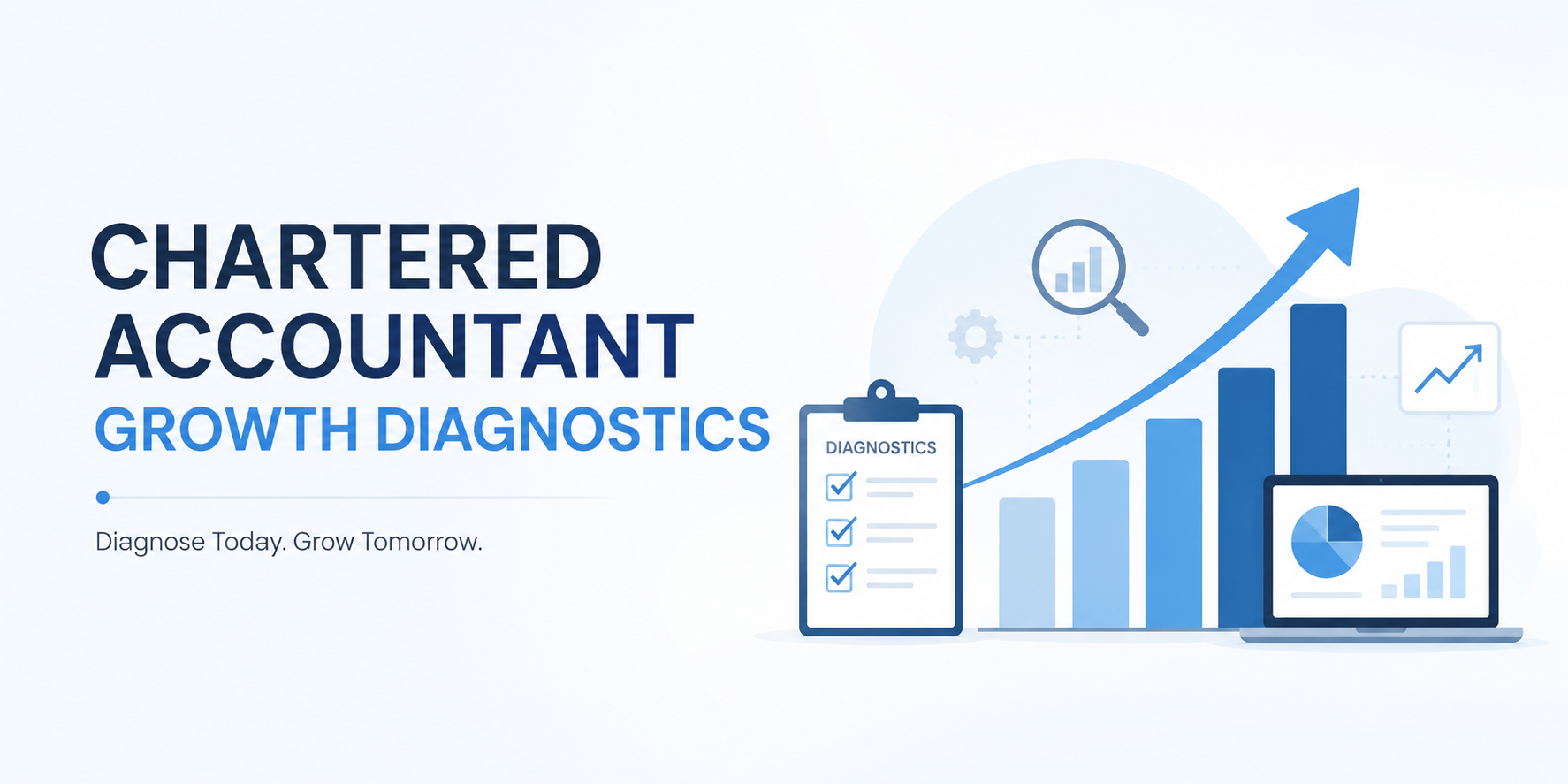
Table of Content
- Why Growth Diagnostics Is Important for Businesses
- Chartered Accountant Growth Diagnostics Improves Financial Analysis
- Identifying Profitability Improvement Opportunities
- Cash Flow Assessment and Working Capital Management
- Business Performance Benchmarking
- Risk Identification and Business Stability
- Supporting Strategic Decision-Making
- Improving Internal Business Processes
- Technology and Data-Driven Diagnostics
- Long-Term Value of Growth Diagnostics
- Conclusion
Growing a business requires much more than increasing sales or expanding operations. Sustainable growth depends on understanding financial performance, identifying operational challenges, managing risks, and making informed strategic decisions. Many businesses focus only on revenue figures while overlooking important indicators such as profitability, cash flow, cost efficiency, and resource utilization. Without proper financial analysis, growth opportunities may remain unnoticed, and business risks may increase over time.
This is where chartered accountant growth diagnostics becomes highly valuable. Chartered Accountants use financial expertise, analytical skills, and business understanding to evaluate an organization's overall performance and identify areas that require improvement. Growth diagnostics helps businesses understand where they stand today, what challenges they face, and what strategies can support future expansion. Instead of relying on assumptions, businesses can make decisions based on accurate financial insights and data-driven analysis.
What Is Chartered Accountant Growth Diagnostics?
Chartered accountant growth diagnostics is a structured process in which Chartered Accountants evaluate a business's financial and operational performance to identify growth opportunities and improvement areas.
The process involves analyzing financial statements, business processes, profitability, cash flow, compliance, and management reporting to provide practical recommendations for sustainable growth. Growth diagnostics acts like a financial health check-up that helps business owners understand both strengths and weaknesses before making major business decisions.
Why Growth Diagnostics Is Important for Businesses
Many businesses experience slow growth not because of market conditions but because internal inefficiencies remain unnoticed. Problems such as rising costs, poor cash flow management, weak financial controls, or ineffective pricing strategies can reduce profitability even when sales increase.
Growth diagnostics helps management identify these issues early and take corrective action before they become major business challenges. Regular business evaluation supports long-term financial stability and operational efficiency.
Chartered Accountant Growth Diagnostics Improves Financial Analysis
One of the key benefits of chartered accountant growth diagnostics is detailed financial analysis. Chartered Accountants evaluate business performance using financial statements and key performance indicators to understand overall business health. The analysis may include:
- Revenue trends
- Profit margins
- Cash flow position
- Working capital efficiency
- Cost structures
- Debt management
This financial evaluation helps businesses make informed strategic decisions with greater confidence.
Identifying Profitability Improvement Opportunities
Increasing revenue does not always result in higher profits. Growth diagnostics help identify areas where costs can be controlled, and operational efficiency can be improved. Chartered Accountants analyze:
- Operating expenses
- Product profitability
- Department-wise costs
- Pricing strategies
- Resource utilization
- Financial leakages
These insights help businesses improve profitability without necessarily increasing sales volume.
Cash Flow Assessment and Working Capital Management
Cash flow is one of the most important indicators of business stability. Even profitable businesses may face financial stress due to poor working capital management. Chartered Accountants evaluate cash inflows, receivables, inventory management, and payment cycles to improve liquidity. Better cash flow planning supports smooth business operations and future expansion without unnecessary financial pressure.
Business Performance Benchmarking
Growth diagnostics also compares business performance with internal targets and industry standards. Benchmarking helps management understand whether the organization is performing efficiently compared to competitors and market expectations. Areas commonly evaluated include:
- Revenue growth
- Profitability ratios
- Cost efficiency
- Operational productivity
- Asset utilization
- Financial stability
Benchmarking provides valuable insights for continuous business improvement.
Risk Identification and Business Stability
Every growing business faces financial and operational risks. Chartered Accountants help identify potential risks that may affect future performance and recommend suitable control measures. Growth diagnostics may identify risks related to:
- Cash flow shortages
- High operating costs
- Compliance issues
- Debt levels
- Internal controls
- Financial reporting
Early identification allows management to take preventive action and strengthen business stability.
Supporting Strategic Decision-Making
Business expansion requires reliable financial information and careful planning. Growth diagnostics provides management with detailed reports that support decisions regarding investments, expansion, hiring, pricing, and resource allocation.
Instead of relying on assumptions, business owners can make informed decisions backed by financial analysis and performance data. Strategic planning becomes more effective when supported by professional financial diagnostics.
Improving Internal Business Processes
Operational inefficiencies often reduce business performance without attracting immediate attention. Chartered Accountants review internal processes and recommend improvements that increase productivity and reduce unnecessary costs. Common improvement areas include:
- Financial reporting systems
- Approval procedures
- Budget monitoring
- Cost controls
- Documentation processes
- Management reporting
Efficient internal processes support sustainable business growth.
Technology and Data-Driven Diagnostics
Modern businesses generate large volumes of financial and operational data. Chartered Accountants increasingly use digital tools and business analytics to evaluate performance more accurately. Technology supports:
- Real-time reporting
- Dashboard analysis
- Financial forecasting
- Trend analysis
- Performance monitoring
- Decision support
Data-driven diagnostics improve both accuracy and business planning.
Long-Term Value of Growth Diagnostics
Growth diagnostics should not be viewed as a one-time financial review. Regular performance analysis helps businesses adapt to changing market conditions, improve efficiency, and identify new expansion opportunities.
Continuous monitoring allows management to take proactive decisions instead of reacting to problems after they arise. Businesses that regularly review their financial health are generally better positioned for sustainable long-term success.
Conclusion
Chartered accountant growth diagnostics provides businesses with valuable financial insights that support informed decision-making, improved profitability, and sustainable growth. By analyzing financial performance, identifying operational inefficiencies, evaluating risks, and recommending practical improvements, Chartered Accountants help organizations strengthen their overall business performance. As competition continues to increase across industries, growth diagnostics has become an essential advisory service for businesses seeking long-term stability and strategic expansion.

FAQs
What is chartered accountant growth diagnostics?
Chartered accountant growth diagnostics is a financial and operational evaluation process that helps businesses identify growth opportunities, improve efficiency, and strengthen long-term performance.
Why is growth diagnostics important for businesses?
Growth diagnostics identifies financial weaknesses, operational inefficiencies, profitability challenges, and business risks while supporting informed strategic decision-making.
How do Chartered Accountants perform growth diagnostics?
Chartered Accountants analyze financial statements, cash flow, profitability, working capital, internal controls, and business processes to recommend performance improvements.
Can growth diagnostics improve business profitability?
Yes. Growth diagnostics identify unnecessary costs, pricing issues, operational inefficiencies, and financial leakages that affect overall profitability.
How does growth diagnostics help with cash flow management?
It evaluates receivables, payables, inventory management, and working capital utilization to improve liquidity and ensure smoother business operations.
Does growth diagnostics include risk assessment?
Yes. Chartered Accountants identify financial, operational, compliance, and internal control risks that may impact future business performance.
Can MSMEs benefit from growth diagnostics?
Absolutely. MSMEs can improve financial management, operational efficiency, profitability, and business planning through professional growth diagnostics.
How often should businesses conduct growth diagnostics?
Businesses should conduct growth diagnostics periodically to monitor performance, identify emerging challenges, and adapt strategies according to changing market conditions.
Does technology support growth diagnostics?
Yes. Modern accounting software and analytics tools help Chartered Accountants perform real-time financial analysis, forecasting, and performance monitoring.
What is the biggest benefit of chartered accountant growth diagnostics?
The biggest benefit is providing businesses with data-driven financial insights that improve decision-making, strengthen profitability, reduce risks, and support sustainable long-term growth.