What Makes a Chartered Accountant Valuable to a Company
Discover what makes a Chartered Accountant valuable to a company and how CAs contribute to growth, profitability, compliance, and strategic decision-making.
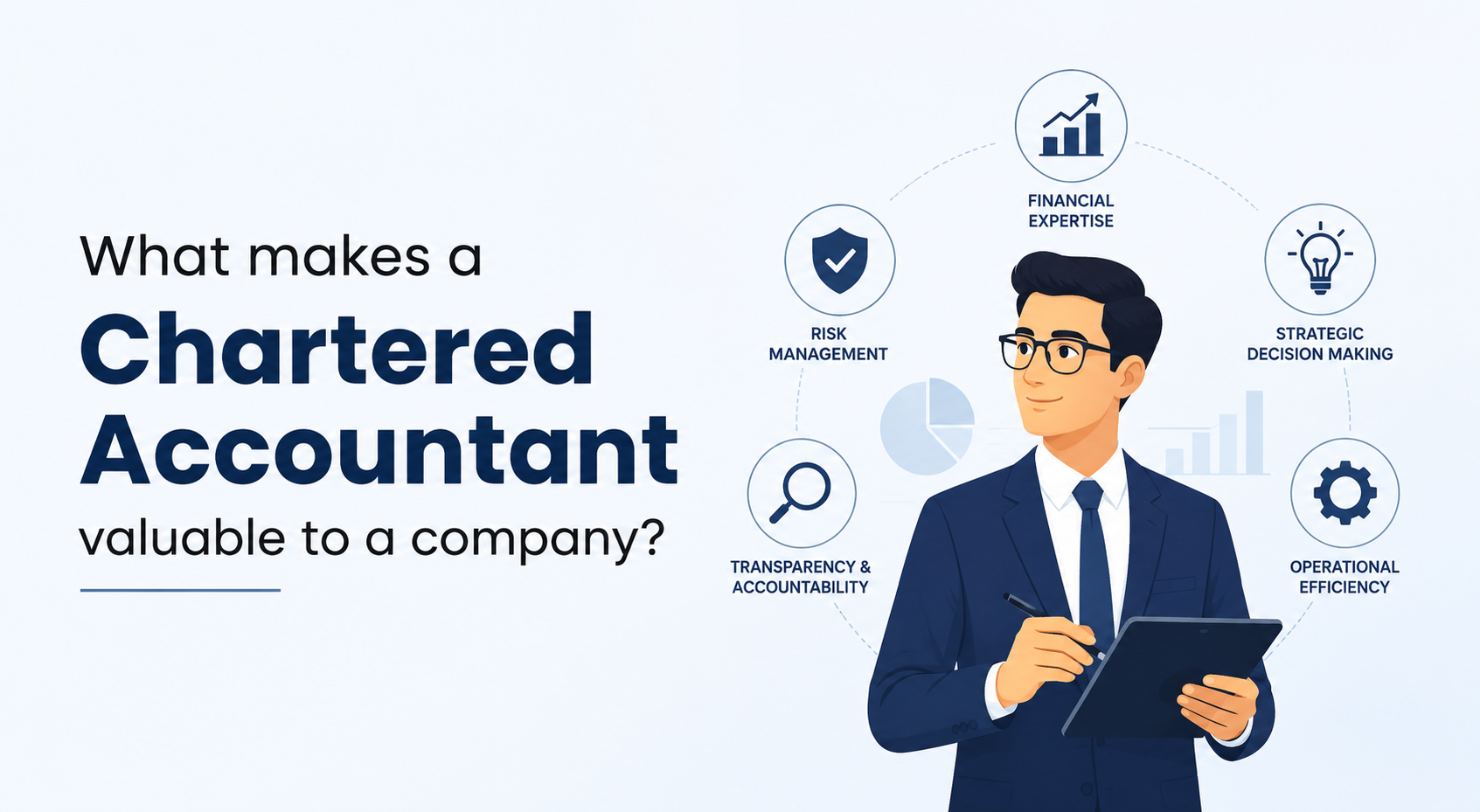
Table of Content
- Chartered Accountants Bring Financial Clarity
- Why Companies Value Chartered Accountants
- They Help Businesses Make Better Decisions
- Profitability Improvement Is a Key Contribution
- Cash Flow Management Supports Stability
- Compliance Protects the Business
- Areas Where CAs Add Value Beyond Compliance
- Risk Management Helps Protect Growth
- They Improve Business Planning
- Technology Has Increased Their Importance
- Investors and Stakeholders Trust Financial Expertise
- Why Even Mature Companies Depend on CAs
- The Future Value of Chartered Accountants
- Conclusion
In today's competitive business environment, companies need much more than accurate accounting records and tax compliance. Organizations face constant pressure to improve profitability, manage costs, comply with regulations, adapt to changing market conditions, and make strategic decisions that support long-term growth. As businesses become more complex, the need for financial expertise and professional guidance becomes increasingly important. This is where Chartered Accountants create significant value for organizations across industries.
A Chartered Accountant is often viewed as a financial expert, but their contribution extends far beyond accounting and taxation. Modern CAs help businesses analyze performance, manage risks, improve cash flow, strengthen governance, and identify opportunities for growth. They provide insights that enable management teams to make informed decisions while ensuring that the company's financial foundation remains strong. Their ability to combine technical knowledge with business understanding makes them one of the most valuable professionals within any organization.
Chartered Accountants Bring Financial Clarity
Every successful business relies on accurate financial information. Without clear financial data, management may struggle to understand performance, allocate resources effectively, or identify potential problems.
Chartered Accountants help transform complex financial information into meaningful insights. They analyze financial statements, review business performance, and present information in a way that supports better decision-making. This financial clarity helps companies focus on opportunities while addressing challenges before they become serious issues.
Why Companies Value Chartered Accountants
- Strong Financial Knowledge – They understand accounting, taxation, compliance, and business finance.
- Data-Driven Decision Support – They help management make decisions based on facts rather than assumptions.
- Risk Identification – They identify financial and operational risks before they escalate.
- Business Improvement Insights – They recommend strategies to improve efficiency and profitability.
- Long-Term Strategic Thinking – They focus on sustainable growth rather than short-term gains.
These qualities make Chartered Accountants valuable business partners.
They Help Businesses Make Better Decisions
Business decisions involving expansion, investments, hiring, pricing, or technology adoption often have significant financial implications. Making these decisions without proper analysis can increase risks and reduce profitability.
Chartered Accountants evaluate financial data, assess risks, and provide objective recommendations that help businesses choose the most effective course of action. Their involvement ensures that major decisions are supported by accurate information and realistic financial projections.
Profitability Improvement Is a Key Contribution
Many companies focus heavily on increasing revenue but overlook opportunities to improve profitability. Higher sales do not always translate into stronger profits if costs are not managed effectively.
Chartered Accountants regularly analyze business performance to identify areas where profitability can be enhanced. They review expenses, evaluate pricing strategies, monitor margins, and recommend improvements that strengthen financial performance.
Ways CAs Improve Profitability
- Cost Optimization – Reducing unnecessary expenses.
- Margin Analysis – Identifying profitable products and services.
- Resource Utilization – Improving operational efficiency.
- Budget Monitoring – Ensuring spending aligns with objectives.
- Performance Tracking – Measuring financial results consistently.
These activities help businesses generate greater value from existing resources.
Cash Flow Management Supports Stability
Cash flow is one of the most important indicators of business health. Even profitable companies can experience difficulties if cash inflows and outflows are not managed properly.
Chartered Accountants help organizations monitor liquidity, improve collections, optimize working capital, and forecast future cash requirements. Their guidance ensures that businesses maintain sufficient resources to support operations and growth initiatives. Strong cash flow management reduces financial stress and improves overall business stability.
Compliance Protects the Business
Regulatory requirements continue to evolve, making compliance an ongoing challenge for organizations. Tax laws, reporting standards, and statutory obligations require careful attention and accurate documentation.
Chartered Accountants help companies remain compliant while reducing the risk of penalties, disputes, and reputational damage. Their expertise allows businesses to focus on operations while maintaining confidence that regulatory requirements are being met.
Areas Where CAs Add Value Beyond Compliance
- Financial Planning – Creating budgets and forecasts.
- Business Advisory – Supporting strategic decisions.
- Risk Management – Identifying and mitigating risks.
- Corporate Governance – Strengthening transparency and accountability.
- Performance Analysis – Monitoring financial and operational results.
These services demonstrate how the profession has evolved beyond traditional accounting functions.
Risk Management Helps Protect Growth
Every business faces uncertainty. Economic changes, market competition, operational challenges, and regulatory developments can affect performance and profitability.
Chartered Accountants help organizations identify potential risks and develop strategies to manage them effectively. Their financial expertise enables businesses to anticipate challenges and respond proactively rather than reactively. Companies that manage risks effectively are generally better positioned for sustainable growth.
They Improve Business Planning
Successful businesses rarely grow by chance. Growth requires careful planning, realistic targets, and disciplined execution.
Chartered Accountants assist with financial planning by preparing budgets, forecasts, and strategic financial models. These tools help businesses evaluate future opportunities and ensure that resources are allocated efficiently. Better planning leads to better outcomes and improved long-term performance.
Technology Has Increased Their Importance
The rise of cloud accounting, automation, ERP systems, and business analytics has changed how companies manage financial information. While technology provides access to more data, businesses still need professionals who can interpret that data and provide meaningful insights.
Chartered Accountants bridge the gap between technology and decision-making. They help organizations use financial information effectively and ensure that technology investments contribute to business objectives.
How Technology Has Expanded the CA's Role
- Business Analytics – Generating actionable insights from data.
- Financial Dashboards – Monitoring performance in real time.
- Automation Projects – Improving efficiency and accuracy.
- Digital Reporting – Enhancing management information systems.
- Technology Evaluation – Assessing financial returns on investments.
This evolution has made Chartered Accountants even more valuable to modern businesses.
Investors and Stakeholders Trust Financial Expertise
Investors, lenders, and stakeholders often evaluate a company's financial discipline before making decisions. Businesses with accurate reporting, strong governance, and reliable financial controls are generally viewed more favorably.
Chartered Accountants help organizations build this credibility through transparent reporting and professional financial management. Their involvement strengthens stakeholder confidence and improves access to funding opportunities.
Why Even Mature Companies Depend on CAs
Many established businesses have experienced management teams and sophisticated systems, yet they continue to rely heavily on Chartered Accountants. This is because financial complexity increases as businesses grow.
Key Reasons Mature Companies Value CAs
- Strategic Financial Advice – Supporting major business decisions.
- Governance Improvement – Strengthening accountability.
- Performance Monitoring – Tracking profitability and efficiency.
- Expansion Planning – Evaluating growth opportunities.
- Risk Management – Protecting long-term business interests.
Their expertise remains valuable regardless of company size.
The Future Value of Chartered Accountants
The future of the profession is shifting toward advisory, analytics, technology, and strategic planning. As automation handles more routine accounting tasks, businesses will increasingly depend on professionals who can interpret data and provide actionable recommendations.
Chartered Accountants are uniquely positioned to fulfill this role because they combine financial expertise with business understanding. Their ability to connect numbers with strategy will continue to increase their value in the years ahead.
Conclusion
The answer to what makes a Chartered Accountant valuable to a company lies in their ability to contribute far beyond accounting and taxation. Chartered Accountants help businesses improve profitability, manage cash flow, strengthen compliance, reduce risks, support strategic decisions, and plan for future growth. Their expertise provides financial clarity and business insights that enable organizations to operate more effectively and achieve long-term success. In an increasingly competitive and data-driven business environment, Chartered Accountants remain essential partners in creating sustainable business value.

FAQs
What makes a Chartered Accountant valuable to a company?
Chartered Accountants provide financial expertise, strategic advisory, risk management, compliance support, and business insights that improve decision-making and performance.
How do Chartered Accountants help businesses grow?
They support growth through financial planning, profitability analysis, cash flow management, budgeting, and strategic business advisory.
Why do companies rely on Chartered Accountants for decision-making?
CAs provide accurate financial analysis and objective recommendations that help management make informed business decisions.
Can Chartered Accountants improve profitability?
Yes. They identify cost-saving opportunities, analyze margins, improve budgeting, and recommend strategies that strengthen profitability.
How do Chartered Accountants help manage risks?
They identify financial and operational risks, strengthen controls, monitor compliance, and recommend risk mitigation strategies.
Why is cash flow management important?
Strong cash flow ensures businesses can meet obligations, invest in growth, and maintain financial stability during changing market conditions.
Do Chartered Accountants contribute beyond taxation?
Absolutely. They provide advisory services, financial planning, governance support, performance analysis, and strategic guidance.
How has technology changed the role of Chartered Accountants?
Technology has expanded their role into analytics, automation, business intelligence, financial dashboards, and strategic decision support.
Why do investors value companies with strong financial management?
Strong financial management improves transparency, governance, credibility, and confidence among investors and lenders.
What is the biggest value a Chartered Accountant brings to a company?
The biggest value is helping businesses make informed decisions through financial expertise, strategic insights, and long-term planning that support sustainable growth.