Why Are CAs Considered Financial Experts: Understanding Their Business Value
Know about why Chartered Accountants are considered financial experts and how they help businesses with finance, compliance, risk management, and growth.
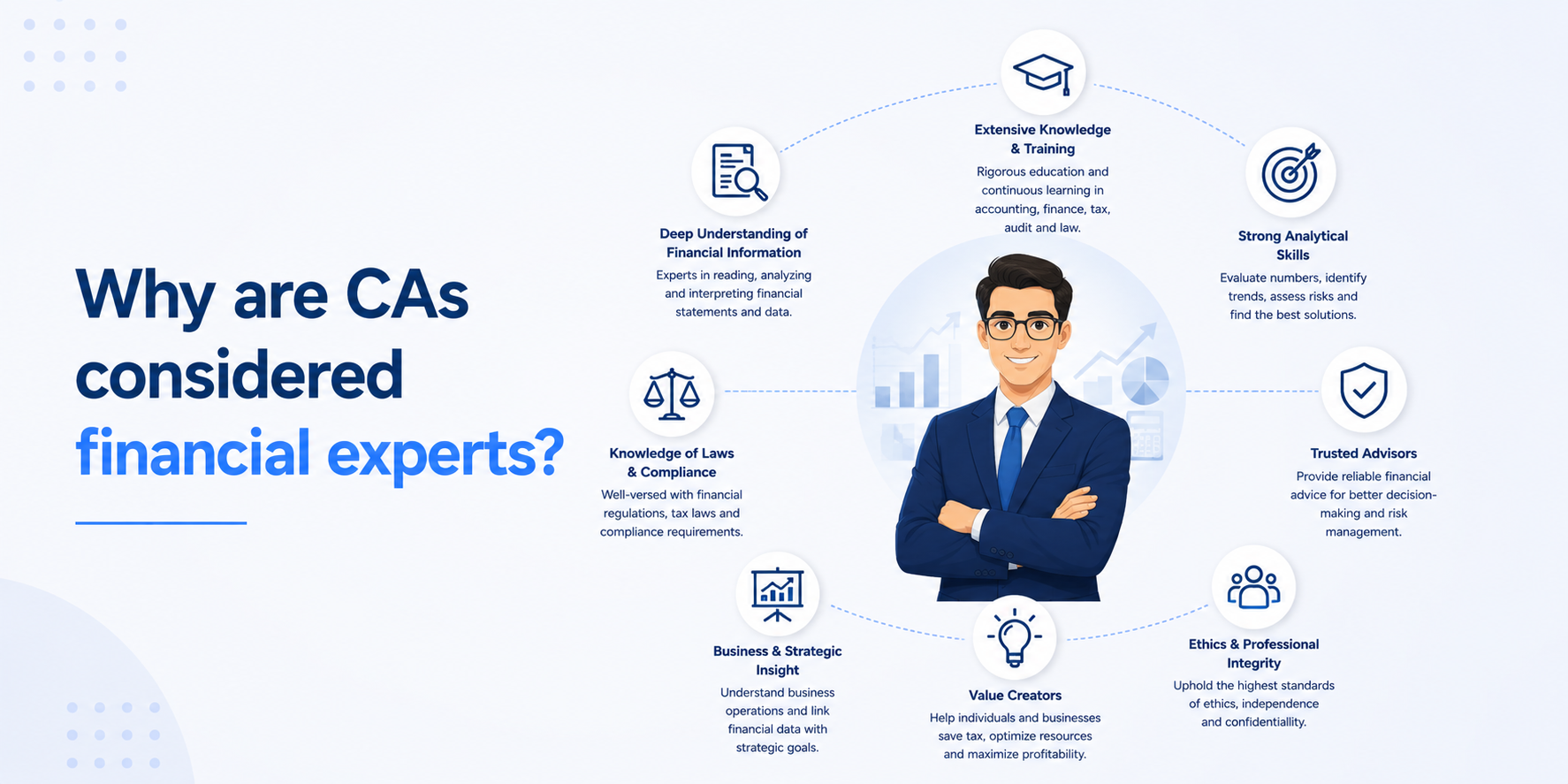
Table of Content
- The CA Qualification Demands Deep Financial Knowledge
- Financial Expertise Goes Beyond Accounting
- Key Skills That Make CAs Financial Experts
- They Understand the Complete Financial Picture
- Financial Analysis Is One of Their Core Strengths
- Why Businesses Depend on CA Analysis
- They Play a Critical Role in Risk Management
- Compliance Expertise Strengthens Their Credibility
- They Support Strategic Business Decisions
- Areas Where CAs Create Business Value
- Technology Has Expanded the Role of Financial Experts
- Why Directors and Investors Trust Chartered Accountants
- The Future of Financial Expertise
- Conclusion
In the modern business world, financial decisions influence almost every aspect of an organization. Whether a company is planning expansion, seeking investment, managing costs, improving profitability, or ensuring compliance, strong financial expertise is essential. Businesses rely on professionals who can understand complex financial information, interpret data accurately, and provide practical recommendations that support long-term success. Among all financial professionals, Chartered Accountants are widely recognized as some of the most trusted experts in the field.
The reputation of Chartered Accountants as financial experts is not built solely on their knowledge of accounting or taxation. It comes from their ability to understand how businesses operate, evaluate financial performance, manage risks, and support strategic decision-making. Their extensive training, practical experience, and analytical skills enable them to solve complex business challenges and guide organizations toward better financial outcomes. This combination of technical knowledge and business understanding is what makes Chartered Accountants highly valuable across industries.
The CA Qualification Demands Deep Financial Knowledge
One of the biggest reasons Chartered Accountants are considered financial experts is the rigorous nature of the CA qualification itself. The course covers a wide range of subjects including accounting, auditing, taxation, financial management, corporate laws, strategic management, and business economics.
Students spend years developing technical expertise while also gaining practical exposure through articleship training. This combination of theory and real-world experience creates professionals who understand both financial concepts and business realities.
As a result, Chartered Accountants develop a strong foundation that prepares them to handle complex financial responsibilities.
Financial Expertise Goes Beyond Accounting
Many people assume that Chartered Accountants only maintain books of accounts or prepare tax returns. While these responsibilities are important, they represent only a small portion of what modern CAs do. Today, Chartered Accountants contribute to:
- Financial planning
- Business advisory
- Risk management
- Corporate finance
- Performance analysis
- Strategic decision-making
Their involvement in these areas demonstrates why they are viewed as financial experts rather than simply accounting professionals.
Key Skills That Make CAs Financial Experts
- Analytical Thinking – Evaluating financial information and identifying trends.
- Problem Solving – Developing practical solutions for business challenges.
- Risk Assessment – Identifying potential financial and operational risks.
- Business Understanding – Connecting financial data with business objectives.
- Decision Support – Helping management make informed choices.
These skills enable Chartered Accountants to create value across multiple business functions.
They Understand the Complete Financial Picture
A business consists of many interconnected activities, including sales, operations, procurement, marketing, and human resources. Every one of these functions has financial implications.
Chartered Accountants understand how different business activities affect profitability, cash flow, and financial stability. This broader perspective allows them to evaluate situations more effectively and provide recommendations that support overall business goals. Their ability to see the complete financial picture makes them valuable advisors to management teams.
Financial Analysis Is One of Their Core Strengths
Businesses generate large amounts of financial information every day. However, raw data alone does not help management make better decisions.
Chartered Accountants specialize in analyzing financial statements, performance reports, budgets, and forecasts to identify meaningful insights. Their analysis helps businesses understand strengths, weaknesses, opportunities, and risks.
This ability to convert numbers into actionable business intelligence is a major reason they are considered financial experts.
Why Businesses Depend on CA Analysis
- Profitability Reviews – Understanding what drives business profits.
- Cost Analysis – Identifying opportunities to improve efficiency.
- Cash Flow Monitoring – Maintaining financial stability.
- Budget Evaluation – Tracking performance against targets.
- Growth Assessment – Measuring the financial impact of expansion plans.
Financial analysis provides the foundation for smarter business decisions.
They Play a Critical Role in Risk Management
Every business faces risks related to finance, operations, compliance, competition, and market conditions. If these risks are not identified early, they can affect profitability and long-term growth.
Chartered Accountants help organizations assess risks and implement controls that reduce potential problems. Their understanding of financial systems and governance enables businesses to operate more securely and confidently. Strong risk management is one of the key reasons businesses trust Chartered Accountants with important decisions.
Compliance Expertise Strengthens Their Credibility
Financial expertise is not only about generating profits. It also involves ensuring that businesses comply with applicable laws and regulations. Chartered Accountants possess extensive knowledge of:
- Income Tax laws
- GST regulations
- Corporate compliance requirements
- Financial reporting standards
- Audit procedures
Their ability to manage compliance effectively helps organizations avoid penalties and maintain credibility with stakeholders.
They Support Strategic Business Decisions
Major business decisions require careful financial evaluation. Whether a company is considering expansion, acquiring another business, launching a new product, or investing in technology, management needs reliable financial insights.
Chartered Accountants evaluate costs, returns, risks, and funding requirements before recommendations are made. Their objective analysis helps businesses make decisions that support sustainable growth rather than short-term gains. This strategic involvement significantly enhances their value within organizations.
Areas Where CAs Create Business Value
- Business Planning – Supporting long-term growth strategies.
- Investment Evaluation – Assessing financial viability.
- Profitability Improvement – Identifying performance enhancement opportunities.
- Financial Forecasting – Preparing businesses for future challenges.
- Corporate Governance – Strengthening accountability and transparency.
These contributions extend far beyond traditional accounting services.
Technology Has Expanded the Role of Financial Experts
The rise of digital technologies has transformed the financial profession. Businesses now use cloud accounting systems, ERP platforms, automation tools, and business analytics software to manage operations. Chartered Accountants have adapted by combining financial expertise with technology-driven insights.
Modern Skills Strengthening the CA Profession
- Data Analytics – Interpreting large volumes of business data.
- Financial Dashboards – Monitoring performance in real time.
- Automation Knowledge – Improving operational efficiency.
- Digital Reporting – Enhancing decision-making processes.
- Technology Advisory – Evaluating financial technology investments.
These skills have strengthened the position of Chartered Accountants in the modern business environment.
Why Directors and Investors Trust Chartered Accountants
Business leaders and investors often depend on Chartered Accountants because they provide objective and reliable financial advice. Their recommendations are based on analysis, evidence, and professional judgment rather than assumptions. This trust is built through:
- Professional ethics
- Technical expertise
- Financial accuracy
- Independent thinking
- Strategic insight
As a result, Chartered Accountants frequently become trusted advisors to senior management and stakeholders.
The Future of Financial Expertise
As businesses become more data-driven and globally connected, the demand for financial experts is expected to increase. Organizations need professionals who can understand complex financial information and convert it into actionable business strategies.
The role of Chartered Accountants is evolving toward advisory, analytics, performance management, and strategic leadership. Their ability to combine financial knowledge with business understanding ensures that they will remain highly valuable in the future.
Companies that leverage financial expertise effectively are generally better positioned to achieve long-term success and competitive advantage.
Conclusion
The answer to Why are CAs considered financial experts lies in their unique combination of technical knowledge, practical experience, analytical thinking, and business understanding. Chartered Accountants help organizations manage finances, improve profitability, maintain compliance, reduce risks, and support strategic decision-making. Their expertise extends far beyond accounting and taxation, making them trusted advisors for businesses of all sizes. In an increasingly complex business environment, Chartered Accountants continue to play a critical role in helping organizations achieve financial stability and sustainable growth.

FAQs
Why are Chartered Accountants considered financial experts?
Chartered Accountants are considered financial experts because of their extensive training, practical experience, analytical skills, and ability to manage complex financial matters.
Do Chartered Accountants only work with accounting and taxation?
No. Modern Chartered Accountants also work in business advisory, financial planning, risk management, consulting, corporate finance, and strategic decision-making.
How do Chartered Accountants help businesses make better decisions?
They analyze financial data, evaluate risks, assess opportunities, and provide recommendations that support informed business decisions.
Why is financial analysis important for businesses?
Financial analysis helps organizations understand performance, identify opportunities, manage risks, and improve profitability.
How do Chartered Accountants support profitability improvement?
They review costs, analyze margins, evaluate pricing strategies, and recommend operational improvements that strengthen financial performance.
Can Chartered Accountants help with risk management?
Yes. They identify financial, operational, and compliance risks and recommend measures that protect business stability.
Why do businesses trust Chartered Accountants?
Businesses trust Chartered Accountants because of their professional ethics, technical expertise, accuracy, and objective financial advice.
How has technology changed the role of Chartered Accountants?
Technology has expanded their role into analytics, automation, digital reporting, and strategic business advisory services.
Do Chartered Accountants help with business growth?
Yes. They support growth through financial planning, forecasting, investment analysis, and strategic decision-making.
What is the biggest strength of a Chartered Accountant?
The biggest strength is the ability to combine financial expertise with business understanding, helping organizations make smarter and more profitable decisions.