
Importance of Corporate Financial Stability Analysis for Business Growth
Learn the importance of corporate financial stability analysis for risk management, profitability, investor confidence, and long-term business sustainability.
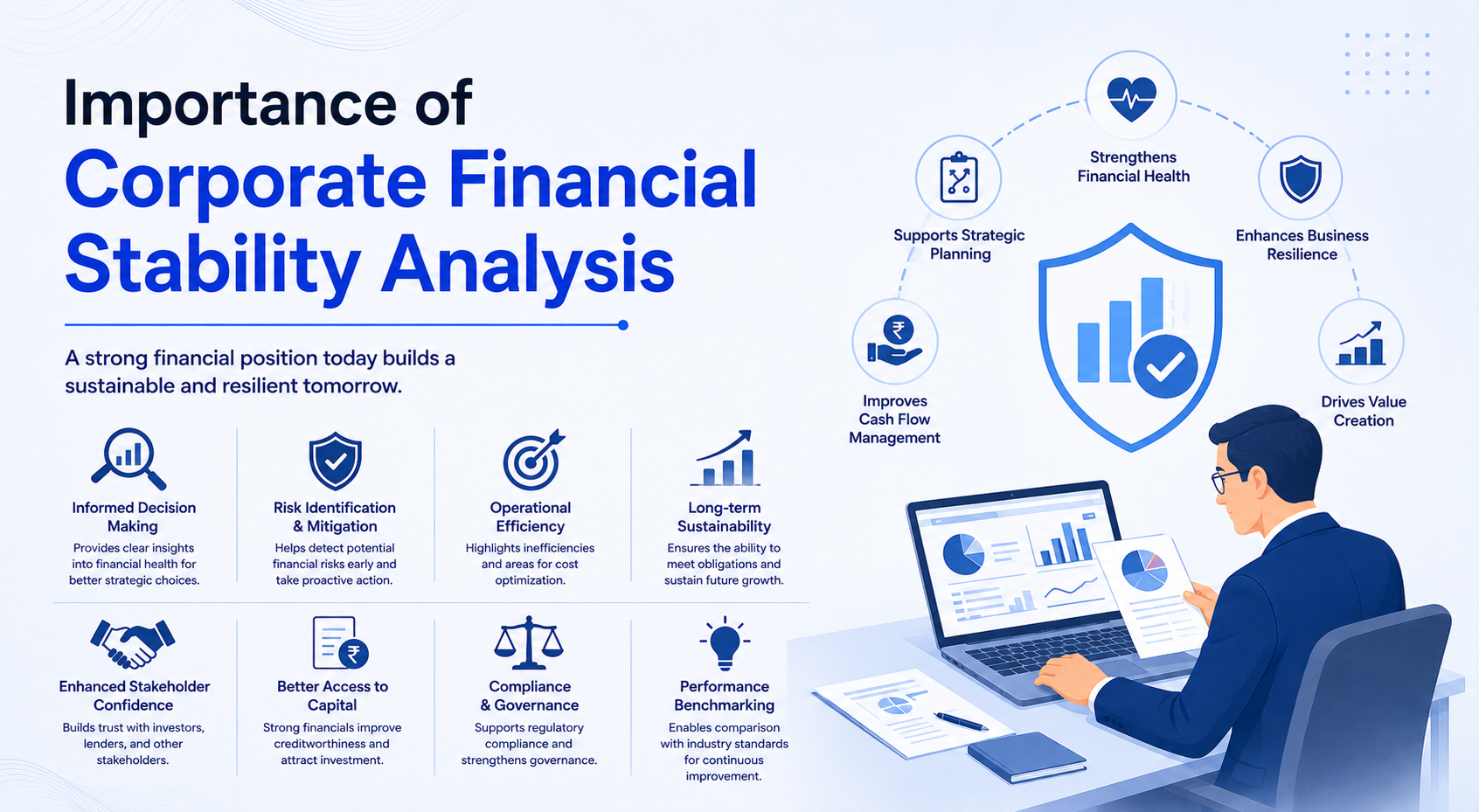
Table of Content
- Financial Stability Helps Businesses Survive Difficult Situations
- Businesses Need Strong Cash Flow Management
- Financial Stability Improves Investor Confidence
- Debt Management Is Important for Business Stability
- Corporate Financial Stability Analysis Supports Better Decision-Making
- Compliance and Financial Discipline Become Stronger
- Profitability Analysis Helps Businesses Improve Performance
- Internal Controls Reduce Financial Risks
- Technology has increased the need for Financial Analysis
- Financial Stability Supports Long-Term Business Growth
- Continuous Monitoring Helps Businesses Remain Competitive
- Conclusion
In today’s competitive business environment, companies face constant financial pressure because of market competition, changing economic conditions, operational costs, and evolving customer demands. Businesses that fail to maintain financial stability often struggle with cash flow issues, debt pressure, declining profitability, and operational disruptions. This is why corporate financial stability analysis has become extremely important for organizations across industries. It helps businesses evaluate their financial condition and identify risks before they become major problems.
Corporate financial stability analysis is not limited to checking profits or losses. It involves evaluating overall financial health, operational sustainability, cash flow strength, debt management, and long-term business capability. Chartered accountants and finance professionals play a major role in this process because businesses depend on their financial expertise for proper analysis and decision-making. Understanding the importance of corporate financial stability analysis helps explain why modern businesses require continuous financial monitoring and strategic planning.
Financial Stability Helps Businesses Survive Difficult Situations
Every business experiences financial uncertainty at some stage. Economic slowdowns, rising operational costs, changing market conditions, or unexpected losses can affect company performance significantly. Businesses with strong financial stability are generally better prepared to handle such situations. Financial stability analysis helps organizations understand:
- Cash flow strength
- Financial reserves
- Debt management capability
- Operational sustainability
- Business profitability
When businesses regularly analyze financial stability, they can take corrective action before problems become severe. This improves long-term survival and operational confidence.
Businesses Need Strong Cash Flow Management
Cash flow is one of the most important indicators of financial stability. Even profitable companies can face serious operational challenges if they fail to manage liquidity properly.
- Daily Operational Expenses: Businesses require stable cash flow to manage salaries, rent, utilities, and operational costs.
- Debt Obligations: Proper liquidity helps companies repay loans and financial liabilities on time.
- Expansion Planning: Strong financial stability supports future business growth opportunities.
- Emergency Situations: Businesses with healthy cash flow are better prepared for unexpected financial challenges.
This is one major reason why the importance of corporate financial stability analysis continues to increase in modern business environments.
Financial Stability Improves Investor Confidence
Investors and financial institutions prefer businesses that demonstrate strong financial discipline and long-term sustainability. Companies with unstable finances often struggle to attract investments or financial support. Corporate financial stability analysis helps improve:
- Financial transparency
- Investor trust
- Business credibility
- Market reputation
When businesses maintain strong financial systems and proper reporting practices, investors feel more confident regarding future business growth and profitability.
Debt Management Is Important for Business Stability
Many businesses use borrowings for expansion and operational support. However, excessive debt can create financial pressure if not managed properly. Financial stability analysis helps businesses evaluate:
- Debt repayment capability
- Interest burden
- Financial liabilities
- Borrowing dependency
Proper debt analysis helps organizations maintain financial balance and avoid long-term instability. Chartered accountants, therefore, carefully monitor debt-related indicators while evaluating business performance.
Corporate Financial Stability Analysis Supports Better Decision-Making
Modern business decisions involve financial risks and long-term operational impact. Companies, therefore, require proper financial analysis before implementing major plans or investments.
- Investment Decisions: Businesses analyze financial feasibility before investing money into projects or expansion opportunities.
- Budget Planning: Financial analysis helps organizations control unnecessary expenses and allocate resources effectively.
- Cost Management: Businesses identify areas where operational efficiency can be improved.
- Risk Management: Financial stability analysis helps detect possible threats before they affect business operations.
This strategic role explains the growing importance of corporate financial stability analysis in modern companies.
Compliance and Financial Discipline Become Stronger
Businesses with strong financial supervision generally maintain better compliance systems and operational discipline. Corporate financial stability analysis helps organizations improve:
- Financial reporting accuracy
- Taxation compliance
- Documentation systems
- Internal financial controls
Proper compliance management reduces risks related to legal complications, penalties, and financial irregularities. Chartered accountants often play an important role in maintaining these systems within organizations.
Profitability Analysis Helps Businesses Improve Performance
Revenue growth alone does not guarantee financial stability. Businesses must also maintain healthy profit margins and operational efficiency for long-term success. Financial stability analysis helps businesses monitor:
- Profitability trends
- Expense patterns
- Operational efficiency
- Business sustainability
Regular profitability analysis helps organizations identify weak areas and improve financial performance over time.
Internal Controls Reduce Financial Risks
Weak internal systems often increase chances of fraud, financial errors, and operational inefficiencies. Businesses, therefore, require strong internal controls and monitoring systems.
- Financial Monitoring: Regular supervision improves transparency and accountability.
- Transaction Control: Proper approval systems reduce the chances of financial irregularities.
- Documentation Accuracy: Well-maintained records improve operational reliability.
- Audit Support: Strong internal systems support better financial audits and compliance management.
Internal controls are, therefore, an important part of financial stability analysis.
Technology has increased the need for Financial Analysis
Modern businesses increasingly use digital financial systems and automated reporting tools. While technology improves efficiency, it also increases operational complexity and financial risks. Today, businesses regularly deal with:
- Digital transactions
- Automated compliance systems
- Online financial reporting
- Data-driven decision-making
Corporate financial stability analysis helps organizations monitor these systems effectively and maintain financial discipline in technology-driven environments.
Financial Stability Supports Long-Term Business Growth
Businesses cannot expand successfully without financial stability. Growth plans require strong financial planning, operational discipline, and risk management capabilities. Financially stable organizations are generally better positioned to:
- Expand operations
- Enter new markets
- Attract investors
- Handle competition
This long-term growth advantage further explains the importance of corporate financial stability analysis for modern businesses.
Continuous Monitoring Helps Businesses Remain Competitive
Business environments change rapidly because of economic conditions, technological growth, and market competition. Companies, therefore, require continuous financial monitoring instead of occasional financial reviews. Chartered accountants regularly analyze:
- Financial reports
- Cash flow trends
- Profitability levels
- Risk indicators
This ongoing supervision helps businesses remain financially healthy and operationally competitive in changing industries.
Conclusion
Understanding the importance of corporate financial stability analysis helps explain why businesses require continuous financial supervision and strategic financial planning. Corporate financial stability analysis supports businesses through cash flow management, debt control, profitability monitoring, compliance discipline, and risk evaluation. Chartered accountants and finance professionals help organizations maintain transparency, operational stability, and long-term growth by identifying financial weaknesses before they become major problems. As business environments continue becoming more competitive and financially complex, financial stability analysis will remain essential for sustainable business success.

FAQs
What is the importance of corporate financial stability analysis?
It helps businesses maintain financial stability, manage risks, improve profitability, and support long-term growth.
Why is cash flow important in financial stability analysis?
Strong cash flow helps businesses manage operations, liabilities, and unexpected financial challenges effectively.
How does financial stability improve investor confidence?
Stable financial systems improve transparency, business credibility, and trust among investors and financial institutions.
Why is debt management important for businesses?
Proper debt management reduces financial pressure and improves long-term business sustainability.
How does financial stability analysis support business decisions?
It helps businesses evaluate investments, budgets, operational costs, and financial risks before major decisions.
Why are internal controls important for financial stability?
Strong internal controls reduce fraud risks, financial errors, and operational inefficiencies.
How does profitability analysis help businesses?
Profitability analysis identifies weak areas and improves operational efficiency and financial performance.
How has technology increased the need for financial stability analysis?
Digital systems increase operational complexity, requiring stronger financial monitoring and supervision.
Why is continuous financial monitoring necessary for companies?
Regular monitoring helps businesses identify risks early and maintain long-term financial discipline.
How do chartered accountants support corporate financial stability?
They help businesses through financial analysis, compliance management, budgeting, risk evaluation, and operational supervision.