How to Identify Preparation Gaps in CA Studies: Improve Your Exam Performance
Learn how to identify preparation gaps in CA studies through self-assessment, mock tests, revision tracking, and smart performance analysis.
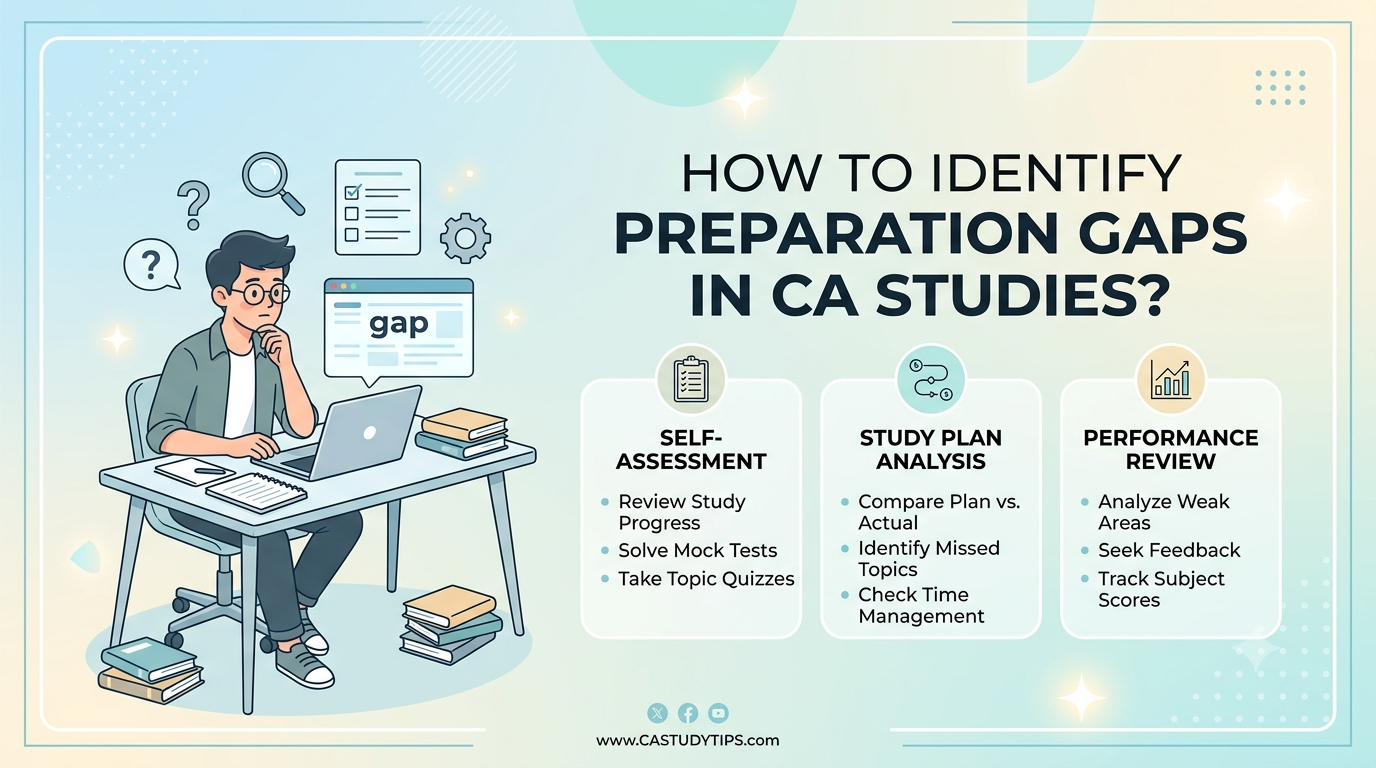
Table of Content
- What Are Preparation Gaps in CA Studies?
- Why Every CA Student Should Analyze Their Preparation
- Signs That Your Preparation May Have Gaps
- Test Your Concepts Instead of Reading Them
- Mock Tests Reveal Hidden Weaknesses
- Areas Every Mock Test Should Evaluate
- Review Your Revision Process Honestly
- Build a Personal Gap Analysis Checklist
- Don't Ignore Weak Subjects
- Compare Your Performance, Not Your Study Hours
- Learn from Every Mistake
- Avoid These Common Preparation Mistakes
- Confidence Improves When Gaps Reduce
- Continuous Improvement Is the Real Goal
- Conclusion
Preparing for the Chartered Accountancy examination is a long and demanding journey that requires consistent effort, disciplined planning, and regular self-evaluation. Most students dedicate months to studying different subjects, attending coaching classes, revising notes, and solving practice questions. However, despite investing significant time, many students fail to achieve the results they expect. In most cases, the issue is not a lack of hard work but the presence of unnoticed preparation gaps that remain unaddressed until the actual examination.
Preparation gaps are the weak areas that silently reduce your performance. These gaps may exist in conceptual understanding, revision quality, answer writing, time management, or even confidence during examinations. The earlier you identify these weaknesses, the easier it becomes to correct them before the final exam. Instead of assuming your preparation is complete, regularly testing and evaluating yourself helps you focus on the areas that truly need improvement. This approach makes your study sessions more productive and significantly improves your chances of success.
What Are Preparation Gaps in CA Studies?
Preparation gaps are the differences between what you think you know and what you can actually perform in an examination. Many students feel confident while reading their notes, but when they attempt a mock test or solve ICAI questions independently, they struggle to recall concepts or apply them correctly.
These gaps are completely normal and are part of every student's preparation journey. The important thing is to identify them early and work systematically to eliminate them before the examination. Ignoring preparation gaps often leads to unexpected mistakes, lower confidence, and disappointing scores.
Why Every CA Student Should Analyze Their Preparation
Studying continuously without evaluating your progress is similar to travelling without checking whether you are moving in the right direction. Regular analysis helps students understand whether their current strategy is producing results. It also prevents unnecessary repetition of topics that are already strong while ensuring additional attention is given to weaker areas. Students who evaluate themselves regularly usually prepare more efficiently because they focus on improvement rather than assumptions.
Signs That Your Preparation May Have Gaps
- Frequent Dependence on Notes – You cannot explain concepts without referring to study material.
- Low Mock Test Scores – Despite studying regularly, marks remain inconsistent.
- Weak Recall During Revision – Previously studied topics are quickly forgotten.
- Difficulty Solving Practical Questions—Concepts are understood theoretically but cannot be applied.
- Poor Time Management – Practice papers remain incomplete within the allotted time.
Recognizing these signs early allows students to improve before the actual examination.
Test Your Concepts Instead of Reading Them
Many students mistake familiarity for understanding. Simply reading a chapter several times may create confidence, but it does not guarantee conceptual clarity.
A better approach is to close the book after studying and explain the topic in your own words. If you can teach the concept, solve related questions, and identify the correct approach without assistance, your understanding is probably strong. This simple self-test quickly reveals whether a concept has truly been mastered.
Mock Tests Reveal Hidden Weaknesses
One of the most reliable ways to identify preparation gaps is by attempting mock tests under real examination conditions. Mock tests reveal weaknesses that are difficult to notice during regular study sessions. They test not only your knowledge but also your writing speed, time management, presentation, and ability to perform under pressure. Instead of focusing only on marks, students should analyze every mistake and understand why it occurred.
Areas Every Mock Test Should Evaluate
- Concept Clarity – Identify chapters where understanding is still weak.
- Time Management – Check whether the paper is completed comfortably within the time limit.
- Answer Presentation – Evaluate whether answers are structured and easy to understand.
- Revision Quality – Observe whether forgotten topics are affecting performance.
- Exam Confidence – Assess how comfortably you handle difficult questions.
Review Your Revision Process Honestly
Revision is often the biggest indicator of preparation quality. Students who revise consistently generally remember concepts longer and perform better in examinations. Ask yourself whether revision has become a regular habit or whether it has been postponed repeatedly.
If important chapters feel unfamiliar every time you revise them, it usually indicates that your revision cycle needs improvement. Consistent revision gradually closes many preparation gaps automatically.
Build a Personal Gap Analysis Checklist
Every student has different strengths and weaknesses. Instead of following someone else's strategy blindly, create your own preparation checklist.
- Concepts I Still Find Difficult – List topics that require another round of study.
- Subjects Needing More Revision – Identify areas where recall is weak.
- Frequently Repeated Mistakes – Record mistakes that appear in multiple mock tests.
- Time Management Issues – Note where excessive time is being spent.
- Presentation Weaknesses – Improve answer-writing style wherever necessary.
Reviewing this checklist every week keeps preparation focused and organized.
Don't Ignore Weak Subjects
Many students naturally prefer revising subjects they enjoy. Unfortunately, this often causes weaker subjects to become even weaker. A smarter strategy is to dedicate extra time to difficult topics while continuing to maintain strong subjects. Improving a weak subject by even a small margin can significantly increase your overall score. Balanced preparation is always more effective than selective preparation.
Compare Your Performance, Not Your Study Hours
Some students study for eight hours, while others study for twelve. However, study hours alone do not measure preparation quality. Instead, evaluate outcomes such as:
- Chapters revised
- Questions solved
- Mock test improvement
- Concept retention
- Accuracy during practice
Productivity should always be measured through results rather than effort alone.
Learn from Every Mistake
Mistakes should never be viewed as failures during preparation. Instead, they provide valuable information about what needs improvement. After every mock test or practice session, ask yourself:
- Why did this mistake happen?
- Was it due to weak concepts?
- Was it caused by poor revision?
- Did I misunderstand the question?
- Could better time management have prevented it?
Understanding the reason behind mistakes is often more valuable than simply correcting the answer.
Avoid These Common Preparation Mistakes
Many preparation gaps develop because students unknowingly follow ineffective study habits.
- Studying Without Self-Assessment – Never checking actual progress.
- Ignoring Mock Tests – Missing opportunities to identify weaknesses.
- Delaying Revision – Forgetting previously studied topics.
- Reading Without Practice—Limiting preparation to passive learning.
- Changing Strategies Frequently – Losing consistency by constantly trying new methods.
Avoiding these habits keeps preparation focused and systematic.
Confidence Improves When Gaps Reduce
Students often believe confidence comes naturally before examinations. In reality, confidence is built by reducing preparation gaps one by one. Every concept understood, every mistake corrected, and every successful mock test increases self-belief. This gradual improvement creates confidence that remains stable even under examination pressure. Confidence is therefore not the starting point of preparation—it is the result of effective preparation.
Continuous Improvement Is the Real Goal
No student begins CA preparation without weaknesses. Even top performers continuously identify and improve their preparation gaps throughout the journey.
Instead of worrying about being perfect, focus on becoming slightly better every week. Small improvements in concept clarity, revision quality, answer writing, and mock test performance eventually create a significant difference in final examination results. The students who clear CA exams confidently are usually those who never stop evaluating and improving themselves.
Conclusion
Understanding how to identify preparation gaps in CA studies is an important part of successful exam preparation. Rather than measuring progress through study hours alone, students should regularly assess concept clarity, revision quality, mock test performance, answer-writing skills, and time management. Honest self-evaluation helps reveal weaknesses before the examination and provides enough time to improve them. Every preparation gap identified today becomes an opportunity to score better tomorrow. By continuously analyzing performance and making targeted improvements, CA students can build stronger preparation and approach the examination with greater confidence.

FAQs
How can I identify preparation gaps in CA studies?
You can identify preparation gaps through mock tests, self-assessment, revision reviews, question practice, and regular performance analysis.
What are preparation gaps in CA exams?
Preparation gaps are weak areas in concepts, revision, answer writing, time management, or confidence that affect examination performance.
Are mock tests useful for identifying weak areas?
Yes. Mock tests reveal conceptual weaknesses, presentation issues, time management problems, and revision gaps under real exam conditions.
How often should I evaluate my preparation?
Students should ideally review their preparation every week through self-assessment, mock tests, and revision tracking.
Why do students fail to identify preparation gaps?
Many students focus only on studying and avoid testing themselves through mock exams or question practice.
Can revision help reduce preparation gaps?
Yes. Regular revision strengthens memory, improves recall, and helps eliminate conceptual weaknesses over time.
Should I focus more on weak subjects?
Yes. Improving weaker subjects while maintaining stronger ones creates balanced preparation and increases overall scores.
How can I track my preparation effectively?
Maintain a weekly checklist covering revisions, mock test scores, weak topics, repeated mistakes, and completed study targets.
What is the biggest mistake students make during CA preparation?
One of the biggest mistakes is assuming they are fully prepared without regularly evaluating their actual performance.
Why is self-assessment important for CA students?
Self-assessment helps students understand their strengths, identify weaknesses, improve study strategies, and become better prepared before the final examination.