What Habits Slowly Reduce CA Exam Performance?
Learn what habits slowly reduce CA exam performance and how poor routines, distractions, weak revision, and unhealthy study patterns affect preparation quality over time.
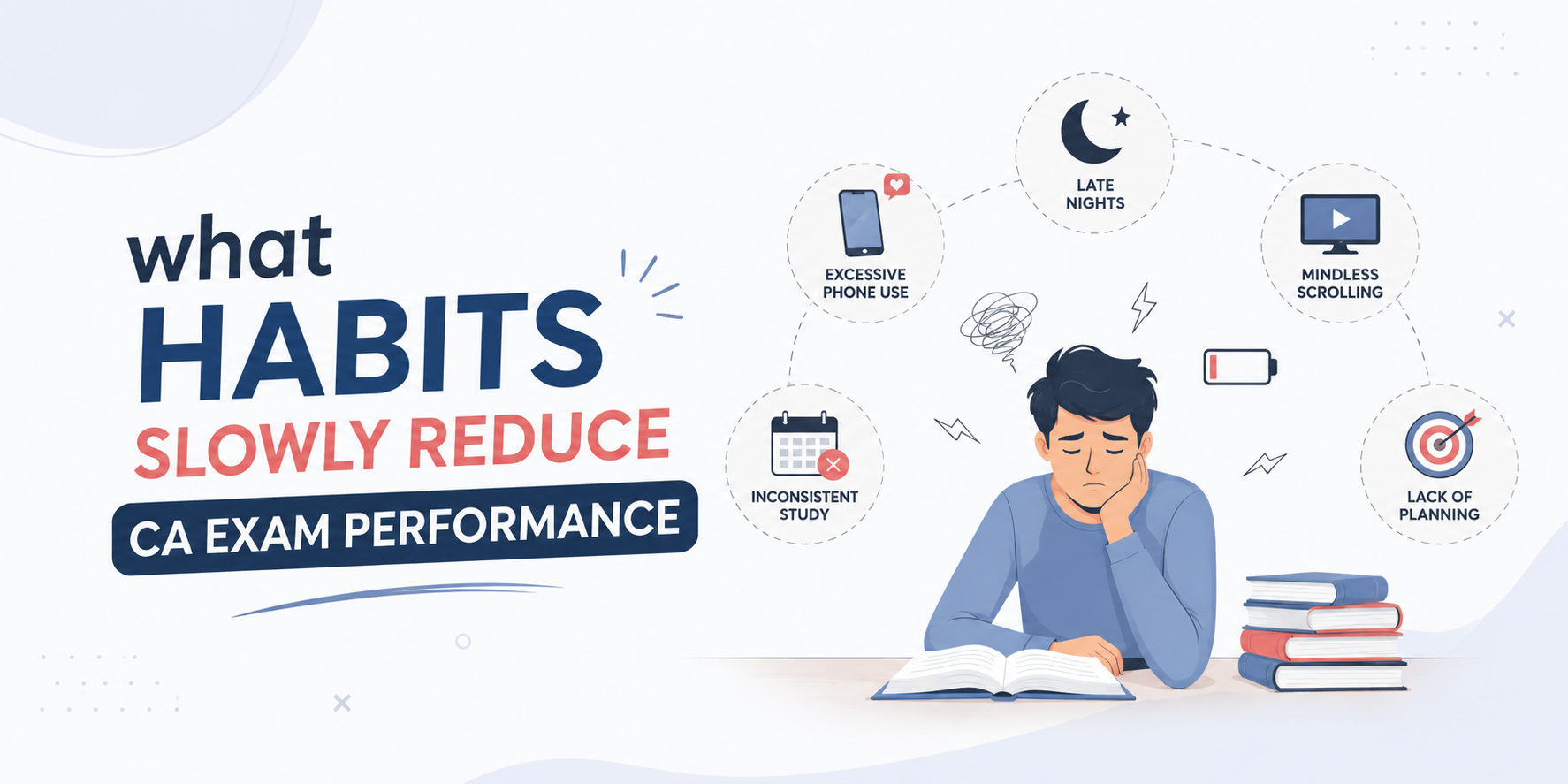
Table of Content
- Irregular Study Routine Weakens Consistency
- Continuous Distractions Reduce Focus
- Avoiding Revision Creates Weak Retention
- Poor Sleep Habits Reduce Mental Efficiency
- Studying Without Active Practice Weakens Preparation
- Constant Comparison Reduces Confidence
- Last-Minute Study Habits Increase Pressure
- Ignoring Health Slowly Reduces Productivity
- Negative Thinking Weakens Performance
- Lack of Planning Creates Unnecessary Confusion
- Conclusion
Many CA students focus heavily on study hours, coaching, and syllabus completion while ignoring the daily habits that quietly affect preparation quality over time. In the beginning, these habits may not seem harmful, but gradually they reduce concentration, retention, revision quality, and overall confidence during exams.
The dangerous part about poor habits is that their impact usually appears slowly. Students often continue following unhealthy routines without realizing that these small patterns are weakening their preparation day by day.
If you want to understand what habits slowly reduce CA exam performance, it is important to observe not only how much you study, but also how consistently and effectively your daily routine supports long-term preparation. Success in CA exams is usually built through disciplined and stable habits, while poor habits slowly create stress, weak retention, and preparation gaps over time.
Irregular Study Routine Weakens Consistency
One of the most common habits affecting CA preparation is studying without consistency. Many students study seriously for a few days and then lose momentum completely for several more days. This irregular pattern affects:
- Revision continuity
- Concept retention
- Study discipline
- Confidence during exams
The CA syllabus is too large for inconsistent preparation. Students who study only according to mood often struggle with weak revision and last-minute pressure later. A stable study routine helps students remain connected with subjects regularly and improves long-term retention naturally.
Continuous Distractions Reduce Focus
Modern distractions have become one of the biggest problems during CA preparation. Frequent mobile checking, social media scrolling, unnecessary notifications, and multitasking damage concentration slowly.
Even short interruptions repeatedly break study flow and reduce deep focus. Over time, distraction habits create:
- Lower concentration span
- Slower learning speed
- Weak retention
- Reduced productivity
Many students spend long hours at the study table, but complete very little because their attention keeps shifting constantly. Focused study sessions usually produce much better results than distracted, long study hours.
Avoiding Revision Creates Weak Retention
Some students focus only on completing new portions continuously while delaying revision repeatedly. Initially, this may feel productive, but slowly, previously studied concepts begin fading from memory. Without regular revision:
- Recall speed becomes weaker
- Concepts feel unfamiliar during exams
- Confidence decreases significantly
CA preparation requires repeated exposure to concepts over long periods. Students who revise regularly usually feel more confident and stable during exams. Revision is not optional in CA preparation. It is one of the most important habits supporting strong exam performance.
Poor Sleep Habits Reduce Mental Efficiency
Many students sacrifice sleep while trying to increase study hours, especially before exams. Although this may temporarily create the feeling of working harder, poor sleep gradually affects preparation quality. Lack of proper sleep often reduces:
- Memory retention
- Calculation accuracy
- Emotional balance
- Concentration level
An exhausted mind struggles to learn efficiently, no matter how long students continue studying. Students who maintain healthier sleep routines usually study more productively because their concentration remains stronger throughout the day.
Studying Without Active Practice Weakens Preparation
Some students spend most of their time only reading theory or watching lectures without practicing the questions properly.
Passive learning may create temporary understanding, but without active practice:
- Writing speed remains weak
- Application ability reduces
- Mistakes repeat frequently
CA exams require students to apply concepts practically under time pressure. Students who regularly solve questions, attempt mock tests, and practice writing usually perform much better during actual exams. Practical engagement strengthens both understanding and confidence.
Constant Comparison Reduces Confidence
Many students develop the habit of continuously comparing their preparation with friends, toppers, or online study discussions. This comparison slowly creates:
- Self-doubt
- Anxiety
- Lack of confidence
- Unnecessary pressure
Students often ignore their own progress and focus only on what others are doing better. Healthy preparation requires concentration on personal improvement rather than constant comparison with others. Confidence grows much better when students focus on their own consistency and preparation quality.
Last-Minute Study Habits Increase Pressure
Some students repeatedly postpone difficult topics, revision, or writing practice until the final weeks before exams.
This creates:
- Heavy syllabus pressure
- Weak revision quality
- Panic before exams
- Mental exhaustion
Last-minute preparation usually increases stress because the brain struggles to manage too much information in very little time. Consistent and gradual preparation is far more effective than depending on emergency study sessions close to exams.
Ignoring Health Slowly Reduces Productivity
CA preparation often becomes so demanding that students completely ignore physical health and mental balance. Unhealthy habits such as:
- Sitting continuously for long hours
- Poor eating routine
- Lack of physical movement
- Constant mental pressure
Healthy routines help students maintain better productivity and emotional stability during long preparation periods. Physical and mental health strongly affect study performance over time.
Negative Thinking Weakens Performance
Students who constantly think:
- “I cannot complete the syllabus.”
- “Others are better prepared.”
- “I will probably fail.”
gradually damage their own confidence and focus. Negative thinking reduces motivation and makes preparation feel emotionally exhausting.
A balanced mindset helps students remain calmer and more productive during difficult phases.
Positive thinking does not mean ignoring problems. It means handling preparation practically instead of emotionally overreacting to every difficulty.
Lack of Planning Creates Unnecessary Confusion
Studying without planning often leads to:
- Random topic selection
- Incomplete revision cycles
- Subject imbalance
- Wasted study time
Students may study continuously, but still feel confused because preparation lacks structure.
Simple planning regarding:
- Daily targets
- Revision schedules
- Subject priorities
- helps improve clarity and reduces unnecessary pressure during exams
- Organized preparation usually feels much more manageable
Conclusion
Many habits slowly reduce CA exam performance without students noticing their impact immediately. Irregular study routines, weak revision, distractions, poor sleep, lack of practice, negative thinking, and unhealthy preparation patterns gradually affect concentration, confidence, and retention over time.
CA preparation is not only about studying harder. It is also about building habits that support consistent learning, emotional stability, and smart revision. Students who improve their daily routines often experience better productivity and stronger exam performance naturally.
Small habits repeated every day eventually create either strong preparation or continuous struggle during the CA journey.

FAQs
What habits slowly reduce CA exam performance?
Habits like irregular studying, poor revision, distractions, lack of sleep, negative thinking, and avoiding practice gradually reduce CA exam performance over time.
How do distractions affect CA preparation?
Frequent distractions reduce concentration, slow learning speed, weaken retention, and lower overall productivity during study sessions.
Why is revision important for CA students?
Revision strengthens memory retention, improves recall speed, and increases confidence during exams through repeated exposure to concepts.
Does poor sleep affect CA exam performance?
Yes, poor sleep negatively affects concentration, memory, emotional balance, and calculation accuracy during preparation and exams.
How does comparison affect CA preparation?
Constant comparison creates anxiety, self-doubt, and unnecessary pressure, which gradually weakens confidence and focus during preparation.
Why is active practice important in CA preparation?
Active practice improves application skills, writing speed, problem-solving ability, and confidence during exams.
Can negative thinking reduce exam performance?
Yes, negative thinking reduces motivation, concentration, and emotional stability, making preparation more stressful and less productive.
How does a lack of planning affect preparation quality?
Lack of planning creates confusion, weak revision management, subject imbalance, and inefficient use of study time.
Why should students maintain healthy routines during CA preparation?
Healthy routines improve energy, concentration, emotional stability, and long-term productivity during demanding preparation periods.
Can small habits really affect CA exam success?
Yes, small daily habits gradually shape consistency, retention, confidence, and overall preparation quality over long periods.