How Mindset Influences Competitive Exam Success and Performance
Discover how mindset influences competitive exam success through confidence, discipline, emotional control, focus, and consistent preparation habits.
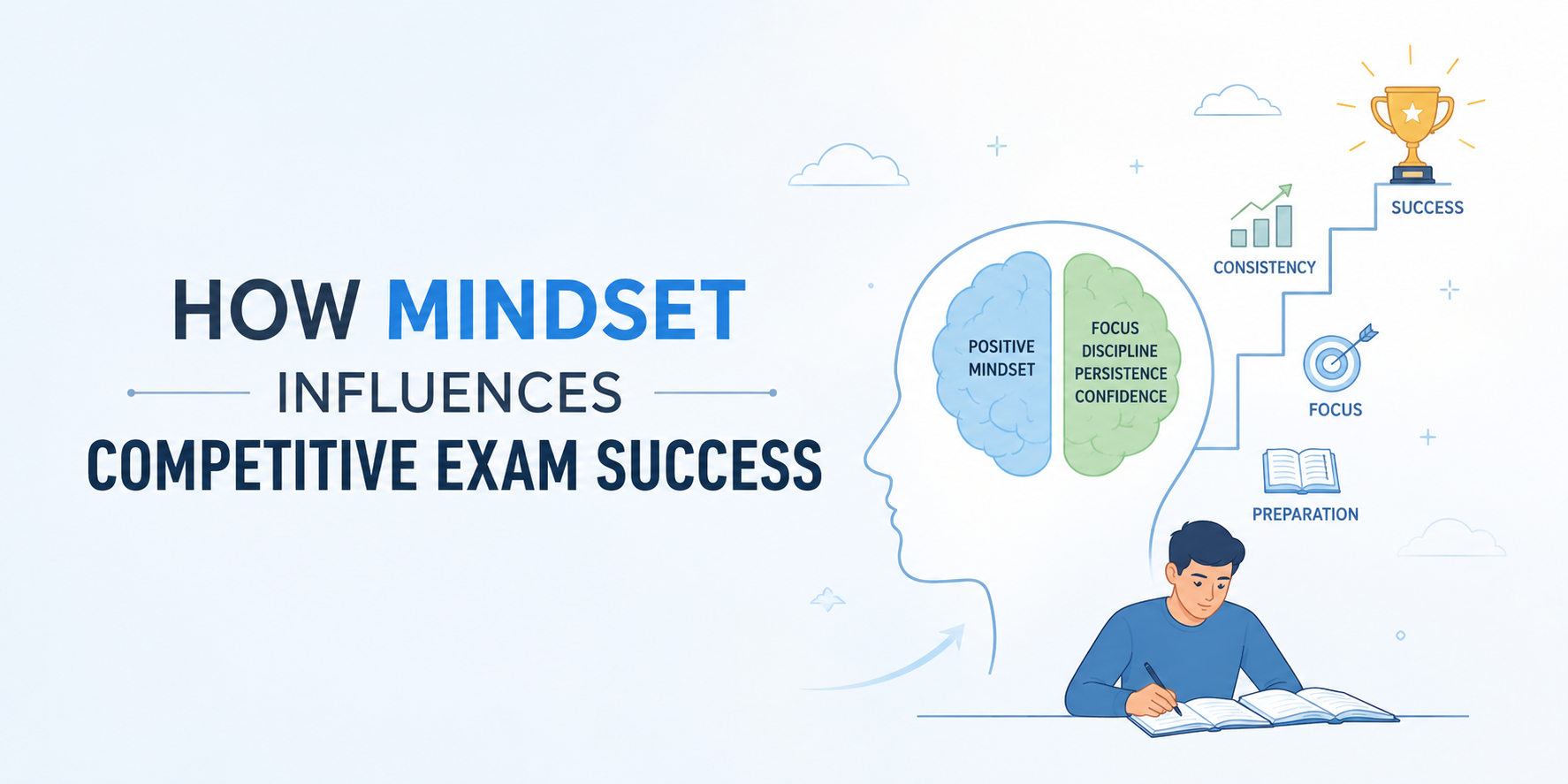
Table of Content
- Why Mindset Matters More Than Students Realize
- Students with a growth mindset usually improve faster
- Fear-Based Preparation Often Reduces Performance
- Confidence Changes Exam Performance
- Why Negative Self-Talk Becomes Dangerous
- Mindset Affects Consistency More Than Motivation
- Comparison Mindset Creates Unnecessary Stress
- Emotional Control Is Part of a Strong Mindset
- Positive Mindset Does Not Mean Ignoring Reality
- How Mindset Affects Exam Hall Performance
- Habits That Help Build a Strong Competitive Exam Mindset
- Why Resilience Matters in Competitive Exams
- Conclusion
Competitive exams are not only a test of intelligence or academic preparation. They also test patience, emotional strength, confidence, discipline, and the ability to stay consistent under pressure. Many students study from the same books, attend similar coaching classes, and follow almost identical preparation strategies, yet their results are completely different. One major reason behind this difference is mindset.
The way students think during preparation strongly affects their performance. A positive and growth-oriented mindset helps students stay motivated, recover from setbacks, and handle exam pressure more effectively. On the other hand, a negative mindset often creates fear, self-doubt, and inconsistency even when preparation is good.
This is why understanding how mindset influences competitive exam success is extremely important for students preparing for exams like CA, CS, CMA, UPSC, etc., and other professional or entrance examinations.
Why Mindset Matters More Than Students Realize
Most students focus only on study material, mock tests, and revision schedules while ignoring their mental approach toward preparation. However, mindset quietly affects every part of the preparation journey. A student’s mindset influences:
- Study consistency
- Confidence level
- Reaction to failure
- Time management
- Ability to handle stress
- Focus during exams
Two students with similar preparation levels may perform very differently simply because one handles pressure calmly while the other loses confidence quickly. Mindset does not replace hard work, but it strongly affects how effectively students use their effort.
Students with a growth mindset usually improve faster
Some students believe intelligence and abilities are fixed. When they face difficult subjects or poor mock test scores, they immediately assume they are “not capable enough.” This type of thinking reduces motivation very quickly.
On the other hand, students with a growth mindset believe improvement is possible through practice, learning, and consistency. Instead of feeling defeated by mistakes, they treat mistakes as learning opportunities. For example, growth-oriented students usually:
- Analyze weak areas calmly
- Improve strategies after poor performance
- Stay patient during slow progress
- Continue practicing consistently
This mindset helps students improve steadily over time.
Fear-Based Preparation Often Reduces Performance
Many students prepare with constant fear:
“What if I fail?”
“What if I cannot complete the syllabus?”
“What if others perform better than me?”
While a little pressure can improve seriousness, excessive fear negatively affects concentration and confidence. Fear-based preparation often creates:
- Overthinking
- Panic during exams
- Low confidence
- Mental exhaustion
- Difficulty focusing properly
Students who prepare with calm determination usually perform better than students studying continuously with anxiety and self-doubt.
Confidence Changes Exam Performance
Mindset directly affects confidence inside the examination hall. Students with balanced thinking usually approach papers more calmly and logically. Confident students often:
- Manage time better
- Recover quickly from difficult questions
- Avoid unnecessary panic
- Think more clearly under pressure
In contrast, students with a negative mindset may panic after seeing one difficult section and lose focus for the rest of the paper. Confidence does not mean overconfidence. It means trusting preparation without becoming emotionally unstable during exams.
Why Negative Self-Talk Becomes Dangerous
Many students unknowingly reduce their own confidence through negative self-talk.
Examples include:
- “I can never clear this exam.”
- “Everyone is better than me.”
- “I always perform badly.”
- “My preparation is useless.”
Repeated negative thoughts slowly affect motivation and mental energy.
Students who continuously criticize themselves often lose productivity even when they are capable of improving. Replacing extreme negativity with balanced thinking helps maintain emotional stability during preparation.
Mindset Affects Consistency More Than Motivation
Motivation changes frequently, but mindset affects long-term consistency. Students with a strong mindset usually continue studying even when:
- Motivation is low
- Results are delayed
- Mock test scores are disappointing
- Preparation feels exhausting
They understand that competitive exam success requires patience and long-term discipline. Students depending only on temporary motivation often lose consistency after a few difficult days.
Comparison Mindset Creates Unnecessary Stress
One of the biggest mindset problems during competitive exam preparation is constant comparison. Students compare:
- Study hours
- Mock test marks
- Syllabus completion
- Coaching institutes
- Speed of learning
Excessive comparison increases stress and reduces focus on personal improvement. Healthy competition can motivate students, but unhealthy comparison usually damages confidence and mental peace. Successful students generally focus more on their own progress rather than constantly measuring themselves against others.
Emotional Control Is Part of a Strong Mindset
Competitive exam preparation includes failures, low scores, delays, and emotional ups and downs. Students with a strong mindset usually handle these situations more practically. Instead of reacting emotionally to every setback, they focus on:
- Recovery
- Improvement
- Better planning
- Consistent effort
Emotional control helps students remain productive even during stressful phases of preparation. This quality becomes especially important during the final months before exams.
Positive Mindset Does Not Mean Ignoring Reality
Some students misunderstand a positive mindset as unrealistic optimism. A strong mindset does not mean pretending everything is perfect.
It means:
- Accepting challenges practically
- Staying solution-focused
- Believing improvement is possible
- Continuing effort despite difficulties
Real confidence comes from preparation and balanced thinking, not blind positivity.
How Mindset Affects Exam Hall Performance
Mindset becomes extremely visible during actual exams. Students with calm and balanced thinking usually:
- Handle Difficult Questions Better: They avoid panic and move strategically through the paper.
- Manage Time More Smartly: Clear thinking improves decision-making under pressure.
- Maintain Focus for Longer Duration: Mental stability reduces unnecessary distractions and confusion.
The same preparation level can produce very different results depending on the student’s exam mindset.
Habits That Help Build a Strong Competitive Exam Mindset
Mindset improves gradually through habits and self-awareness. Some useful practices include:
- Avoiding extreme negative thinking
- Following realistic study goals
- Taking mock tests regularly
- Learning from mistakes calmly
- Maintaining healthy routines
- Focusing on improvement instead of perfection
Students who combine these habits with consistent preparation usually become mentally stronger over time.
Why Resilience Matters in Competitive Exams
Competitive exams are long journeys where setbacks are common. Some students fail mock tests, face low confidence phases, or struggle with difficult subjects. Resilient students usually recover faster because they do not allow temporary setbacks to define their future.
They understand:
- One bad test does not decide final success
- Improvement takes time
- Consistency matters more than temporary emotions
This mindset keeps them moving forward even during difficult preparation phases.
Conclusion
Understanding how mindset influences competitive exam success can completely change the way students approach preparation. Competitive exams are not only about books, notes, and study hours — they also require emotional balance, confidence, patience, and resilience.
A strong mindset helps students stay consistent, recover from failures, manage pressure, and maintain focus during difficult situations. Students with balanced thinking usually use their preparation more effectively and perform better under exam pressure.

FAQs
How does mindset influence competitive exam success?
Mindset influences confidence, consistency, emotional control, focus, and the ability to handle setbacks effectively during competitive exam preparation and performance.
Why is mindset important during exam preparation?
Mindset affects study discipline, stress management, confidence, motivation, and how students respond to challenges and failures during preparation.
What is a growth mindset in competitive exams?
A growth mindset means believing that abilities improve through practice, learning, consistency, and effort instead of assuming intelligence is fixed permanently.
How does negative thinking affect exam performance?
Negative thinking reduces confidence, increases stress, weakens concentration, and creates fear-based preparation that affects overall productivity and exam performance.
Can confidence improve competitive exam results?
Yes, confidence helps students remain calm, manage time effectively, avoid panic, and perform more efficiently during examinations.
Why is comparison harmful during preparation?
Excessive comparison increases stress, lowers self-confidence, and shifts focus away from personal improvement and consistent preparation habits.
How does mindset affect consistency?
Students with a strong mindset continue studying even during low motivation phases, while those with a weak mindset often experience inconsistency after setbacks or difficult periods.
What role does emotional control play in competitive exams?
Emotional control helps students handle pressure calmly, recover from mistakes, and remain productive during stressful preparation and examination situations.
Can resilience help students succeed in competitive exams?
Yes, resilience helps students recover from failures, continue improving consistently, and stay focused despite setbacks during long preparation journeys.
How can students improve their exam mindset?
Students can improve their mindset through realistic goals, positive thinking, mock test practice, healthy routines, emotional balance, and focusing on gradual improvement.