How Can I Identify My Weak Areas in CA Preparation?
Learn how I can identify my weak areas in CA preparation with practical strategies, mock test analysis, self-assessment, and revision techniques to improve exam performance.
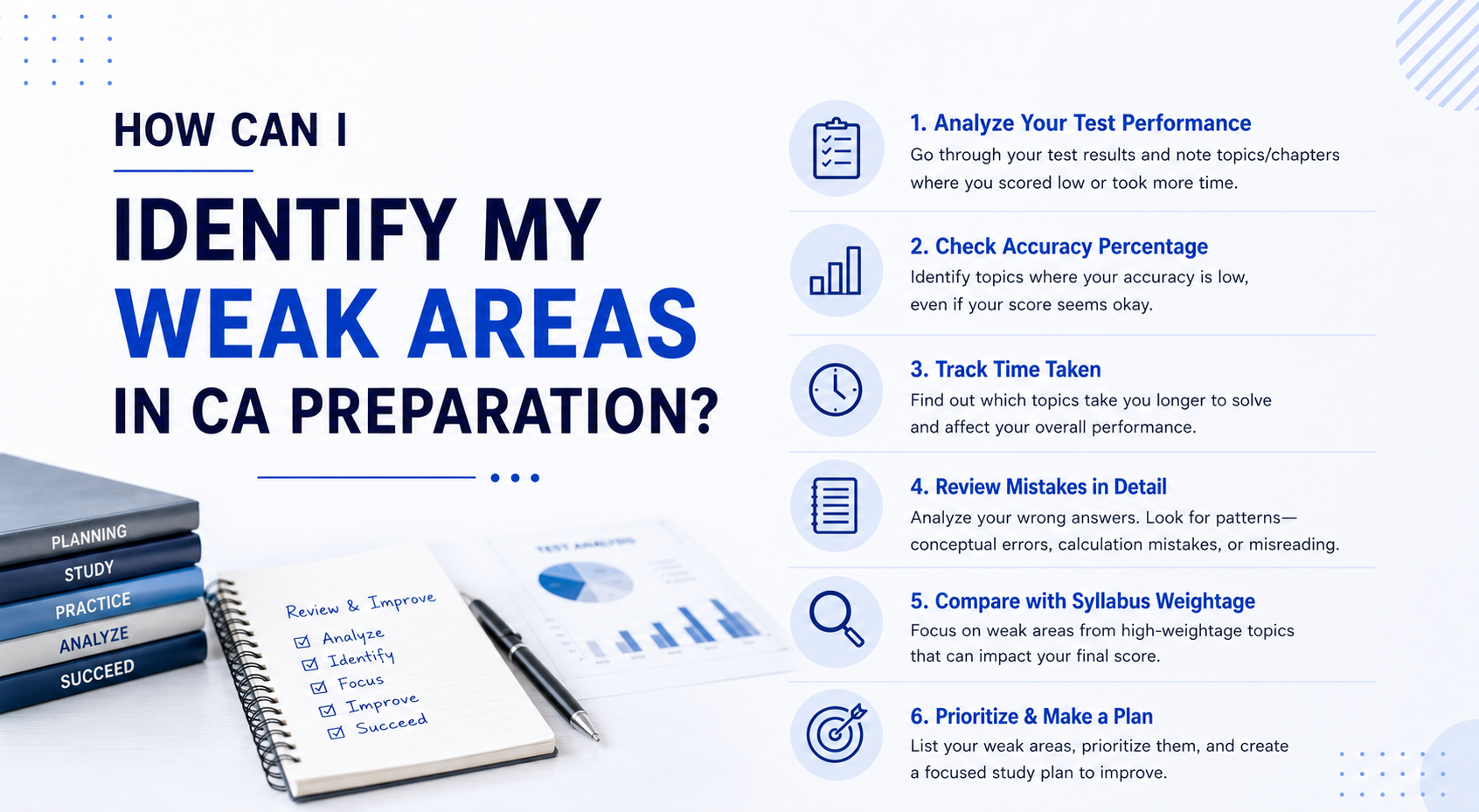
Table of Content
- Why Identifying Weak Areas Is Important
- Analyze Your Mock Test Performance
- Compare Preparation with ICAI Study Material
- Track Topics That Take More Time
- Self-Questioning Improves Self-Assessment
- Review Your Answer Writing
- Pay Attention to Subjects You Keep Avoiding
- Use Performance Tracking Sheets
- Discuss Doubts with Mentors or Teachers
- Practice Full-Length Papers Regularly
- Don't Ignore Repeated Mistakes
- Conclusion
Preparing for the Chartered Accountancy examination requires consistent effort, proper planning, and continuous self-evaluation. Many students spend months studying different subjects but still fail to achieve their desired scores because they are unaware of the areas where they need improvement. They continue revising their favorite topics while ignoring concepts that actually require more attention. As a result, the same mistakes are repeated in every mock test and final examination.
The question "How can I identify my weak areas in CA preparation?" is one that every serious CA aspirant should ask during the preparation journey. Identifying weaknesses at the right time allows students to improve their concepts, revise more effectively, and prepare with greater confidence. Instead of studying harder, students can study smarter by focusing on the areas that need the most improvement.
Why Identifying Weak Areas Is Important
Many students believe that completing the syllabus means they are fully prepared for the examination. However, syllabus completion and examination readiness are two different things. A student may understand one subject well but struggle with another without realizing it.
When weak areas remain unidentified, they often become the biggest reason for low scores. On the other hand, students who regularly evaluate their preparation can improve continuously and avoid unpleasant surprises in the examination hall. Some major benefits of identifying weak areas include:
- Better study planning
- More effective revision
- Improved confidence
- Better time utilization
- Higher scoring potential
- Reduced examination stress
Regular self-assessment makes preparation more focused and productive.
Analyze Your Mock Test Performance
One of the easiest ways to identify weak areas is by analyzing mock test performance. Many students simply check their marks and move on to the next paper. However, the real value of a mock test lies in understanding why marks were lost. After every mock test, carefully review:
- Questions answered incorrectly
- Topics repeatedly causing mistakes
- Calculation errors
- Presentation issues
- Time management problems
- Questions left unanswered
Maintaining a record of these observations helps students identify recurring weaknesses that require additional attention.
Compare Preparation with ICAI Study Material
Many students depend heavily on coaching notes and summary books while ignoring ICAI Study Material. One effective way to answer how can I identify my weak areas in CA preparation is by comparing your understanding with the ICAI material. If you struggle to solve ICAI questions without referring to notes, that topic probably requires more revision. ICAI resources such as:
- Study Material
- RTPs
- MTPs
- Previous Year Question Papers
provide an excellent benchmark for evaluating preparation quality.
Track Topics That Take More Time
Every student has certain topics that require significantly more time to understand or revise. If a chapter repeatedly takes longer than expected, it may indicate conceptual weakness rather than difficulty in memorization. Maintain a notebook where you record:
- Difficult chapters
- Frequently forgotten concepts
- Topics requiring repeated revision
- Areas where doubts arise regularly
This simple habit provides a clear picture of subjects requiring additional effort.
Self-Questioning Improves Self-Assessment
A useful technique for identifying weak areas is asking yourself questions after completing every chapter. For example:
- Can I explain this concept without looking at notes?
- Can I solve practical questions independently?
- Can I answer application-based questions?
- Can I recall important provisions quickly?
If the answer is "No" to any of these questions, that topic should be revised again. Self-questioning strengthens conceptual understanding and highlights areas needing improvement.
Review Your Answer Writing
Many CA students know concepts well but lose marks because of poor answer presentation. After writing mock tests or practice questions, evaluate whether your answers include:
- Proper structure
- Relevant provisions
- Working notes
- Clear conclusions
- Appropriate headings
- Logical flow
Poor presentation can become a hidden weakness even when conceptual understanding is strong. Regular answer-writing practice helps identify such issues before the final examination.
Pay Attention to Subjects You Keep Avoiding
Most students naturally spend more time studying subjects they enjoy while postponing difficult topics. If you continuously avoid a particular subject or chapter, it often indicates weakness or lack of confidence. Instead of delaying these topics, allocate dedicated study sessions to strengthen them gradually. Ignoring weak subjects rarely makes them easier. Addressing them early usually reduces overall preparation stress.
Use Performance Tracking Sheets
Maintaining a performance tracker is one of the most practical preparation techniques. Students can create a simple table containing:
- Subject name
- Chapter name
- Confidence level
- Mock test score
- Revision completed
- Further practice required
Updating this sheet regularly provides a visual representation of preparation progress and highlights weak areas that need immediate attention. This systematic approach improves planning and accountability.
Discuss Doubts with Mentors or Teachers
Sometimes students are unable to identify weaknesses on their own because they believe they understand a concept correctly. Discussing doubts with mentors, teachers, or experienced seniors often provides valuable feedback regarding preparation gaps. An experienced mentor can quickly identify:
- Conceptual misunderstandings
- Poor answer-writing habits
- Revision problems
- Study planning mistakes
- Time management issues
External feedback often reveals weaknesses that self-assessment may overlook.
Practice Full-Length Papers Regularly
Subject-wise preparation is important, but full-length mock papers provide a more realistic evaluation of overall readiness. Writing complete papers helps students assess:
- Writing speed
- Stamina
- Time allocation
- Concept retention
- Revision effectiveness
- Overall examination strategy
Many students discover their real weak areas only after attempting full-length papers under actual exam conditions. Regular testing remains one of the best methods for self-evaluation.
Don't Ignore Repeated Mistakes
Every student makes mistakes during preparation, but repeating the same mistake multiple times indicates an unresolved weakness. Maintain a separate "Mistake Register" where you note:
- Incorrect provisions
- Common calculation errors
- Frequently forgotten concepts
- Presentation mistakes
- Time management issues
Revising this notebook regularly prevents repeated errors and strengthens overall preparation.
Conclusion
The answer to "How can I identify my weak areas in CA preparation?" lies in continuous self-assessment, mock test analysis, answer-writing practice, and honest evaluation of performance. Students who regularly identify and improve their weak areas prepare more efficiently and enter the examination hall with greater confidence. Rather than studying everything equally, focusing on weaker topics helps maximize overall performance and increases the chances of success in the CA examination.

FAQs
How can I identify my weak areas in CA preparation?
You can identify weak areas by analyzing mock tests, reviewing answer sheets, tracking difficult topics, practicing full-length papers, and honestly evaluating your conceptual understanding after every revision.
Why is identifying weak areas important in CA preparation?
Identifying weak areas helps students focus on topics that need improvement, making revision more effective and increasing the chances of scoring better marks in the examination.
Do mock tests help identify weak subjects?
Yes. Mock tests reveal conceptual gaps, time management problems, presentation issues, and frequently repeated mistakes that may not be visible during regular study sessions.
How often should I evaluate my preparation?
Students should evaluate their preparation after every mock test and at the end of each revision cycle to monitor progress and identify areas requiring additional practice.
Can answer writing reveal weak areas?
Yes. Poor presentation, missing provisions, weak conclusions, and improper answer structure often indicate areas that require improvement despite conceptual understanding.
Should I maintain a notebook for mistakes?
Yes. Recording repeated mistakes, forgotten concepts, and calculation errors helps students revise efficiently and avoid repeating similar errors in future examinations.
Why do students ignore their weak subjects?
Many students naturally focus on comfortable topics while postponing difficult ones, which creates preparation gaps and affects overall examination performance.
Can mentors help identify weak areas?
Yes. Mentors and teachers can identify conceptual mistakes, answer-writing problems, revision gaps, and study strategy issues that students may overlook themselves.
How do ICAI mock papers help in self-assessment?
ICAI Study Material, RTPs, MTPs, and previous-year papers provide a realistic benchmark for evaluating conceptual understanding and examination readiness.
What is the best way to improve weak areas after identifying them?
The best approach is regular revision, conceptual learning, additional question practice, mock tests, and continuous performance tracking until confidence improves in those topics.