Best CA Notes for First Attempt Success: How to Choose and Use Them
Discover the best CA Notes for first attempt success, how to choose reliable notes, revise effectively, avoid common mistakes and combine notes with practice for better CA exam preparation.
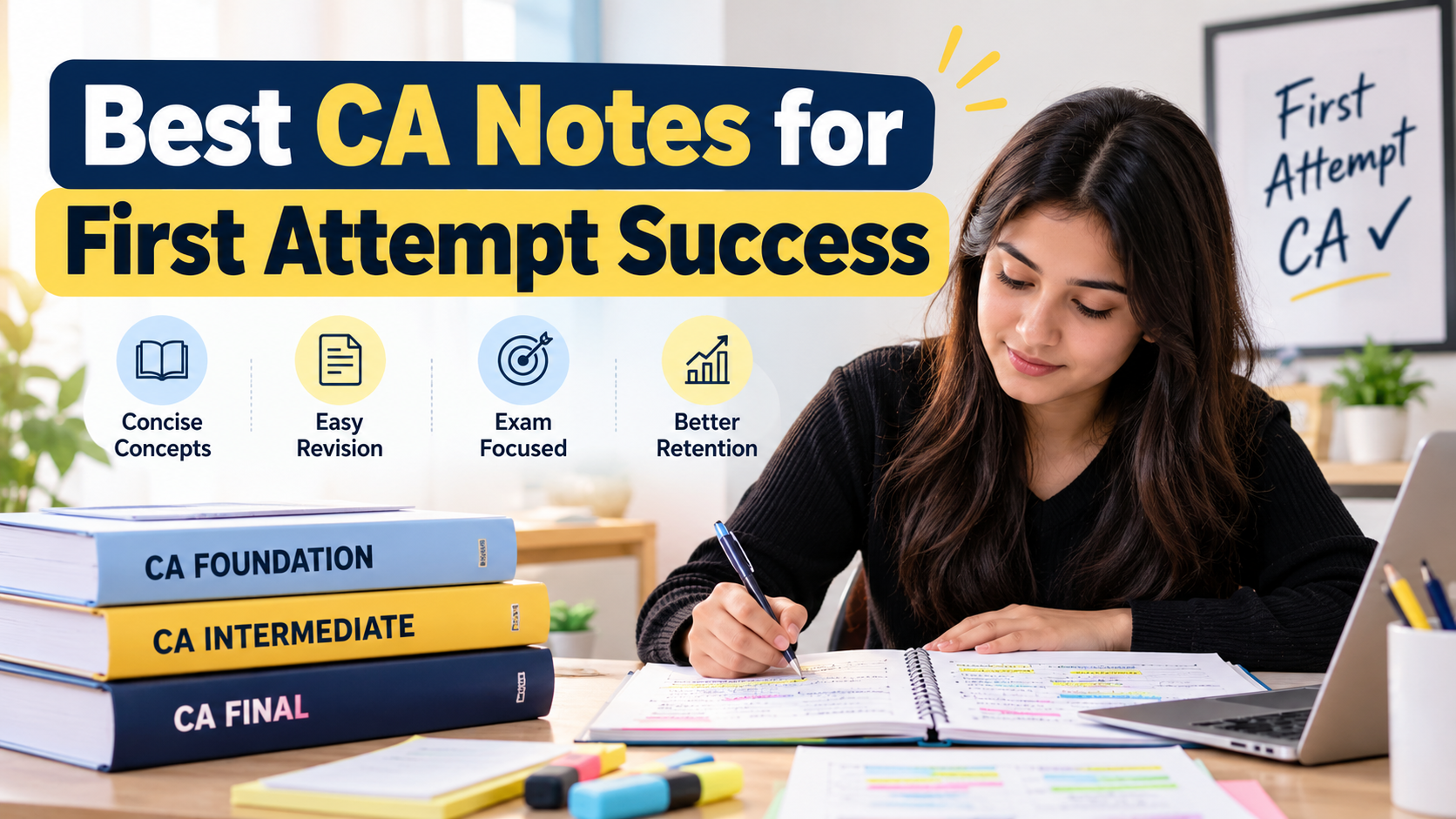
Table of Contents
- What Makes CA Notes the Best for First Attempt Preparation?
- Why Good CA Notes Help First Attempt Students
- Types of CA Notes You Can Use
- How to Choose the Best CA Notes
- Best Notes for Foundation, Intermediate and Final
- CA Notes vs Detailed Study Material
- How to Use Notes During First Reading
- How to Revise CA Notes for First Attempt
- Use Active Recall With CA Notes
- Combine Notes With Questions and Tests
- Common Mistakes First Attempt Students Make
- How Studycaller Can Support Your Preparation
- Best CA Notes Selection Checklist
- FAQs
Best CA Notes for First Attempt Success
Clearing a CA examination in the first attempt is a goal many students set from the beginning, but the preparation journey can quickly become overwhelming. There are textbooks, official study material, lectures, question banks, revision notes and countless PDFs available online. The challenge is not finding something to study; it is deciding what deserves your attention and what should stay out of your study plan.
This is where the right CA Notes can make a meaningful difference. Good notes do not magically guarantee a first-attempt result, but they can make revision faster, improve recall and help you return to important concepts without repeatedly going through every page of a large book. This guide explains what the best CA Notes for first attempt success should look like, how to choose them and how to use them as part of a practical preparation strategy with Studycaller.
What Makes CA Notes the Best for First Attempt Preparation?
There is no single set of notes that is automatically the best for every CA student. A first-attempt student needs notes that match the current syllabus, explain important concepts clearly and make repeated revision easier. The ideal notes are not necessarily the shortest ones. They are the ones that give you enough information to understand and recall a topic without unnecessary repetition.
Good notes should have a logical structure. Chapters should follow the syllabus, important concepts should be easy to locate and practical topics should not be reduced to unexplained formulas. For theory-heavy subjects, definitions, provisions, exceptions and applications should be presented clearly. For numerical subjects, formulas should be accompanied by enough explanation to understand when and how they are used.
Another important quality is accuracy. First-attempt students often have limited experience identifying incorrect or outdated content. Therefore, notes should come from a dependable source and should be checked against applicable official material, particularly when amendments or syllabus changes are relevant.
Why Good CA Notes Help First Attempt Students
Imagine completing a large chapter and then trying to revise every page before a test. It may take hours, even when you already understand most of the content. A well-organised note can bring the important information together so that the second and third revision becomes much faster.
Notes are also useful for identifying weak areas. You can mark a formula you repeatedly forget, a provision that causes confusion or a concept that needs another round of practice. Over several revisions, your notes become a personalised map of the syllabus.
The biggest benefit of notes is not saving pages; it is saving revision time. That extra time can then be used for solving questions, taking tests and improving exam writing.
Types of CA Notes You Can Use
Different stages of preparation require different types of notes. Instead of asking which format is universally best, ask which format fits your current need.
| Type of CA Notes | Best For | Main Benefit |
|---|---|---|
| Detailed Chapter Notes | Learning and early revision | Better conceptual coverage |
| Concise Revision Notes | Second and later revisions | Faster recall |
| Formula Sheets | Numerical subjects | Quick formula revision |
| Summary Notes | Theory revision | Easy review of key points |
| Amendment Notes | Updated exam preparation | Focus on applicable changes |
| Error Notes | Personal weak areas | Targeted correction before exams |
How to Choose the Best CA Notes for First Attempt Success
1. Match the Current Syllabus
Before downloading or buying notes, confirm that they correspond to your current course and syllabus. Old notes can contain deleted topics or miss changes that matter for your examination.
2. Look for Clear Explanations
Notes should make concepts easier to understand rather than simply compressing text. If a student cannot explain a topic after reading the notes, the notes are not doing their job.
3. Check Topic Coverage
Concise does not mean incomplete. Compare the chapter headings with the syllabus and ensure that important areas have not been removed just to make the notes shorter.
4. Prefer Exam-Oriented Structure
Useful notes should help you recognise what needs to be remembered and what needs application. Important provisions, formulas, concepts and practical approaches should be easy to find during revision.
5. Check for Updates
Always verify whether the notes reflect applicable amendments and changes for your attempt. This is especially important for subjects where laws, standards or provisions can change.
6. Choose Notes You Will Actually Revise
Even technically excellent notes are of limited value if they are difficult to read. Clear headings, spacing, tables and logical sequencing make repeated revision less tiring.
Best CA Notes for Foundation, Intermediate and Final
The best notes also depend on the CA level. A Foundation student may need more explanation, while an Intermediate student may need a balance between concepts and application. Final students generally need focused material that helps them revise a broad syllabus efficiently.
CA Foundation Notes
Foundation notes should focus on building a clear base. Students should avoid using extremely compressed notes before they understand the fundamentals. Short summaries become more useful after the first reading.
CA Intermediate Notes
Intermediate notes should help with both conceptual understanding and practical application. Students should look for notes that make provisions, formulas, accounting treatments and important concepts easier to revisit.
CA Final Notes
Final-level notes need to be selective but accurate. Students should pay particular attention to applicable amendments and professional updates. Concise notes are valuable when they help reduce the time required for repeated revision without removing important details.
CA Notes vs Detailed Study Material
First-attempt students sometimes make the mistake of choosing between notes and detailed study material as if only one can be used. In reality, they have different roles.
| Factor | CA Notes | Detailed Study Material |
|---|---|---|
| Primary Purpose | Revision and consolidation | Detailed learning |
| Length | Usually concise | More comprehensive |
| Revision Speed | Fast | Slower |
| Best Stage | After understanding the topic | First learning and detailed study |
| Question Practice | Supports revision | May include detailed examples and exercises |
A sensible first-attempt strategy is to use detailed material to build understanding and concise notes to make subsequent revisions efficient. This gives you depth without making every revision as long as the first one.
How to Use CA Notes During Your First Reading
Although notes are usually associated with revision, they can be introduced during the first reading in a limited way. After studying a chapter, compare the key concepts with your notes. This helps you see whether the chapter has been understood at a broad level.
Do not try to memorise every line immediately. Instead, use the notes to create a mental structure of the chapter. Identify the major headings, formulas, provisions and difficult areas. Then return to detailed study material whenever you find a gap.
How to Revise CA Notes for First Attempt Success
First-attempt success requires repeated revision, not one perfect reading. A practical approach is to make each revision different from the previous one.
First revision: Read the notes carefully and check whether the concepts are still clear. Mark weak areas but avoid highlighting everything.
Second revision: Increase your speed. Try recalling points before reading the answer. Spend extra time on topics that were difficult during the first revision.
Third revision: Move towards exam-oriented recall. Focus on formulas, provisions, definitions, important concepts and mistakes from question practice.
Final revision: Use only your most useful marked material. Avoid starting completely new notes unless there is a genuine gap that needs to be addressed.
The purpose of repeated revision is to make recall increasingly automatic. If every revision takes exactly the same amount of time, your process probably needs more compression.
Use Active Recall With CA Notes
One of the easiest ways to improve the value of CA Notes is to stop reading them continuously. After reading a section, close the document and ask yourself what you remember.
For theory, try explaining the concept in your own words. For numerical subjects, write the formula or approach without looking. For law or standards-related areas, recall the conditions, exceptions and applications. Then open the notes and check your answer.
This method shows you the difference between recognition and recall. A topic may look familiar while you are reading it but become difficult to reproduce when the notes are closed.
Active recall turns CA Notes from reading material into a testing tool. It also helps you identify exactly what needs another revision.
Combine CA Notes With Questions and Tests
Notes alone cannot tell you whether you are ready for an examination. Questions and tests provide the missing feedback.
After revising a chapter, solve relevant questions without immediately checking the solution. If you make a mistake, identify the reason. Maybe the concept was unclear, the formula was forgotten or the question required a different application.
Record meaningful mistakes in a small error notebook or inside your notes. During the next revision, review these errors first. This creates a preparation cycle in which every test improves the next revision.
For first-attempt students, this feedback loop is particularly valuable because it prevents false confidence. Feeling comfortable while reading is not the same as being able to answer under exam conditions.
Common Mistakes First Attempt Students Make With CA Notes
Collecting Too Many Resources
Students often download several PDFs because each one looks useful. In practice, overlapping resources can make revision slower. Choose a dependable primary set of notes and stick with it.
Using Notes as the Only Study Material
Concise notes may not contain every explanation needed for first learning. Use detailed material when a concept is unclear instead of trying to understand everything from a summary.
Ignoring Updates
Old notes can create unnecessary risk. Check the applicable syllabus and amendments before relying on any material for the examination.
Skipping Questions
Reading notes does not develop enough exam-writing ability by itself. Regular question practice is essential for understanding application and improving speed.
Waiting Until the Final Days
Notes become much more effective when they are revised repeatedly. Leaving everything until the end makes the process rushed and reduces opportunities to correct weak areas.
How Studycaller Can Support First Attempt Preparation
First-attempt preparation is easier when study resources, revision and performance practice work together. Studycaller can be included in that broader system rather than treating notes as the entire preparation strategy.
This creates a simple loop: learn the concept, revise it, test it, analyse the mistake and revise again. It is a much more practical approach than repeatedly collecting new material.
Best CA Notes Selection Checklist
| Check Before Choosing Notes | What Good Notes Should Provide |
|---|---|
| Current syllabus | Alignment with your applicable course and attempt |
| Accurate content | Reliable concepts, formulas and provisions |
| Complete coverage | Important syllabus areas are not unnecessarily removed |
| Simple structure | Clear headings and easy navigation |
| Revision-friendly format | Concise explanations and important points |
| Update status | Relevant amendments and changes are considered |
| Exam support | Useful for recall, questions and final revision |
Choose Fewer, Better Notes for Your First Attempt
The best CA Notes for first attempt success are not necessarily the longest, shortest or most popular notes available online. They are the notes that fit your syllabus, preparation level and revision style while remaining accurate and easy to use.
Use detailed study material to understand the subject properly, then use concise notes to make repeated revision faster. Test yourself after studying, solve questions regularly and maintain a record of mistakes. As the exam approaches, rely more heavily on your marked notes instead of constantly searching for new resources.
With Studycaller and a well-organised study system, students can bring notes, revision and performance practice into one routine. No notes can guarantee a first-attempt result, but the right notes can remove unnecessary friction from your preparation.
Ultimately, first-attempt success comes from a combination of consistent study, repeated revision, question practice, accurate resources and honest self-assessment. Choose your notes carefully, use them repeatedly and let your test performance tell you what to revise next.

FAQs
FAQs
Which CA Notes are best for first attempt preparation?
The best CA Notes are current, accurate, syllabus-aligned and easy to revise. Choose notes that explain important concepts clearly, cover the required topics and help you recall information without replacing detailed study material.
Can CA Notes help me clear the exam in the first attempt?
Good notes can make revision more efficient, but they cannot guarantee a first-attempt result. Combine them with proper learning, question practice, mock tests, amendments and consistent revision for a stronger preparation strategy.
Should first-attempt students use short CA Notes?
Short notes are useful for revision, but students should first understand the concepts properly. Use detailed study material for learning and concise notes later to improve revision speed and recall.
How many times should I revise CA Notes?
There is no fixed number because retention differs between students. Plan multiple revisions and make each one faster and more focused. Give additional time to weak topics, repeated mistakes and important exam-oriented areas.
Are CA Notes better than ICAI study material?
They serve different purposes. ICAI study material can provide detailed coverage, while concise CA Notes can make revision faster. A strong preparation strategy uses detailed material for understanding and notes for repeated revision.
How do I choose reliable CA Notes?
Check the syllabus, applicable attempt, update status, completeness, source and readability. Also compare important topics with your primary study material before relying on the notes for serious exam preparation.
Should I make my own CA Notes or use ready-made notes?
Both approaches can work. Ready-made notes save time, while personal notes can focus on individual weaknesses. Many students benefit from using reliable ready-made notes and adding only their own mistakes and difficult points.
When should I start using CA Notes?
You can introduce notes after understanding a chapter during the first reading. They become particularly valuable during the first full revision, when you need to revisit the syllabus faster and identify areas requiring additional practice.
Can I use CA Notes for last-minute revision?
Yes. Concise notes are especially useful during final revision because they allow quick review of formulas, provisions, concepts and marked weak areas. Use familiar notes rather than introducing several new resources at the last moment.
Can Studycaller help with first-attempt CA preparation?
Studycaller can support a structured preparation approach by combining study resources with revision and performance practice. Students can use notes for recall and tests to identify weak areas that need further improvement.