Financial Warning Signs Every CA Should Understand in Businesses
Learn financial warning signs every CA should understand, including cash flow issues, rising debt, weak profitability, compliance risks, and operational instability.
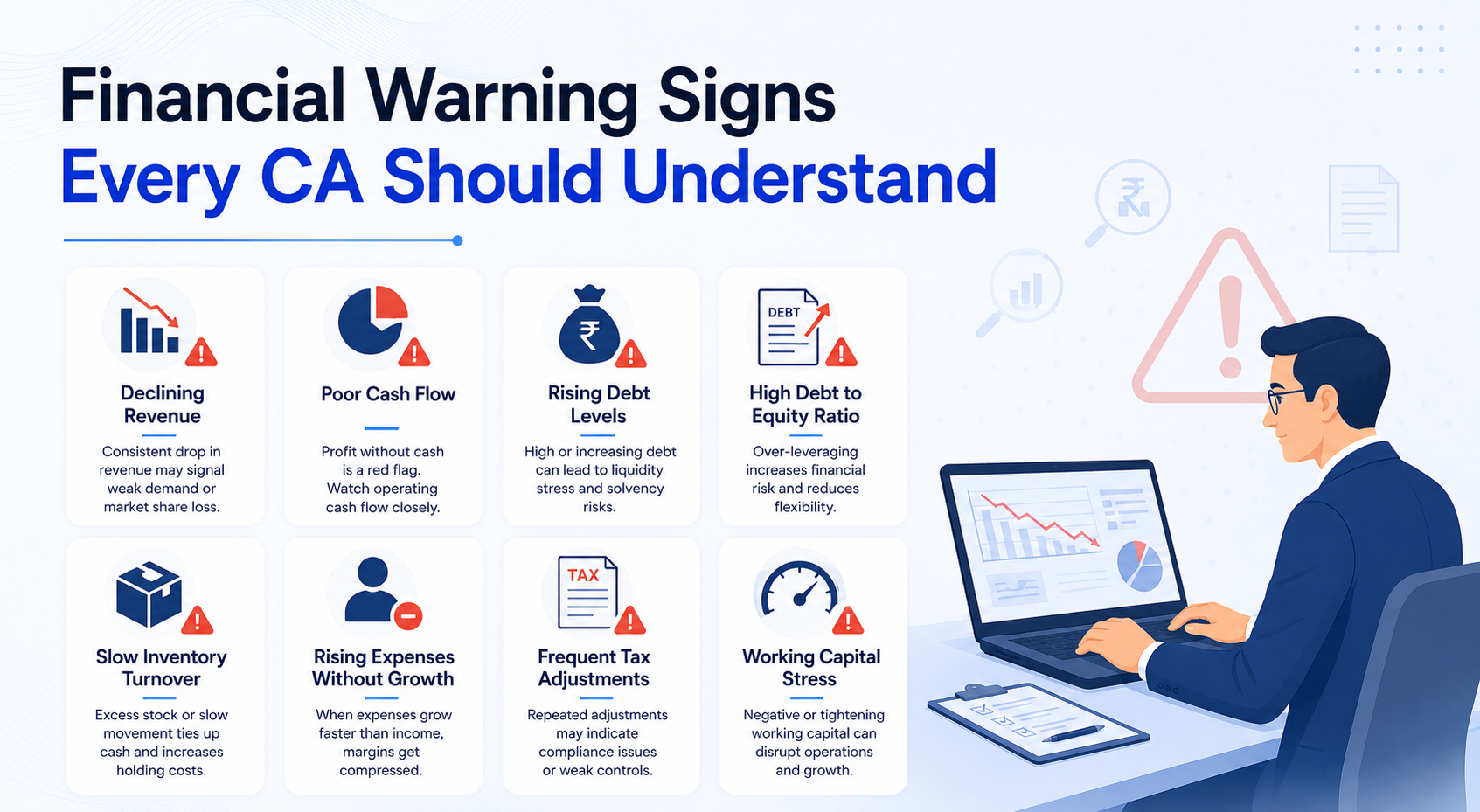
Table of Content
- Continuous Cash Flow Problems Are Major Warning Signs
- Rising Debt Levels Can Create Financial Instability
- Declining Profit Margins Should Not Be Ignored
- Delays in Compliance and Reporting Are Risk Indicators
- Increasing Operational Expenses Need Attention
- Weak Internal Controls Increase Risk of Financial Problems
- Declining Customer or Market Confidence Is Important
- Technology and Digital Risks Are Increasing
- Inventory and Working Capital Issues Should Be Monitored
- Frequent Employee Turnover Can Also Be a Warning Sign
- Financial Warning Signs Help Prevent Larger Problems
- Continuous Monitoring Is Essential for Businesses
- Conclusion
Modern businesses operate in highly competitive and financially uncertain environments where even small financial problems can gradually become serious risks if ignored. This is why chartered accountants must develop the ability to identify early warning signs before businesses face major financial losses or operational instability. A CA’s role is not limited only to preparing financial statements or managing compliance work. Today, finance professionals are also expected to analyze business performance, monitor financial health, and help organizations avoid future financial crises.
Understanding financial warning signs every CA should understand is extremely important because early identification of problems often helps businesses take corrective action at the right time. Companies that ignore financial warning indicators may eventually struggle with cash flow pressure, debt burdens, compliance issues, or declining profitability. Chartered accountants, therefore, play a major role in helping businesses remain financially stable and operationally strong.
Continuous Cash Flow Problems Are Major Warning Signs
Cash flow is one of the strongest indicators of financial health in any business. Even profitable companies can face serious operational problems if they fail to manage cash flow properly. Chartered accountants should carefully monitor situations such as:
- Delayed customer payments
- Increasing operational expenses
- Regular cash shortages
- Difficulty paying liabilities
- Dependency on short-term borrowing
When businesses consistently struggle with cash flow management, it often indicates deeper financial or operational weaknesses. Early monitoring helps organizations avoid severe financial pressure in the future.
Rising Debt Levels Can Create Financial Instability
Businesses often use loans and borrowings for growth and operations, but excessive debt can become dangerous if not managed properly.
- Increasing Interest Burden: High interest expenses may reduce profitability and create financial pressure.
- Poor Repayment Capacity: Businesses struggling to repay liabilities may face long-term instability.
- Dependency on Borrowings: Continuous dependence on loans for operational survival can indicate weak financial management.
- Declining Financial Flexibility: Excessive debt reduces the company’s ability to handle future business challenges effectively.
Financial warning signs every CA should understand often include debt-related problems because they directly affect long-term business sustainability.
Declining Profit Margins Should Not Be Ignored
A business may continue generating revenue but still experience financial weakness if profit margins continuously decline. Chartered accountants should analyze profitability trends carefully instead of focusing only on sales growth. Falling margins may result from:
- Rising operational costs
- Poor pricing strategies
- Weak cost management
- Market competition pressure
If profitability continues decreasing over time, businesses may eventually struggle with operational continuity and future expansion plans.
Delays in Compliance and Reporting Are Risk Indicators
Modern businesses operate under strict taxation and regulatory systems. Frequent delays in compliance activities often indicate financial or management problems within organizations.
- Delayed Tax Filings: Late GST or income tax filings may suggest operational inefficiency or financial stress.
- Incomplete Financial Records: Poor documentation can increase compliance and audit-related risks.
- Frequent Reporting Errors: Repeated reporting mistakes may reflect weak internal systems.
- Ignored Regulatory Notices: Failure to respond properly to legal or compliance notices can create larger problems later.
Chartered accountants must monitor these warning signs carefully because compliance weaknesses often affect business credibility and financial stability.
Increasing Operational Expenses Need Attention
Rising operational costs without corresponding business growth can become a major financial concern. Chartered accountants should regularly analyze expense patterns to identify areas where businesses may be losing financial efficiency. Important areas to monitor include:
- Administrative costs
- Employee expenses
- Marketing expenditure
- Technology and operational costs
Uncontrolled expenses may gradually reduce profitability and increase financial pressure on businesses.
Weak Internal Controls Increase Risk of Financial Problems
Businesses with poor financial monitoring systems are more likely to face fraud, errors, and operational inefficiencies. Chartered accountants should carefully review whether organizations maintain proper internal controls and financial discipline.
- Lack of Approval Systems: Weak authorization procedures can increase the chances of financial irregularities.
- Poor Documentation Management: Incomplete records reduce transparency and operational accountability.
- Inadequate Financial Monitoring: Businesses may fail to identify operational problems early.
- Weak Audit Systems: Limited internal review processes can increase financial and compliance risks.
Strong internal controls help organizations maintain stability and reduce future financial uncertainty.
Declining Customer or Market Confidence Is Important
Financial warning signs are not always limited to accounting figures. Chartered accountants should also observe business trends that may indirectly affect financial stability.
These may include:
- Declining customer retention
- Falling sales growth
- Negative market reputation
- Delayed vendor payments
Such operational indicators often reflect deeper business problems that may eventually affect financial performance significantly.
Technology and Digital Risks Are Increasing
Modern businesses increasingly depend on digital systems and online financial operations. Because of this, chartered accountants must also understand technology-related financial risks. Businesses may face challenges related to:
- Cybersecurity threats
- Data breaches
- Digital fraud risks
- System reliability issues
Technology risks can create both financial and reputational damage if not monitored properly.
Inventory and Working Capital Issues Should Be Monitored
Poor inventory management can create serious financial inefficiencies. Chartered accountants should monitor whether businesses maintain excessive stock levels or face slow-moving inventory problems. Working capital issues may indicate:
- Weak sales performance
- Poor operational planning
- Cash flow inefficiency
- Financial mismanagement
Efficient working capital management is extremely important for long-term business stability.
Frequent Employee Turnover Can Also Be a Warning Sign
High employee turnover may indirectly indicate internal management or financial problems within organizations. It may suggest issues such as:
- Poor workplace environment
- Financial instability
- Weak leadership systems
- Operational pressure
Chartered accountants involved in strategic analysis should not ignore such business indicators because they may eventually affect overall financial performance.
Financial Warning Signs Help Prevent Larger Problems
One major reason financial warning signs every CA should understand is that early identification helps businesses take corrective action before problems become severe. Timely financial analysis helps organizations:
- Improve planning
- Reduce risks
- Strengthen operations
- Maintain financial discipline
Prevention is often much more effective than managing full financial crises later.
Continuous Monitoring Is Essential for Businesses
Financial health cannot be evaluated only once or twice a year. Businesses require continuous monitoring and regular financial review systems to remain stable in changing market environments. Chartered accountants, therefore, regularly analyze:
- Financial reports
- Profitability trends
- Cash flow patterns
- Compliance performance
This ongoing supervision helps organizations remain financially disciplined and operationally efficient.
Conclusion
Understanding financial warning signs every CA should understand is extremely important for maintaining business stability and long-term financial health. Chartered accountants play a major role in identifying cash flow problems, rising debt, compliance weaknesses, declining profitability, operational inefficiencies, and financial risks before they become major crises. Through proper financial analysis, monitoring, and strategic guidance, CAs help businesses take corrective action early and maintain stronger financial discipline in competitive and uncertain business environments.

FAQs
What are financial warning signs every CA should understand?
Important warning signs include cash flow issues, rising debt, declining profitability, compliance delays, and weak internal controls.
Why are cash flow problems considered major warning signs?
Poor cash flow can affect daily operations, liability payments, and overall business stability.
How can rising debt create financial risks for businesses?
Excessive debt increases interest burden, repayment pressure, and long-term financial instability.
Why should chartered accountants monitor declining profit margins?
Continuous reduction in profits may indicate weak cost management or operational inefficiencies.
How do compliance delays indicate financial problems?
Delayed filings and reporting errors often reflect operational weakness or financial stress within businesses.
Why are internal controls important for financial stability?
Strong internal controls reduce fraud risks, financial errors, and operational inefficiencies.
How can technology create financial risks for businesses?
Digital systems may create cybersecurity threats, fraud risks, and data security concerns.
Why is working capital management important?
Efficient working capital management supports cash flow stability and operational continuity.
How does continuous financial monitoring help businesses?
Regular monitoring helps identify problems early and improves long-term financial planning and stability.
Why do chartered accountants play an important role in risk identification?
CAs analyze financial trends, compliance systems, and operational performance to prevent future business crises.