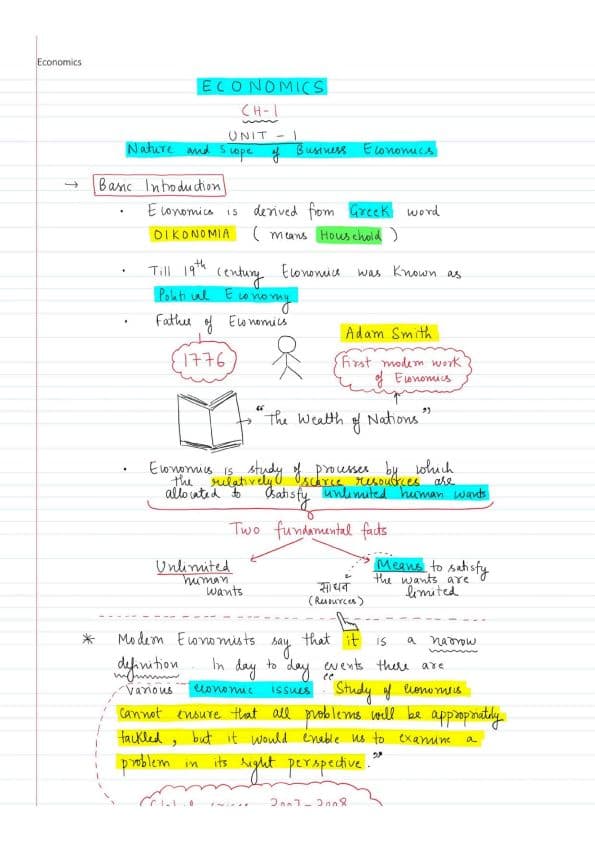
Accounting can feel unfamiliar when you begin preparing for the CA Foundation examination. Terms such as journal, ledger, trial balance and financial statements may look complicated at first, especially if you have not studied accounts in depth before.
Downloadable CA Foundation Accounts notes can make revision more manageable when they explain each concept in a logical order and include examples. Use notes alongside the latest ICAI study material, question practice and regular revision rather than treating them as a replacement for learning the concepts.
Why beginners need well-organised Accounts notes
Good notes reduce the time spent searching through different chapters when you want to revise one idea. They should explain the purpose of a concept, show the steps involved and include a short example. For instance, a note on journal entries should help you identify the accounts affected, decide which account is debited or credited, and understand why the entry is passed.
Beginners benefit most from notes that use simple language without removing the accounting logic. If a rule is presented without its reason, it may be difficult to apply it when an examination question changes the figures or circumstances.
What your CA Foundation Accounts notes should cover
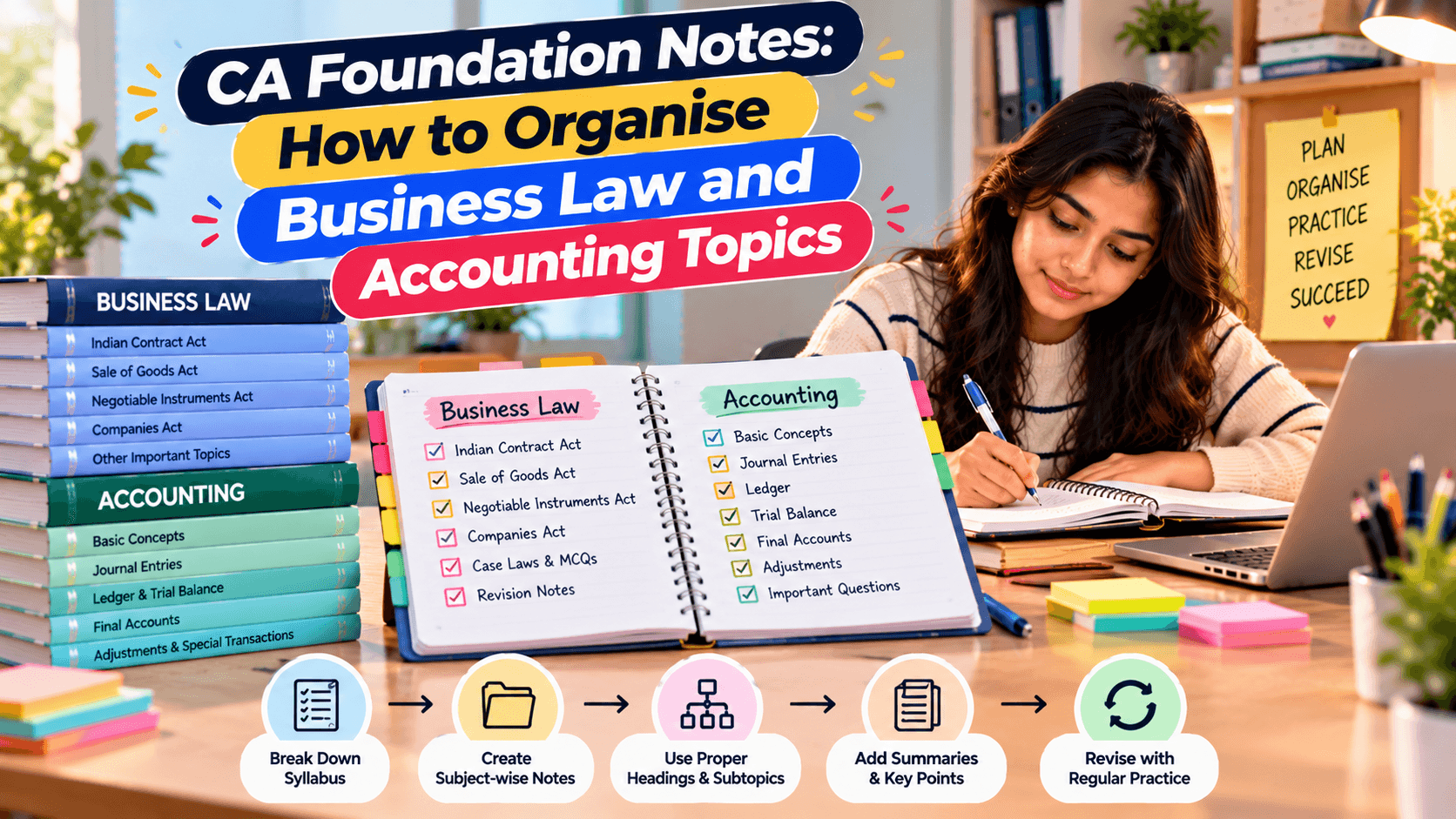
Start with accounting fundamentals: terminology, accounting principles, the accounting equation, debit and credit rules, and the movement from source documents to journal, ledger and trial balance. These ideas support later chapters, so revise them until you can explain the process without looking at the page.
Next, organise notes for subsidiary books, bank reconciliation, depreciation, inventory valuation, bills of exchange, rectification of errors and final accounts according to the syllabus applicable to your attempt. Keep separate pages for formats, common adjustments and mistakes. Verify topic coverage against current ICAI material.
How to use downloadable notes effectively
Read the topic from prescribed study material or class notes first. Then use the downloadable notes to condense the main rules and revisit examples. Close the notes and explain the topic in your own words; this quick recall check reveals whether you understood it or only recognised the wording.
After revising a concept, solve questions without checking the worked answer. If you get stuck, mark the exact step where your reasoning stopped. Return to that part of the notes, correct the gap and attempt a similar question. Repeatedly reading or highlighting a PDF does not prove that you can solve a fresh problem.
A practical chapter-wise revision routine
Use a three-stage cycle for each chapter. First, learn the concept and annotate important rules. Second, solve basic illustrations and then questions that combine more than one adjustment. Third, revisit the chapter after a gap and attempt a short set of questions from memory.
Keep a mistake register with columns for chapter, mistake, reason and correction. Common entries include using the wrong balance, omitting an adjustment, making a calculation error or presenting a format incorrectly. Review this register before mock tests because repeated errors can cost marks even when the main concept is understood.
Building confidence with journal entries and ledger posting
Journal entries are easier when you follow a consistent sequence. Read the transaction carefully, identify the accounts, classify them, apply the relevant debit-credit rule and check whether the entry reflects the substance of the transaction. Do not memorise every transaction as an isolated pattern; understand why each account is affected.
Ledger posting and trial balance questions test accuracy as well as understanding. Write figures neatly, carry balances correctly and check totals. When a trial balance does not agree, use a systematic approach to find the error instead of changing figures at random.
Preparing final accounts and adjustment notes
Final accounts often combine several concepts. Keep a separate adjustment checklist for items such as outstanding and prepaid expenses, accrued income, income received in advance, depreciation, bad debts and closing inventory wherever relevant to your syllabus and question. For each item, note where it affects the statements and why.
Practise identifying the effect of each adjustment before preparing the full statement. This reduces the risk of recording an item in only one place when the treatment requires two effects. Use the format prescribed in your study material and pay attention to labels, working notes and arithmetic.
How to choose reliable notes
Choose notes that identify the syllabus or attempt they are designed for, use correct terminology, explain working steps and include practice questions with solutions. Check that formulas and accounting treatments agree with current official material. Be cautious with old PDFs that do not identify their source or version.
Download files from a trusted source, keep a backup and use descriptive filenames. Organise files by subject and chapter so that you can open the correct version quickly. If a note conflicts with current ICAI material, verify the point rather than assuming the shorter note is correct.
A weekly plan for beginners
At the start of the week, select a realistic number of topics based on your progress. Divide each study session between concept learning, written practice and recall. After learning a chapter, use a separate session to solve questions and another to revisit the errors you made.
Reserve one slot each week for mixed questions from previously completed chapters. This prevents you from remembering only the topic studied most recently. As the examination approaches, increase timed practice and use official syllabus and question resources to check coverage.
Using Studycaller in your preparation
Studycaller can be included in your wider preparation workflow as a way to organise revision support and exam-practice resources. The most important part of the process is active learning: study the concept, solve questions independently, review the solution and return to weak areas.
Keep your notes concise enough to revise but detailed enough to explain the reason behind a rule. Your final revision file should help you recall a method quickly and then move directly to question practice.
Common mistakes to avoid
Do not collect multiple versions of the same notes and spend more time comparing them than studying. Do not skip prescribed material because a summary looks shorter. Avoid leaving all practical questions until the final weeks, and do not ignore mistakes simply because the final answer happened to be correct.
Another common problem is making notes too long. Copying every paragraph defeats the purpose of a revision resource. Keep the principle, the method, one representative example and a reminder of mistakes you personally make.