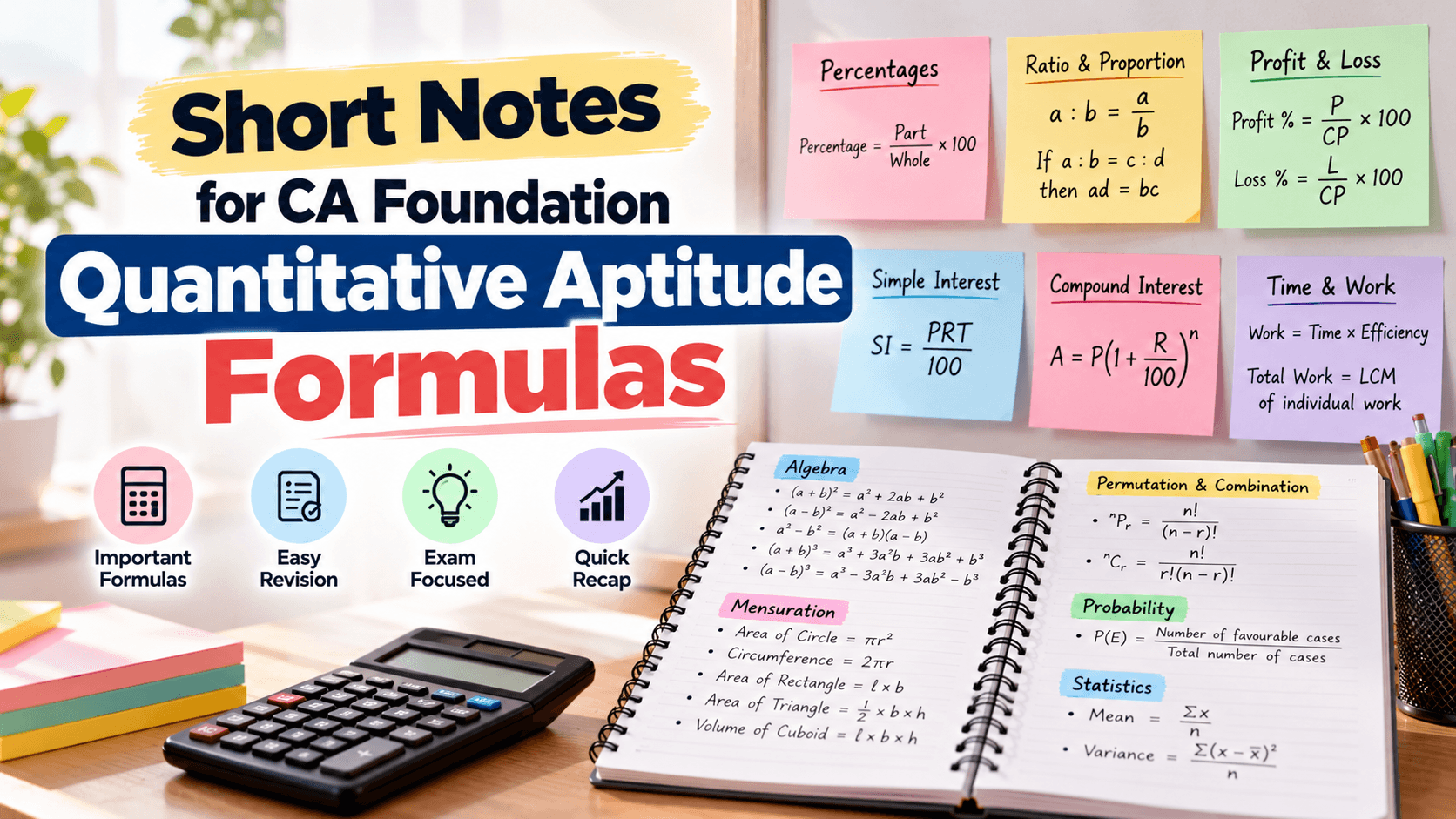
Short Notes for CA Foundation Quantitative Aptitude Formulas
Create quick CA Foundation Quantitative Aptitude formula notes with topic grouping, worked examples, revision prompts and practice tips for better speed and accuracy.
In this article(11 sections)ShowHide
Quantitative Aptitude becomes easier to revise when formulas are organised by topic and paired with short examples. A long formula list may look comprehensive, but it is not useful if you cannot remember when to apply each formula or make calculation errors under time pressure.
Prepare formula notes using the syllabus and study material applicable to your CA Foundation attempt. Use the method below to organise key formulas, practise their use and build a compact revision sheet. Include only topics that match the prescribed syllabus.
Organise formulas by syllabus topic
List the Quantitative Aptitude topics included in your current syllabus and arrange formulas under the relevant chapter headings. This helps you recall a formula in the context of the question where it is used.
Keep an index and mark formulas you know well, formulas you confuse and formulas needing practice. This helps you spend time on weak areas instead of reviewing every formula at the same pace.
Write the meaning of each formula
Do not record a formula without explaining its symbols. Write what each variable represents and any conditions under which the formula applies. A formula may be easy to memorise but still lead to a wrong answer if values are substituted incorrectly.
Add one short worked example below each important formula. Show the values substituted and the calculation steps. The example should demonstrate the method rather than only display the final answer.
Group related formulas
Create sections for topics prescribed in your syllabus, such as percentages, ratios, averages, interest, time and work or other relevant quantitative areas. Under each heading, group formulas that solve related types of problems.
When formulas look similar, write the clue that tells you which one to choose, the required inputs and the common error. This is often more useful than memorising formulas in isolation.
Practise choosing the right method
First identify what the question asks and what information is provided. Decide which relationship fits the situation before substituting numbers. This reduces the tendency to apply a familiar formula simply because it contains similar values.
After solving a question, explain why the formula was suitable. If you selected the wrong method, write the clue you missed and practise similar questions until you can distinguish them reliably.
Check calculations and units
Common errors include sign mistakes, incorrect units, careless substitution and rounding too early. Add a short check beside formulas where these errors occur. Before finalising an answer, verify that the units and magnitude make sense.
Follow the permitted-calculator policy for your session. Build accuracy first, then work on speed. Rushing through a formula you do not understand often creates more errors than it saves time.
Use active recall
Cover the formula and write it from memory, then check the symbols and conditions. Try again later that day, the next day and during a weekly review. Keep frequently forgotten formulas on a separate sheet.
Seeing a formula can make it feel familiar, but an examination requires you to retrieve and apply it. Short blank-page tests are a useful way to check whether your notes are working.
Keep formula sheets readable
Use clear headings, consistent symbols and enough spacing. Avoid squeezing every formula onto one page if it makes the sheet hard to read. Several topic-wise pages can be faster to use than one overcrowded sheet.
Keep the sheet focused on formulas, conditions, short examples and common errors. Detailed explanations belong in your main notes. Update the sheet only when you confirm the addition is relevant to the current syllabus.
Practise timed sets
Once you can recall a topic’s formulas, complete a short timed set. Review both accuracy and time. If you are slow, determine whether the issue is recall, choosing the method, arithmetic or reading the question.
Increase difficulty gradually. Start with straightforward examples, then practise mixed questions where the topic is not identified for you. Mixed practice builds the decision-making skill needed under exam conditions.
Use Studycaller as a practice companion
Studycaller can be an additional support resource for structured revision and question practice. Select material matching the CA Foundation syllabus applicable to your attempt, and use official ICAI material to confirm coverage and examination instructions.
Track performance by topic, not just total score. If one area repeatedly causes errors, revisit its formula sheet and solve focused questions before attempting another mixed set. Use feedback to guide the next study session.
Prepare a final-week routine
Review the formula sheet daily in short blocks. Write key formulas from memory, solve representative questions and revisit errors. Avoid adding unfamiliar formulas unless you have confirmed they are relevant and understand how to use them.
Before the examination, focus on recall and calm practice rather than learning an entire topic from scratch. Keep notes organised and follow the official instructions regarding permitted materials and calculator use.
How Studycaller Can Support Your Revision
Studycaller can be used as an additional revision and practice resource alongside the applicable ICAI study material. Choose content aligned with your examination attempt, and verify syllabus coverage, amendments and examination instructions through official ICAI sources.
CA Foundation notes students love
Free notes from the Studycaller library, picked for this article.
 Amendments
CA Foundation · Business Economics
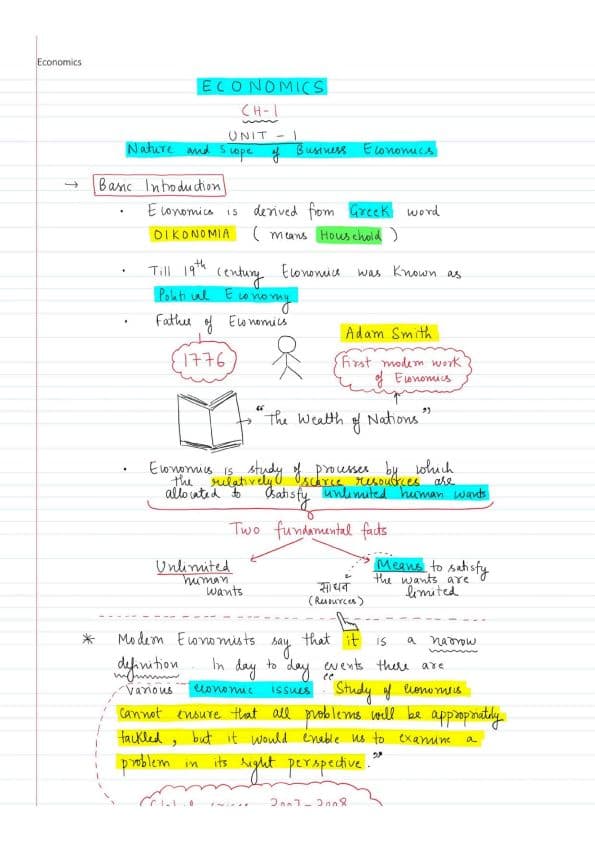
Full economics handwritten notes by CA Parag Gupta sir
Heet HingrajiyaLikes 209Views 68.6k Detailed Notes
CA Foundation · Business Economics
"Hi guys! Maine kuch naya try kiya Economics me — ek alag andaaz, ek alag soch. Chapter 1: Nature & Scope of Business Economics – Unit 1
مُحَمَّدLikes 126Views 14.7k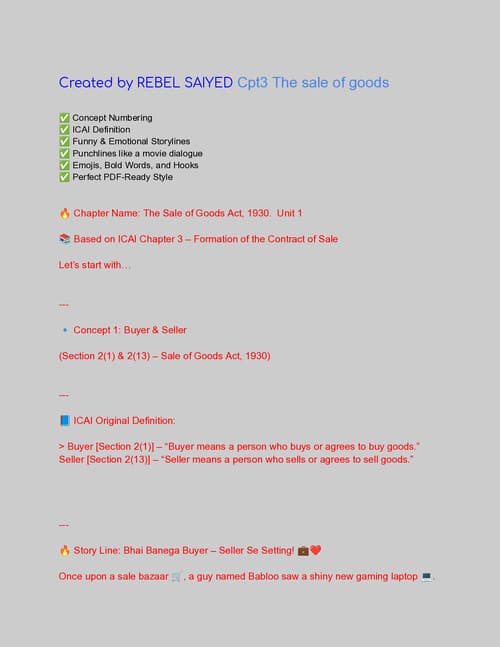 Charts
CA Foundation · Business Laws
Chpter 3 the sale of goods act Unit. 1 only. Full of story line Concept clarity and funny stories punch lines
مُحَمَّدLikes 118Views 14.2k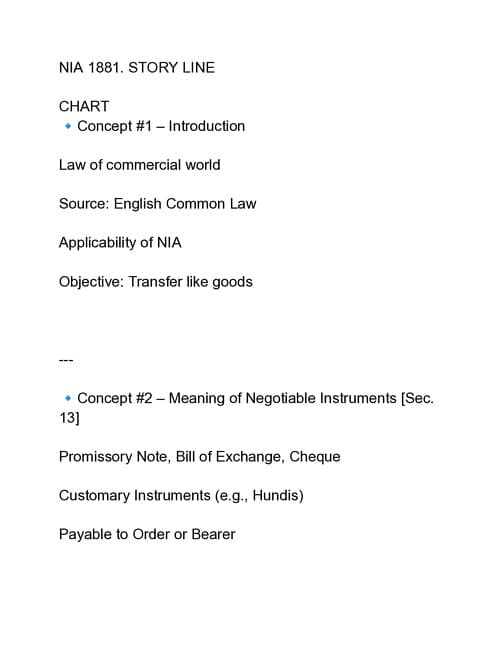 Amendments
CA Foundation · Business Laws
Nia 1881 story line pdf Coverage total 11 Concept
مُحَمَّدLikes 117Views 12.5k
Frequently asked questions
How should I prepare CA Foundation formula notes?
Organise formulas by the current syllabus, define each symbol, record conditions and add a short worked example. Keep common errors and revision prompts nearby.
Should all formulas fit on one page?
No. Readable topic-wise sheets are more useful than one overcrowded page. Keep the layout clear enough for quick recall.
How can I remember formulas longer?
Write them from memory, check symbols and conditions, and revisit them at spaced intervals. Use short questions to reinforce when each formula applies.
Why do I forget which formula to use?
You may be memorising formulas without practising question identification. Note clues and common distinctions, then practise mixed questions.
Should I focus on speed or accuracy first?
Build accurate formula selection and calculation first. Increase speed through timed practice once you can apply the method reliably.
Can I use a calculator in the exam?
Follow the official ICAI examination instructions and calculator policy for your attempt. Do not assume rules from an older session remain unchanged.
How often should I revise formulas?
Use short recall sessions regularly and a weekly review for the full set. Practise weak formulas more often.
Are formula sheets enough?
No. Formula sheets support revision, but conceptual understanding and varied question practice are needed to choose and apply methods correctly.
Can Studycaller help with formula practice?
Studycaller can supplement revision with resources matching your syllabus. Confirm topic coverage and exam rules through official ICAI material.
What should I do in the final week?
Recall formulas without looking, solve representative questions and review recurring errors. Avoid cramming unverified formulas or neglecting practice.