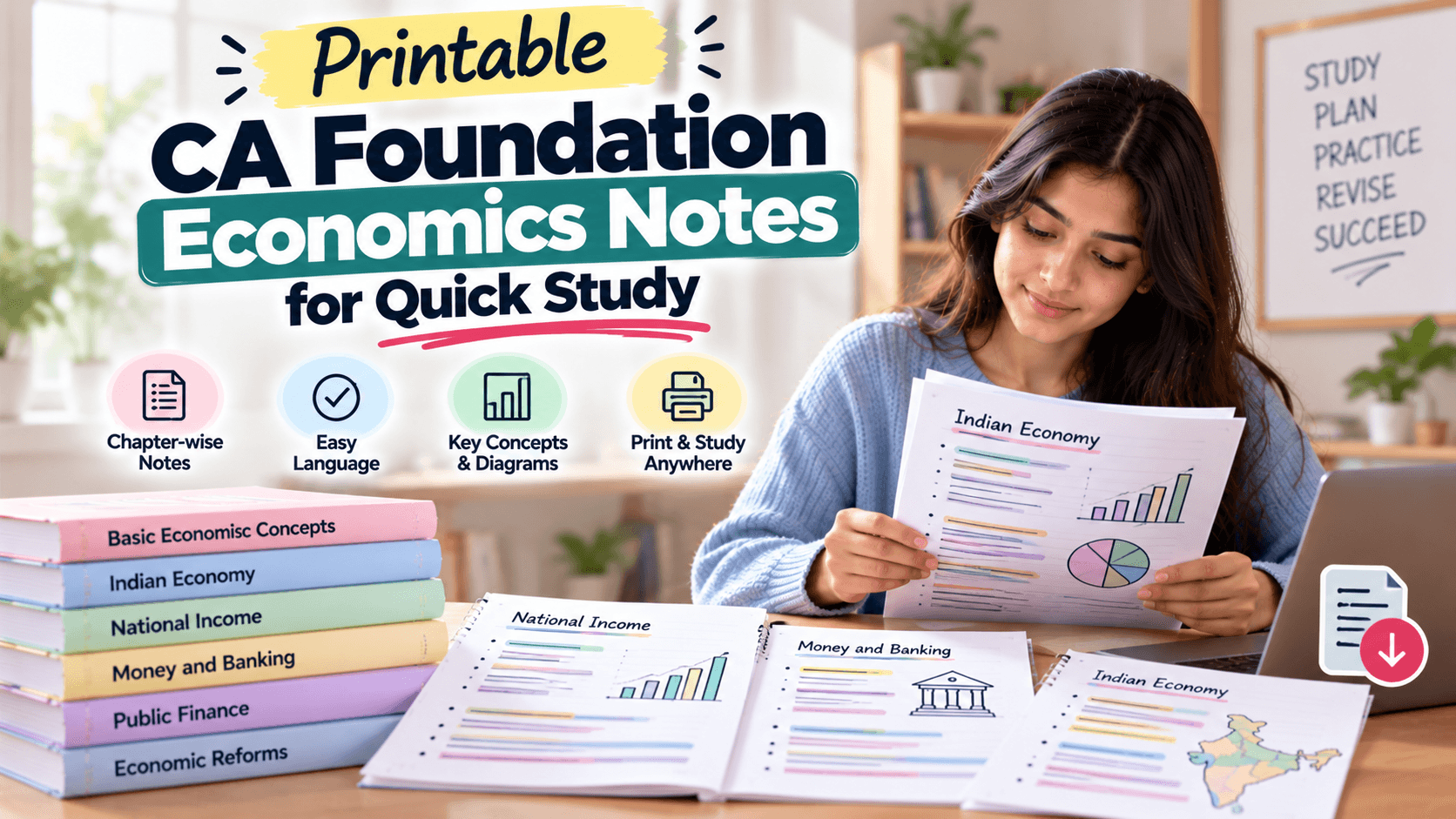
Printable CA Foundation Economics Notes for Quick Study
Make CA Foundation Economics revision easier with printable notes, clear definitions, diagrams, comparison tables and a recall plan aligned with the syllabus for your…
In this article(10 sections)ShowHide
Economics includes concepts, definitions, relationships and diagrams that can be difficult to revise if they are spread across long chapters. Students often understand a topic while reading it but struggle to recall the exact meaning or apply it to a new question later.
Printable CA Foundation Economics notes can provide a compact revision resource that is easy to annotate and review away from a screen. Use them to organise concepts and test recall, while checking the current syllabus and prescribed ICAI material for your attempt.
Why printable notes can improve revision
Printed notes make it easy to underline key terms, draw a diagram beside an explanation and write a question in the margin. They can also help you study without switching between several browser tabs. Their value comes from how you use them, not from the act of printing.
Keep each page focused on one topic or connected group of ideas. A page that contains a definition, the main relationship, a diagram where useful and one example is easier to review than a dense copy of the textbook. Leave enough space to add corrections after practice.
What to include in Economics notes
Follow the chapter order in the current syllabus. For each topic, note the main definition, assumptions, factors that influence the concept, relationships between variables and limitations or exceptions that matter. If a topic includes a graph, label the axes and explain what a shift or movement represents.
Use comparison tables for ideas that are commonly confused. Where the syllabus distinguishes between two market structures or economic measures, write the defining features and implications side by side. Keep terms accurate and verify them against official course material.
Make definitions short but precise
Definitions should be concise without losing the key idea. Write the essential meaning in one or two sentences, then add a simple example if it helps explain the concept. Avoid replacing technical terms with vague language, especially where a single word distinguishes one concept from another.
To check your notes, cover the definition and reproduce it from memory. Compare your version with the source and correct missing elements. This is more effective than highlighting a sentence several times without testing whether you can recall it.
Use diagrams and tables strategically
Graphs can make relationships easier to understand, but only when they are labelled and explained. Add the axes, curves, equilibrium point or relevant labels required for the topic, and write a sentence describing the movement or shift. Do not include a diagram simply to make the page look complete.
Tables work well for comparisons, advantages and limitations, or lists of factors. Keep the columns short and use parallel wording. If a table becomes too wide or crowded, split it into two smaller tables rather than reducing the text until it becomes difficult to read.
A quick-study method for each chapter
First, read the topic from prescribed material and identify the concepts that support the rest of the chapter. Second, review your printable sheet and explain the main idea without looking. Third, attempt questions and mark concepts you misunderstood. Finally, update the sheet with a brief correction or memory cue.
Do not treat quick study as a substitute for first-time learning. A one-page summary works best after you understand the full explanation. If you cannot explain a concept or interpret a graph, return to the original material before shortening it further.
Plan short and spaced revision sessions
Instead of waiting for one long revision day, schedule brief sessions across the week. Review a recently studied topic, then revisit older material in the next session. Use a blank sheet to write definitions, draw a graph or list the factors that influence a concept.
Mix topics once you have covered the basics. A short mixed quiz helps you practise identifying which concept a question is testing. Track mistakes and return to the relevant page instead of rereading the entire chapter every time.
How to prepare for objective questions
Read every option carefully and identify the concept being tested before choosing an answer. Watch for qualifiers such as “always”, “only” or “except”, and check whether the statement matches the definition or condition in your notes. Avoid choosing an option merely because it contains a familiar phrase.
After attempting a question, review explanations for both correct and incorrect choices where available. If you guessed correctly, treat the question as a revision need rather than assuming the concept is secure. Add a concise reminder to your notes when the same misunderstanding occurs repeatedly.
Make a printable revision pack
Arrange the pages in chapter order and include a contents page with page numbers. Use clear headings, readable font sizes and enough margins for handwritten additions. Date the pack and note which syllabus or attempt it is intended for so old material is not confused with current coverage.
Keep a separate final-review section for difficult definitions, diagrams you often mislabel and distinctions you tend to mix up. This section should remain short and personal. It is more useful to revise a few genuine weak points than to print every chapter again.
Mistakes to avoid when making Economics notes
Do not print notes from an unknown source without checking accuracy or syllabus relevance. Avoid filling pages with text copied from the book, and do not omit assumptions or limitations simply to make a definition shorter. A concise note should preserve the logic of the concept.
Another mistake is studying diagrams passively. Practise drawing and labelling them from memory and explaining what changes under different conditions. This turns a visual summary into a skill you can use during an examination.
Using Studycaller as part of your study routine
Studycaller can be part of a broader preparation routine that combines organised revision with regular question practice. Use printable notes to identify topics that need another look, then return to prescribed material when you need a fuller explanation or confirmation of syllabus coverage.
Keep your pack flexible. Add a correction when practice reveals a gap, remove duplicate pages and make sure the final version is clear enough to use during a short revision session.
CA Foundation Economics notes
Free notes from the Studycaller library, picked for this article.
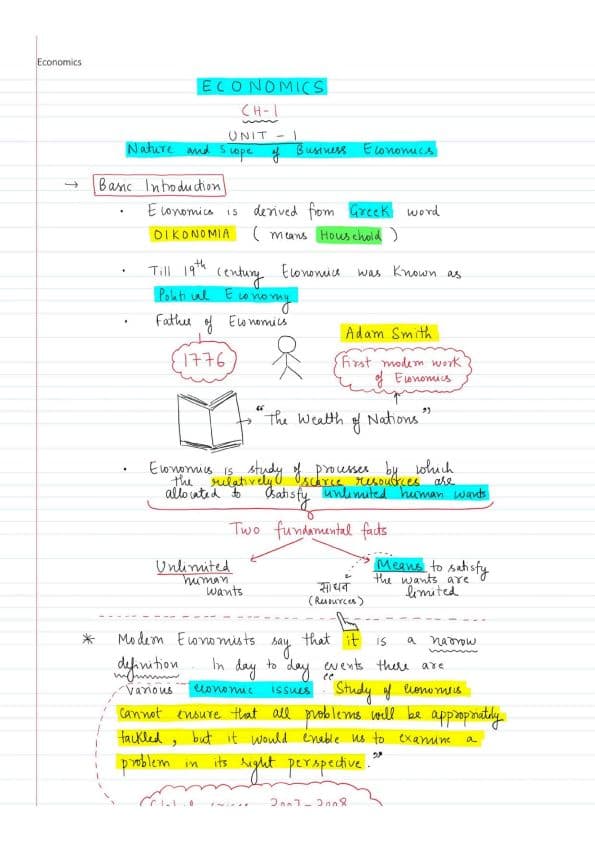 Amendments
CA Foundation · Business Economics
Full economics handwritten notes by CA Parag Gupta sir
Heet HingrajiyaLikes 209Views 68.6k Detailed Notes
CA Foundation · Business Economics
"Hi guys! Maine kuch naya try kiya Economics me — ek alag andaaz, ek alag soch. Chapter 1: Nature & Scope of Business Economics – Unit 1
مُحَمَّدLikes 126Views 14.7k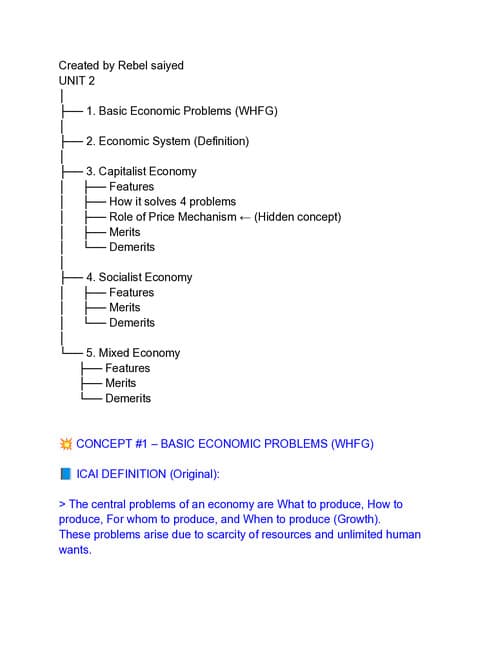 Amendments
CA Foundation · Business Economics
Hello dosto ' ye tumhare liye Eco chpt 1 unit 2 story full and esay
مُحَمَّدLikes 116Views 13.3k Summary
CA Foundation · Business Economics
TOP 150 EXPECTED QUESTIONS of Business Economics
Yashwanth K.JLikes 103Views 84.2k
Frequently asked questions
Are printable Economics notes useful for CA Foundation?
Yes. They can make revision easier when they are accurate, clearly organised and used with question practice.
Should I print the entire Economics syllabus?
Not necessarily. Print concise summaries and the pages you need to annotate or revise frequently.
What should a good Economics note include?
Include precise definitions, key relationships, assumptions, diagrams where useful and common confusions.
How can I remember Economics definitions?
Use active recall, write definitions from memory and check whether you included the essential terms.
Do diagrams matter in Economics revision?
They help explain relationships when relevant, but practise labelling and interpreting each diagram rather than memorising its appearance.
Can I use old Economics PDFs?
Check the current syllabus and official material before relying on an older PDF.
How should I revise Economics quickly?
Use short spaced sessions, blank-page recall and mixed questions to identify gaps efficiently.
How can I avoid mistakes in objective questions?
Read qualifiers carefully, identify the concept tested and review explanations even when you guessed correctly.
Should I make my own printable notes?
Personal notes can be useful because they focus on your weak areas, provided the content remains accurate.
How can Studycaller support Economics preparation?
Use Studycaller as part of an organised revision routine and confirm syllabus coverage with official ICAI resources.