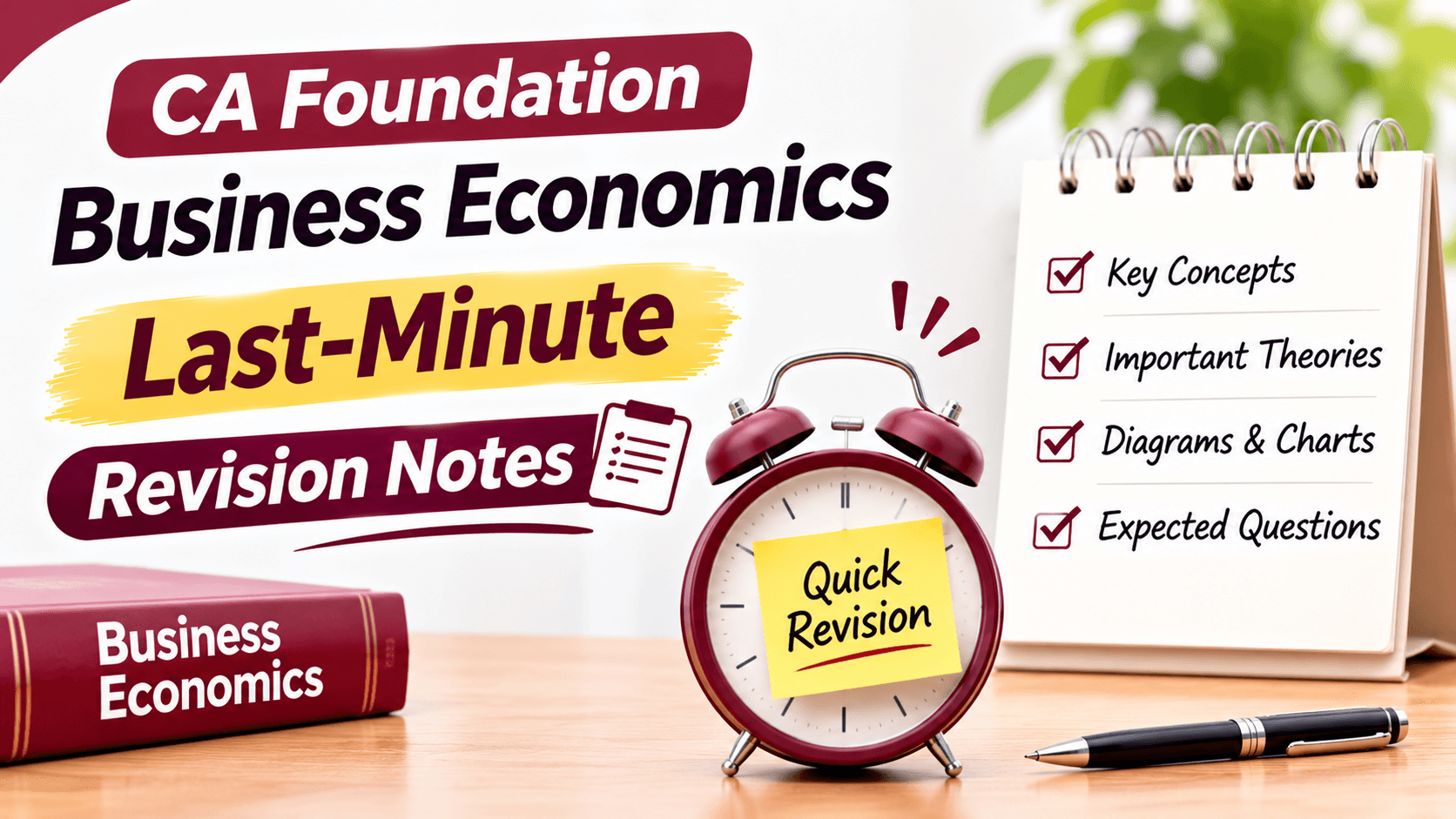
Last-Minute CA Foundation Business Economics Revision Notes
Revise CA Foundation Business Economics efficiently with concise concept summaries, diagrams, comparison points, active recall, practice questions and a final-week…
In this article(13 sections)ShowHide
Last-minute revision for Business Economics should focus on clear concepts, important distinctions, and the ability to explain how ideas relate. Rushing through every page can create the feeling of progress without showing whether you can recall the material or answer questions accurately.
Use concise summaries and active recall to identify what you know and what still needs attention. Keep revision aligned with the current ICAI syllabus and study material, and leave time for question practice rather than spending the entire final phase reading.
Start with a chapter audit
List topics in your current syllabus and mark each as strong, uncertain, or weak. This helps you decide where time will make the biggest difference. Avoid spending the whole session on familiar topics simply because they feel comfortable.
Close your notes after this topic and check what you can recall or apply independently. Record any gap and schedule a follow-up review rather than marking the topic complete based only on reading.
Revise concepts, not isolated sentences
For each topic, write the central idea, key terms, assumptions, and relationships. Explain the concept in plain English without looking at notes. If you cannot explain it clearly, revisit the relevant section before attempting more questions.
Close your notes after this topic and check what you can recall or apply independently. Record any gap and schedule a follow-up review rather than marking the topic complete based only on reading.
Compare similar ideas
Economics includes concepts that are related but not identical. Put them side by side and compare meaning, assumptions, effects, and examples. Keep comparisons accurate to current study material and use them to test yourself.
Close your notes after this topic and check what you can recall or apply independently. Record any gap and schedule a follow-up review rather than marking the topic complete based only on reading.
Draw and interpret diagrams where relevant
If a topic uses a graph or diagram, practise drawing it from memory, labelling the axes, and explaining what changes when a factor changes. Understand the relationship the diagram represents rather than memorising its shape alone.
Close your notes after this topic and check what you can recall or apply independently. Record any gap and schedule a follow-up review rather than marking the topic complete based only on reading.
Create concise revision summaries
Keep key definitions, assumptions, relationships, and commonly confused points in a short document. Avoid copying the textbook. A useful summary should help you recall the topic quickly and direct you back to detailed material when needed.
Close your notes after this topic and check what you can recall or apply independently. Record any gap and schedule a follow-up review rather than marking the topic complete based only on reading.
Use active recall in short sessions
Close the notes and write a brief explanation, list key points, or answer a self-made question. Check the answer and correct gaps. Short recall sessions are easier to fit into a busy revision day than passive reading.
Close your notes after this topic and check what you can recall or apply independently. Record any gap and schedule a follow-up review rather than marking the topic complete based only on reading.
Practise objective questions carefully
Attempt practice questions without checking answers immediately. When an answer is wrong, identify whether the issue was a misunderstood concept, confusing wording, or a rushed choice. Review why the correct option fits and why alternatives do not.
Close your notes after this topic and check what you can recall or apply independently. Record any gap and schedule a follow-up review rather than marking the topic complete based only on reading.
Review confusing terms
Maintain a short list of concepts, definitions, and comparisons that you repeatedly mix up. Revisit it daily during the final phase. Keep explanations beside terms so the distinction remains meaningful rather than becoming a memorised label.
Close your notes after this topic and check what you can recall or apply independently. Record any gap and schedule a follow-up review rather than marking the topic complete based only on reading.
Use a realistic final-week schedule
Divide each day between topic revision, question practice, and review of errors. Include buffer time for unfinished work. Avoid creating perfect notes in the final days or sacrificing sleep to cover every line.
Close your notes after this topic and check what you can recall or apply independently. Record any gap and schedule a follow-up review rather than marking the topic complete based only on reading.
Take timed practice tests
Timed sets help you manage pace and reveal whether you can recall ideas under exam conditions. Review your performance and identify a few corrections for the next session. Avoid taking test after test without analysing what went wrong.
Close your notes after this topic and check what you can recall or apply independently. Record any gap and schedule a follow-up review rather than marking the topic complete based only on reading.
Keep the final day light and organised
Use the final day for concise summaries, confusing concepts, and exam-logistics reminders. Do not introduce multiple new resources or unverified notes. The goal is to reinforce what you have studied and arrive ready to concentrate.
Close your notes after this topic and check what you can recall or apply independently. Record any gap and schedule a follow-up review rather than marking the topic complete based only on reading.
Use Studycaller as part of revision
Use relevant Studycaller preparation resources alongside prescribed study material and practice questions. Let practice results identify weak concepts and focus the remaining time where it is most useful.
Close your notes after this topic and check what you can recall or apply independently. Record any gap and schedule a follow-up review rather than marking the topic complete based only on reading.
Quick Revision Table
| Revision activity | What to do | Purpose |
|---|---|---|
| Chapter audit | Mark strong, uncertain, weak | Set priorities |
| Concept recall | Explain topic without notes | Check understanding |
| Comparison review | Compare similar concepts | Reduce confusion |
| Question practice | Attempt without checking answers | Test application |
| Error review | Record and correct mistakes | Avoid repeat errors |
CA Foundation Economics notes
Free notes from the Studycaller library, picked for this article.
 Amendments
CA Foundation · Business Economics
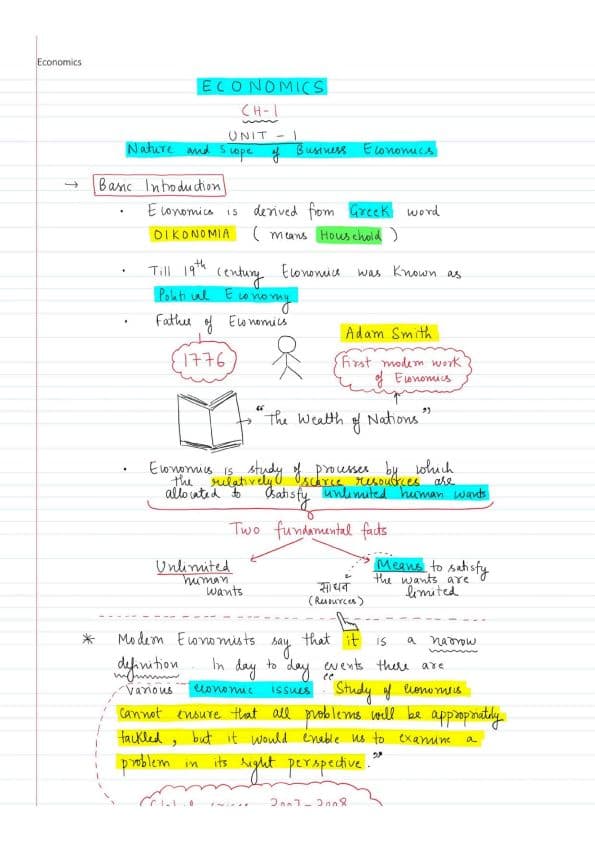
Full economics handwritten notes by CA Parag Gupta sir
Heet HingrajiyaLikes 209Views 68.6k Detailed Notes
CA Foundation · Business Economics
"Hi guys! Maine kuch naya try kiya Economics me — ek alag andaaz, ek alag soch. Chapter 1: Nature & Scope of Business Economics – Unit 1
مُحَمَّدLikes 126Views 14.7k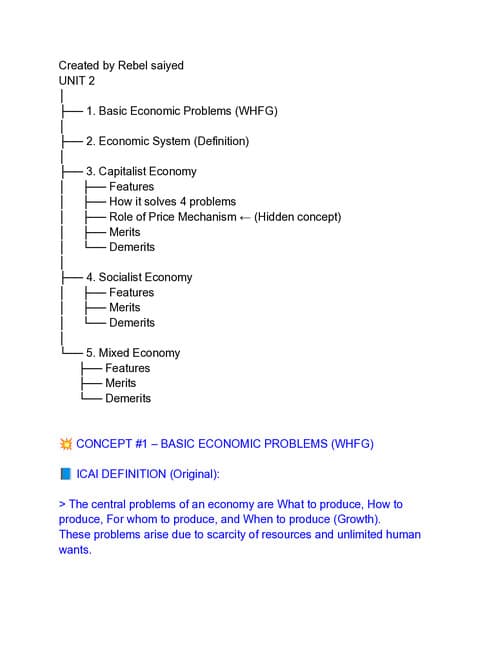 Amendments
CA Foundation · Business Economics
Hello dosto ' ye tumhare liye Eco chpt 1 unit 2 story full and esay
مُحَمَّدLikes 116Views 13.3k Summary
CA Foundation · Business Economics
TOP 150 EXPECTED QUESTIONS of Business Economics
Yashwanth K.JLikes 103Views 84.2k
Frequently asked questions
What should I revise first?
Audit the current syllabus and identify weak or uncertain topics. Prioritise concepts you cannot explain clearly, then use practice questions to check whether revision has worked.
Are short notes enough for last-minute revision?
Short notes support recall but should not replace understanding or question practice. Use them to revisit concepts, definitions, assumptions, and comparisons from prescribed material.
How can I remember similar concepts?
Create comparison tables explaining each concept, its assumptions, effects, and examples. Test yourself by describing the difference without looking at the table.
Should I practise diagrams?
Yes, where diagrams are relevant to the syllabus. Draw and label them from memory and explain what each diagram represents.
How many mock tests should I take in the final week?
Choose a realistic number that leaves enough time to analyse each test and correct mistakes. A test is most useful when feedback changes what you revise next.
What should I do with wrong objective answers?
Identify the concept or wording that caused the error, check the explanation, and retry a similar question later. Do not simply memorise the correct option.
Can I cover the whole subject in one day?
That depends on prior preparation, but one day is rarely enough to learn everything deeply. Use a priority list, concise summaries, and question practice instead of reading every page at the same pace.
Should I study new topics on the last day?
Avoid opening many new resources on the final day. If a specific gap is important, review it briefly from reliable material, then return to familiar summaries.
How can I avoid panic?
Use short blocks with clear targets, keep a written priority list, and track completed tasks. Protect sleep and take brief breaks to keep revision focused.
How can Studycaller fit into my revision plan?
Use relevant Studycaller resources alongside prescribed material and independent question practice. Let mistakes guide which concepts to revisit instead of relying only on passive reading.