
Daily Execution Plan for CA Students: A Proven System to Score Higher
Discover a practical daily execution plan for CA students to improve consistency, revision, productivity, and exam performance with smart study habits.
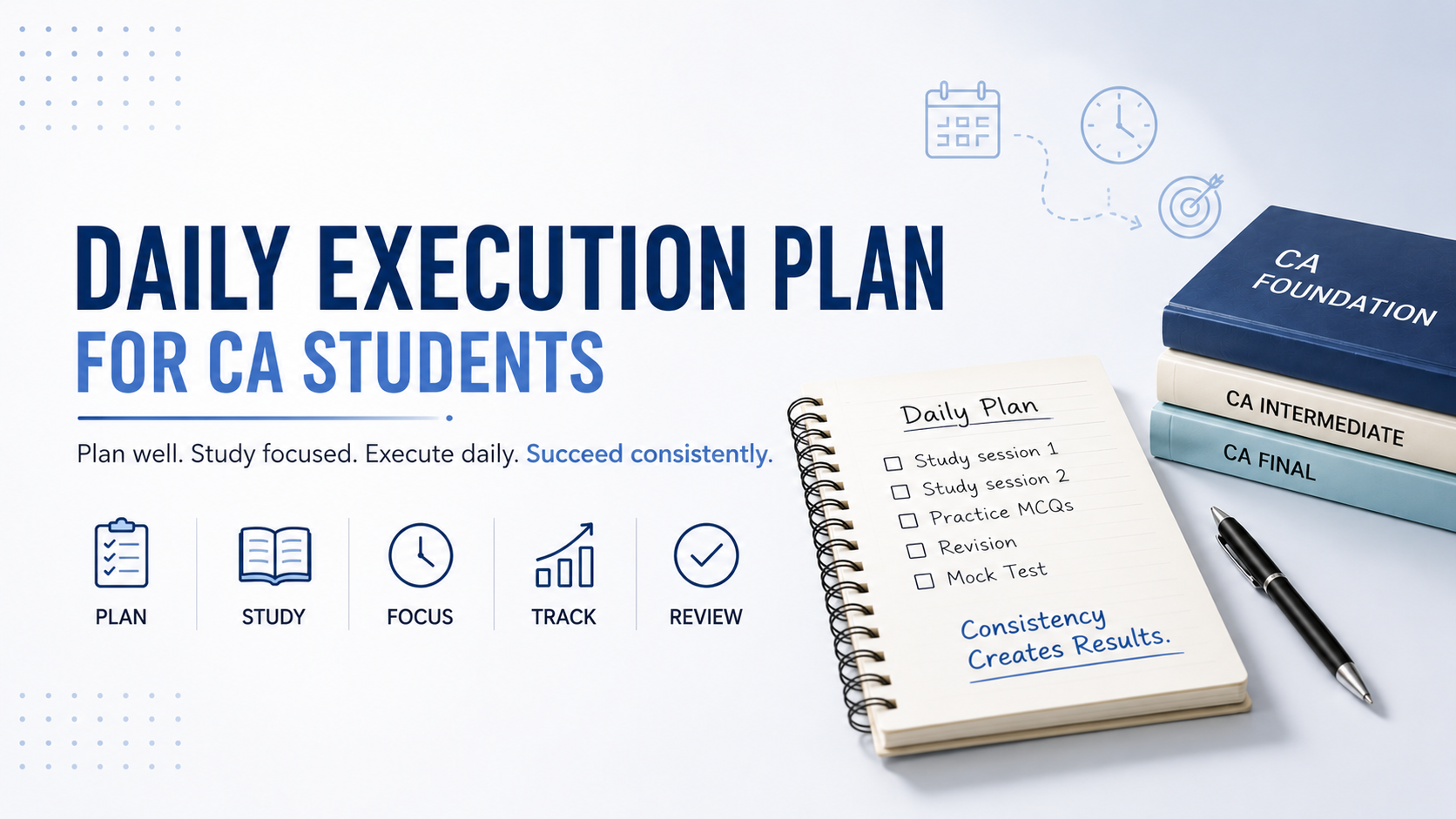
Table of Content
- Why Daily Execution Is More Important Than Motivation
- Build Your Day Around Results, Not Study Hours
- Essential Elements of a Daily Execution Plan
- Begin the Day with Your Toughest Subject
- Don't Study Randomly—Create Study Blocks
- Daily Habits That Separate Successful CA Students
- Make Revision a Non-Negotiable Activity
- Question Practice Is Where Real Preparation Begins
- Benefits of Solving Questions Daily
- Use Mock Tests to Measure Daily Execution
- Review Your Progress Every Evening
- Avoid Common Execution Mistakes
- Balance Productivity with Well-Being
- Consistency Always Beats Perfection
- Daily Execution Creates Long-Term Success
- Conclusion
Every CA student dreams of clearing the examination on the very first attempt. They purchase the best books, attend coaching classes, prepare detailed timetables, and begin their journey with great enthusiasm. However, after a few weeks, many students realize that creating a study plan is much easier than following it consistently. Daily distractions, irregular routines, pending revisions, and unfinished targets slowly affect their preparation. As a result, students spend more time planning than actually studying.
The biggest difference between successful CA students and average performers is not intelligence or study hours—it's daily execution. Students who consistently complete their daily targets, revise regularly, and monitor their progress usually stay ahead throughout their preparation. A well-planned execution system helps students convert their study plans into measurable progress while avoiding last-minute stress. Instead of focusing only on the final result, they concentrate on winning every single day, and that daily discipline eventually leads to examination success.
Why Daily Execution Is More Important Than Motivation
Motivation is temporary. Some days you will feel energetic and excited to study, while on other days you may struggle to even open your books. If your preparation depends only on motivation, consistency becomes difficult.
Daily execution, however, is based on habits and discipline. It ensures that even on less productive days, some meaningful progress is made. Students who rely on routines instead of emotions generally complete their syllabus on time and enter the examination with greater confidence.
Build Your Day Around Results, Not Study Hours
Many CA students proudly say they studied for ten or twelve hours. Unfortunately, spending long hours with books does not always mean productive learning. A student who studies with complete focus for five hours may achieve far more than someone who spends an entire day getting distracted.
Instead of asking, "How many hours did I study today?" ask yourself, "What did I actually complete today?" This simple shift in thinking helps students become more productive and accountable.
Essential Elements of a Daily Execution Plan
- Clear Daily Targets – Decide exactly what chapters, questions, or revisions must be completed before starting your study session.
- Focused Study Sessions – Study with complete concentration instead of multitasking between different subjects and devices.
- Daily Revision – Allocate dedicated time to revise previously studied topics so concepts remain fresh.
- Question Practice – Solve practical and theory questions every day to improve application skills.
- Progress Tracking – Review your achievements at the end of the day and prepare for tomorrow.
Following these five elements consistently builds a strong preparation routine.
Begin the Day with Your Toughest Subject
Most students naturally postpone difficult subjects until later in the day. Unfortunately, by that time, mental energy has already been reduced. A better strategy is to start your day with the subject that requires the highest concentration. Whether it is Financial Reporting, Costing, Direct Tax, or Advanced Accounting, tackling difficult topics early increases productivity and builds confidence. Once the hardest work is completed, the remaining study sessions become much easier to manage.
Don't Study Randomly—Create Study Blocks
Instead of studying continuously for long hours, divide your day into focused study blocks.
For example, one block can be dedicated to concept learning, another to revision, another to question practice, and another to mock test analysis. This approach keeps the brain engaged and prevents mental fatigue. Students who organize their study sessions properly usually retain information more effectively.
Daily Habits That Separate Successful CA Students
- Morning Planning – Spend five minutes deciding the day's priorities before opening your books.
- Topic-Wise Revision – Revise older chapters daily instead of waiting for the final month.
- Writing Practice – Solve questions with proper workings and presentation.
- Limited Distractions – Keep social media and unnecessary notifications away during study sessions.
- Night Review – Evaluate what was completed and prepare tomorrow's target list.
These simple habits may look small individually, but together they create extraordinary long-term results.
Make Revision a Non-Negotiable Activity
One of the biggest mistakes students make is giving complete attention to new chapters while ignoring revision. As a result, concepts studied a month ago become difficult to remember. Revision should become part of your daily execution plan rather than a separate activity.
Even thirty to forty-five minutes of revision every day can significantly improve retention. Students who revise regularly often find that the final revision phase becomes much less stressful because they are strengthening concepts instead of relearning them.
Question Practice Is Where Real Preparation Begins
Reading concepts creates understanding, but solving questions develops examination skills. Students should attempt practical problems, descriptive questions, and previous examination questions regularly. This improves application, increases writing speed, and develops familiarity with ICAI's examination style. The more questions you solve before the examination, the more confident you become during the actual paper.
Benefits of Solving Questions Daily
- Better Concept Application – Practical exposure strengthens theoretical understanding.
- Improved Writing Speed—Regular writing develops faster answer presentation.
- Higher Accuracy – Repeated practice reduces calculation and conceptual mistakes.
- Greater Confidence – Familiarity with different question patterns reduces examination anxiety.
- Better Time Management – Students learn how to allocate time effectively during papers.
- Daily question practice converts preparation into performance.
Use Mock Tests to Measure Daily Execution
Many students attempt mock tests only during the final weeks. However, mock tests are useful throughout the preparation journey because they reveal whether your daily execution strategy is actually working.
A mock test highlights areas where concepts are weak, revision is insufficient, or time management needs improvement. Instead of considering a mock test as just another paper, treat it as a report card that tells you exactly what should be improved before the actual examination. Students who analyze every mock test carefully usually improve their scores steadily.
Review Your Progress Every Evening
A productive day should always end with a short review session. Ask yourself questions like:
- Did I complete today's targets?
- Which chapter needs another revision?
- What mistakes did I make today?
- Which subject should I begin with tomorrow?
This habit improves accountability and prevents unfinished work from accumulating. Small daily reviews lead to better weekly and monthly progress.
Avoid Common Execution Mistakes
Many students struggle not because they lack knowledge but because their execution process is weak.
- Creating Unrealistic Timetables – Plans that cannot be followed usually reduce motivation.
- Ignoring Revision – New learning without revision leads to faster forgetting.
- Studying Without Practice – Reading alone is not enough for CA examinations.
- Frequently Changing Strategies – Constantly switching methods creates confusion.
- Comparing Yourself with Others – Personal progress matters far more than someone else's timetable.
Avoiding these mistakes makes daily preparation smoother and more effective.
Balance Productivity with Well-Being
Studying continuously without taking care of your health eventually reduces concentration and efficiency. A good execution plan should also include:
- Proper sleep
- Nutritious meals
- Short study breaks
- Light physical activity
- Positive mental habits
Students who maintain their health throughout the preparation period often perform better because they can sustain productivity for longer durations.
Consistency Always Beats Perfection
Many students postpone studying because they believe they need a perfect schedule, perfect mood, or perfect environment. Unfortunately, perfection rarely exists. Successful CA students focus on consistency instead. Even on difficult days, they complete at least a part of their planned work. This habit prevents long gaps in preparation and keeps momentum alive. Remember, studying consistently for six months is far more effective than studying extremely hard for only a few weeks.
Daily Execution Creates Long-Term Success
Every completed chapter, every solved question, every revision session, and every mock test contributes to your final result. These small actions may seem ordinary on a daily basis, but together they build extraordinary preparation over time.
The students who clear CA examinations confidently are usually those who respected their daily routine. They did not wait for motivation or the perfect time to study. They simply executed their plan consistently, one day at a time.
Conclusion
A successful Daily Execution Plan for CA Students is not about studying the longest hours but about making every study session meaningful. Students who combine clear daily targets, regular revision, question practice, mock tests, and performance reviews build a strong foundation for examination success. Rather than chasing perfection, focus on executing your plan consistently. Every productive day brings you one step closer to becoming a Chartered Accountant. Small daily improvements, maintained over several months, often produce the biggest results.

FAQs
What is a daily execution plan for CA students?
A daily execution plan is a structured routine that combines concept learning, revision, question practice, and progress tracking to ensure consistent exam preparation.
Why is execution more important than planning?
Planning provides direction, but execution converts plans into actual results through daily action and disciplined study habits.
How should I divide my study day?
You should divide your day into focused study blocks for learning new concepts, revision, question-solving, and reviewing your progress.
Should revision be included every day?
Yes. Daily revision strengthens memory, improves concept retention, and reduces pressure during the final examination phase.
Why is question practice important?
Question practice improves conceptual application, writing speed, accuracy, and familiarity with the CA examination pattern.
How often should I attempt mock tests?
Students should attempt mock tests regularly, preferably every week or after completing major portions of the syllabus.
How can I stay consistent with my study routine?
Set realistic daily targets, avoid distractions, review your progress every evening, and focus on completing tasks instead of counting study hours.
What are the biggest mistakes in daily CA preparation?
Ignoring revision, studying without solving questions, following unrealistic timetables, and changing study strategies frequently are common mistakes.
Should I measure my preparation by study hours?
No. Measuring completed topics, revisions, and question practice provides a much more accurate picture of your preparation.
What is the biggest benefit of following a daily execution plan?
The biggest benefit is consistent progress, which improves confidence, reduces exam stress, and significantly increases the chances of clearing CA exams.