Why Active Learning Works Better for CA Students: Complete Guide
Discover why active learning works better for CA students and how it improves retention, understanding, and exam performance compared to passive study methods.
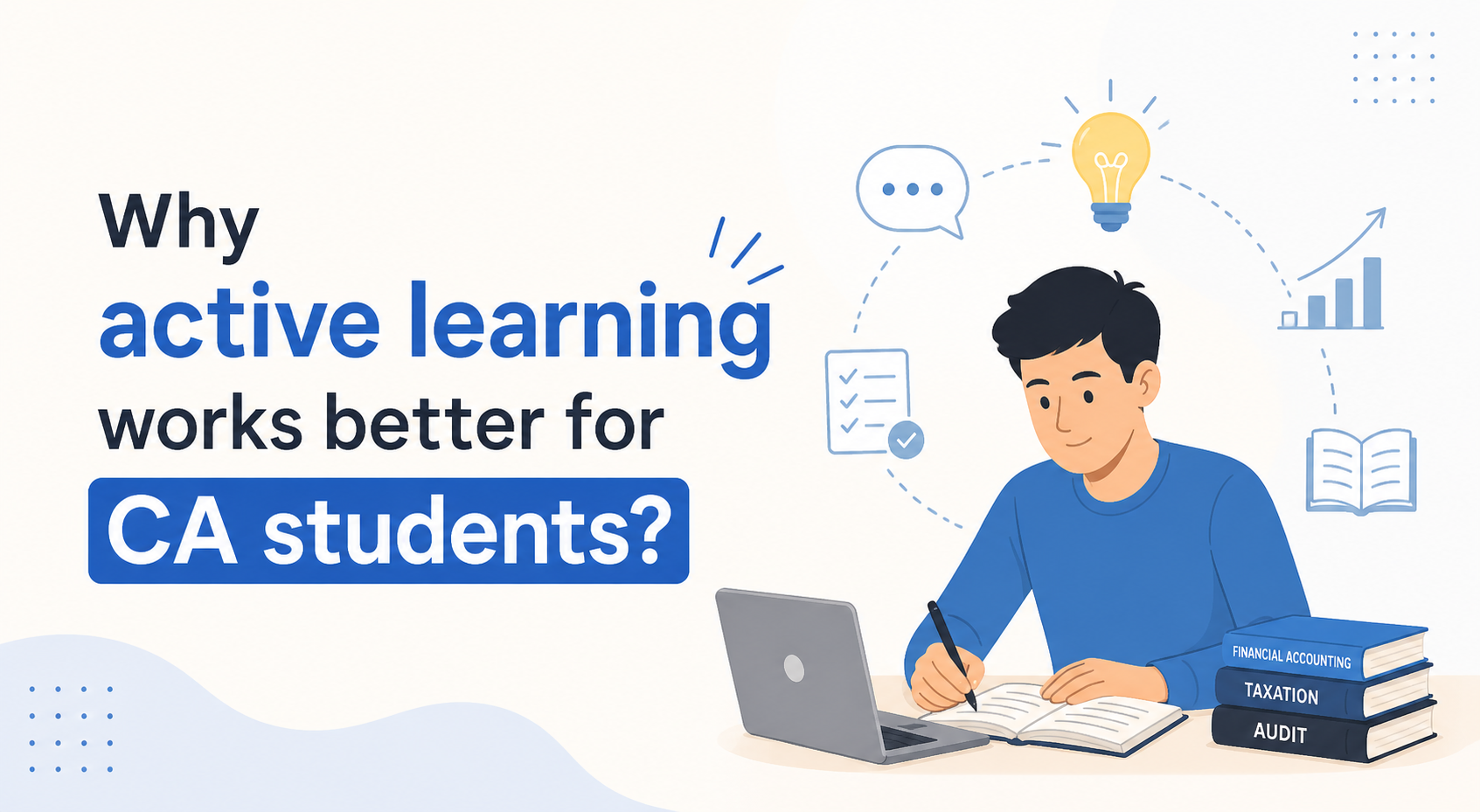
Table of Content
- Understanding the Problem with Traditional Study Methods
- What is Active Learning?
- Why Active Learning Works Better for CA Students
- Active Learning Improves Retention
- It Builds Strong Conceptual Understanding
- Active Learning Reduces Exam Anxiety
- Practical Ways to Apply Active Learning
- Balancing Active and Passive Learning
- Why Many Students Avoid Active Learning
- How Active Learning Helps in Both Theory and Practical Subjects
- Building a Habit of Active Learning
- Conclusion
CA preparation is not just about studying for long hours—it is about studying in the right way. Many students spend entire days reading books, attending lectures, and revising notes, yet they struggle to recall concepts during exams. This creates a gap between effort and results, which often leads to frustration.
If you are wondering why active learning works better for CA students, the answer lies in how the brain processes and retains information. Active learning is not about studying more; it is about engaging your mind in a way that improves understanding, memory, and application.
Understanding the Problem with Traditional Study Methods
Most students rely heavily on passive learning. This includes reading textbooks, highlighting important lines, or listening to lectures without much involvement. While these methods may create a sense of familiarity, they do not ensure deep understanding.
Passive learning makes you feel productive, but it does not challenge your brain. When you see the same content again, it feels familiar, and you assume you know it. However, in the exam hall, when you need to recall information without any support, that familiarity disappears. This is where active learning makes a difference.
What is Active Learning?
Active learning is a method where you actively engage with the subject instead of simply consuming information. It involves thinking, recalling, applying, and analyzing concepts. Instead of just reading a topic, you interact with it. You ask questions, solve problems, explain concepts, and test your understanding. In simple terms, active learning means:
- Learning by doing, not just reading
- Focusing on understanding, not memorizing
- Engaging your brain instead of passively observing
This approach makes learning more effective and long-lasting.
Why Active Learning Works Better for CA Students
CA exams are not designed to test how much you have read. They test how well you understand and apply concepts. This is why active learning works better than passive methods.
When you actively engage with the subject, your brain processes information at a deeper level. This leads to better retention and faster recall. Active learning helps CA students in multiple ways:
- It improves conceptual clarity, which is essential for both theory and practical subjects
- It strengthens memory through repeated recall and application
- It reduces dependency on rote learning
- It prepares you for unpredictable exam questions
Because of these benefits, students who use active learning techniques often perform more consistently in exams.
Active Learning Improves Retention
One of the biggest challenges in CA preparation is remembering large volumes of information. Passive learning may help you understand concepts temporarily, but it does not ensure long-term retention.
Active learning forces your brain to retrieve information repeatedly. This process strengthens memory and makes it easier to recall during exams. For example, instead of reading a chapter again, try explaining it in your own words. Even if you struggle initially, this effort improves retention significantly.
It Builds Strong Conceptual Understanding
CA subjects are interconnected. Concepts from one topic often apply to another. If your understanding is weak, you may face difficulty in solving questions or writing answers.
Active learning focuses on understanding the logic behind concepts. When you actively engage with the material, you start seeing connections between topics. This deeper understanding makes it easier to handle complex questions and reduces confusion during exams.
Active Learning Reduces Exam Anxiety
Exam anxiety is often caused by lack of confidence. When you rely only on passive learning, you are never fully sure whether you actually know the topic. Active learning builds confidence because it involves regular self-testing. When you practice recalling and applying concepts, you become more aware of your strengths and weaknesses. This clarity reduces uncertainty and helps you stay calm during exams.
Practical Ways to Apply Active Learning
Active learning does not require complicated methods. Small changes in your study routine can make a big difference. Some simple ways to apply active learning include:
- Asking yourself questions after studying a topic
- Solving problems without looking at solutions
- Explaining concepts to yourself or someone else
- Practicing mock tests regularly
These techniques keep your mind engaged and improve your overall learning experience.
Balancing Active and Passive Learning
While active learning is highly effective, it does not mean passive learning has no role. Reading and listening are still important, especially during the initial stage of learning. The key is to maintain a balance. Use passive learning to understand new concepts, and then switch to active learning to strengthen them. For example, after attending a lecture or reading a chapter, spend some time recalling and practicing what you learned. This combination creates a strong learning cycle.
Why Many Students Avoid Active Learning
Despite its benefits, many students hesitate to use active learning. The main reason is that it feels difficult. Active learning requires effort. It forces you to think, recall, and sometimes struggle. Passive learning, on the other hand, feels easy and comfortable. However, this comfort can be misleading. Real learning happens when your brain is challenged. The initial discomfort of active learning leads to better results in the long run.
How Active Learning Helps in Both Theory and Practical Subjects
Active learning is not limited to one type of subject. It works effectively for both theory and practical papers. In theory, it helps you remember concepts and present answers clearly. In practical subjects, it improves problem-solving skills and accuracy. By using active learning, you develop a deeper understanding of subjects, which helps you perform better across all papers.
Building a Habit of Active Learning
Like any skill, active learning becomes easier with practice. Initially, it may feel slow and challenging, but with time, it becomes a natural part of your study routine. Start with small changes. Instead of reading passively, pause and think. Instead of revising by reading, try recalling. Gradually, these habits will improve your efficiency. Consistency is the key. The more you practice active learning, the better your results will be.
Conclusion
Understanding why active learning works better for CA students can completely change the way you study. It shifts your focus from quantity to quality, from reading to understanding, and from memorizing to applying.
Active learning is not about working harder—it is about working smarter. When you engage your mind actively, your retention improves, your concepts become clear, and your confidence increases. In the long run, this approach not only helps you clear exams but also builds a strong foundation for your professional career.

FAQs
Why does active learning work better for CA students than passive learning?
Active learning works better for CA students because it involves recalling, applying, and understanding concepts, which improves retention and exam performance compared to passive reading methods.
What is active learning in CA preparation?
Active learning in CA preparation means engaging with the subject through recall, problem-solving, and self-testing instead of only reading or listening to lectures.
How does active learning improve memory?
Active learning improves memory by forcing the brain to retrieve information repeatedly, which strengthens retention and makes it easier to recall concepts during exams.
Can active learning help in theoretical subjects?
Yes, active learning helps in theoretical subjects by improving understanding, making it easier to remember concepts, and helping students write structured answers in exams.
Is active learning useful for practical subjects?
Active learning is highly useful for practical subjects as it involves solving problems and applying concepts, which improves accuracy and speed in exams.
How can I start using active learning?
You can start using active learning by asking questions, recalling concepts without notes, solving problems, and explaining topics in your own words.
Why do students avoid active learning?
Students avoid active learning because it feels difficult and requires effort, while passive learning feels easier but is less effective for long-term retention.
How much time should be given to active learning daily?
Students should dedicate a significant portion of their study time to active learning, ideally combining it with passive learning for a balanced approach.
Does active learning reduce exam stress?
Yes, active learning reduces exam stress by building confidence through regular practice and improving clarity of concepts.
Is active learning enough for CA preparation?
Active learning is essential for CA preparation, but it should be combined with basic reading and understanding to create an effective study strategy.