You have about 40 days before the CA Inter January 2027 exams begin on 2 January. That is enough for one full revision of both groups, one round of mock papers and a short final revision, but only if every day has a fixed job. This CA Inter study plan for January 2027 gives you that day-by-day structure.
The plan assumes you have studied the syllabus at least once, even if some chapters are weak. If large parts are still untouched, use the same structure but give those chapters the first slot of each week and cut back on mocks.
CA Inter January 2027 exam schedule at a glance
ICAI announced the January 2027 schedule on 23 September 2026. Group I papers are on 2, 4 and 6 January 2027, and Group II papers on 8, 10 and 12 January 2027. Every paper runs from 2 pm to 5 pm, with 15 minutes of advance reading time from 1:45 pm.
| Group | Papers | Exam days (January 2027) |
|---|---|---|
| Group I | Paper 1 Advanced Accounting, Paper 2 Corporate and Other Laws, Paper 3 Taxation | 2, 4 and 6 January |
| Group II | Paper 4 Cost and Management Accounting, Paper 5 Auditing and Ethics, Paper 6 Financial Management and Strategic Management | 8, 10 and 12 January |
The one-day gap between papers is short. You cannot learn a new chapter in it, only revise. That is why your real preparation must finish before the exams start. Our CA Inter January 2027 exam schedule post has the full timetable as ICAI released it.
A note on Taxation for this attempt
Many students are confused about the new Income-tax Act. ICAI has announced that the Income-tax Act, 2025 will apply to Intermediate Paper 3A (Income-tax Law) from the May 2027 examination onwards. So the January 2027 attempt is not the first one under the new Act. Prepare Taxation from the ICAI study material and the applicability notice meant for January 2027, which you can find on the ICAI Intermediate Taxation page.
Do not mix notes made for the new Act with your current material. Students who switch sources at this stage often end up learning section numbers that will not be tested in this attempt.
How to split 40 days between both groups
If you are writing both groups, a 60:40 split in favour of your weaker group works for most students. Here is the overall shape of the plan.
- Days 1 to 24: first full revision of all six papers, four days per paper.
- Days 25 to 34: mock papers under exam conditions, one paper every day, with the next morning spent on checking.
- Days 35 to 40: quick revision of Group I, since it comes first.
- Exam gaps: revision only for the next paper, Group II revision done in the gaps between Group I papers and in the days after.
If you are writing only one group, double the days per paper in the first phase and write two rounds of mocks instead of one.
Day 1 to 24: first full revision
Each paper gets four days. Split those days into two for the heavy chapters, one for the remaining chapters and one for questions from past papers and the revision test papers ICAI publishes.
| Days | Paper | Focus |
|---|---|---|
| 1 to 4 | Advanced Accounting | Accounting Standards and company accounts, then remaining chapters |
| 5 to 8 | Cost and Management Accounting | Costing methods, standard costing, marginal costing, budgets |
| 9 to 12 | Taxation | Income tax computation chapters, then GST |
| 13 to 16 | Financial Management and Strategic Management | FM numericals first, SM theory in short sessions |
| 17 to 20 | Corporate and Other Laws | Company law chapters, then other laws |
| 21 to 24 | Auditing and Ethics | Standards on Auditing, audit of items, ethics |
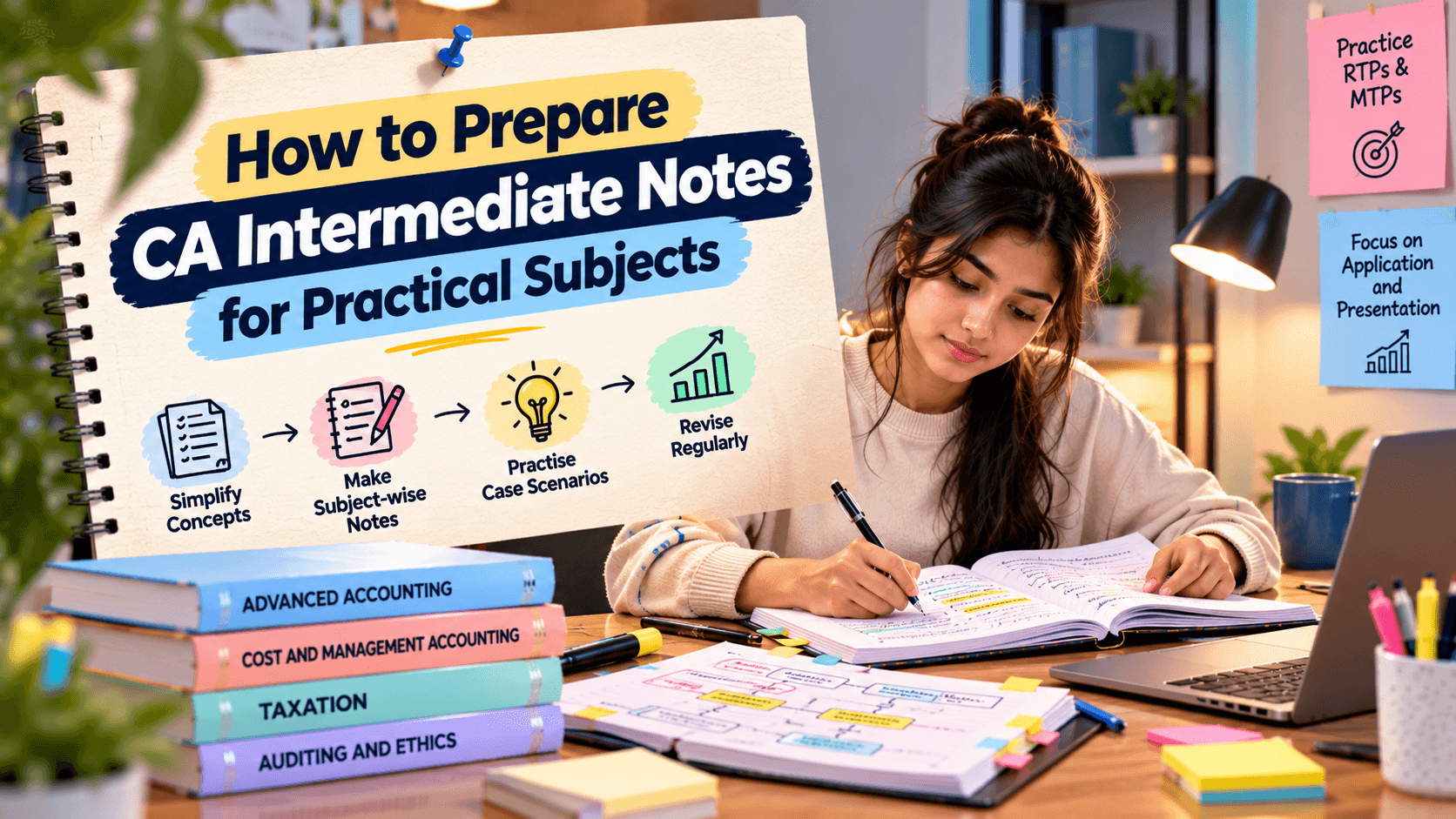
We alternate practical and theory papers on purpose. After four days of numbers, a law or audit paper feels fresh, and you remember more. Keep a small sheet for each paper with the formulas, sections and standard lines you will revise again in the last week.
A daily routine that holds up
Most students who finish this phase on time study in three blocks: a morning block of three hours for the hardest chapter of the day, an afternoon block from 2 pm to 5 pm matching the exam slot, and an evening block for theory and the revision sheet. Studying in the 2 to 5 pm slot trains your brain for exam time.
Day 25 to 34: mock papers and checking
This is the phase most students skip, and it is the one that moves marks the most. Write one full paper each day in the 2 to 5 pm slot. Next morning, check it against suggested answers and note every lost mark in three buckets: did not know, knew but made an error, ran out of time.
The third bucket is the most common in CA Inter. If time runs out in a practical paper, look at where you spent too long. Usually it is one long question in Advanced Accounting or a costing question where the working notes grew too big. Set a rough limit of 1.8 minutes per mark and stick to it in the next mock.
Check your own mocks strictly. Give yourself marks only for what is written, not for what you meant. If a step is missing, cut the mark. Students who check kindly feel good for a week and then get a shock in the result. A strict self-check also shows you which presentation habits lose marks, such as missing units, unlabelled working notes or answers without a conclusion line.
Keep a simple mock log with the date, paper, score, time left at the end and the top three reasons for lost marks. By day 34 you will see clear patterns, and the last six days can go straight to fixing them.
Past papers are the best mock material. Use the questions from our CA Intermediate previous year question papers list along with ICAI's mock test papers.
Day 35 to 40 and the exam gaps
From day 35, focus on Group I because it comes first. Spend two days each on Advanced Accounting, Corporate and Other Laws, and Taxation, using only your revision sheets, marked questions from the study material and your mock mistakes. No new books.
In the one-day gaps between papers, revise only the next paper. Read the revision sheet in the morning, solve a few short questions in the afternoon, and look at the theory lines at night. Group II revision is lighter here because you revised it in the first phase and wrote its mocks in the second.
Common mistake in the last week
Most students lose marks in the last week because they start a fresh set of notes or videos in panic. Your own sheets and your own mistakes are faster to revise and more useful. Trust the work you have done.
Paper-wise tips for the final weeks
In Advanced Accounting and Cost and Management Accounting, presentation counts. Write working notes neatly and refer to them in the main answer. In Taxation, keep computation formats ready and practise GST questions in a fixed layout.
In Corporate and Other Laws and in Auditing and Ethics, write answers in the provision, facts, conclusion style and quote the section or standard only when you are sure. In FM and SM, give FM numericals the first and larger share of time, and keep SM answers short and to the point.
For chapter notes on every Inter paper, open the free CA Inter notes. If a doubt is stopping you on a chapter, post it on Studycaller doubts and move to the next chapter while you wait for the answer. Do not let one doubt cost you a whole evening.
Looking after yourself in these 40 days
Sleep at least six to seven hours. A tired brain makes more calculation errors, and no extra hour of study makes up for that. Take one short break every 90 minutes, eat on time and step outside for a few minutes daily. These small things decide how well you perform on 12 January, ten days after your first paper.