The CA Inter January 2027 exam date is fixed. ICAI will hold Group 1 on 2, 4 and 6 January 2027 and Group 2 on 8, 10 and 12 January 2027, with every paper from 2 PM to 5 PM. Each paper has exactly one free day before it, except Advanced Accounting, which opens the attempt.
ICAI released this schedule on 23 September 2026. Exam forms closed on 19 November with the late fee, and the correction window runs from 20 to 22 November 2026. Below you will find both groups in one table and the deadlines that still matter. The bigger part of this page is a plan for what to revise on each gap day, because that one day decides more marks than most students expect.
CA Inter January 2027 exam date sheet: both groups in one table
The table puts both groups together with the weekday, so you can see where your gap days fall. If you are writing both groups, this is your full 11-day run. If you are writing only one group, read only your rows.
| Date | Day | Group | Paper | Time |
|---|---|---|---|---|
| 2 January 2027 | Saturday | Group 1 | Paper 1: Advanced Accounting | 2 PM to 5 PM |
| 4 January 2027 | Monday | Group 1 | Paper 2: Corporate and Other Laws | 2 PM to 5 PM |
| 6 January 2027 | Wednesday | Group 1 | Paper 3: Taxation (Income Tax and GST) | 2 PM to 5 PM |
| 8 January 2027 | Friday | Group 2 | Paper 4: Cost and Management Accounting | 2 PM to 5 PM |
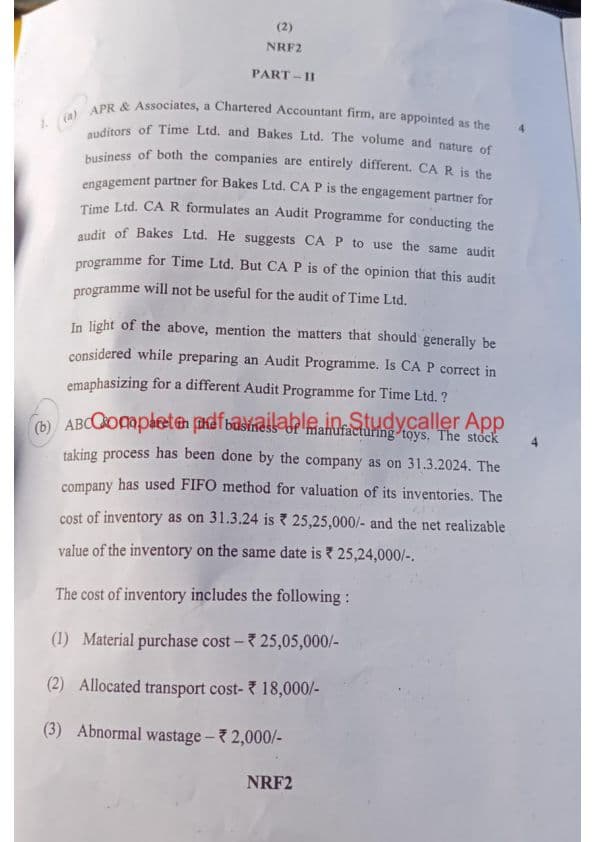
| 10 January 2027 | Sunday | Group 2 | Paper 5: Auditing and Ethics | 2 PM to 5 PM |
| 12 January 2027 | Tuesday | Group 2 | Paper 6: Financial Management and Strategic Management | 2 PM to 5 PM |
Two things students often miss. First, 10 January is a Sunday, and the Audit paper still goes ahead. ICAI's notice says the schedule will not change even if a Central or State Government or a local body declares a public holiday on an exam day. Second, CA Foundation January 2027 runs from 3 to 9 January, so your gap days overlap with Foundation papers. Your exam centre will be busy on those days, which does not affect you, but it is worth knowing if a younger sibling or friend is also writing. Our CA Foundation January 2027 timetable has their dates.
Key dates left before the January 2027 attempt
Most of the form process is already over. Here is where things stand as of 20 November 2026.
| Event | Date | Status |
|---|---|---|
| Schedule announced by ICAI | 23 September 2026 | Done |
| Exam form opened | 3 November 2026 | Done |
| Last date without late fee | 16 November 2026 | Closed |
| Last date with Rs 600 late fee | 19 November 2026 | Closed |
| Correction window (exam city, medium) | 20 to 22 November 2026 | Open now |
| Admit card | Not announced yet | Expected in the second half of December 2026 |
| Result | Not announced yet | Expected around March 2027 |
The exam fee at Indian centres was Rs 1,500 for one group and Rs 2,700 for both groups. If you picked the wrong exam city or medium, fix it on eservices.icai.org before 22 November closes. Do not leave it for the last evening, because the portal slows down when everyone logs in at once.
ICAI has not announced the admit card date or the result date yet, and we will update this page when it does. The expectations above come from past sessions. Admit cards usually come out about two weeks before the first paper, and January Inter results have come out around March. Keep an eye on the official ICAI website for the actual notices.
How the paper gaps work in the CA Inter January 2027 schedule
Every gap in this timetable is a single day. There is no long break between groups. If you write both groups, Taxation on 6 January is followed by one day off, and then Costing on 8 January. That means the gap day before Costing is the only Costing-specific day you get once exams begin.
The mistake we see every attempt is students treating a gap day like a fresh study day. It is not. You cannot learn a new chapter in 20 hours and also sleep properly. A gap day is for revision from your own short notes, formula sheets and marked questions, plus one timed attempt of a few questions to get your writing speed back. If a topic is completely new to you on the gap day, let it go and make the rest of the paper solid.
A simple rhythm works for most people:
- Morning (about 4 hours): the heaviest scoring chapters, from your own notes.
- Afternoon (about 3 hours): the second half of the syllabus, faster, at a summary level.
- Evening (about 2 hours): MCQ practice or a few timed descriptive answers, then a quick look at formats and sections.
- Night: sleep by 11. The paper starts at 2 PM, but your brain needs the rest.
What to revise on each gap day: Group 1
Before 2 January: Advanced Accounting
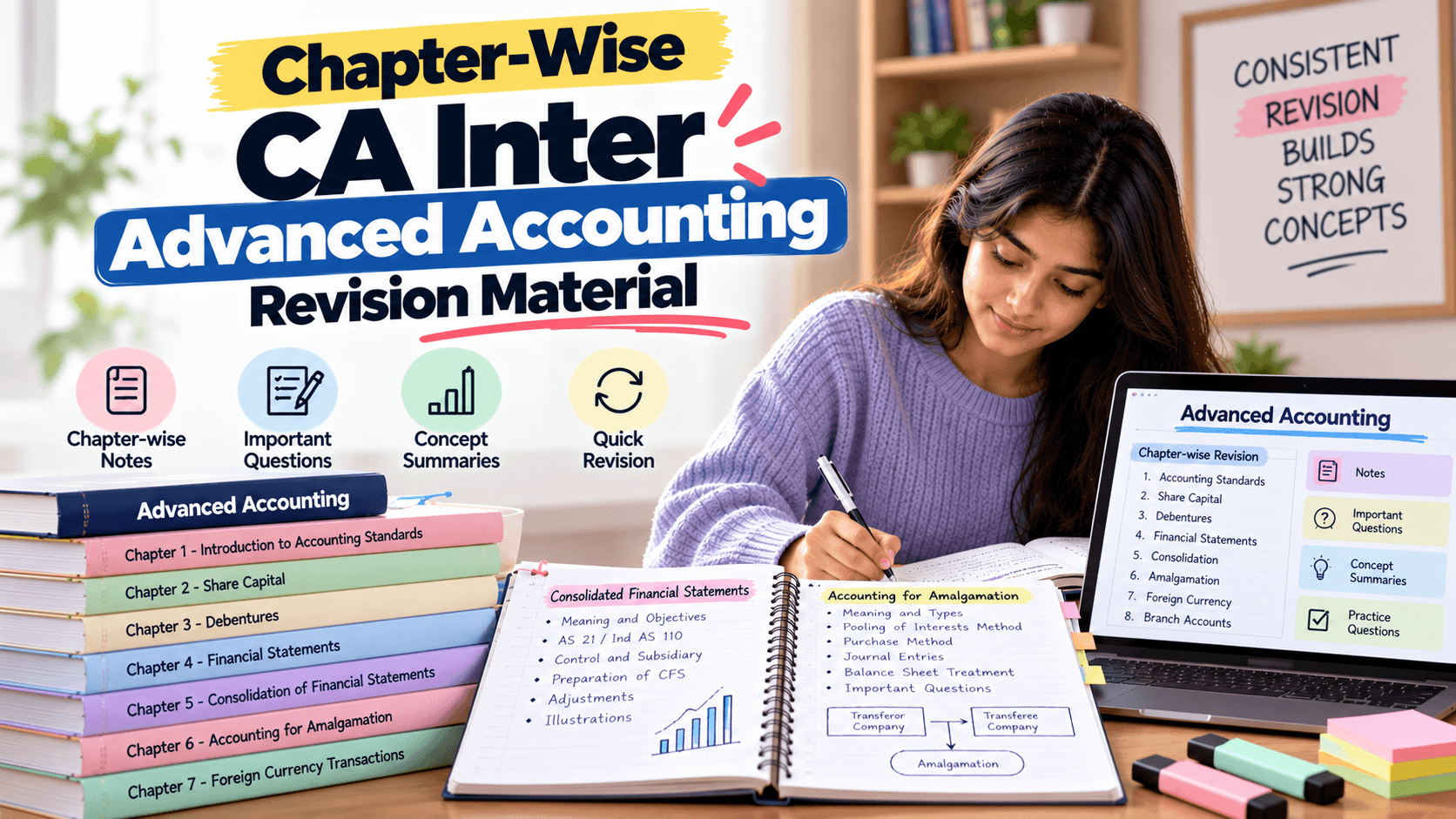
There is no gap day before Paper 1, so your last three or four days of December act as the gap. Spend them on Accounting Standards questions, company accounts, amalgamation and buyback, and consolidated statements. Advanced Accounting is the paper where presentation costs marks quietly. Practise writing working notes clearly, because examiners give step marks only when they can follow your workings. If you need more questions, the CA Inter notes section has question banks for Advanced Accounting along with every other paper.
3 January: Corporate and Other Laws
Paper 2 has Company Law and LLP as the major part, and Other Laws (General Clauses Act, Interpretation of Statutes and FEMA) as the smaller part. Spend the morning on Companies Act chapters with the most questions in past papers: incorporation, share capital and debentures, deposits, registration of charges, members and meetings, and accounts and audit. Use the afternoon for LLP and the Other Laws chapters. These are short and score well if you remember the definitions.
Most students lose marks here because they write the conclusion without the provision. Write the relevant rule first, then apply it to the facts, then conclude. Practise three case questions in the evening in that order. Our CA Inter Law notes and question banks are arranged chapter by chapter, which makes this kind of quick revision easier.
5 January: Taxation
Taxation is split into Income Tax Law and GST, 50 marks each. The common mistake is giving the whole gap day to Income Tax because it feels heavier, then walking into the GST half underprepared. Split the day evenly.
- Morning, Income Tax: profits and gains of business or profession, capital gains, house property, salary computation and Chapter VI-A deductions. Redo two full computation questions to get the format into your hands.
- Afternoon, GST: supply, charge of tax, exemptions, time and value of supply, input tax credit, registration, and tax invoice and returns.
- Evening: the MCQ block, which carries 30 marks with no negative marking. Attempt every MCQ in the exam.
Check ICAI's applicability notice for the January 2027 attempt so you know which Finance Act and amendments apply. Our CA Inter Taxation notes include GST and Income Tax question banks, chart books and summary notes that fit a one-day revision.
What to revise on each gap day: Group 2
7 January: Cost and Management Accounting
If you are writing both groups, this is the day after Taxation, and you will be tired. Do not start with theory. Open your formula sheet first and go through standard costing variances, marginal costing, budgets and budgetary control, process costing, and joint and by-products. Then attempt one question from each of those chapters against the clock.
Costing marks leak through wrong formats: a cost sheet with missing heads, or variance answers without saying favourable or adverse. Spend the last hour only on presentation. You will find Costing notes and practice material in the CA Inter notes library.
9 January: Auditing and Ethics
Audit is a pure writing paper, apart from its MCQ block. The gap day should go to the Standards on Auditing, the Code of Ethics and professional misconduct, company audit, the audit report, and audit of items of financial statements. Keep a one-page list of SA numbers and titles, and read it three times through the day.
Students who score well in Audit quote the SA number and the exact principle, then apply it. Vague answers that sound right still get low marks. Our CA Inter Audit summary notes are short enough to finish in one sitting on this day.
11 January: Financial Management and Strategic Management
Monday 11 January is the only day in this window with no CA paper at all, Foundation or Inter. Use it fully. Paper 6 has two halves, so split the day the same way you did for Taxation.
- Morning, FM: capital budgeting, cost of capital, leverages, capital structure, working capital management and ratio analysis. These are formula heavy, so solve rather than read.
- Afternoon, SM: go chapter by chapter through strategic analysis, strategic choices and strategy implementation. Use keywords and short frameworks, not long paragraphs.
- Evening: one timed mixed set of FM numericals and SM case questions.
Most students neglect SM because it feels like easy reading, then write general answers that score poorly. Tie each SM answer to the case facts. For FM practice, open our CA Inter FM notes and practice questions.
One group or both: how the gaps change your plan
If you are writing Group 1 only, your attempt ends on 6 January. That gives you more December time for Taxation, which is the heaviest paper in the group. If you are writing Group 2 only, your first paper is on 8 January, so you get an extra week compared with both-group students. Use it for Costing and FM numericals, which reward repeated practice.
If you are writing both groups, plan your December backwards from 12 January. Keep the final ten days of December for revision only, and finish all first reading before about 20 December. That way each gap day in January is a second or third revision, not a first one.
A few things to sort out before December
- Confirm your exam city and medium in the correction window, which closes on 22 November.
- Download the admit card the day it is released, and check your photo, centre address and papers.
- Visit your exam centre a day before your first paper so the travel time does not surprise you.
- Make one-page sheets for each paper now. Those are the sheets you will read on the gap days.
All the notes linked above are free on Studycaller, and you can save them in the Studycaller app to revise offline on gap days. If a doubt comes up the evening before a paper, post it there and get it cleared before you sleep.