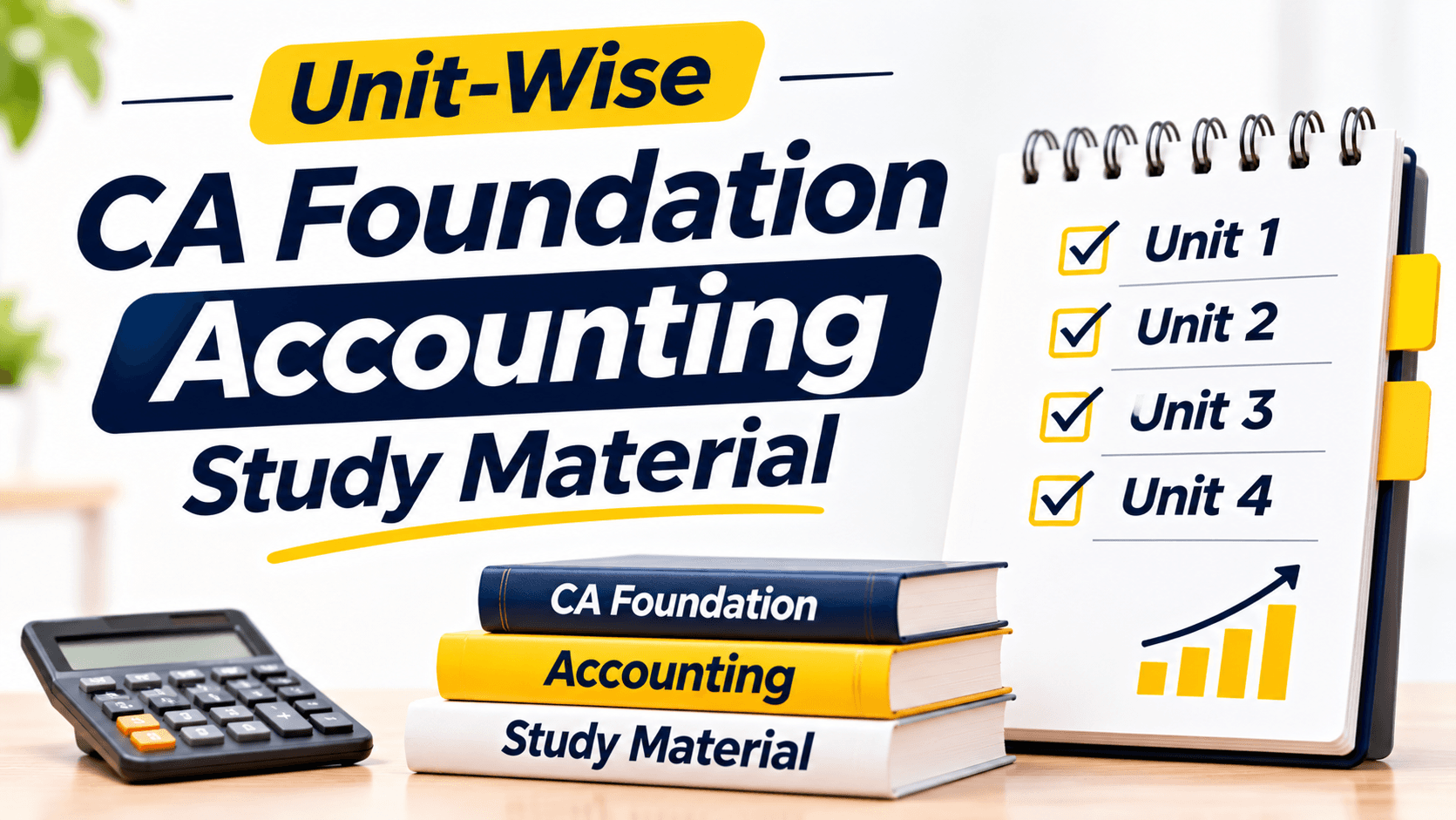
Unit-Wise CA Foundation Accounting Study Material
Learn how to organise unit-wise CA Foundation Accounting study material for concept learning, journal entry practice, revision, numerical accuracy and exam preparation.
In this article(11 sections)ShowHide
CA Foundation Accounting includes concepts and practical procedures that students need to understand and apply accurately. Studying the subject unit by unit can make the syllabus easier to manage, especially when each unit is supported by examples, practice questions and a clear revision plan.
Unit-wise study material is most effective when it follows the applicable ICAI syllabus and helps students move from basic concepts to independent problem-solving. This guide explains how to organise Accounting preparation, build useful notes and practise consistently without treating the subject as a collection of memorised formats.
Benefits of unit-wise study material
Unit-wise material divides a large subject into smaller learning blocks. Students can focus on one group of concepts at a time, track completed topics and identify areas that need more practice. It also makes it easier to plan revision without repeatedly searching through an entire book.
A unit structure should not separate concepts that depend on one another. Use cross-references when a later topic builds on an earlier accounting principle. This helps you understand the subject as a connected system rather than unrelated chapters.
Map units to the current syllabus
Start with the latest CA Foundation Accounting syllabus and study material applicable to your attempt. Use the official unit and chapter sequence as the base for your study plan. Check relevant ICAI announcements and updates before relying on older notes.
Prepare a checklist showing each unit, its topics and your progress. You can use simple labels such as not started, learning, practised and revised. This gives you a clear picture of the syllabus and helps prevent smaller topics from being overlooked.
Use a consistent unit structure
For every unit, organise material into learning objectives, key concepts, accounting treatment or process, worked examples, practice questions and revision points. The exact headings can vary depending on the topic, but a consistent layout makes it easier to study and review.
Keep definitions and principles concise but accurate. Add step-by-step workings for numerical topics and show the reason behind important entries or adjustments. If a topic has a standard format, practise preparing it from memory rather than only reading a completed example.
Include a small section for common errors. Record issues such as incorrect classification, missed adjustments, wrong calculations or incomplete presentation so that future revision targets the areas where you need improvement.
Build concepts before solving questions
Before attempting a numerical question, understand the accounting concept behind it. Identify what the transaction represents, which accounts are affected and why a particular treatment is appropriate. This reduces dependence on memorised patterns.
Work through a basic example slowly and explain each step. Once the logic is clear, attempt a similar question without looking at the solution. Then increase the complexity by practising questions that combine more than one concept.
If you repeatedly make the same error, return to the underlying concept instead of solving many more questions mechanically. A small correction in understanding can improve performance across several question types.
Practise journal entries and formats
Journal entry practice should focus on identifying the transaction, selecting the accounts, applying the correct debit and credit treatment and recording the amount accurately. Explain the reason for the entry while learning, then practise writing it without assistance.
For formats and statements, learn the sequence and purpose of each component. Use blank templates to reconstruct the format from memory and complete it using practice data. This is more effective than repeatedly viewing a fully solved statement.
Check your working against the prescribed study material or reliable solutions. Pay attention to narration, classification, adjustments and the presentation required by the question.
Improve numerical accuracy
Accuracy improves when calculations are organised and each figure is traceable. Write intermediate steps clearly, label amounts and keep units consistent. Avoid performing too many calculations mentally when the working can be shown on paper.
Read the question carefully for dates, rates, quantities, conditions and adjustments. Underline the requirement and note the information provided before starting. Many mistakes occur because a detail is overlooked rather than because the accounting concept is unknown.
After solving, check whether the answer is reasonable and whether all relevant adjustments have been considered. Review arithmetic and presentation before moving to the next question.
Revise with unit-wise question sets
After completing a unit, solve a small set of questions covering its major concepts. Begin with direct questions and move towards mixed or application-based problems. Review every incorrect answer and identify whether the cause was conceptual, procedural or arithmetic.
Once several units are complete, attempt mixed questions that combine topics. This helps you identify the correct accounting treatment without being prompted by a unit heading. Use past examination questions to understand question style, but do not treat them as a substitute for syllabus coverage.
Schedule a later revision session for each unit. Start with recall of the key concepts and formats, then solve selected questions without looking at your notes.
Create a progress tracker
Track progress by more than reading completion. For each unit, record whether you understand the concepts, can complete a representative question independently and can reproduce important formats or entries accurately.
Review your tracker every week. If a unit remains at the learning stage, identify what is blocking progress. You may need to revisit a concept, practise more basic questions or improve the way you read the requirement.
Keep the plan balanced across Accounting and your other CA Foundation subjects. Give additional time to weak areas without allowing the rest of the syllabus to remain untouched.
Common study material mistakes
Do not collect multiple sets of notes without checking whether they match the current syllabus. Too many versions can create confusion and make revision slower. Keep the official material as your base and use supplementary notes only when they add clear value.
Avoid copying worked solutions without understanding the treatment. Rewriting an answer can create the appearance of practice while leaving the underlying concept unclear. Close the solution and attempt the question independently after studying it.
Do not postpone revision until the whole syllabus is complete. Short, repeated unit-wise reviews help retain earlier concepts and make final preparation more manageable.
Quick Reference Table
| Unit study component | Suggested material | Learning outcome |
|---|---|---|
| Concept notes | Definitions, principles and explanations | Understand the accounting treatment |
| Worked examples | Step-by-step solutions | See the method in practice |
| Practice set | Basic and application questions | Build independent problem-solving |
| Format practice | Blank statements and templates | Recall structure accurately |
| Error tracker | Mistake, reason and correction | Improve consistency |
| Revision checklist | Key points and selected questions | Monitor exam readiness |
How Studycaller Can Support Your Preparation
Studycaller can be considered as a supplementary learning and practice resource where relevant CA course material or tests are available. Check the current course coverage and use any practice feedback alongside the applicable ICAI study material. Supplementary notes and tests do not replace official content, amendment verification or independent revision.
CA Foundation notes students love
Free notes from the Studycaller library, picked for this article.
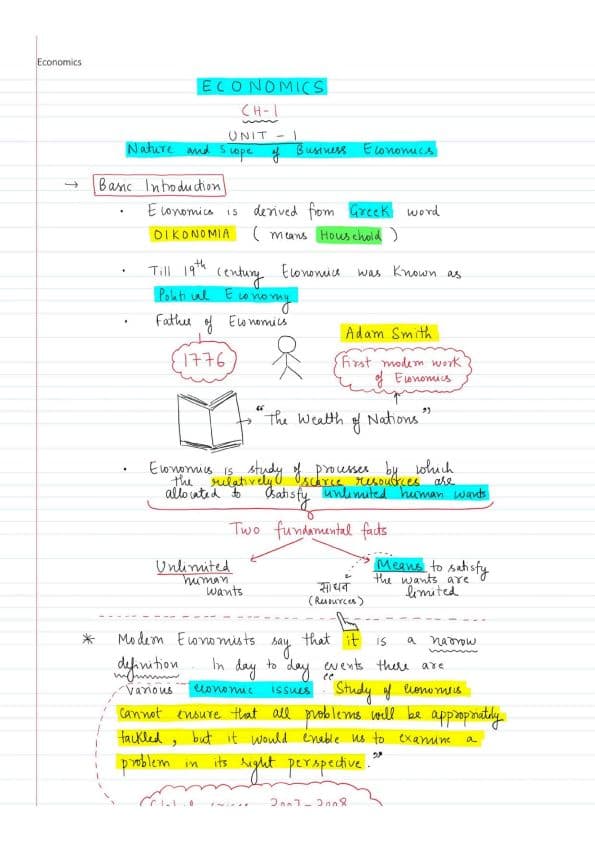 Amendments
CA Foundation · Business Economics
Full economics handwritten notes by CA Parag Gupta sir
Heet HingrajiyaLikes 209Views 68.6k Detailed Notes
CA Foundation · Business Economics
"Hi guys! Maine kuch naya try kiya Economics me — ek alag andaaz, ek alag soch. Chapter 1: Nature & Scope of Business Economics – Unit 1
مُحَمَّدLikes 126Views 14.7k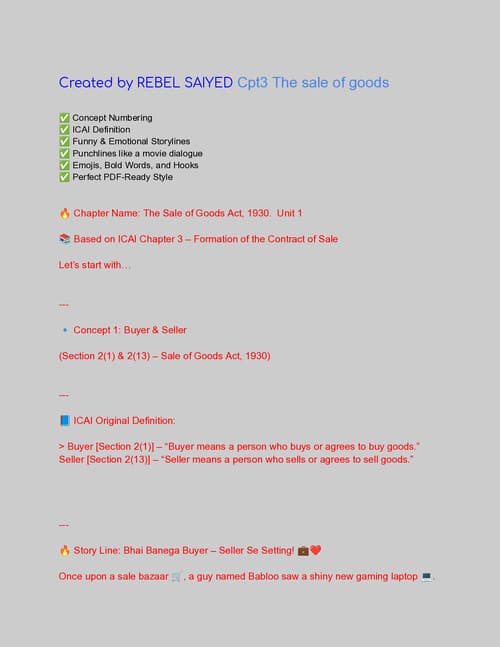 Charts
CA Foundation · Business Laws
Chpter 3 the sale of goods act Unit. 1 only. Full of story line Concept clarity and funny stories punch lines
مُحَمَّدLikes 118Views 14.2k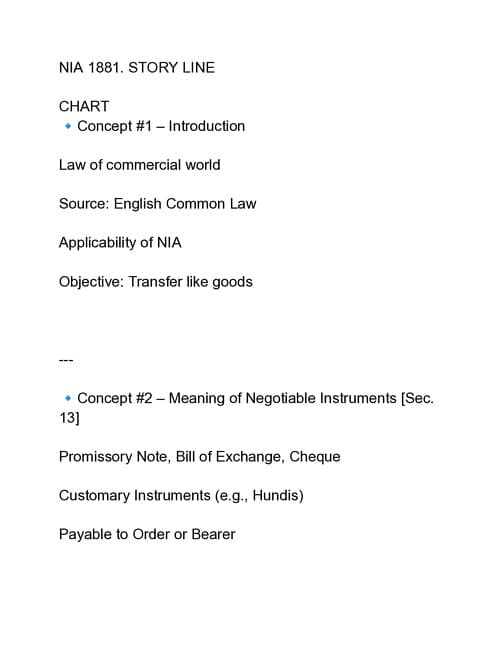 Amendments
CA Foundation · Business Laws
Nia 1881 story line pdf Coverage total 11 Concept
مُحَمَّدLikes 117Views 12.5k
Frequently asked questions
How should I study CA Foundation Accounting unit by unit?
Map the current ICAI syllabus into units, study concepts in sequence, practise worked examples and solve questions after each unit. Track understanding, accuracy and revision separately.
Is unit-wise CA Foundation Accounting material useful?
Yes. It breaks the subject into manageable learning blocks and helps track progress. Use cross-references for connected topics so that the subject remains a connected system rather than isolated units.
What should each Accounting unit's notes include?
Include learning objectives, key concepts, accounting treatment, worked examples, practice questions, formats and common errors. Keep the notes accurate and aligned with the applicable official material.
Should I memorise journal entries for CA Foundation?
Understand why each account is debited or credited and how the transaction affects the accounts. Then practise writing entries independently so that you can handle variations in question wording.
How can I improve accuracy in Accounting numericals?
Read the requirement carefully, list the relevant data, show intermediate workings, label amounts and units, and review adjustments and arithmetic before finalising the answer.
How many questions should I solve after completing a unit?
There is no fixed number for every unit. Solve enough representative questions to cover the main concepts, then review errors and practise additional questions in areas where accuracy is weak.
When should I revise completed Accounting units?
Revisit a unit soon after completing it, include a short review in your weekly plan and return to it during mixed practice. Use recall and questions rather than only rereading notes.
Can I use online notes instead of ICAI Accounting material?
Use online notes only as supplementary support after checking their accuracy and syllabus relevance. The applicable official ICAI material should remain the primary reference for preparation.
How do I know whether an Accounting unit is fully prepared?
You should be able to explain its main concepts, reproduce important formats or entries and solve representative questions independently with reasonable accuracy. Track errors and revise weak areas.
How can Studycaller support CA Foundation Accounting preparation?
Studycaller can be considered as a supplementary practice option where relevant CA Foundation Accounting tests are available. Use practice feedback with current ICAI material and unit-wise revision.