Exam-Focused CA Intermediate Audit Short Notes PDF
Understand how to prepare and use exam-focused CA Intermediate Audit short notes for standards, concepts, procedures, answer writing and quick revision.
In this article(11 sections)ShowHide
Audit preparation requires students to understand concepts, remember relevant standards and procedures, and present answers in a clear and logical manner. The subject can feel extensive because similar terms and processes appear across different chapters. Short notes can help organise these details for faster revision.
However, short notes are useful only when they are accurate, current and connected to the prescribed study material. This guide explains how to create exam-focused CA Intermediate Audit notes, what to include in them and how to use them with question practice and mock tests.
Purpose of exam-focused Audit notes
Audit short notes help students locate key concepts without repeatedly searching through lengthy chapters. They are particularly useful for revising definitions, objectives, responsibilities, procedures, documentation and differences between related terms.
Exam-focused does not mean prediction-based. Notes should cover the applicable syllabus and highlight the concepts that need clear explanation in an answer. Avoid reducing a topic to a few keywords if you cannot explain what those keywords mean.
Verify the current syllabus and material
Start by checking the CA Intermediate syllabus, applicable study material and updates for your examination attempt. Confirm the relevant auditing standards, announcements and any changes communicated by ICAI. A PDF shared online may belong to an earlier syllabus or may not reflect current amendments.
Use the official material as your reference point. If you use a third-party short-notes PDF, compare its chapter coverage and terminology with the prescribed content before relying on it.
Structure notes chapter by chapter
Follow the chapter order in the applicable study material. Under each chapter, create sections for the meaning of the concept, its objective, important requirements, steps or procedures, and practical relevance where applicable.
Keep related topics together but separate concepts that have different purposes. A comparison table can help distinguish similar terms, while a process chart can show the sequence of an audit procedure. Use concise explanations rather than unexplained abbreviations.
Leave room for examples and corrections. When a question reveals that a point is missing or unclear, update the relevant section instead of keeping a separate collection of disconnected additions.
Summarise standards and key concepts
When revising auditing standards, focus on the objective, scope, key requirements and responsibilities relevant to the prescribed syllabus. Avoid memorising a standard's title without understanding what it requires and how the requirement affects audit work.
Use a repeatable note format for each standard: purpose, central requirement, important terms, auditor's responsibility and a short application cue. The format helps you compare standards while keeping their individual requirements distinct.
Check exact wording and technical details against the current official material. Short notes should simplify revision, not alter the meaning of a requirement.
Make procedures and evidence easier to revise
Audit procedures can be organised by purpose and the type of evidence they help obtain. For each procedure, note what the auditor is trying to establish, what action may be performed and what the result helps the auditor evaluate.
Flowcharts can be useful for sequential processes, while tables are better for comparing procedures or types of evidence. Add a short example only when it clarifies the reason for performing a procedure.
During revision, ask yourself why a procedure is relevant in a particular situation. This helps you move beyond listing audit terms and towards explaining how the work supports an audit conclusion.
Prepare answer-writing frameworks
An answer framework helps you organise a response quickly. For a theory question, identify the central concept, explain the relevant requirements and include the points specifically requested. For a scenario-based question, identify the issue, connect it with the relevant audit principle and state a reasoned conclusion.
Use headings and numbered points where they improve readability. Keep the answer relevant to the question and avoid writing an entire chapter when only one requirement is asked.
Practise writing answers within a time limit. Review whether you addressed every part, used appropriate terminology and explained the point rather than simply naming it.
Use questions to test understanding
After revising a chapter, solve questions without looking at your notes. Start with short questions to test basic recall, then attempt longer questions that require explanation or application. Check the answer and identify the exact reason for each mistake.
Use past papers and practice questions to understand how concepts are examined. Do not rely on a list of supposedly important questions as a substitute for syllabus coverage.
Maintain an error log. If you confuse two concepts, add a comparison to your notes. If you forget a requirement, create a recall question and revisit it after a gap.
Plan quick revision
Divide the subject into manageable revision blocks. Each block should include a quick review of the notes, active recall and a few questions. Revisit difficult chapters more frequently while keeping earlier chapters in rotation.
Use a checklist to track whether you can explain the chapter, recall its key requirements and answer representative questions. Mark a topic as ready only when you can use the information without relying constantly on the notes.
Keep the final revision document readable. Avoid adding too many colours, symbols or decorative layouts that make the notes harder to scan under time pressure.
Mistakes to avoid
Do not download several short-notes PDFs and switch between them without checking accuracy. Conflicting terminology can create confusion and waste revision time. Select a reliable base resource and update it carefully.
Do not assume that a short PDF is complete merely because it is labelled exam-focused. Check syllabus coverage, current applicability and whether it explains concepts sufficiently for answer writing.
Finally, do not revise Audit only by reading. Retrieval, written answers and review of mistakes are necessary to check whether you can explain and apply the concepts.
Quick Reference Table
| Note format | Include | How to use it |
|---|---|---|
| Standard summary | Objective, scope and key requirements | Recall the purpose and requirements |
| Concept sheet | Definitions and distinctions | Revise similar terms accurately |
| Procedure chart | Steps, purpose and evidence | Understand audit work in sequence |
| Answer framework | Issue, concept, explanation and conclusion | Practise structured responses |
| Error log | Repeated mistakes and corrections | Target weak areas in revision |
How Studycaller Can Support Your Preparation
Studycaller can be considered as a supplementary learning and practice resource where relevant CA course material or tests are available. Check the current course coverage and use any practice feedback alongside the applicable ICAI study material. Supplementary notes and tests do not replace official content, amendment verification or independent revision.
CA Inter Audit notes
Free notes from the Studycaller library, picked for this article.
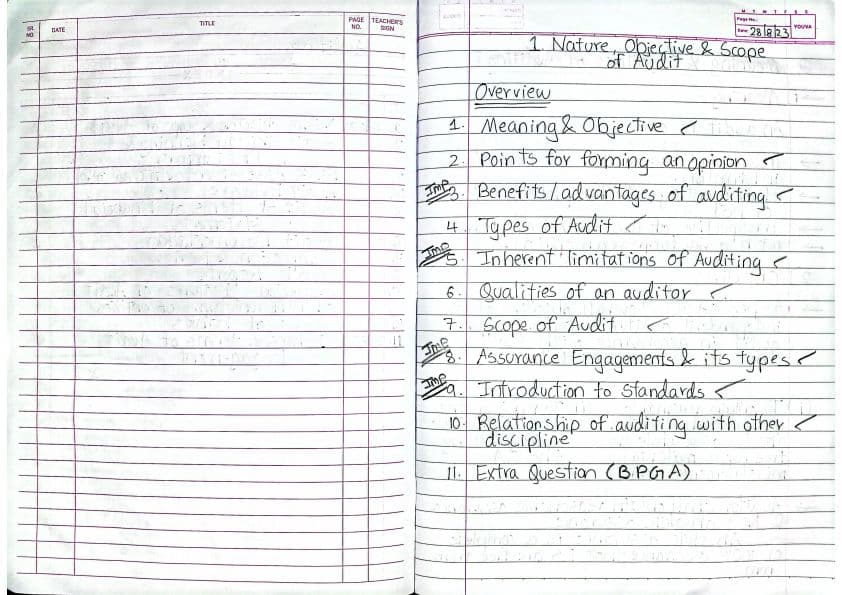 Handwritten
CA Inter · Auditing and Ethics
Audit Full Notes May 2024
Naman chaplotLikes 43Views 21.8k Charts
CA Inter · Auditing and Ethics
CA INTERMEDIATE AUDITING AND ETHICS CONCEPT BOOK BY CA DEEPIKA RATHI For September/January 24/25
Aadesh KumarLikes 34Views 22.7k Handwritten
CA Inter · Auditing and Ethics
Audit - Handwritten Notes By Rishabh Jain Sir !
Sujal TurakhiyaLikes 27Views 17.6k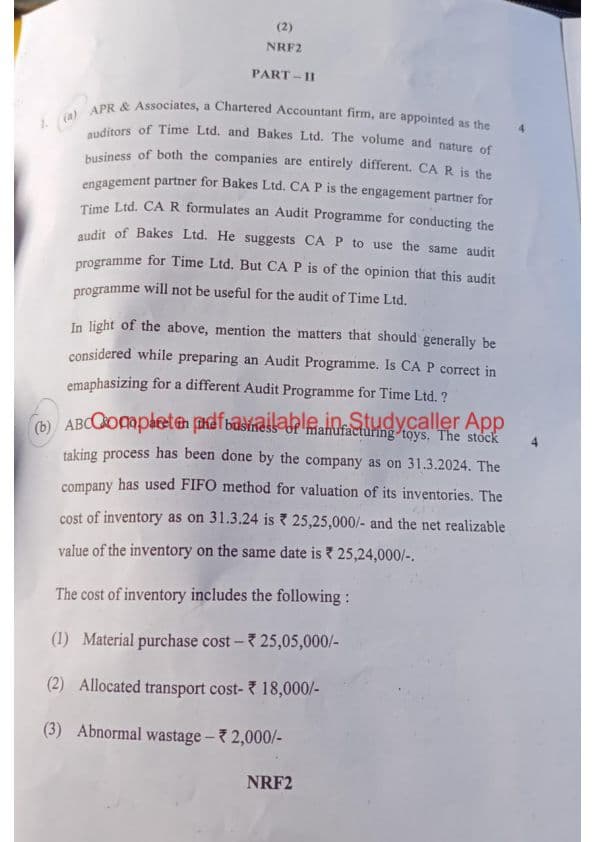 Amendments
CA Inter · Auditing and Ethics
CA Inter Auditing and Ethics Question Paper May 2024 Part II
Mahi❤️Likes 27Views 14.5k
Frequently asked questions
What should CA Intermediate Audit short notes include?
Organise notes around the applicable syllabus, standards, key concepts, procedures, evidence, responsibilities and answer frameworks. Keep explanations concise but accurate, and verify the content against current official study material.
Are CA Inter Audit short notes PDFs enough for exam preparation?
A short-notes PDF can support revision but should not replace the prescribed study material. Use detailed explanations to understand concepts, then revise through notes, questions and written practice.
How do I check whether an Audit notes PDF is updated?
Compare its chapter coverage and technical content with the current ICAI syllabus and study material. Check the applicable examination attempt and verify relevant updates or announcements from official sources.
How can I revise auditing standards quickly?
Prepare a consistent summary for each prescribed standard, covering its objective, scope, key requirements and responsibilities. Test recall and practise questions that require you to explain or apply the requirements.
Should I memorise Audit answers word for word?
Focus on understanding the concept and remembering essential technical terms and requirements. Practise explaining the points clearly in your own words while preserving the meaning of the prescribed material.
How can I improve Audit answer presentation?
Read the question requirement, use relevant headings and explain each point clearly. Avoid listing keywords without explanation and ensure that the answer addresses all parts of the question.
Are flowcharts useful for Audit revision?
Flowcharts can help with sequential procedures and processes, while tables are useful for comparing concepts. Choose the format that makes the relationship or sequence easier to understand.
How should I use past papers for CA Inter Audit?
Use past papers to understand question style and practise application. Review your answers against reliable guidance, identify missing points and continue covering the complete applicable syllabus.
How can I avoid confusion between similar Audit concepts?
Create comparison tables showing the meaning, purpose and distinguishing features of each concept. Test yourself by explaining the difference without looking at the notes.
Does Studycaller provide CA Intermediate Audit practice?
Studycaller may be used as a supplementary practice option where the relevant CA Intermediate Audit tests are available. Confirm current paper coverage and combine practice with official ICAI material.