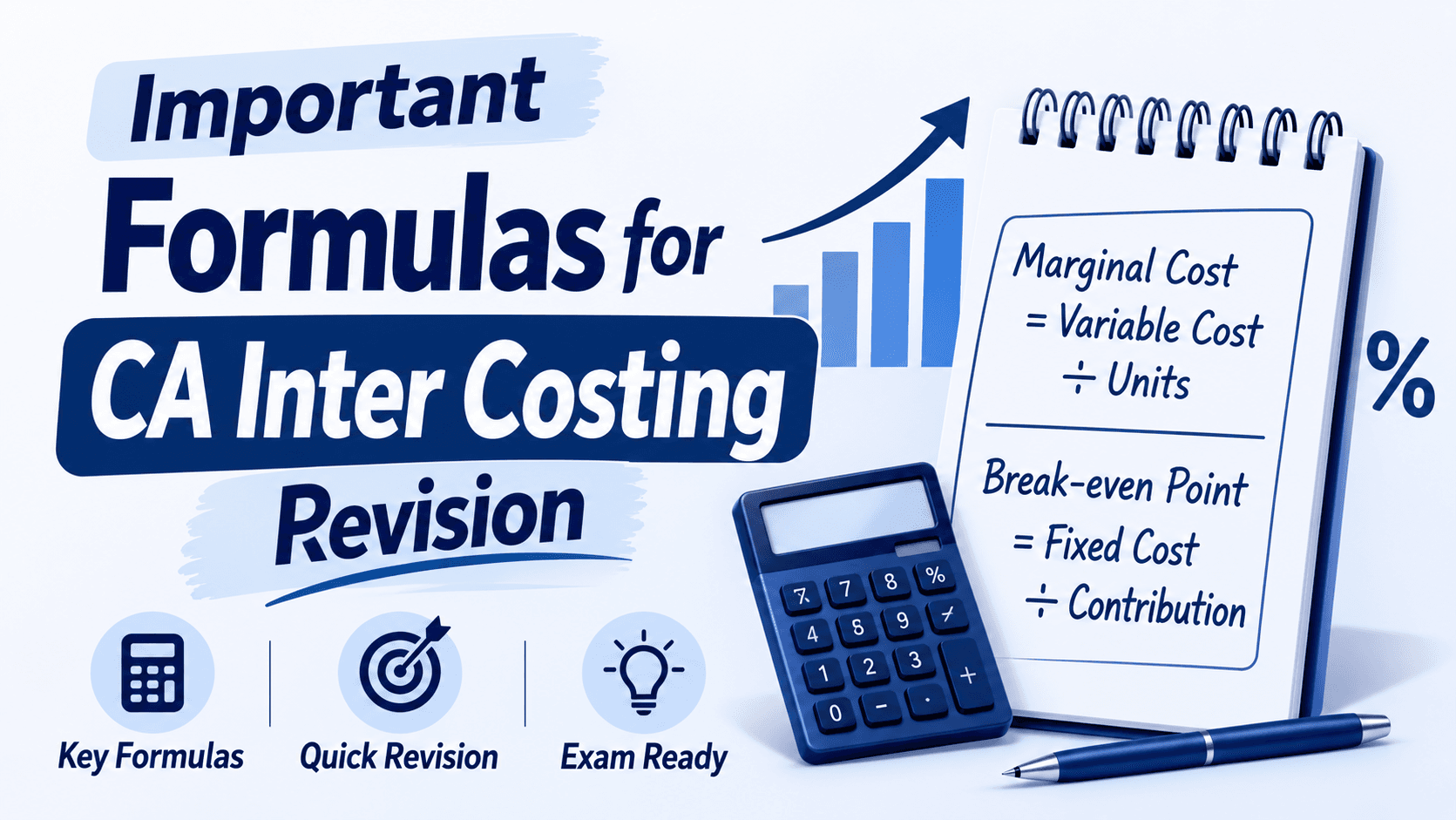
Important Formulas for CA Inter Costing Revision
Organise important CA Intermediate Costing formulas for revision with topic-wise formula sheets, calculation steps, practice questions and common error checks.
In this article(11 sections)ShowHide
Costing revision often involves moving between concepts, formula selection and numerical application. Students may remember an equation but still lose marks if they use the wrong figures, overlook units or fail to understand what the question is asking. A topic-wise formula sheet can make revision quicker, provided it is supported by regular problem-solving.
This guide explains how to organise important CA Intermediate Costing formulas, practise their application and avoid common calculation errors. The exact formula coverage should always be checked against the applicable ICAI syllabus and study material for your examination attempt.
Why a formula sheet helps
A formula sheet reduces the time spent searching for equations during revision. It also helps students compare related formulas and identify which figures are needed for a calculation. The sheet is most useful when each formula is accompanied by a short explanation and a practice reference.
Do not memorise formulas as isolated strings. Understand the relationship represented by the equation, the meaning of each variable and the conditions under which it is used. This makes it easier to adapt when a question presents information in a different order.
Organise formulas by syllabus topic
Follow the chapter structure in the applicable CA Intermediate Costing material. Create separate sections for each topic and list formulas under meaningful subheadings. Avoid placing every equation on one crowded page.
Use a consistent format: formula name, equation, meaning of symbols, unit of measurement and a short note about when to use it. If a formula has variations, show the difference clearly and explain the circumstances in which each version applies.
Keep a reference to the worked example or question type where you practised the formula. This allows you to move from quick recall to a full calculation when revising.
Understand the meaning of each variable
Before using a formula, identify each variable and confirm that the question provides the required information. Check whether the figure represents units, hours, rates, percentages, quantities or monetary values. Mixing units is a common source of avoidable mistakes.
Write down the known values before substituting them. If a value must be calculated first, complete that step separately and label the result. This makes your working easier to check and reduces the risk of using an incorrect figure.
Where a formula includes a percentage or ratio, confirm the base to which it applies. A correct percentage applied to the wrong base can still produce an incorrect answer.
Revise material and labour calculations
Material-related questions may involve quantities, prices, usage, purchase or stock-related calculations depending on the prescribed chapter. Keep the relevant formulas grouped together and note the meaning of each quantity and rate. Verify the exact method required by the question before beginning the calculation.
Labour-related questions may require you to distinguish time, wage rate, hours worked and any applicable incentive or efficiency information. Write the units beside the values and check whether the question asks for total cost, rate, time or variance.
Do not rely on a formula title alone. Practise questions that present the same relationship in different ways so you learn how to identify the required calculation.
Review overhead and cost sheet relationships
Overhead questions require careful attention to the basis of allocation, apportionment or absorption described in the question. Note the cost centre, activity base and rate before applying the relevant method. Keep the formula and the assumptions together in your notes.
A cost sheet should be revised as a connected structure. Understand how material, labour, direct expenses and overheads contribute to the relevant cost totals. A flow or layered table can help you see how one subtotal leads to the next.
Practise preparing the full statement as well as calculating individual components. This helps you check whether a figure has been included in the correct place and whether the final total is reasonable.
Practise marginal and standard costing
For marginal costing, understand the relationship between sales, variable cost, contribution and fixed cost. Learn what the question asks you to find before selecting the relevant equation. Use a small diagram or formula map to connect contribution with profit and break-even analysis where these topics are included in your syllabus.
Standard costing questions require you to identify the relevant standard and actual data and understand the direction of the variance. Keep formulas grouped by material, labour and overhead categories as applicable to the prescribed material.
Do not memorise variance formulas without understanding the meaning of favourable and adverse results. Practise interpreting the result in words as well as calculating it.
Use formula selection steps
Read the question and identify the required output. Is it asking for a cost, rate, quantity, contribution, break-even measure or variance? Underline the key requirement before choosing a formula.
List the available figures and their units. Compare them with the variables in the formula. If an intermediate value is needed, calculate it first and label it. Then substitute carefully, show the working and state the final answer with the correct unit.
After calculating, perform a reasonableness check. Consider whether the result is within a sensible range and whether the direction of the result matches the information in the question.
Avoid common numerical errors
Frequent errors include using a formula from a similar but different topic, mixing units, applying a percentage to the wrong base, copying a figure incorrectly and rounding too early. A formula sheet cannot prevent these errors unless it is used with careful question reading.
Keep workings in a logical order and label each step. Recheck arithmetic and signs, especially where the question involves differences or variances. Follow the rounding instructions given in the question or applicable guidance.
Maintain an error log. Record the formula, the mistake and the correction. Re-solve the question after a gap to confirm that you have corrected the underlying issue.
Build a formula revision routine
Begin each revision session by recalling a small set of formulas without looking at the sheet. Then solve questions that require you to select and apply those formulas. This tests both memory and understanding.
Mix questions from earlier chapters so you practise identifying the correct method without being told the topic in advance. Review difficult formulas more frequently and keep familiar ones in periodic revision.
Use timed practice to improve calculation speed while protecting accuracy. Studycaller can be considered as a supplementary practice option where relevant CA Intermediate Costing tests are available. Check paper coverage and use practice alongside the current ICAI material.
Quick Reference Table
| Formula revision element | What to record | Why it matters |
|---|---|---|
| Formula | Equation in the form used in your syllabus | Supports accurate recall |
| Variables | Meaning and unit of each symbol | Prevents substitution errors |
| Application cue | What the question is asking for | Helps select the right method |
| Worked example | One representative solved problem | Shows how the formula is applied |
| Error note | Common mistake and correction | Improves calculation accuracy |
How Studycaller Can Support Your Preparation
Studycaller can be considered as a supplementary learning and practice resource where relevant CA course material or tests are available. Check the current course coverage and use any practice feedback alongside the applicable ICAI study material. Supplementary notes and tests do not replace official content, amendment verification or independent revision.
CA Inter Costing notes
Free notes from the Studycaller library, picked for this article.
 Amendments
CA Inter · Cost and Management Accounting
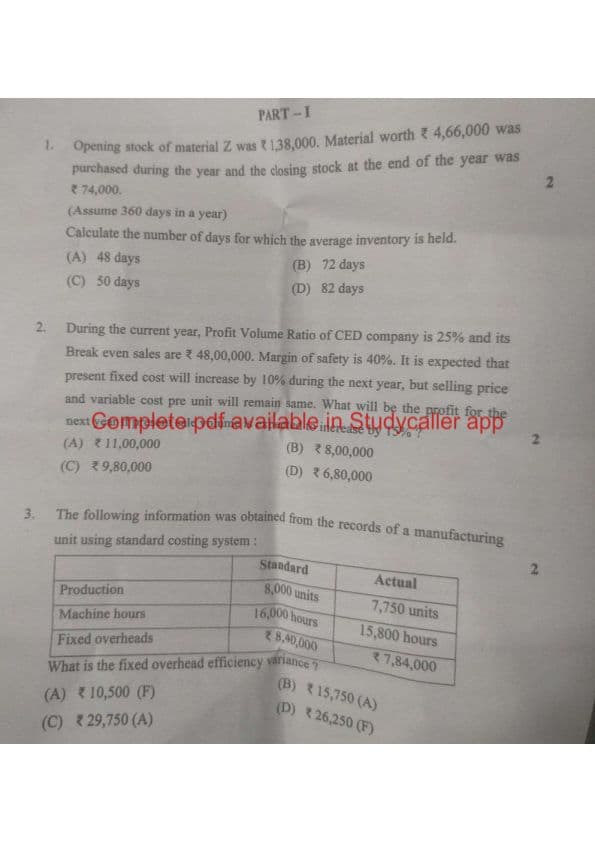
Cost and Management Accounting Mcq Question Paper Part I, CA Inter
Mahi❤️Likes 25Views 10.9k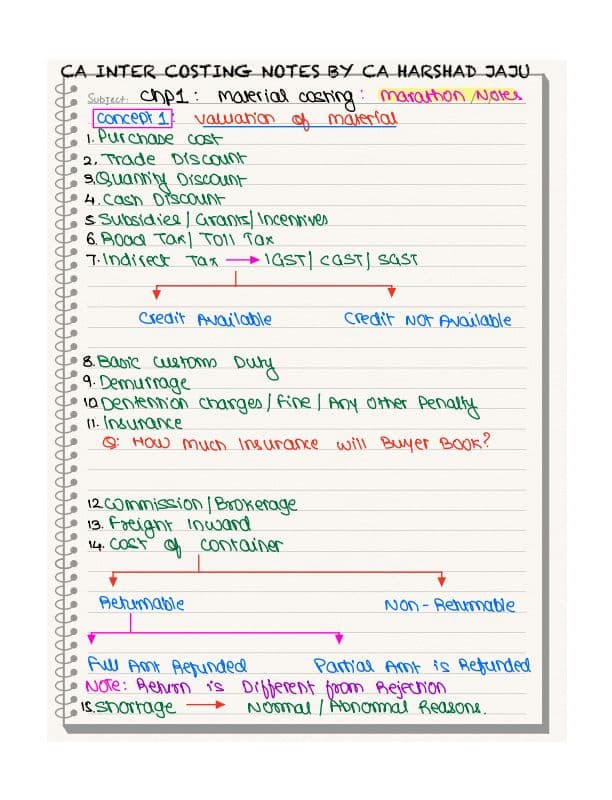 Amendments
CA Inter · Taxation
Costing Notes by CA Harshad Jaju: Material Costing Marathon Notes, Re-order
Mahi❤️Likes 23Views 26.6k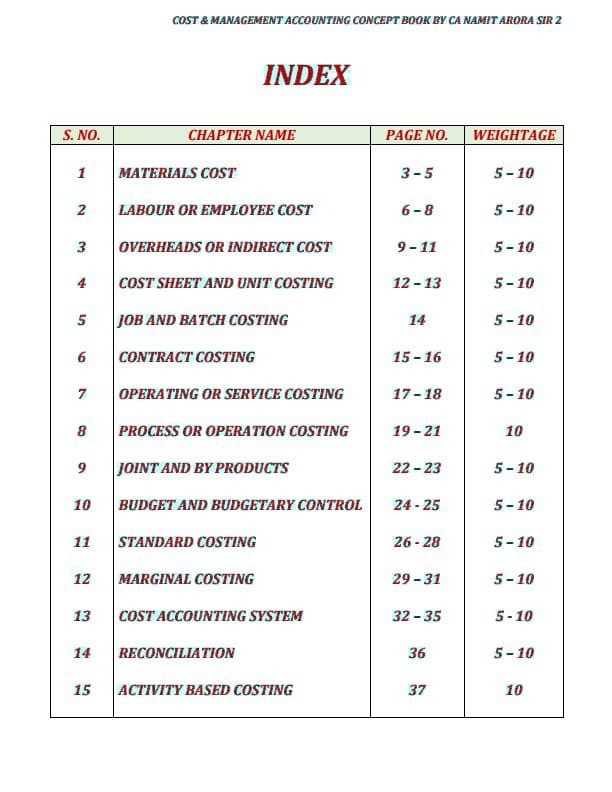 Handwritten
CA Inter · Cost and Management Accounting
Cost and Management Accounting Formula Concept Book by CA Namit Arora Sir
MANAN KABRALikes 22Views 26.3k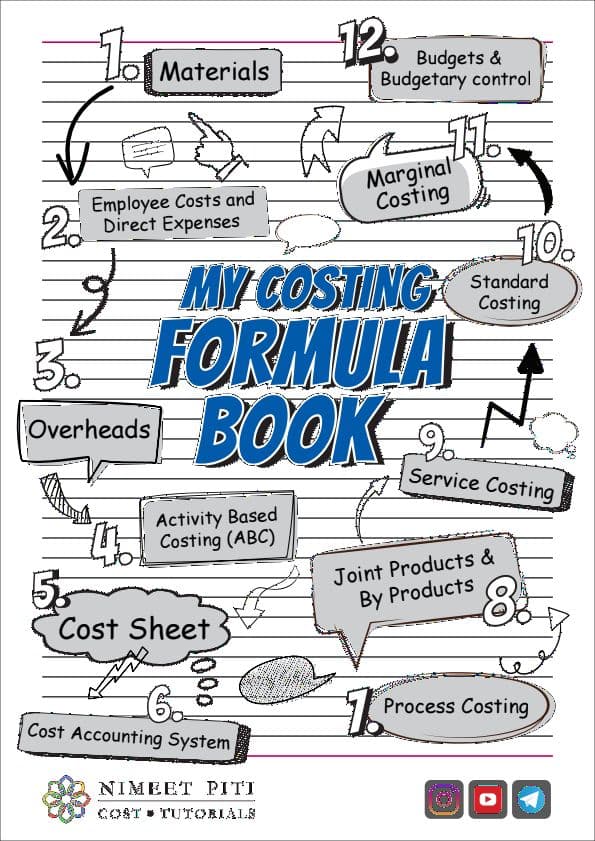 Charts
CA Inter · Cost and Management Accounting
Cost and Management Accounting Formula Chart Book, CA Inter
NadeemLikes 21Views 14.9k
Frequently asked questions
How should I prepare a CA Inter Costing formula sheet?
Organise formulas by the applicable syllabus topic. For each formula, record the equation, variable meanings, units, application cue and a representative worked example. Practise selecting the formula independently.
Are formula sheets enough for CA Intermediate Costing?
No. Formula sheets support recall, but students must understand concepts and solve numerical questions. Use the prescribed study material, worked examples and timed practice to build accuracy.
How can I remember Costing formulas?
Understand what each formula measures and how its variables relate. Recall the formula from memory, explain the symbols and solve questions that use it in different ways.
Why do I make mistakes even when I know the formula?
Errors may come from selecting the wrong formula, mixing units, using the wrong base, copying figures incorrectly or making arithmetic mistakes. Identify the exact cause and practise correcting it.
Should I memorise all formulas before solving questions?
Learn the basic relationships as you study each topic and apply them immediately through questions. This connects formula recall with understanding and makes it easier to identify when an equation is needed.
How can I improve calculation speed in Costing?
Practise regularly with clear workings and gradually introduce time limits. Focus on accurate formula selection and organised calculations before trying to increase speed.
How do I choose the correct formula in a Costing question?
Identify what the question asks you to calculate, list the available data with units and match those values to the formula variables. Calculate any required intermediate figure before substitution.
How should I revise variance formulas?
Group formulas by the relevant cost category and understand what each variance measures. Practise both calculation and interpretation, including whether the result is favourable or adverse.
Can I use one formula sheet for every CA Inter attempt?
Use it only after checking the current syllabus and applicable study material. Update the sheet when the syllabus or prescribed content changes, and verify all formula variations before relying on it.
Does Studycaller offer CA Inter Costing practice?
Studycaller can be considered as a supplementary practice resource where CA Intermediate Costing tests are available. Confirm current coverage and use timed questions alongside official study material.