Is CA Better Than an MBA for Business Management: A Complete Career Comparison
Compare CA and MBA for business management. Learn the differences in skills, career opportunities, business roles, leadership, and which option is better for your goals.
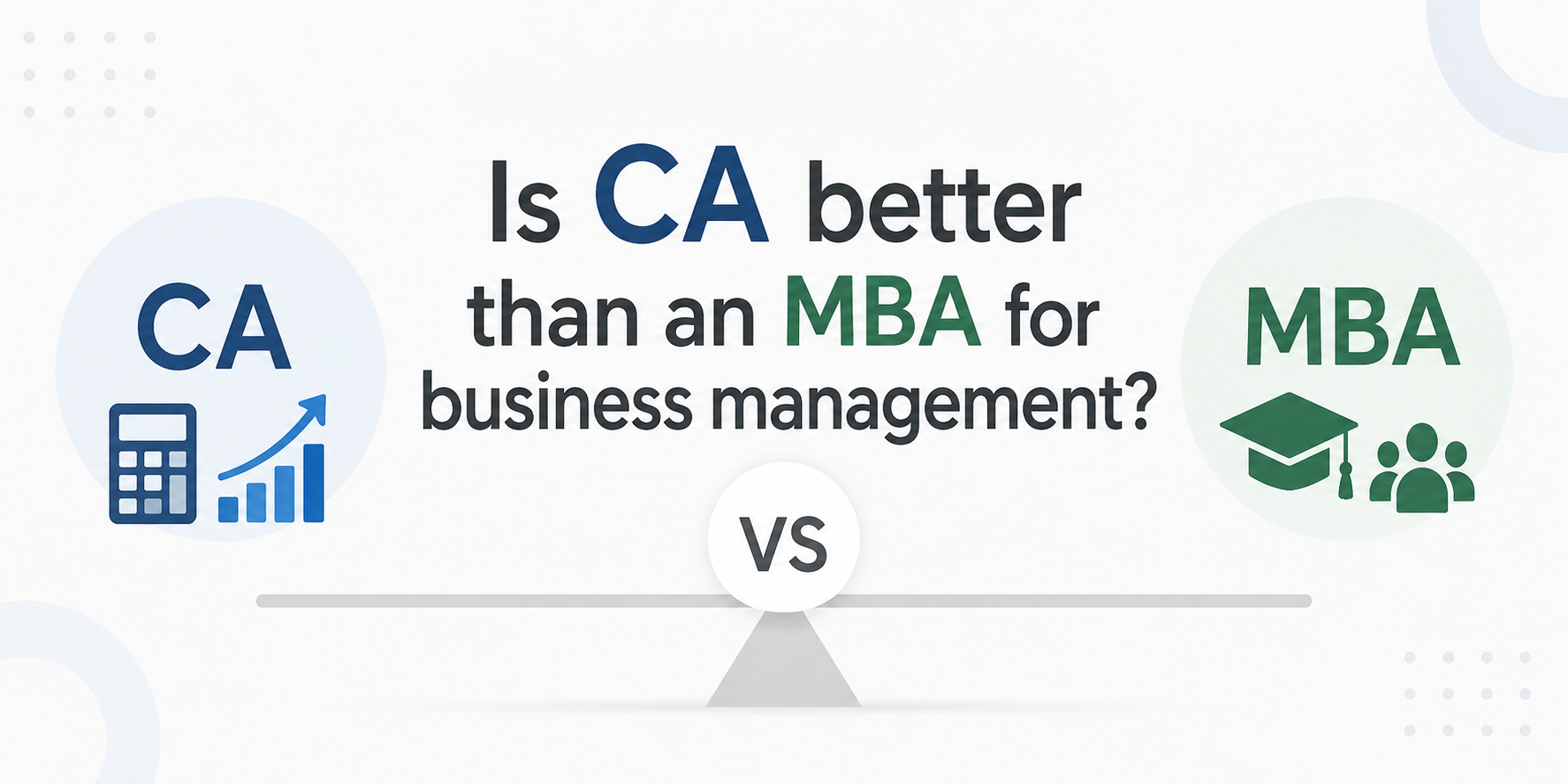
Table of Content
- Understanding the Difference Between CA and MBA
- What Skills Does Each Qualification Develop?
- CA vs MBA: Key Areas of Difference
- Why Chartered Accountants Are Valuable in Business Management
- Business Management Roles Performed by Chartered Accountants
- MBA Provides a Broader Management Perspective
- Can a Chartered Accountant Become a Business Leader?
- Skills That Make CAs Strong Business Managers
- Career Opportunities After CA and MBA
- Which Qualification Is Better for Entrepreneurs?
- Conclusion
Students planning a career in finance or business management often face one important question: Should I pursue Chartered Accountancy (CA) or an MBA? Both qualifications are highly respected and can lead to successful careers, but they are designed for different purposes. While an MBA focuses on developing managerial, leadership, and business administration skills, the CA qualification builds deep expertise in finance, taxation, auditing, accounting, and business advisory. Choosing between the two depends on your career goals, not on a simple comparison of their popularity.
In today's business environment, companies need professionals who can make informed financial decisions and contribute to business growth. Chartered Accountants are no longer limited to accounting and taxation. They actively participate in strategic planning, financial management, risk assessment, corporate advisory, and business consulting. Similarly, MBA graduates contribute through marketing, operations, human resources, strategy, and organisational leadership. Understanding the strengths of both qualifications helps students make a well-informed career decision.
Understanding the Difference Between CA and MBA
Although both qualifications prepare professionals for the corporate world, their learning approach is very different. The CA course focuses on developing technical expertise in finance and regulatory compliance. Students gain in-depth knowledge of accounting standards, taxation, auditing, corporate laws, financial reporting, and strategic financial management.
An MBA, on the other hand, provides broader exposure to business management. It includes subjects such as marketing, operations, human resource management, organisational behaviour, entrepreneurship, and business strategy. Neither qualification is universally better. Their value depends on the career path a student wants to pursue.
What Skills Does Each Qualification Develop?
A Chartered Accountant develops specialised financial and analytical skills that help businesses make informed decisions. MBA graduates build leadership and management capabilities that prepare them to manage teams, departments, and business operations. Both skill sets are valuable, but they serve different business functions.
CA vs MBA: Key Areas of Difference
- Core Expertise – A CA specialises in finance, taxation, audit, compliance, and financial advisory, while an MBA focuses on management, leadership, and business operations.
- Career Approach – CAs become financial specialists, whereas MBA graduates often pursue broader management roles.
- Business Decision-Making – CAs support decisions through financial analysis, while MBA professionals focus on strategy, execution, and organisational growth.
- Professional Recognition – Both qualifications are highly respected but in different domains.
- Long-Term Opportunities – Career growth depends more on skills and experience than on the qualification alone.
Understanding these differences helps students choose the path that aligns with their interests.
Why Chartered Accountants Are Valuable in Business Management
Many people assume that business management is only for MBA graduates. However, modern Chartered Accountants play an equally important role in managing businesses. Every major business decision has a financial impact. Whether a company wants to expand, acquire another business, launch a new product, or improve profitability, financial analysis becomes essential.
Chartered Accountants provide this expertise by evaluating risks, forecasting financial outcomes, managing budgets, and ensuring long-term sustainability. Their ability to combine financial knowledge with business understanding makes them valuable members of senior management teams.
Business Management Roles Performed by Chartered Accountants
Today's CAs contribute to much more than accounting functions.
- Strategic Financial Planning – Preparing financial roadmaps that support business expansion.
- Business Advisory – Guiding management on investments, growth strategies, and financial decisions.
- Risk Management – Identifying operational and financial risks before they affect business performance.
- Profitability Improvement – Analysing costs, pricing, and margins to improve overall business results.
- Performance Monitoring – Using financial reports to evaluate organisational performance and efficiency.
These responsibilities clearly demonstrate that CAs actively contribute to business management.
MBA Provides a Broader Management Perspective
MBA programmes are designed to prepare students for leadership roles across different business functions. Students learn about team management, organisational behaviour, marketing strategy, supply chain management, operations, and entrepreneurship. This broad perspective allows MBA graduates to work across multiple departments rather than specialising only in finance. For professionals interested in managing people, business operations, or corporate strategy, an MBA can be an excellent choice.
Can a Chartered Accountant Become a Business Leader?
Many successful CEOs, CFOs, entrepreneurs, and business consultants started their careers as Chartered Accountants. A CA develops analytical thinking, problem-solving ability, financial discipline, and decision-making skills that are highly valuable in leadership positions. As professionals gain experience, they often move into senior management, corporate leadership, and board-level advisory roles. Business leadership depends on competence, communication, and experience—not only on academic qualifications.
Skills That Make CAs Strong Business Managers
- Financial Intelligence – Understanding how every business decision affects profitability and cash flow.
- Analytical Thinking – Evaluating complex business situations using data.
- Decision Support – Helping management make financially sound choices.
- Problem Solving – Identifying challenges and recommending practical solutions.
- Business Ethics – Maintaining transparency and professional integrity.
These qualities make Chartered Accountants effective business managers and advisors.
Career Opportunities After CA and MBA
Both qualifications open diverse career opportunities.
Chartered Accountants commonly work in:
- Corporate Finance
- Tax Advisory
- Audit and Assurance
- Business Consulting
- Risk Management
- Investment Advisory
- Financial Planning
- Virtual CFO Services
MBA graduates often pursue careers in the following:
- Marketing Management
- Operations Management
- Human Resources
- Business Development
- Product Management
- Strategy Consulting
- Sales Leadership
- Entrepreneurship
Career success ultimately depends on professional performance rather than qualifications alone.
Which Qualification Is Better for Entrepreneurs?
Entrepreneurs need financial discipline as much as business vision. A Chartered Accountant understands budgeting, cash flow management, compliance, taxation, fundraising, and financial planning—all of which are essential for building a sustainable business.
An MBA contributes through marketing, customer acquisition, business strategy, and organisational growth. For entrepreneurs, both qualifications can be valuable, but a CA often provides a stronger financial foundation for managing business resources effectively.
Conclusion
The answer to "Is CA better than an MBA for business management?" depends entirely on your career aspirations. If you want to build expertise in finance, taxation, auditing, business advisory, and strategic financial decision-making, Chartered Accountancy is an outstanding choice. If your interests lie in leadership, marketing, operations, or general business management, an MBA may be more suitable. Both qualifications offer excellent career opportunities and can lead to leadership positions. The best choice is the one that matches your strengths, interests, and long-term professional goals rather than following popular opinion.

FAQs
Is CA better than an MBA for business management?
It depends on your career goals. A CA is ideal for finance-focused business management, while an MBA provides broader exposure to leadership and organisational management.
Can a Chartered Accountant manage a business?
Yes. Chartered Accountants possess strong financial, analytical, and strategic skills that help them manage businesses effectively.
Is an MBA necessary after CA?
No. Many Chartered Accountants achieve leadership positions without an MBA, although combining both qualifications can provide additional career opportunities.
Can a CA become a CEO?
Yes. Many successful CEOs have a Chartered Accountancy background because of their financial expertise and strategic decision-making abilities.
Which qualification is better for entrepreneurship?
Both are valuable. CA provides strong financial management skills, while an MBA focuses on business growth, leadership, and marketing.
Do companies prefer CA or MBA?
It depends on the role. Finance and compliance positions often prefer CAs, while general management and marketing roles may prefer MBA graduates.
Can a CA work in business consulting?
Yes. Many Chartered Accountants work as business consultants, helping organisations improve financial performance and strategic decision-making.
Is CA more technical than MBA?
Yes. CA focuses deeply on finance, taxation, auditing, and accounting, whereas an MBA covers broader business management topics.
Can a CA lead a company's finance department?
Absolutely. Chartered Accountants commonly work as Finance Managers, Financial Controllers, CFOs, and senior finance leaders.
Which qualification offers better long-term career growth?
Both qualifications offer excellent growth opportunities. Long-term success depends more on professional skills, experience, and continuous learning than on the qualification itself.