Can You Pass CA Exams Using Only Notes? A Practical Guide
Can you pass CA exams using only notes? Understand where notes help, where they fall short, and how to combine them with study material, practice and tests for better results.
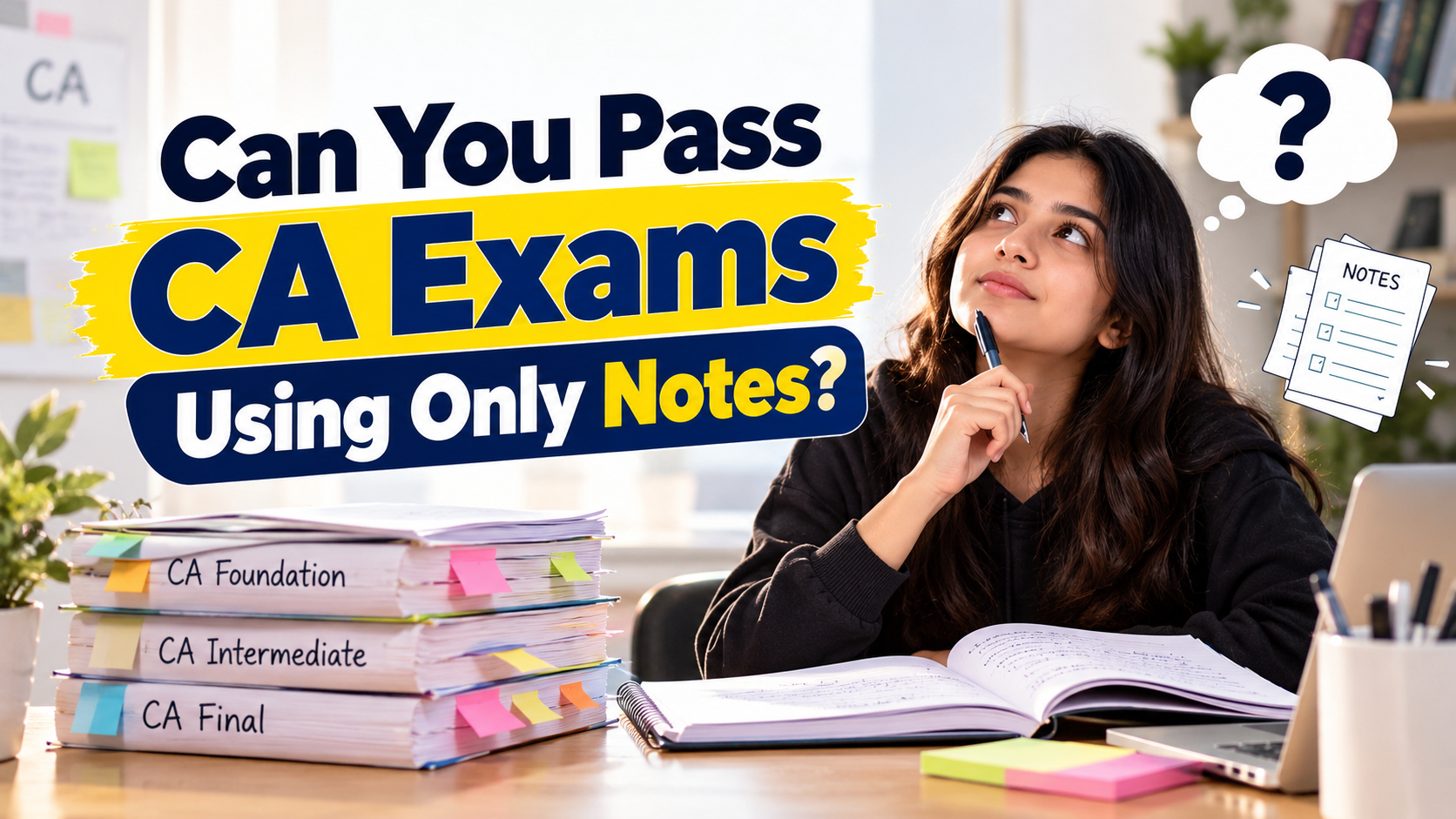
Table of Contents
- Can You Really Pass CA Exams Using Only Notes?
- What CA Notes Can Do for Your Preparation
- Where Notes Alone Fall Short
- Does It Depend on Your CA Level?
- Can Foundation Students Rely Mainly on Notes?
- Can Intermediate Students Pass Using Notes?
- Can CA Final Students Prepare With Notes?
- Do Notes Work Equally Well for Every Subject?
- The Right Way to Use CA Notes
- Why Question Practice Is Essential
- Why Mock Tests Matter
- A Practical Notes-Based CA Study Plan
- Common Mistakes Students Make With Notes
- Final Answer: Can You Pass CA Exams Using Only Notes?
- Frequently Asked Questions
It is a very common question among CA students, especially when exams are getting closer: Can I pass CA exams by studying only notes? The short answer is that notes can be a powerful part of your preparation, but relying on them blindly is risky. Notes can simplify a large syllabus, make revision faster and highlight important concepts, but they cannot automatically replace understanding, question practice and exam simulation.
The confusion usually starts because good notes can make a subject look much more manageable. A 500-page study resource may become a 100-page revision document, which feels like a huge advantage. It is an advantage—but only if you already understand what those pages mean and can apply the information when a question appears in the examination.
So, the real question is not whether notes are enough by themselves. It is how much of your CA preparation can notes realistically handle, and what else needs to be added to turn that preparation into an exam-ready strategy. This guide breaks down the answer for Foundation, Intermediate and Final students and explains how to use notes without creating a false sense of preparation.
What CA Notes Can Do for Your Preparation
Good notes solve a genuine problem: CA students have a lot of information to remember, but limited time for repeated revision. A well-prepared set of notes reduces the information to a manageable format without losing the points that matter.
They Make Revision Faster
Instead of reopening a complete chapter every time you forget a formula or provision, you can use a concise revision resource. This is particularly valuable in the weeks before an exam when you need to revisit multiple subjects.
They Highlight Important Information
Well-structured notes can bring formulas, definitions, conditions, exceptions, adjustments and common mistakes into one place. This makes it easier to identify what needs repeated attention.
They Help Connect Related Concepts
A good note can place connected ideas next to each other. For example, a comparison table can help you distinguish between two similar provisions or methods that are easy to confuse during an exam.
They Can Become Personal Revision Tools
The most useful notes become better over time. When you make a mistake in a practice question, adding the correction to your notes turns a generic study resource into something personalised to your preparation.
Where Notes Alone Fall Short
The biggest weakness of relying only on notes is that reading and knowing are not the same as applying. A student may understand every page of a summary but still struggle when the examination question changes the wording, combines two concepts or requires a calculation.
Notes can also omit detail. Because their purpose is usually summarisation, a short resource may not explain every background concept or exception required for a difficult topic.
There is also the problem of passive learning. Repeated reading can create familiarity without strong recall. The page looks familiar, but when the book is closed, the answer may not come as quickly.
That is why notes should be treated as a revision and learning support tool, not as a complete substitute for every other part of CA preparation.
Does It Depend on Your CA Level?
Yes. The role of notes changes as you move from Foundation to Intermediate and Final.
| CA Level | Role of Notes | What Should Be Added |
|---|---|---|
| Foundation | Build and revise basic concepts | Primary study material, examples and question practice |
| Intermediate | Condense concepts and support application | Practical questions, provisions and mock tests |
| Final | Support advanced revision and recall | Detailed reference material, application practice and test analysis |
As the level increases, notes become more useful for selective revision, but advanced subjects also require deeper understanding and application. Therefore, the higher the level, the more important it becomes to use notes alongside other preparation tools.
Can Foundation Students Rely Mainly on Notes?
Foundation students can use notes extensively, especially after they have understood the basic concepts. However, a beginner should be careful about starting with extremely condensed notes.
If a student has never studied a topic before, a two-page summary may tell them what to remember without explaining why it matters. That can make later question practice difficult.
A better approach is to first understand the chapter from reliable primary material, then use concise notes for revision. For numerical areas, practise questions after learning formulas. For theory areas, learn the important terms and then practise recalling the answer structure.
At Foundation level, notes should make concepts clearer, not merely shorter.
Can Intermediate Students Pass Using Notes?
Intermediate students can make very effective use of notes because the syllabus is broad and repeated revision becomes important. But relying exclusively on notes can become risky when subjects require detailed application.
For example, a note may give you the formula or provision, but the actual question may require several steps before you can use it correctly. That skill comes from practice.
Intermediate students should therefore maintain three connected resources: a reliable study source, concise revision notes and a mistake tracker. After solving questions, add only meaningful corrections to the notes.
This approach saves time while preserving the depth needed for exam preparation.
Can CA Final Students Prepare With Notes?
At Final level, notes can become one of the most important revision resources, but “notes only” becomes even less advisable for difficult topics. Advanced subjects often require students to understand relationships between concepts and apply them to practical or case-based situations.
Final students can use concise notes for repeated revision while keeping detailed reference material available for topics that require deeper understanding.
The ideal system is a two-layer approach: detailed material for learning and clarification, followed by compact notes for repeated revision. Tests and practice questions then show whether the revision is translating into actual performance.
Do Notes Work Equally Well for Every CA Subject?
No. The effectiveness of notes depends heavily on the nature of the subject.
Theory-Heavy Subjects
Notes can be extremely useful for definitions, provisions, conditions, exceptions, distinctions and answer-writing structures. However, students should understand the provision before trying to memorise a summary.
Numerical Subjects
Notes are excellent for formulas, methods, adjustments and common traps, but they cannot replace solving. A formula that looks familiar may still be difficult to apply when the question changes its structure.
Law and Application-Based Areas
Concise notes can help organise provisions, but students should practise applying those provisions to different situations. This is where question practice becomes especially important.
Tax and Update-Sensitive Areas
Notes can simplify complex provisions, but students must ensure that the material is relevant to the applicable attempt. Outdated notes can create confusion even when the basic explanation looks correct.
The Right Way to Use CA Notes
If you want notes to carry a major part of your CA preparation, use them actively rather than treating them as a book to read from beginning to end.
Step 1: Understand Before You Condense
Do not shorten a concept that you have not understood. Use detailed material when necessary, then create or select concise notes for revision.
Step 2: Mark What You Forget
Whenever you cannot recall a point, mark it. Your final revision should give extra attention to information that your memory repeatedly loses.
Step 3: Add Practice-Based Corrections
After solving questions, add important corrections to your notes. This prevents the same error from appearing repeatedly.
Step 4: Use Active Recall
Close the notes after studying a section and explain the concept from memory. For numerical subjects, solve a fresh question without looking at the method.
Step 5: Keep a Final Revision Layer
Near the examination, reduce the material further. Maintain short sheets containing formulas, important provisions, exceptions, difficult areas and repeated mistakes.
Why Question Practice Is Essential
Notes cannot replace question practice because the exam does not ask you to identify a page; it asks you to produce an answer.
Question practice tests whether you can retrieve the concept, understand the requirement, select the correct method and present the answer within the available time.
After every practice session, ask yourself three questions:
- Did I know the concept?
- Could I apply it correctly?
- Could I complete it within reasonable time?
If the answer to any of these is no, your notes should be updated to address the specific weakness—but the weakness should also be practised again.
Why Mock Tests Matter When You Study From Notes
Mock tests are particularly important for students who rely heavily on notes because they provide an external reality check. While reading notes, everything may appear familiar. A timed test removes that comfort.
A structured test can reveal problems such as slow calculations, weak recall, poor answer presentation, incomplete understanding or difficulty managing time across a full paper.
This is where Studycaller can fit into a notes-based preparation strategy. A structured CA test and performance-review approach can help students move beyond passive revision and identify what actually needs improvement.
The goal is not simply to complete more tests. It is to use each test as feedback for your next revision. If a chapter repeatedly causes mistakes, return to the notes, identify the missing concept and practise that question type again.
A Practical Notes-Based CA Study Plan
| Study Stage | Primary Activity | Role of Notes |
|---|---|---|
| Learning | Understand concepts | Summarise difficult points |
| First Revision | Recall and connect topics | Use chapter-wise notes |
| Practice | Solve questions | Add mistakes and corrections |
| Testing | Attempt timed papers | Identify weak areas |
| Final Revision | Rapid recall | Use formulas, key points and mistake sheets |
This approach allows notes to do what they are best at: reducing revision time and organising information. Other tools handle the jobs notes cannot do, such as testing application, speed and exam performance.
Common Mistakes Students Make When Studying Only From Notes
Thinking Shorter Means Better
A 20-page document is not automatically better than a 100-page document. If important conditions, examples or exceptions have been removed, the shorter resource may actually be less useful.
Skipping the Primary Source Completely
Short notes can simplify information, but students should understand where the concepts come from and what the applicable official requirements are. Use concise notes as a support, not as an excuse to avoid understanding.
Reading the Same Notes Repeatedly
Repeated reading can create an illusion of preparation. Close the notes and recall the content. If possible, follow revision with a question.
Ignoring Weak Areas
Students often revise the chapters they already like because it feels comfortable. Your notes should make weak areas visible and push you toward them.
Not Analysing Test Results
A test score without analysis tells you very little. Review mistakes and update your preparation system after every meaningful test.
Final Answer: Can You Pass CA Exams Using Only Notes?
Yes, notes can play a major role in helping you pass CA exams, but relying on notes alone is not the safest preparation strategy. Notes are excellent for organising information, simplifying revision and improving recall. They are much less effective when they are expected to replace understanding, question practice and timed examination experience.
If you are short on time, do not panic and try to study every resource available. Choose one reliable set of notes, understand the important concepts, practise questions, record mistakes and test yourself regularly.
For self-study students especially, the winning approach is not “notes only”. It is notes + understanding + practice + testing + analysis. That combination gives you a much clearer picture of whether you are genuinely exam-ready.
With a structured approach such as the one supported by Studycaller, your notes can become the centre of an efficient revision system without becoming the only thing you depend on.

FAQs
Frequently Asked Questions
Can you pass CA exams using only notes?
Notes can cover a large part of revision, but relying on them alone is risky. Students also need concept understanding, question practice and exam-style testing. Notes work best as a structured learning and revision resource rather than a complete preparation replacement.
Are CA notes enough for last-minute exam preparation?
They can be very useful when time is limited because they condense important information. However, last-minute preparation should still include question practice, important updates, formulas, mistakes and at least some timed exam-style practice.
Can CA Foundation students pass by studying notes?
Foundation students can use notes extensively, especially for revision, but beginners should first understand the underlying concepts. Very short notes may not provide enough explanation for first-time learning, so they should be supported by reliable study material.
Can CA Intermediate students rely mainly on revision notes?
Intermediate students can rely heavily on concise notes during revision, but they should also practise practical and theory questions. Notes provide the knowledge base, while question practice checks whether that knowledge can be applied accurately under exam conditions.
Are notes alone enough for CA Final preparation?
Usually, notes alone are not sufficient for comprehensive Final preparation. Advanced topics may require detailed understanding and application. Use concise notes for repeated revision while keeping detailed reference material available for difficult concepts and practising relevant questions.
Do CA notes improve exam performance?
Well-organised notes can improve revision efficiency and recall, but they do not guarantee better marks. Performance improves when notes are combined with active recall, question practice, mock tests, mistake analysis and consistent revision.
How should I use CA notes with question practice?
Revise a topic from your notes, close the material and attempt related questions without looking at the solution. Record meaningful mistakes and add short corrections to your notes. Revisit those weak points before attempting similar questions again.
Can printed CA notes replace handwritten notes?
Yes, for many students printed notes can work well, especially for structured revision. You can personalise them by adding handwritten annotations, formulas, doubts and mistakes. The key factor is active learning rather than whether the notes are printed or handwritten.
How can Studycaller help students who use CA notes?
Studycaller can complement a notes-based preparation strategy by helping students focus on structured practice, performance review and identifying preparation gaps. The aim is to connect revision with measurable exam performance instead of relying only on passive reading.
What is better than studying CA notes alone?
A balanced approach is better: understand concepts from reliable material, revise through concise notes, solve questions, attempt timed tests and analyse mistakes. This combination helps students develop both knowledge and the application skills needed in CA examinations.