How Can I Avoid Wasting Time During CA Preparation? A Practical Guide for CA Students
Learn how to avoid wasting time during CA preparation with practical time management strategies, study techniques, daily routines, and productivity tips for CA students.
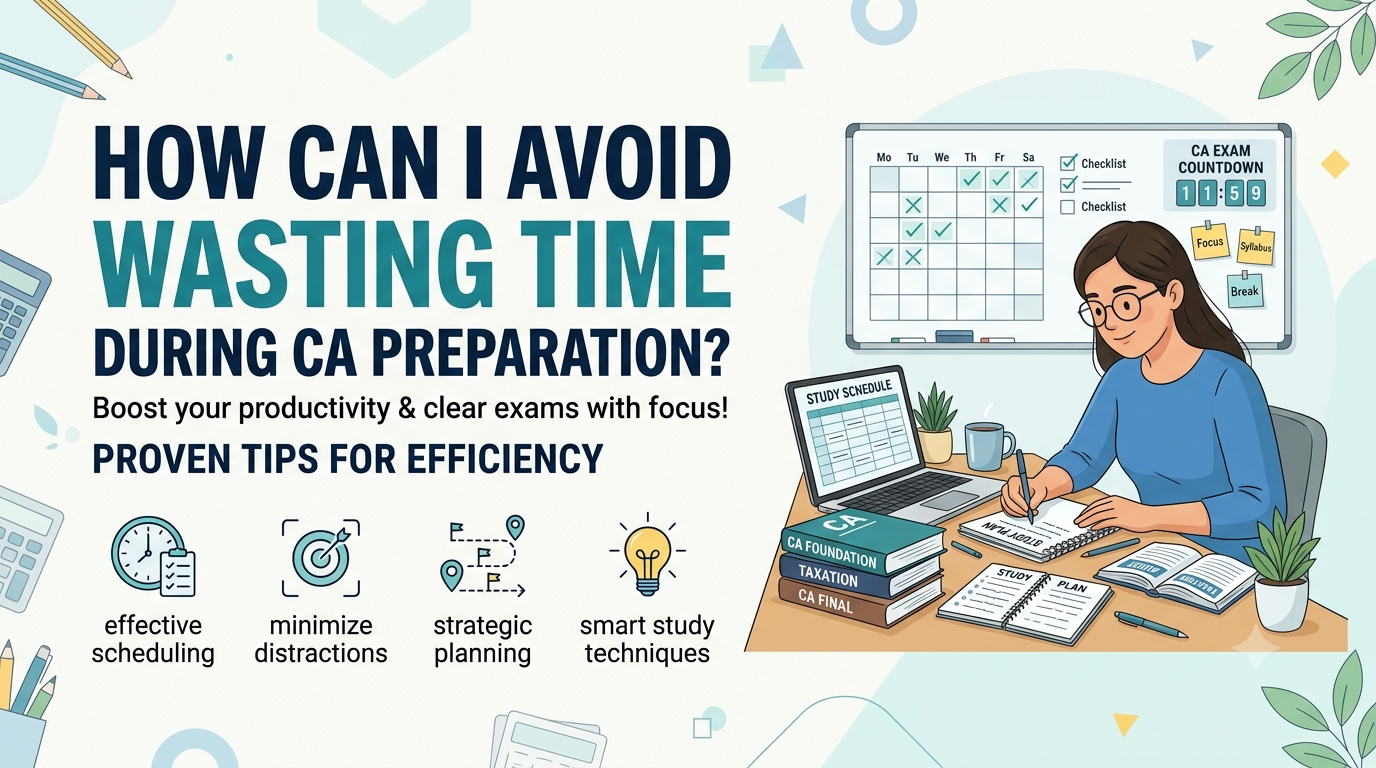
Table of Content
- Why Do CA Students Waste So Much Time?
- Start Tracking Where Your Time Actually Goes
- Stop Creating Extremely Complicated Timetables
- Use the “Most Important Task First” Strategy
- Keep Your Mobile Phone Away While Studying
- Do Not Study Without a Clear Purpose
- Avoid Collecting Too Much Study Material
- Use Active Study Techniques Instead of Passive Learning
- Follow the 50–10 or 90–15 Study Method
- Stop Waiting for Motivation
- Learn to Say No During Your Preparation Period
- Avoid Multitasking
- Deal With Difficult Subjects Instead of Avoiding Them
- Plan Your Revision From the Beginning
- Do Not Compare Your Study Hours With Other Students
- Keep a Weekly Review System
- A Sample Productive Day for CA Preparation
- The Biggest Time-Wasting Habits CA Students Should Eliminate
- Final Thoughts: Focus on Effective Hours, Not Just Long Hours
Preparing for the CA examinations is not just about studying for long hours. It is about making every hour count.
Many CA students sit at their study tables for 10 to 12 hours a day but still feel that they have not completed enough. On the other hand, some students study for fewer hours and manage to complete their syllabus, revise properly, and perform well in examinations.
So, what is the difference?
Usually, it is not intelligence.
It is not always about having better teachers or better study material either.
The biggest difference is often how effectively a student uses time.
CA preparation is a long journey. Whether you are preparing for CA Foundation, CA Intermediate, or CA Final, the syllabus is extensive and demanding. Every subject requires conceptual understanding, practice, revision, and repeated exposure. Because of this, wasting even a few hours every day can become a major problem over several months.
For example, wasting just two hours daily may not seem serious. But over 100 days, that becomes 200 hours. Imagine how many chapters, mock tests, revisions, or RTPs could have been completed during that time.
The good news is that avoiding time waste does not mean studying continuously without breaks. In fact, trying to study nonstop is itself one of the biggest productivity mistakes CA students make.
The real goal is to identify where your time is going and create a system that helps you study with better focus.
Why Do CA Students Waste So Much Time?
Before fixing the problem, it is important to understand where the problem begins.
Most students do not intentionally decide to waste time. Time is usually lost gradually through small distractions.
You may open your phone for five minutes and end up scrolling for forty-five minutes. You may sit down to study but spend twenty minutes deciding which subject to start. You may watch multiple lectures without revising anything. You may create a perfect timetable and then spend more time adjusting it than following it.
These small habits slowly destroy productivity.
Here are some of the most common reasons CA students waste time:
|
Common Problem |
How It Wastes Time |
|
Excessive mobile phone usage |
Breaks concentration and increases distraction |
|
No daily study plan |
Creates confusion about what to study |
|
Unrealistic timetables |
Leads to frustration and inconsistency |
|
Studying without clear goals |
Results in long hours with low output |
|
Too many study resources |
Creates unnecessary confusion |
|
Constantly changing strategies |
Prevents consistency |
|
Perfectionism |
Makes simple tasks take too long |
|
Avoiding difficult subjects |
Creates backlog and exam pressure |
|
Poor revision planning |
Forces students to relearn topics |
|
Comparing with others |
Creates anxiety and loss of focus |
Recognising your personal time-wasting habits is the first step toward improving your preparation.
Start Tracking Where Your Time Actually Goes
Many students believe they know how they spend their day. But when they actually track their activities, they are often surprised.
You might think you studied for eight hours, but your effective study time may only be five hours.
The remaining time could be lost in:
- Checking notifications
- Searching for study resources
- Taking unnecessarily long breaks
- Watching irrelevant videos
- Switching between subjects
- Daydreaming or worrying about exams
- Reorganising notes repeatedly
For three to five days, track your daily activities honestly.
You do not need a complicated productivity application. A simple notebook can work.
Write down:
- When you started studying
- What subject you studied
- How long you studied with focus
- How much time was lost to distractions
- What caused the distraction
For example:
|
Time |
Activity |
Planned Duration |
Actual Focused Time |
|
7 AM – 9 AM |
Accounts |
2 hours |
1 hour 40 minutes |
|
10 AM – 12 PM |
Law |
2 hours |
1 hour 30 minutes |
|
2 PM – 4 PM |
Costing |
2 hours |
1 hour 20 minutes |
This exercise is not meant to make you feel guilty.
Its purpose is awareness.
Once you know where your time is disappearing, you can start fixing the problem.
Stop Creating Extremely Complicated Timetables
One of the biggest mistakes CA students make is spending too much time designing the “perfect timetable.”
They create colour-coded schedules with every hour planned for the next six months.
Then real life happens.
You wake up late one day. A family responsibility comes up. A lecture takes longer than expected. You fall behind schedule and suddenly feel like the entire timetable has failed.
Instead of creating a rigid hourly schedule, create a flexible daily target system.
For example:
Daily Targets
Priority 1
- Complete Accounting Chapter 3 questions
- Revise Law Chapter 2
Priority 2
-
Watch two Costing lectures
Priority 3
-
Solve 30 MCQs
This approach gives you direction without making you feel trapped.
The key is to know what must be completed today.
A good study plan should guide you, not control you.
Use the “Most Important Task First” Strategy
Your energy and concentration are not the same throughout the day.
For most students, the first few hours after waking up are more productive than late-night study sessions after an exhausting day.
Use your best mental hours for your most difficult task.
For example:
|
Time of Day |
Best Type of Work |
|
High-energy hours |
Difficult concepts and problem-solving |
|
Medium-energy hours |
Lectures and practice questions |
|
Low-energy hours |
Revision, reading, and MCQs |
Do not waste your highest-energy hours checking social media or organising study material.
Ask yourself every morning:
What is the one academic task that will make today productive?
Start with that.
If you complete the most important task early, you automatically reduce stress and improve your sense of progress.
Keep Your Mobile Phone Away While Studying
This is probably the most obvious advice, but it is also one of the most ignored.
The problem with mobile phones is not only the time spent scrolling.
Every notification breaks concentration.
After checking a message, your brain may take several minutes to return to the same level of focus.
Imagine this happening ten times during a study session.
You may physically sit at your desk for three hours while your brain is constantly restarting.
Try these practical methods:
Option 1: Keep the Phone in Another Room
This is one of the most effective strategies because it removes temptation completely.
Option 2: Use Focus Mode
Block unnecessary applications during study hours.
Option 3: Schedule Phone Time
For example:
- 20 minutes during lunch
- 20 minutes in the evening
- 30 minutes after completing daily targets
The goal is not to completely eliminate your phone.
The goal is to stop allowing your phone to control your study sessions.
Do Not Study Without a Clear Purpose
Simply sitting with books open is not productive studying.
Every study session should have a specific objective.
Instead of saying:
“I will study Audit for three hours.”
Say:
“I will complete Standards on Auditing 200 to 230 and solve 20 related questions.”
The second goal is measurable.
You know exactly when the task is completed.
Before starting a study session, define:
- What will I study?
- How much will I complete?
- What should I be able to do after this session?
This small habit can significantly improve your efficiency.
Avoid Collecting Too Much Study Material
CA students often waste enormous amounts of time searching for the “best” resources.
One teacher recommends one book.
Another YouTube video recommends something else.
A Telegram group shares another set of notes.
A friend sends another PDF.
Before you realise it, you have collected 20 resources and completed none of them.
Remember this:
More study material does not mean better preparation.
Choose your resources carefully and stay consistent.
A simple resource structure could be:
- ICAI study material
- One reliable faculty or source for conceptual learning
- One practice source
- RTPs and MTPs
- Past examination questions
That is usually enough when used properly.
Platforms and student communities such as Studycaller can help students discover useful preparation resources, but avoid constantly jumping between new materials.
Your focus should be completion, not collection.
Use Active Study Techniques Instead of Passive Learning
Many students spend hours reading but remember very little.
Passive learning includes:
- Repeatedly reading notes
- Highlighting everything
- Watching lectures without taking action
- Listening without solving questions
Active learning is much more effective.
Try:
Active Recall
Close your book and ask yourself what you remember.
Practice Questions
Apply concepts immediately after studying them.
Self-Testing
Test yourself regularly instead of waiting for mock exams.
Teaching the Concept
Explain the topic aloud as if you are teaching another student.
Short Written Summaries
Write key points in your own words.
The more actively your brain participates, the better you learn.
This also reduces revision time later.
Follow the 50–10 or 90–15 Study Method
Studying continuously for five or six hours is not realistic for most students.
Instead, divide your study into focused sessions.
You can try:
Method 1: 50–10 Rule
Study with complete focus for 50 minutes.
Take a 10-minute break.
Method 2: 90–15 Rule
Study deeply for 90 minutes.
Take a 15-minute break.
During your study session:
- No phone
- No unnecessary conversations
- No social media
- No random internet browsing
During your break:
- Walk
- Drink water
- Stretch
- Relax your eyes
Avoid opening Instagram or YouTube during short breaks because a 10-minute break can quickly become a 45-minute distraction.
Stop Waiting for Motivation
One major reason students waste time is waiting to “feel motivated.”
The problem is that motivation is temporary.
Some days you will feel highly energetic.
Other days you may feel tired, stressed, or uninterested.
If you only study when you feel motivated, your preparation will become inconsistent.
Instead, build a system.
For example:
- Study at the same time every day
- Start with a small five-minute task
- Keep your books ready before the study session
- Follow a fixed starting routine
You do not need motivation to start.
Often, motivation comes after starting.
Tell yourself:
“I only need to study for ten minutes.”
Once you begin, continuing becomes much easier.
Learn to Say No During Your Preparation Period
CA preparation requires sacrifices.
You do not need to completely disconnect from friends and family, but you must protect your priorities.
Sometimes time is wasted because students feel uncomfortable saying no.
They attend every event.
They respond to every call.
They go out whenever friends invite them.
Then they feel stressed about the syllabus.
Create boundaries.
You can say:
“I have an important study target today. I will join next time.”
This is not rude.
It is responsible.
Your preparation period is temporary, but the effort you invest can have a long-term impact on your career.
Avoid Multitasking
Multitasking feels productive but usually reduces efficiency.
For example:
- Watching a lecture while checking messages
- Reading theory while listening to unrelated music
- Solving questions while constantly checking notifications
Your brain performs better when focused on one meaningful task.
Use the “one task at a time” principle.
During a session:
- One subject
- One chapter
- One objective
Finish it before switching.
This reduces mental fatigue and improves retention.
Deal With Difficult Subjects Instead of Avoiding Them
Students naturally prefer subjects they enjoy.
But avoiding difficult subjects creates a dangerous backlog.
You may tell yourself:
“I will start tomorrow.”
Tomorrow becomes next week.
Next week becomes next month.
Eventually, the difficult subject becomes your biggest source of anxiety.
Instead, use the “small exposure method.”
Study the difficult subject for 30 to 60 minutes daily.
You do not need to complete everything at once.
Consistent exposure makes difficult topics less intimidating.
For example:
|
Week |
Daily Difficult Subject Time |
|
Week 1 |
30 minutes |
|
Week 2 |
45 minutes |
|
Week 3 |
60 minutes |
|
Week 4 |
Practice and revision |
Slow progress is still progress.
Plan Your Revision From the Beginning
One of the biggest time-management mistakes is completing the entire syllabus first and thinking about revision later.
CA preparation requires multiple revisions.
If you do not revise regularly, you will forget older chapters and spend additional time relearning them.
Try a revision cycle.
Revision System
Day 1: Learn the topic.
Day 2 or 3: Quick revision.
After 7 days: Revise again.
After 30 days: Perform another revision.
This method helps transfer information into long-term memory.
It also makes final revision significantly easier.
Do Not Compare Your Study Hours With Other Students
You may see someone online claiming:
“I studied for 16 hours today.”
Another student may say:
“I completed the entire syllabus in three months.”
Someone else may already be giving mock tests while you are still completing lectures.
Comparison can waste enormous mental energy.
Your preparation journey is different.
Instead of asking:
“How much are others studying?”
Ask:
“Am I improving compared to last week?”
Your goal should be consistent progress.
Even improving your effective study time from four hours to five focused hours is a major achievement.
Keep a Weekly Review System
Daily planning is important, but weekly reviews are even more powerful.
At the end of every week, ask yourself:
Weekly Review Questions
- What did I complete this week?
- What targets did I miss?
- Why did I miss them?
- Which distractions wasted the most time?
- Which subject needs more attention?
- What should I improve next week?
Do not judge yourself harshly.
The purpose is improvement.
For example, if you discover that you consistently waste time between 2 PM and 4 PM, you can modify your schedule.
Maybe that time is better for revision rather than difficult problem-solving.
A good preparation strategy evolves based on your actual performance.
A Sample Productive Day for CA Preparation
Here is an example of how a CA student can structure a productive day.
|
Time |
Activity |
|
6:30 AM |
Wake up and prepare |
|
7:00 AM – 9:00 AM |
Difficult subject / practical questions |
|
9:00 AM – 10:00 AM |
Breakfast and break |
|
10:00 AM – 12:00 PM |
Theory subject |
|
12:00 PM – 1:00 PM |
Lunch and rest |
|
1:00 PM – 3:00 PM |
Lectures or concept learning |
|
3:00 PM – 3:30 PM |
Break |
|
3:30 PM – 5:30 PM |
Practice questions |
|
5:30 PM – 6:30 PM |
Exercise or relaxation |
|
6:30 PM – 8:00 PM |
Revision |
|
8:00 PM onwards |
Dinner and personal time |
This is only an example.
Your routine should depend on your:
- College schedule
- Articleship
- Coaching classes
- Sleep pattern
- Personal responsibilities
Do not copy someone else's timetable blindly.
Create a system that you can realistically follow.
The Biggest Time-Wasting Habits CA Students Should Eliminate
Here is a quick summary.
|
Habit |
Better Alternative |
|
Constant phone checking |
Scheduled phone usage |
|
Random studying |
Daily targets |
|
Collecting resources |
Limited reliable resources |
|
Long passive reading |
Active recall and practice |
|
Avoiding difficult subjects |
Small daily exposure |
|
Waiting for motivation |
Consistent routine |
|
No revision schedule |
Planned revision cycles |
|
Comparing with others |
Personal progress tracking |
|
Unrealistic schedules |
Flexible planning |
|
No weekly review |
Weekly performance analysis |
Final Thoughts: Focus on Effective Hours, Not Just Long Hours
CA preparation is a marathon.
You do not need to be perfect every day.
You will have unproductive days.
You may miss targets.
You may sometimes lose motivation.
That is completely normal.
The important thing is not allowing one bad day to become one bad week.
If you waste time today, do not waste tomorrow feeling guilty about it.
Restart.
Identify what went wrong.
Make a small correction.
Continue.
The students who succeed in CA are not necessarily productive every single day. But successful students usually learn how to return to their routine quickly.
Remember, your goal is not to study for the maximum number of hours.
Your goal is to make meaningful progress.
Five hours of focused study can be more valuable than ten hours spent sitting with books while constantly checking your phone.
At Studycaller, we understand that CA preparation can sometimes feel overwhelming. The syllabus is large, attempts can be emotionally challenging, and the pressure to perform can make students feel lost.
But better preparation does not always require doing more.
Sometimes it simply requires wasting less.
Start by identifying your biggest distractions. Create realistic daily targets. Focus deeply for shorter periods. Revise regularly. Avoid unnecessary comparison.
Most importantly, trust the process.
Every focused study session takes you one step closer to your goal.

FAQs
How can I stop wasting time during CA preparation?
Start by identifying your biggest distractions, such as mobile phone usage, social media, unnecessary breaks, and lack of planning. Create clear daily targets and track your effective study hours.
How many hours should a CA student study daily?
There is no single ideal number. Most importantly, focus on productive study hours. Depending on your preparation stage and schedule, 6 to 10 focused hours may be sufficient for full-time preparation.
Is using a mobile phone during CA preparation bad?
Mobile phones are not inherently bad, but uncontrolled usage can significantly reduce concentration. Use focus mode, app blockers, or keep your phone away during study sessions.
How can I improve concentration while studying for CA exams?
Study in distraction-free sessions, keep your phone away, set specific goals for each session, take planned breaks, and use active learning techniques such as practice questions and self-testing.
Why do I study for long hours but still feel unproductive?
You may be spending too much time on passive learning, distractions, multitasking, or unplanned study sessions. Focus on measurable outcomes instead of simply counting hours.
Should I make a strict timetable for CA preparation?
A flexible timetable with daily and weekly targets is generally more sustainable than an extremely strict hourly schedule. Your timetable should adapt to your actual progress.
How can I avoid procrastination during CA preparation?
Break large tasks into smaller goals and start with just a few minutes of work. Avoid waiting for motivation and create a consistent study routine.
How often should I revise during CA preparation?
Regular revision is essential. Try revising topics shortly after learning them, again after a week, and periodically throughout your preparation.
How can I manage difficult CA subjects without wasting too much time?
Do not avoid difficult subjects completely. Study them in smaller daily sessions and gradually increase practice time as your confidence improves.
What is the best way to stay productive throughout CA preparation?
Maintain a realistic routine, track your progress, minimise distractions, practise actively, revise regularly, and focus on consistency rather than perfection.