CA Notes PDF for Self-Study: Resources to Collect Before You Start
Find out which CA Notes PDF resources self-study students should collect first, including ICAI material, chapter notes, past papers, mock tests and revision tools with Studycaller.
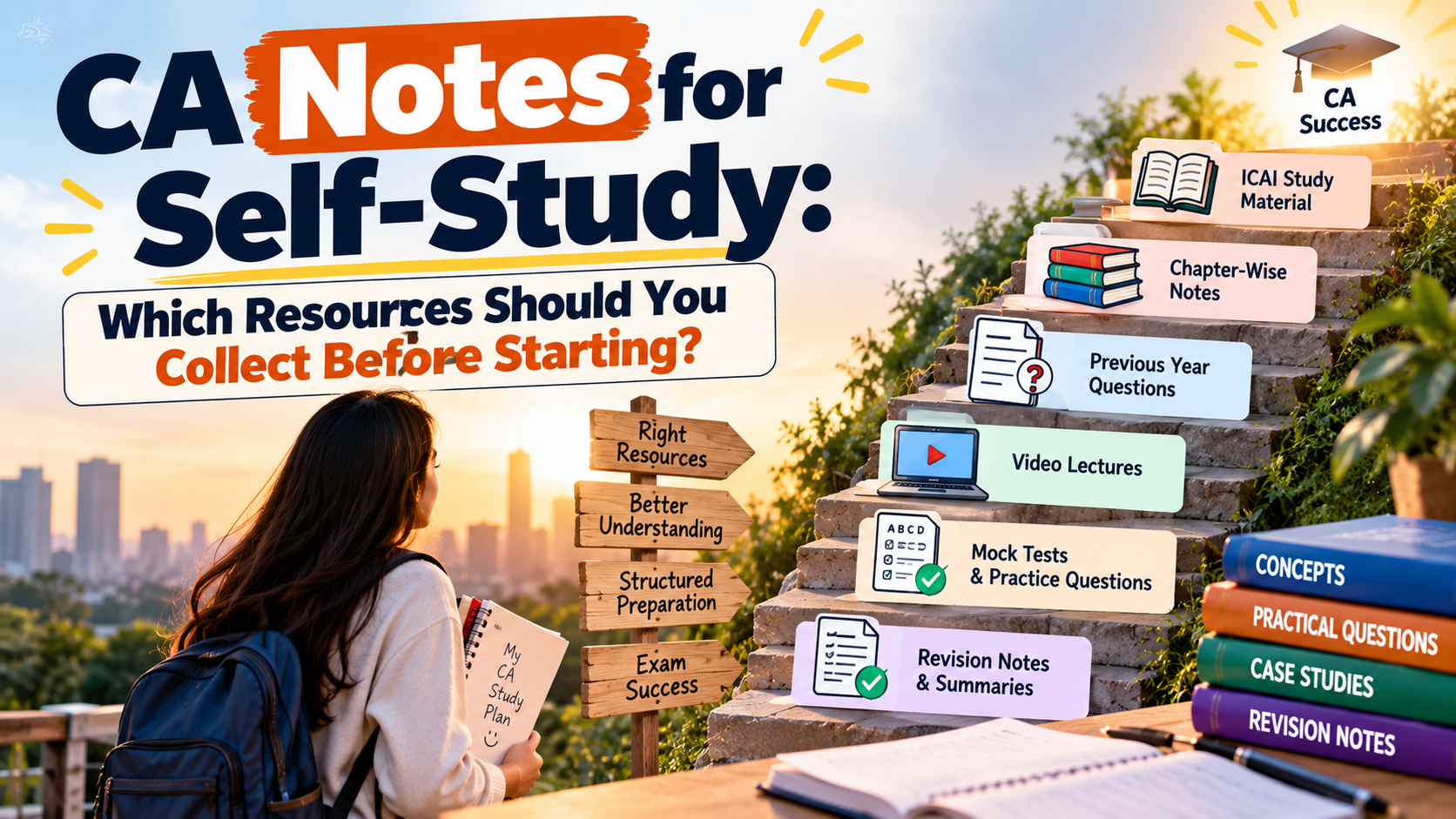
Table of Contents
- Why CA Notes PDFs Can Help Self-Study
- 1. Start With the Latest Official Study Material
- 2. Choose Subject-Wise CA Notes PDFs
- 3. Collect Previous-Year Papers and Solutions
- 4. Add Question Banks and Mock Tests
- 5. Keep Amendments and Attempt-Specific Updates
- 6. Create Short Revision PDFs
- How to Check the Quality of a CA Notes PDF
- How to Organise Your PDF Library
- Common Mistakes to Avoid
- CA Notes PDF Collection Checklist
- How Studycaller Fits Into Your Resource Plan
- Start Small and Study Consistently
- Frequently Asked Questions
CA Notes PDF: CA Notes for Self-Study: Which Resources Should You Collect Before Starting
Introduction
Starting CA preparation on your own can feel confusing when every search leads to another notes PDF, question bank, lecture link or revision sheet. The challenge is not finding the largest number of files; it is choosing a dependable set of resources that you can actually study, practise with and revise before your attempt. A well-organised CA Notes PDF collection can make self-study easier, provided the material matches your course and current syllabus. You need a main reference, concise explanations, practice questions and a simple way to track what you have completed. This guide explains what to collect first, how to check whether a PDF is useful and how to avoid wasting time on duplicate resources.
Why CA Notes PDFs Can Help Self-Study
A PDF collection gives you access to study material in one portable format. You can search for a keyword, highlight a key point, add digital bookmarks and carry the same resource between devices. For students who prefer printed pages, selected chapters can also be printed and arranged in a binder. However, a PDF is only a format, not a guarantee of quality. Some files are outdated, incomplete, poorly scanned or written for a different syllabus. A large file can also become difficult to revise if it contains too much detail without clear headings. Evaluate each resource by accuracy, syllabus relevance, readability and usefulness—not by page count. Before downloading a file, ask what job it will do. Is it your main learning reference, a short revision guide, a source of practice questions or an official update? If two files serve exactly the same purpose, you probably do not need both.
1. Start With the Latest Official Study Material
Begin by identifying the CA level and examination attempt you are preparing for. Then check the latest applicable syllabus, study material and exam-related announcements from the Institute of Chartered Accountants of India (ICAI). This is the foundation against which you should check every supplementary PDF. Save the official material in a clearly labelled folder. Keep the attempt or syllabus label in the filename where relevant, so that you do not accidentally use a module saved for an earlier course structure. If you are unsure whether a chapter or provision has changed, verify it against the current official information rather than relying on an old file. Official material may be extensive, but do not replace it entirely with short notes. Use it to confirm topic coverage, understand explanations that a summary has simplified too much and check important details. Your supplementary CA Notes PDF should make study more efficient while keeping you connected to the full syllabus.
2. Choose Subject-Wise CA Notes PDFs
Once the official material is ready, select one concise notes PDF for each subject where it will help you learn or revise. Subject-wise files are usually easier to navigate than one enormous document containing every paper. They also let you update or replace a resource without rebuilding your whole collection. For theory-heavy subjects, look for clear definitions, organised concepts, key provisions and examples of how a rule applies. For numerical subjects, choose notes that explain the method, show working steps and discuss common adjustments. A page that lists only formulas or final answers may be useful as a quick reminder, but it is rarely enough to learn an unfamiliar topic. Check whether the notes are mapped to the applicable syllabus and whether the language is understandable without a teacher explaining every paragraph. Test one chapter before collecting the complete set. Read a section, close the PDF and try to explain the concept in your own words. Then solve a related question. If you cannot do that, you may need a fuller explanation or worked examples. Studycaller can be explored as one option for CA learning and revision resources. Whichever provider you choose, compare the content with the official material and make sure it suits your level and attempt. Keep one main notes source for each subject; use additional PDFs only when they fill a specific gap.
3. Collect Previous-Year Papers and Solutions
Previous-year question papers show you how topics can be tested and help you become familiar with the wording, structure and level of detail expected in exam-style questions. Collect relevant papers for your course and prioritise recent attempts, while using older papers selectively when the syllabus and underlying rules still apply. Keep solutions or suggested answers alongside each paper, but do not read the solution first. Attempt the question independently, check your work afterwards and note why you lost marks. Common reasons include misunderstanding the requirement, skipping a step, making a calculation error, forgetting a provision or spending too much time on one part. Use the solutions to improve both knowledge and presentation. For practical subjects, compare the working and sequence of steps. For theory subjects, notice how the answer addresses the exact question instead of reproducing a general explanation. Treat past papers as practice material, not as a promise that the same questions will appear again.
4. Add Question Banks and Mock Tests
Question banks help you practise after completing each chapter. They are useful during the learning stage because you can identify misunderstandings before they become part of your revision routine. Choose a bank that is organised by topic and includes answers or explanations that help you understand mistakes. Mock tests serve a different purpose: they help you practise under time limits and check whether you can manage a complete paper. Use chapter-wise practice early in preparation, then introduce sectional and full-length tests as your coverage grows. Check that the questions follow the applicable syllabus and exam pattern. After each test, maintain a short error log. Record the topic, the mistake and the corrective action. For example, write that you missed a condition in a question, confused two concepts or spent too long on a calculation. Reattempt the question after a gap instead of simply reading the solution once. A test series can provide structure and feedback, but consistent review is what turns a score into improvement.
5. Keep Amendments and Attempt-Specific Updates
Some subjects require attention to amendments, revised provisions or attempt-specific updates. Collect relevant official notifications, revision test papers (RTPs), mock test papers (MTPs) and other applicable resources as they become available for your examination. Confirm the material's relevance before adding it to your main study folder. Store update PDFs separately and label them clearly by subject and attempt. If a change affects your existing notes, add a marked update page or correct the relevant section. Avoid keeping old and new versions side by side without a note explaining which one applies; this can cause confusion during last-minute revision. Important exam changes should be verified through official notices. A short post or forwarded file can alert you to an update, but it should not be your only evidence of what applies to your attempt.
6. Create Short Revision PDFs
Your own revision files become valuable once you have understood a topic. Make compact summaries of formulas, formats, key provisions, definitions, diagrams, exceptions and frequently missed steps. Keep each file focused on a clear purpose rather than copying the entire chapter into a new document. Use your own words and include a small example when it makes a method easier to recall. For numerical subjects, show the sequence of steps and the conditions under which a formula applies. For theory subjects, organise concepts under meaningful headings and highlight exceptions that can change the answer. Build a separate PDF or page for repeated mistakes from tests and question practice. Review it every week and before a mock test. Personal revision notes should reflect the areas you need to improve, not just the topics that are easiest to summarise.
How to Check the Quality of a CA Notes PDF
Before depending on a file, run through a quick quality check. Confirm the subject and syllabus, inspect the publication or attempt label, look for clear headings and readable text, and check whether examples or solutions are included where needed. If pages are blurry, missing or out of order, find a better copy rather than struggling with it throughout preparation. Check the notes against a sample topic in the official material. Look for missing subtopics, oversimplified rules or statements that do not match the current applicable information. For practical questions, make sure the steps can be followed and the final answer is supported by the working. Finally, test the resource in practice. Can you use it to understand the concept, answer a question and revise the chapter later? If it only looks attractive but does not help you perform those tasks, it may not deserve a place in your core collection.
How to Organise Your PDF Library
Set up folders before downloading dozens of files. A simple structure is course level, then subject, then resource type. Keep main study material, concise notes, question papers, solutions, amendments and personal revision sheets in separate folders. This makes it easier to find a specific resource during a short study session. Use filenames that describe the contents and, where relevant, the applicable attempt. For example: “Audit_Chapter_Notes_Attempt” or “Accounting_Mock_Test_Solutions_Attempt.” Avoid names such as “new PDF,” “final latest” or “notes 2,” which become confusing as your collection grows. Back up important files and keep offline copies of resources you need regularly. If you print PDFs, label the pages and store them by subject. Review the folder once a month and remove duplicate files or clearly outdated versions, while retaining any material you need for comparison or reference.
Common Mistakes to Avoid
The first mistake is downloading everything before beginning. Collecting resources can feel productive, but it becomes a distraction when you keep searching instead of studying. Gather the essentials, choose a start date and begin working through the syllabus. The second mistake is using only short notes for every topic. Summaries are useful for revision, but difficult concepts may need a full explanation and worked examples. Similarly, reading solved papers is not the same as solving them yourself. Another mistake is ignoring practice until the syllabus is complete. Try questions after each topic and review errors immediately. Also avoid keeping several competing notes sets for the same subject; multiple versions can waste time and make you unsure which explanation to trust.
CA Notes PDF Collection Checklist
Use this table to check whether you have the basic resources in place. Some attempt-specific documents may become available later, so add them when relevant rather than delaying the start of your preparation.
| Resource | Purpose | Collected |
|---|---|---|
| Latest applicable ICAI syllabus and study material | Confirms coverage and provides a main reference | ☐ |
| Subject-wise CA Notes PDF | Supports concept learning and revision | ☐ |
| Previous-year question papers | Builds familiarity with exam-style questions | ☐ |
| Suggested answers or reliable solutions | Helps review method and presentation | ☐ |
| Chapter-wise question bank | Provides regular practice | ☐ |
| Relevant RTPs, MTPs and updates | Supports attempt-specific preparation | ☐ |
| Personal revision sheets and error log | Targets weak areas and improves recall | ☐ |
| Study planner and organised folders | Keeps preparation structured | ☐ |
How Studycaller Fits Into Your Resource Plan
Studycaller can be considered while exploring supplementary CA notes and revision resources. The important point is to choose material based on your actual need: clearer explanations, chapter-wise revision, additional practice or a more structured preparation routine. Do not select a resource only because it contains many pages or promises quick results. Before using any notes PDF, check the syllabus alignment, readability and depth of explanation. Keep official ICAI material as your reference for coverage and applicable updates, and use supplementary resources to make learning and revision more manageable. Your final resource kit should be compact enough that you know exactly where to find what you need.
Start Small and Study Consistently
A useful CA Notes PDF library is built around a few reliable resources, not an endless collection of downloads. Begin with the latest applicable official material, choose one good notes set per subject, gather relevant question papers and practice tests, and create a simple folder system. Then put the resources to work. Study a topic, practise questions, record mistakes and revise at planned intervals. Add new PDFs only when you identify a real gap. This approach keeps self-study focused and gives you more time for the activity that matters most: understanding the syllabus and learning to answer questions accurately.

FAQs
Frequently Asked Questions
Which CA Notes PDF should I download first?
Start with the latest applicable official ICAI study material and syllabus. Then choose one clear, subject-wise notes PDF for the areas where concise explanations will help. Check the attempt and syllabus before relying on any supplementary file.
Are CA Notes PDFs enough for self-study?
Notes PDFs can make learning and revision easier, but they should be combined with official study material, question practice and mock tests. Short notes alone may not explain difficult concepts or provide enough practice for exam conditions.
Where can I find reliable CA Notes PDFs?
Look for resources from credible educational providers and verify their coverage against the applicable ICAI material. Studycaller is one option to explore for supplementary CA learning resources, but assess each file for accuracy, clarity and syllabus relevance.
Should I use one PDF for all CA subjects?
Separate subject-wise PDFs are generally easier to navigate, update and revise. Organise them by subject and resource type so that notes, question papers, solutions and amendments do not get mixed together.
How can I check whether a CA Notes PDF is updated?
Check its syllabus or attempt label and compare a sample chapter with the latest official material. Verify important amendments through official announcements, and avoid relying on files with unclear dates or incomplete pages.
Do I need previous-year papers if I have CA notes?
Yes. Notes help you learn concepts, while previous-year papers show how concepts are tested. Attempt questions independently, review the solutions and record the reasons for mistakes so that your practice improves over time.
What should a CA revision PDF contain?
A revision PDF should contain concise summaries, key formulas or provisions, formats, exceptions and points you repeatedly forget. Keep it short, accurate and useful for quick recall rather than copying entire chapters into it.
When should I start using mock tests?
Practise chapter-wise questions soon after studying each topic. Add timed sectional and full-length mock tests as you cover more of the syllabus, then review each test to identify weak topics and time-management problems.
How should I name and store CA study PDFs?
Use folders for your CA level, subject and resource type. Give each file a descriptive name and include the attempt label where relevant. Back up important material and remove confusing duplicates from your main study folders.
Can Studycaller be used with ICAI study material?
You can explore Studycaller as a supplementary resource while keeping the latest applicable ICAI material as your main reference. Check that any notes or practice files you use match your syllabus and help address a specific learning need.