How to Revise Using CA Notes Before Exams? A Smart Revision Strategy
Learn how to revise using CA Notes before exams with a practical strategy for quick recall, repeated revision, question practice and better exam performance with Studycaller.
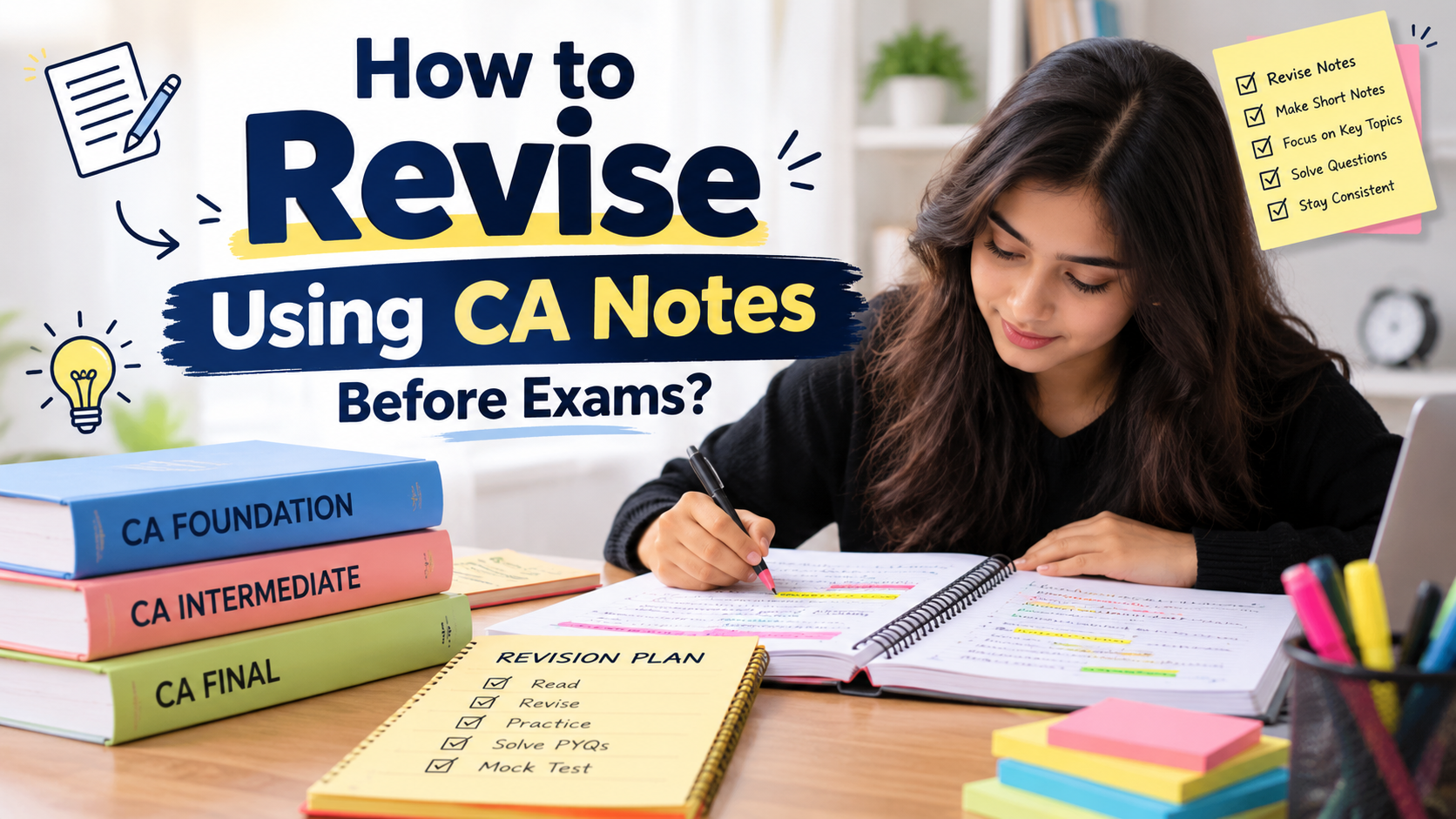
Table of Contents
- Why CA Notes Matter During Revision
- When Should You Start Revising With CA Notes?
- The Three-Stage CA Notes Revision Method
- How to Prioritise Subjects and Chapters
- Use Active Recall Instead of Passive Reading
- Sample CA Notes Revision Schedule
- Combine Notes With Question Practice
- How to Revise Weak Topics
- How to Use CA Notes During the Last Week
- Common Mistakes While Revising With CA Notes
- How Studycaller Can Support Your CA Revision
- Final Checklist for Revising With CA Notes
- Make Every Revision Count
- FAQs
How to Revise Using CA Notes Before Exams?
CA preparation involves studying a large syllabus, but the final weeks before an examination are mainly about one thing: remembering what you have already studied. This is where well-organised CA Notes can make a real difference. Instead of reopening every textbook and spending hours searching for important points, students can use concise notes to revise the syllabus in a more focused way.
However, simply reading CA Notes again and again does not guarantee better retention. Effective revision requires a method. You need to know what to revise first, how often to repeat important topics, when to solve questions and how to identify the areas that still need attention. This guide explains a practical way to use CA Notes before exams and how Studycaller can fit into a structured CA preparation routine.
Why CA Notes Matter During Revision
The first reading of a CA subject and the final revision serve different purposes. During the first reading, students need detailed explanations and enough time to understand the logic behind each topic. During revision, the focus changes to recall, speed and accuracy.
CA Notes can act as a bridge between these two stages. They condense important concepts into a format that can be reviewed repeatedly. Instead of spending several hours reading a complete chapter again, a student can often revisit its key ideas in much less time.
Good notes are particularly helpful when the syllabus is large. They can bring together definitions, formulas, provisions, formats, important adjustments, practical steps and other high-value information in one organised place. But the notes should be treated as a revision tool rather than a substitute for understanding.
The biggest advantage comes when you use the same notes multiple times. Every revision becomes faster because familiar information requires less time to process. The goal is not to read more pages; the goal is to recall more information correctly.
When Should You Start Revising With CA Notes?
If you begin using revision notes too early without understanding the chapter, you may memorise isolated points without understanding their application. On the other hand, waiting until the last few days can make revision unnecessarily stressful.
A practical approach is to start using concise notes as soon as you complete each chapter. Read the chapter properly, practise a few relevant questions and then mark the key points in your notes. When the first full revision begins, you already have a familiar revision resource.
This approach also makes it easier to identify weak areas. If a particular topic repeatedly takes longer to recall, mark it for additional revision rather than treating every chapter equally.
The Three-Stage CA Notes Revision Method
A simple three-stage method can make CA Notes much more effective. The first stage is understanding, the second is active revision and the third is exam-oriented recall.
Stage 1: Understand Before You Compress
Do not begin by memorising every line of a short note. First make sure you understand the concept from your primary study material. If a topic is difficult, use a detailed explanation before returning to the concise notes.
Stage 2: Revise and Mark
During your first revision, mark formulas, provisions, definitions, exceptions, practical steps and concepts that you tend to forget. Keep these markings limited. If everything is highlighted, nothing is truly a priority.
Stage 3: Recall Without Looking
Close the notes and try to explain the topic in your own words. Write formulas from memory, list the steps of a practical question or recall important provisions. This turns revision into an active exercise instead of passive reading.
This three-stage cycle is far more useful than simply reading the same PDF several times.
How to Prioritise Subjects and Chapters
One common revision mistake is giving exactly the same amount of time to every chapter. Your preparation history, confidence level and chapter importance should influence the order of revision.
| Priority | Type of Topic | Revision Approach |
|---|---|---|
| High | Weak or frequently forgotten topics | Repeat more often and practise questions |
| High | Important scoring areas | Revise notes and solve exam-style questions |
| Medium | Concepts you understand reasonably well | Regular short revision |
| Low | Strong and familiar topics | Quick recall checks |
This does not mean ignoring any part of the syllabus. It simply means using your available revision time intelligently. If a strong chapter takes 20 minutes to recall while a weak chapter takes two hours, the weak chapter deserves more attention.
Use Active Recall Instead of Passive Reading
One of the most effective ways to use CA Notes is to turn the revision process into a question-and-answer exercise. Read a heading, close the page and ask yourself what you remember. If you cannot explain the topic, reopen the notes and review it.
For theory subjects, try writing key provisions or concepts without looking at the notes. For practical subjects, write the formula or method first and then compare it with the notes. For subjects involving standards, laws or detailed rules, test yourself on conditions, exceptions and applications.
Active recall may feel slower than reading, but it gives you better information about what you actually know. A page that looks familiar while reading can become surprisingly difficult to reproduce from memory.
Your revision should expose weaknesses rather than hide them. That is why active recall is so valuable before exams.
Sample CA Notes Revision Schedule
| Revision Phase | Main Focus | How to Use Notes |
|---|---|---|
| First Revision | Complete syllabus recall | Read chapter notes and mark weak areas |
| Second Revision | Speed and retention | Use active recall and important marked points |
| Third Revision | Exam readiness | Rapid notes revision with question practice |
| Final Days | High-value recall | Review formulas, provisions, mistakes and difficult topics |
Combine Notes With Question Practice
Reading notes can tell you whether you recognise a concept. Questions tell you whether you can actually use it. For CA exams, this difference matters because many topics require application rather than simple recall.
After revising a chapter from your notes, solve a few relevant questions without looking at the solution. When you make a mistake, identify why it happened. Was the concept unclear? Did you forget a provision? Did you use the wrong formula? Did you misunderstand what the question was asking?
Add only the important learning from that mistake to your revision notes. Over time, your notes become more personalised and more useful because they reflect the areas that are genuinely difficult for you.
Notes plus questions create a stronger revision loop than notes alone. This is especially important for numerical and application-oriented subjects.
How to Revise Weak Topics Using CA Notes
Weak topics should not simply be read repeatedly. First identify the exact problem. Some students struggle because they do not understand the concept, while others understand it but cannot recall the formula or apply it under time pressure.
If the problem is conceptual, return to detailed study material or a clear explanation. If the problem is memory, use active recall and spaced repetition. If the problem is application, solve more questions. This prevents you from using the same revision method for every weakness.
You can also create a small “error list” alongside your CA Notes. Keep only the points you repeatedly forget or get wrong. Review this list at the end of each study session and again before the next revision cycle.
Over time, the error list can become one of your most valuable last-minute resources because it represents your personal weaknesses rather than a generic list of important topics.
How to Use CA Notes During the Last Week Before Exams
The final week is not the ideal time to start collecting new resources. Your focus should shift towards consolidation. Use the notes you have already revised instead of searching for another PDF or changing your entire study strategy.
Begin each session by reviewing the topics you marked as difficult. Follow this with a quick revision of important formulas, provisions and concepts. Then spend some time solving questions or reviewing mistakes from previous practice.
During the last few days, avoid trying to memorise every small detail with equal intensity. Prioritise information that you are expected to recall accurately and areas where you have previously made mistakes.
For the final revision, your notes should become progressively shorter in practical use. You should be able to move from full chapter notes to marked pages, then to key points and finally to quick recall.
Common Mistakes While Revising With CA Notes
Reading Without Testing Yourself
Repeated reading creates familiarity, but familiarity is not the same as recall. Always include some closed-book recall in your revision.
Using Too Many Note Sources
Switching between multiple PDFs for the same topic wastes time and makes revision inconsistent. Select one reliable primary set and add only genuinely useful information.
Using Outdated Notes
Always check whether your notes match the applicable syllabus and attempt. This is especially important for subjects affected by amendments, notifications or changes in provisions.
Ignoring Question Practice
Even excellent notes cannot tell you whether you can write an answer under exam conditions. Pair revision with relevant questions, mock tests and self-assessment.
Starting Revision Too Late
When all revision is pushed into the last few days, students often read quickly without retaining much. Earlier, repeated revisions are usually more effective than one exhausting final reading.
How Studycaller Can Support Your CA Revision
A good revision system needs more than notes. Students also need a way to practise questions, identify weak areas and understand whether their preparation is improving. Studycaller can be part of that broader preparation process.
For students using CA Notes as their main revision resource, a structured test and performance approach can add an important second layer. After revising a subject, testing yourself helps identify whether the information can actually be recalled and applied.
This is particularly useful for self-study students. When you are preparing independently, it is easy to overestimate your preparation because the notes look familiar. Performance-based practice provides a more realistic picture.
The ideal process is straightforward: study, revise, recall, practise, analyse and revise again. Notes support the revision part, while tests and performance review help you decide what needs to happen next.
Final Checklist for Revising With CA Notes
| Check | What to Do |
|---|---|
| Understand | Make sure the chapter is conceptually clear |
| Condense | Use concise and updated notes for revision |
| Recall | Close the notes and reproduce key information |
| Practise | Solve relevant exam-style questions |
| Analyse | Identify repeated mistakes and weak topics |
| Repeat | Revise difficult areas more frequently |
| Finalise | Use familiar notes instead of collecting new resources |
Make Every Revision Count
CA Notes are most powerful when they help you revisit information repeatedly without making revision feel overwhelming. The objective is not to finish a PDF as quickly as possible. The objective is to reach a point where you can recall the important concepts and apply them when you see an exam question.
Keep your revision system simple. Use reliable notes, mark your weak areas, practise active recall and connect every major revision session with questions. As the exam gets closer, reduce the amount of material you are actively reviewing and increase the frequency of high-value recall.
With a structured approach, notes can save valuable time and reduce the pressure of revising a large syllabus. Studycaller can complement this process by helping students bring revision and performance practice into the same preparation routine.
Most importantly, do not judge your preparation by how many pages you have read. Judge it by how confidently you can recall concepts, solve questions and write answers within the exam time. That is the real purpose of revision.

FAQs
Are CA Notes enough for final revision?
CA Notes can be very useful for final revision, but they should not be your only resource. Combine them with appropriate study material, question practice, amendments and mock tests for complete exam preparation.
When should I start revising with CA Notes?
You can start using concise notes after completing a reasonable first reading of a chapter. Using them early for repeated revision helps you identify weak topics instead of leaving the entire revision burden for the final days.
How many times should I revise CA Notes?
There is no fixed number because it depends on your preparation and retention. Aim for repeated revisions, with each later revision becoming faster and more focused on weak areas, important topics and previously made mistakes.
Is active recall useful for CA exam revision?
Yes. Active recall makes you reproduce information without looking at your notes, which exposes gaps in memory. It is useful for formulas, provisions, definitions, concepts and other information that must be recalled accurately during exams.
Should I solve questions after revising CA Notes?
Yes. Questions show whether you can apply what you have revised. After solving them, analyse mistakes and add only useful learning to your notes so future revisions become more targeted and effective.
How can I revise difficult CA topics quickly?
First identify whether the difficulty is conceptual, memory-related or application-based. Then choose the appropriate method: detailed learning for concepts, active recall for memory and question practice for application.
Should I use multiple CA Notes PDFs for one subject?
Usually, one dependable set of notes is better than several overlapping PDFs. Too many sources can increase revision time and confusion. Add information from another source only when it fills a genuine gap in your primary notes.
What should I revise from CA Notes in the last few days?
Focus on marked weak areas, important formulas, provisions, concepts, personal mistakes and frequently tested topics. Avoid starting unfamiliar resources at the last minute because they can increase stress without improving retention.
Can Studycaller help with CA revision and practice?
Studycaller can support a structured preparation approach by combining study resources with revision and performance-oriented practice. Students can use notes for recall and tests to identify the areas that require further improvement.