Can a CA Work Without Audit Practice? Career Options Beyond Audit
Can a CA work without audit practice? Explore alternative career opportunities in taxation, consulting, finance, advisory, Virtual CFO services, and entrepreneurship.
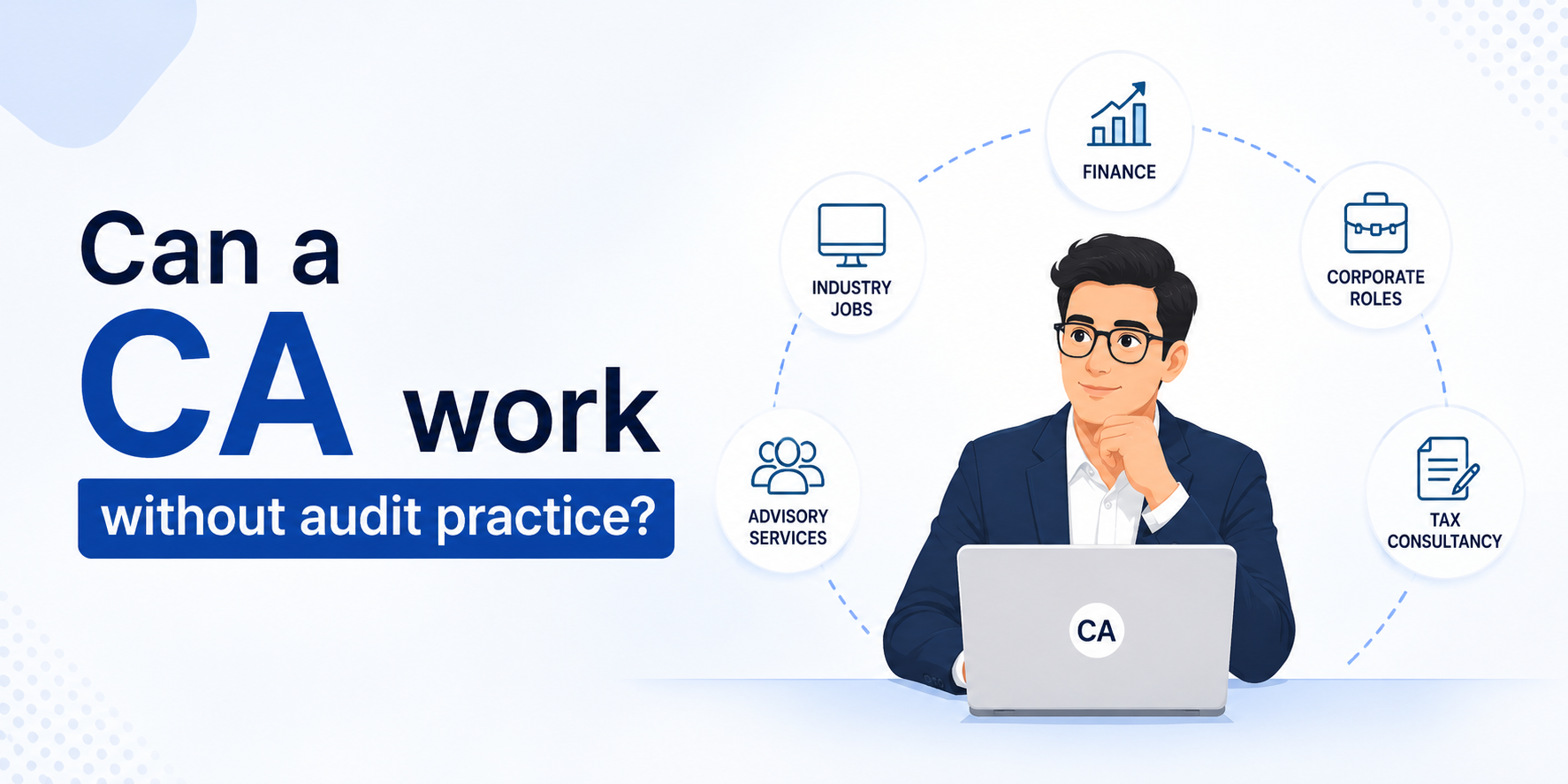
Table of Content
- Audit Is Only One Part of the CA Profession
- Can a CA Work Without Audit Practice?
- Taxation Practice Is a Popular Alternative
- Business Consulting Offers Excellent Opportunities
- Virtual CFO Services Are Growing Rapidly
- Corporate Careers Without Audit Practice
- Startup Advisory Is Becoming a Preferred Career Option
- Technology Has Reduced Dependence on Traditional Audit
- Industry Specialization Creates New Practice Areas
- Entrepreneurship Without Audit Practice
- Skills Required Beyond Technical Knowledge
- The Future of Chartered Accountancy Is Advisory-Driven
- Conclusion
For many aspiring Chartered Accountants, audit is often considered the most traditional career path after qualifying. Since audit forms an important part of the CA curriculum and articleship training, many students assume that practicing audit is compulsory for building a successful career. However, the accounting profession has evolved significantly over the past decade. Businesses today expect Chartered Accountants to contribute not only through audit and compliance but also through financial advisory, taxation, business consulting, technology implementation, risk management, and strategic planning. This shift has opened numerous opportunities for professionals who want to build their careers outside the audit domain.
This naturally raises an important question: Can a CA work without audit practice? The answer is yes. A Chartered Accountant can build a highly successful career without offering audit services. The knowledge gained during the CA course equips professionals with expertise in finance, taxation, accounting, corporate laws, compliance, financial analysis, and business management, allowing them to explore multiple career paths. Whether someone wants to establish an advisory firm, work in the corporate sector, become a Virtual CFO, or start a consulting practice, audit is only one among many professional opportunities available to Chartered Accountants.
Audit Is Only One Part of the CA Profession
The Chartered Accountancy profession is much broader than statutory audit and assurance services. Modern businesses require financial professionals who can solve business challenges, improve profitability, manage compliance, strengthen governance, and support strategic decision-making.
As industries continue to evolve, Chartered Accountants are increasingly moving toward advisory-driven roles where business consulting and financial management create greater value than traditional audit assignments. This expansion has significantly increased career flexibility for qualified CAs.
Can a CA Work Without Audit Practice?
Yes, a Chartered Accountant can work successfully without practicing audit. Many qualified CAs choose careers in taxation, corporate finance, business consulting, financial planning, startup advisory, compliance management, management reporting, and Virtual CFO services instead of traditional audit practice.
The CA qualification provides a versatile skill set that allows professionals to explore diverse industries and business functions while building rewarding careers. Professional success depends more on expertise and specialization than on audit practice alone.
Taxation Practice Is a Popular Alternative
Taxation remains one of the strongest practice areas for Chartered Accountants who do not wish to conduct audits. Businesses constantly require professional assistance in managing direct and indirect tax matters while ensuring regulatory compliance. Taxation services may include:
- Income Tax advisory
- GST consultancy
- TDS compliance
- Tax planning
- Tax return filing
- Litigation support
Tax specialization provides recurring client engagements and long-term professional growth.
Business Consulting Offers Excellent Opportunities
Many Chartered Accountants establish themselves as business consultants by helping organizations improve financial performance and operational efficiency. Consulting assignments may include:
- Business strategy
- Cost optimization
- Profitability improvement
- Financial diagnostics
- Growth planning
- Business restructuring
Consulting enables Chartered Accountants to create greater value by solving business problems rather than focusing only on compliance work. The demand for advisory services continues to increase across industries.
Virtual CFO Services Are Growing Rapidly
Small and medium-sized businesses often require financial leadership but may not have the resources to hire a full-time Chief Financial Officer. This has created significant opportunities for Chartered Accountants to provide Virtual CFO services. Virtual CFO assignments generally involve:
- Financial planning
- Budget preparation
- Cash flow management
- Investor reporting
- Financial analysis
- Strategic advisory
These long-term engagements generate recurring revenue while allowing CAs to build strong client relationships.
Corporate Careers Without Audit Practice
Many Chartered Accountants choose employment opportunities instead of independent practice. Corporate organizations actively recruit CAs for various finance and management positions where audit experience is not mandatory. Common corporate roles include:
- Financial Analyst
- Finance Manager
- Business Controller
- Treasury Manager
- Corporate Finance Executive
- Chief Financial Officer
Corporate finance offers stable career growth with exposure to strategic business decision-making.
Startup Advisory Is Becoming a Preferred Career Option
India's startup ecosystem has created exciting opportunities for Chartered Accountants. Startups require professional support for financial planning, fundraising, budgeting, compliance management, and investor reporting. Chartered Accountants can provide advisory services such as:
- Business registration
- Financial projections
- Compliance management
- Investment readiness
- Budget planning
- Cash flow management
Startup advisory allows professionals to work closely with entrepreneurs while contributing to business growth.
Technology Has Reduced Dependence on Traditional Audit
Digital transformation has changed the accounting profession significantly. Automation, cloud accounting, business analytics, and financial dashboards have expanded the role of Chartered Accountants into technology-enabled financial advisory. Modern practice areas include:
- Cloud accounting implementation
- ERP consulting
- Financial analytics
- Dashboard reporting
- Workflow automation
- Digital finance transformation
Technology creates new opportunities that go far beyond conventional audit services.
Industry Specialization Creates New Practice Areas
Many Chartered Accountants now specialize in serving particular industries instead of offering general audit services. Sector-focused advisory enables professionals to develop deep expertise and deliver customized financial solutions. Popular industries include:
- Healthcare
- Manufacturing
- Education
- Real estate
- Retail
- Information Technology
- Hospitality
- MSMEs
Industry specialization strengthens professional reputation and improves client retention.
Entrepreneurship Without Audit Practice
Many Chartered Accountants establish independent consulting firms that focus entirely on advisory and financial management services. Instead of offering audits, these firms specialize in helping businesses improve operations and profitability through strategic financial guidance. Entrepreneurial practice areas may include:
- Business consulting
- Financial planning
- Compliance outsourcing
- Management reporting
- Working capital advisory
- Business process improvement
Such firms often enjoy higher-value engagements with long-term clients.
Skills Required Beyond Technical Knowledge
Building a successful non-audit career requires more than accounting expertise. Chartered Accountants should develop additional professional skills that improve advisory capabilities and client engagement. Important skills include:
- Communication skills
- Leadership ability
- Strategic thinking
- Business analysis
- Client relationship management
- Technology adoption
Continuous learning helps professionals remain competitive in evolving practice areas.
The Future of Chartered Accountancy Is Advisory-Driven
The accounting profession is gradually shifting from compliance-based services toward strategic business advisory. Automation is reducing manual accounting work, while businesses increasingly seek guidance on growth, profitability, technology adoption, governance, and financial planning.
Chartered Accountants who expand into consulting and advisory services are likely to enjoy greater professional opportunities and long-term career growth. The future belongs to professionals who combine financial expertise with business strategy and technology.
Conclusion
The answer to "Can a CA work without audit practice?" is a clear yes. Audit is only one of the many professional opportunities available to Chartered Accountants today. Taxation, business consulting, Virtual CFO services, startup advisory, corporate finance, financial planning, technology consulting, and management advisory offer excellent career prospects for CAs who wish to build their careers beyond audit. By continuously upgrading their skills and adapting to changing business needs, Chartered Accountants can create highly successful and future-ready careers without depending on traditional audit practice.

FAQs
Can a CA work without audit practice?
Yes. Chartered Accountants can build successful careers in taxation, consulting, corporate finance, Virtual CFO services, compliance management, and business advisory without practicing audit.
Is audit compulsory for every Chartered Accountant?
No. Audit is one professional option, but Chartered Accountants can choose several alternative career paths depending on their interests and expertise.
What are the best career options for CAs without audit practice?
Popular options include taxation, business consulting, financial planning, Virtual CFO services, startup advisory, corporate finance, compliance management, and financial analysis.
Can a CA start a consulting firm without offering audit services?
Yes. Many Chartered Accountants establish consulting firms that specialize in financial advisory, business strategy, compliance, and profitability improvement without conducting audits.
Are Virtual CFO services suitable for Chartered Accountants?
Absolutely. Virtual CFO services allow Chartered Accountants to provide financial leadership, budgeting, cash flow management, and strategic advisory to businesses.
Can a CA work in the corporate sector without audit experience?
Yes. Many companies hire Chartered Accountants for finance, treasury, planning, business analysis, management reporting, and leadership roles that do not involve audit practice.
Does technology create new opportunities for non-audit CAs?
Yes. Cloud accounting, ERP consulting, business analytics, automation, and financial dashboards have expanded career opportunities beyond traditional audit.
Can Chartered Accountants specialize in particular industries?
Yes. Many CAs focus on sectors such as healthcare, manufacturing, education, startups, IT, real estate, and MSMEs to provide specialized advisory services.
What skills are important for CAs pursuing non-audit careers?
Communication, strategic thinking, technology skills, business analysis, leadership, and client relationship management are highly valuable for non-audit practice.
What is the biggest advantage of working without audit practice?
The biggest advantage is the flexibility to explore diverse advisory and consulting opportunities that offer long-term career growth, specialization, recurring revenue, and greater value creation for clients.