Why Long Study Hours Do Not Always Work in CA Preparation?
Learn why long study hours do not always work in CA preparation and how smart revision, consistency, focus, and balanced study routines improve exam performance more effectively.
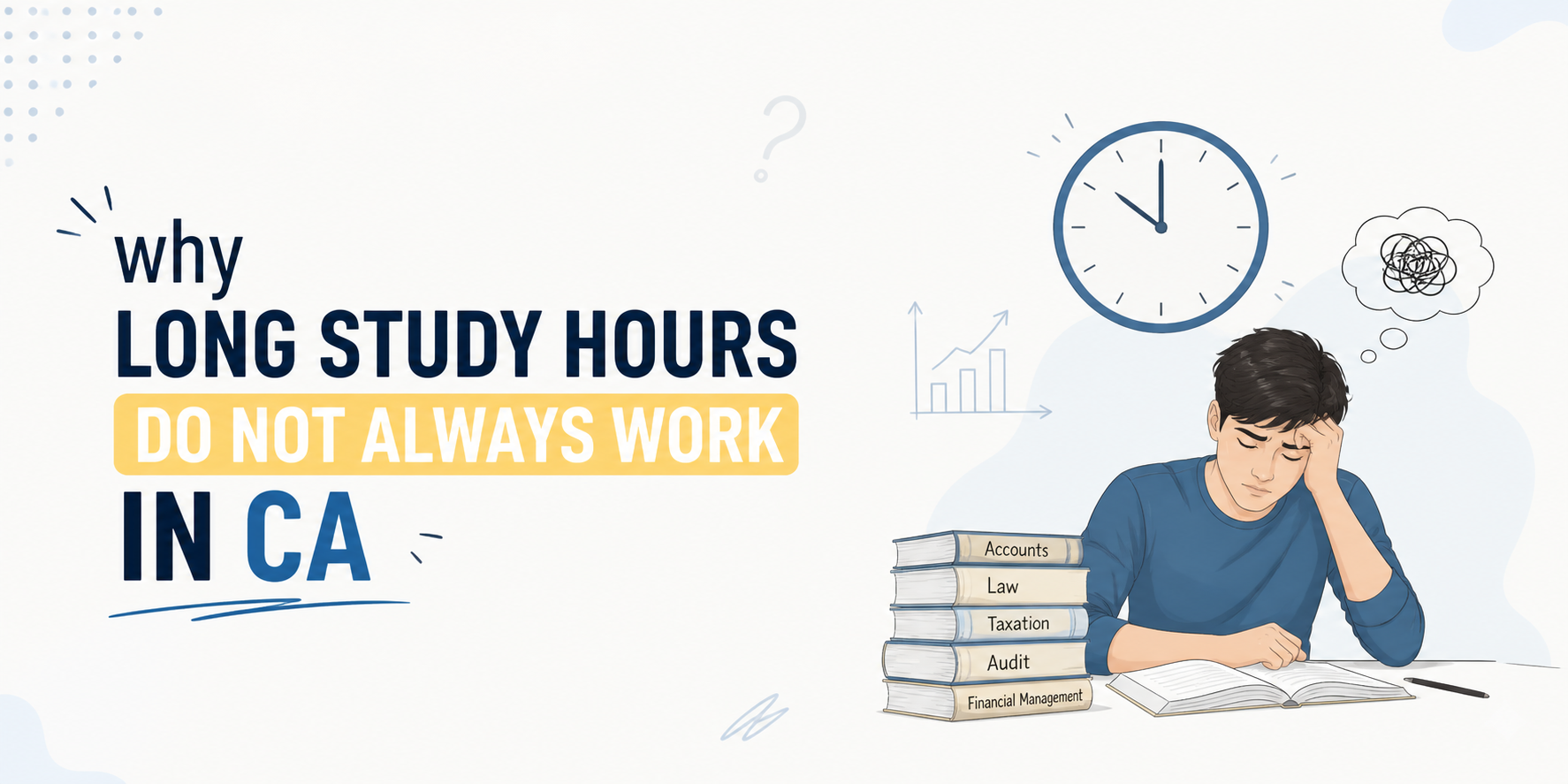
Table of Content
- Productivity Matters More Than Study Duration
- Mental Fatigue Reduces Learning Efficiency
- Consistency Is More Important Than Extreme Study Hours
- Lack of Revision Weakens Long Study Sessions
- Poor Sleep Negatively Affects Preparation
- Quality of Study Improves Exam Performance
- Burnout Can Damage Preparation
- Every Student Learns Differently
- Smart Preparation Is More Effective
- Conclusion
Many CA students believe that studying for extremely long hours automatically increases the chances of success. Because of this mindset, students often compare their study hours with others and feel pressured to sit for 12–14 hours daily, even when concentration and productivity are low.
In reality, long study hours do not always guarantee strong preparation. Many students spend entire days at the study table but still struggle with retention, revision, and confidence during exams. On the other hand, some students study comparatively fewer hours but perform much better because their preparation remains more focused and consistent.
If you want to understand why long study hours do not always work in CA, it is important to realize that exam performance depends more on learning quality than simply increasing the number of hours studied. CA preparation is not a competition of who sits longer with books. It is about how effectively students understand, revise, and retain concepts over time.
Productivity Matters More Than Study Duration
One of the biggest mistakes students make during CA preparation is assuming that sitting longer automatically means studying better.
In many cases, students continue studying even after their concentration level drops completely. They keep reading pages without properly understanding or remembering the concepts. This creates the illusion of hard work without actual improvement in preparation quality. Students often become unproductive because of:
- Mental exhaustion
- Frequent distractions
- Lack of active revision
- Continuous passive reading
A focused and fully concentrated study session of five or six hours can sometimes become more effective than ten hours of distracted study. The brain absorbs information much better when attention and energy levels remain stable.
Mental Fatigue Reduces Learning Efficiency
The human brain cannot maintain deep concentration continuously for very long periods. After several hours of intense studying, mental fatigue naturally starts increasing.
When students continue forcing themselves to study despite exhaustion, learning efficiency gradually reduces. They may physically remain at the study table, but mentally, the brain struggles to process information properly. This often affects:
- Memory retention
- Problem-solving ability
- Conceptual understanding
- Calculation accuracy
Many students experience situations where they study for long hours but later realize they remember very little from the session. This usually happens because the mind is already mentally overloaded. Balanced study sessions with proper breaks often improve learning quality much more effectively.
Consistency Is More Important Than Extreme Study Hours
CA preparation is a long-term process that usually continues for several months. Because of this, consistency becomes more valuable than a temporary aggressive effort.
Some students follow unrealistic routines for a few days and then completely lose momentum because the schedule becomes mentally exhausting. This creates irregular preparation patterns. Students who maintain balanced and consistent routines usually:
- Revise more regularly
- Retain concepts better
- Experience less burnout
- Stay connected with studies for longer periods
Steady preparation over several months generally produces stronger results than short periods of extreme study pressure. Consistency helps students maintain both productivity and emotional stability during preparation.
Lack of Revision Weakens Long Study Sessions
Many students spend excessive time trying to complete new topics continuously while ignoring proper revision. As a result, previously studied concepts slowly fade from memory. Without regular revision:
- Retention becomes weak
- Confidence decreases
- Similar concepts create confusion
- Recall speed becomes slower during exams
This is why students sometimes feel underprepared despite studying for very long hours. Effective preparation depends heavily on repeated revision rather than only completing syllabus portions. Students who revise regularly often feel much more confident during exams compared to students who only increase study duration.
Poor Sleep Negatively Affects Preparation
One common habit among CA students is sacrificing sleep to increase study hours before exams. Initially, this may feel productive, but over time, it reduces overall efficiency significantly. Poor sleep affects:
- Focus level
- Memory performance
- Emotional stability
- Concentration during revision
An exhausted brain cannot absorb information properly, no matter how long students continue sitting with books.
Students who maintain proper sleep schedules usually perform better because their concentration remains sharper and their minds stay fresher during study sessions. Mental freshness often matters more than extreme study duration.
Quality of Study Improves Exam Performance
CA exams test conceptual understanding, analytical ability, practical application, and presentation quality. These skills improve through focused preparation rather than passive long reading sessions. Students who actively:
- Solve practical questions
- Practice writing answers
- Revise concepts repeatedly
- Analyze mistakes carefully
usually perform better during exams.
Simply increasing study hours without improving study quality often creates frustration because effort and results do not match properly. Effective learning depends more on engagement and understanding than on total hours studied.
Burnout Can Damage Preparation
Continuous long study schedules without balance often create mental burnout. Students start feeling emotionally exhausted and mentally disconnected from studies. Burnout may lead to:
- Low motivation
- Reduced concentration
- Frustration during studying
- Lack of confidence
Once burnout develops, even simple study tasks start feeling difficult and tiring. Balanced preparation helps students remain productive for longer periods without damaging mental health and emotional stability. Avoiding burnout becomes extremely important during demanding courses like CA.
Every Student Learns Differently
Many students compare their study schedules with toppers or friends and assume they must follow the same routine to succeed. However, every student differs in:
- Learning speed
- Concentration ability
- Revision needs
- Memory retention
Some students understand concepts faster, while others require more repetition and revision. This is why blindly copying someone else’s long study routine may not always produce good results. Students should focus on finding study patterns that suit their own concentration and productivity levels instead of comparing only study hours.
Smart Preparation Is More Effective
Students who prepare smartly usually focus more on:
- Revision cycles
- Active recall practice
- Mock tests
- Conceptual clarity
- Time management
These methods improve efficiency and retention significantly. Smart preparation helps students reduce unnecessary study pressure while improving actual learning quality. Especially during the final months before exams, efficient study methods become much more useful than simply increasing study duration.
Conclusion
Long study hours do not always work in CA preparation because productivity depends more on focus, revision quality, consistency, and mental freshness than on the number of hours studied. Students who maintain balanced routines and study with concentration often perform much better than students who depend only on extreme study schedules.
CA preparation is a long-term journey that requires sustainable effort and effective learning habits. In the end, smart preparation, regular revision, and disciplined consistency usually matter far more than counting study hours alone.

FAQs
Why do long study hours not always work in CA preparation?
Long study hours may reduce concentration and learning quality if students become mentally tired, distracted, or unable to revise concepts effectively.
Is studying for 12–14 hours necessary for CA success?
No, CA success depends more on focused learning, revision quality, consistency, and conceptual understanding rather than only extremely long study hours.
How does mental fatigue affect CA preparation?
Mental fatigue reduces concentration, memory retention, problem-solving ability, and overall learning efficiency during long study sessions.
Why is consistency important in CA preparation?
Consistency helps students revise regularly, avoid burnout, maintain stable productivity, and strengthen long-term retention during preparation.
Does poor sleep affect study performance?
Yes, poor sleep negatively affects focus, memory, emotional stability, and concentration during preparation and exams.
Why is revision more important than long study hours?
Revision strengthens retention, improves recall speed, and increases confidence during exams more effectively than passive long reading sessions.
Can burnout affect CA preparation quality?
Yes, burnout reduces motivation, concentration, emotional stability, and productivity during long preparation periods.
Why should students avoid comparing study hours?
Every student learns differently, so comparing study hours creates unnecessary pressure and may reduce confidence during preparation.
What is smart preparation in CA studies?
Smart preparation includes focused revision, active recall, mock test practice, conceptual understanding, and effective time management strategies.
What matters more in CA preparation, quality or quantity of study?
Quality of study matters more because focused learning and strong revision usually produce better results than passive long study hours.