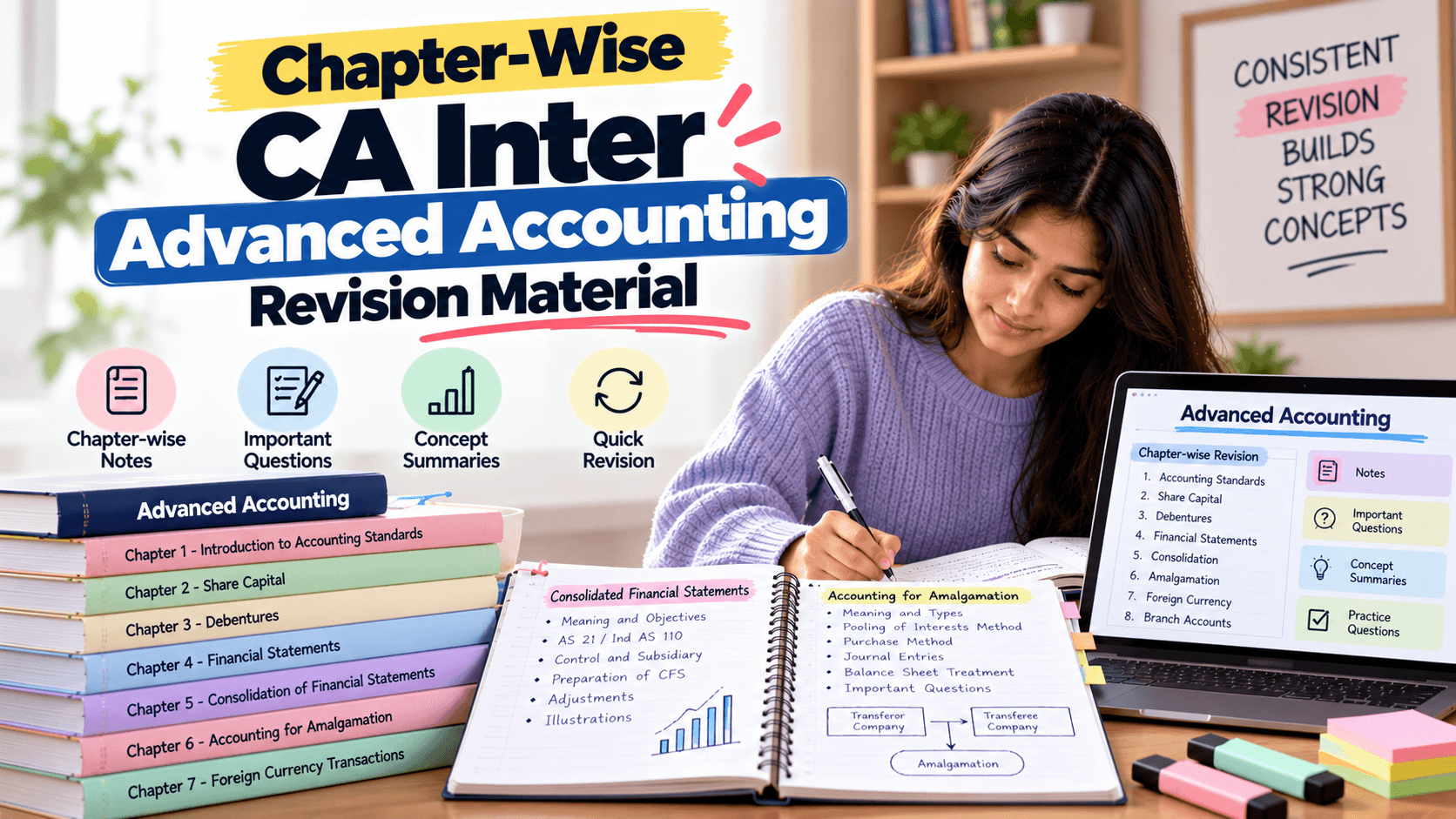
Chapter-Wise CA Inter Advanced Accounting Revision Material
Plan CA Intermediate Advanced Accounting revision chapter by chapter using concept summaries, formats, working notes, practice questions and a personal error log.
In this article(10 sections)ShowHide
Advanced Accounting revision becomes difficult when you try to cover the whole subject at once. Different chapters may require different formats, calculations and accounting treatments, and switching between them without a plan can make revision feel longer than it needs to be.
Chapter-wise revision material gives each topic a clear place in your schedule. It helps you track what you have studied, what still needs practice and which errors keep returning. Keep the material aligned with the current syllabus and prescribed ICAI resources for your attempt.
Why chapter-wise revision works
A chapter-wise system turns a large subject into smaller tasks that can be planned and measured. Instead of writing “revise Advanced Accounting” on your timetable, set a concrete goal such as reviewing one topic’s treatment, solving selected illustrations and attempting a short question set without help.
It also makes gaps easier to identify. If you can explain a rule but cannot complete the working, focus next on application. If you can solve a question but repeatedly miss presentation details, your revision needs a format and checking routine.
Create a revision sheet for every chapter
Use a repeatable template for each chapter: core concepts, accounting treatment, format or sequence, important adjustments, one worked example, common mistakes and practice questions to revisit. The template keeps your revision material consistent and makes it easier to compare progress across chapters.
Do not reduce a complicated chapter to a few unexplained formulas. Record the reason behind the treatment and any conditions that affect its application. When the topic requires a particular format, reproduce it accurately and practise using it rather than assuming that recognising it is enough.
How to revise accounting standards and principles
For standards-based topics, organise notes around scope, recognition, measurement, presentation and disclosure requirements where relevant to the syllabus. Add a short example that shows how the principle changes the accounting treatment. Keep terminology consistent with official study material.
Separate the general rule from exceptions and special cases. When two standards or treatments appear similar, make a comparison table that highlights the difference. Verify any amendment or syllabus-specific inclusion using current official material instead of relying on an older notebook.
Practise formats and working notes
Many accounting questions require a clear sequence of workings before the final answer. Practise writing the format from memory, then complete a question while showing each calculation. A neat layout makes it easier to check your reasoning and reduces the chance of skipping an adjustment.
After solving a question, compare the method as well as the final number. Ask whether you used the correct figures, applied the required treatment, included all relevant adjustments and labelled the answer clearly. If the result is wrong, identify the first incorrect step and redo the question from there.
Use active recall and spaced revision
At the end of a chapter, close the material and write the key treatment or steps from memory. Then compare your response with the revision sheet and add missing points. Repeat the recall exercise later rather than waiting until the entire subject has been completed.
Spaced revision helps you revisit material before it becomes unfamiliar. A simple cycle is to review a topic the next day, include it in the weekly revision session and test it again during mixed practice. Adjust the intervals to your schedule and how well you remember the topic.
Build a chapter tracker
Maintain a tracker with chapter name, first revision date, question practice completed, confidence level, errors to revisit and next review date. Keep the status honest: reading a chapter does not mean it is exam-ready if you have not solved questions independently.
Use the tracker to make decisions about study time. Chapters with repeated errors may need a concept review, while topics you can solve accurately may need only short recall sessions. Update the tracker after each practice session so it reflects your current level.
A routine for solving questions
Begin with one illustration to confirm the method, then solve a similar question independently. Move to mixed or exam-style questions once you can complete the basic steps. During timed practice, resist checking the solution midway; note where you felt uncertain and review it afterward.
Classify mistakes by cause: misunderstanding, incorrect treatment, missing adjustment, arithmetic, presentation or time pressure. This classification turns a wrong answer into a clear revision task. Keep a few representative mistakes in your notes so that you remember the warning sign next time.
Weekly and final revision planning
Divide your weekly plan between new or weak chapters, older chapters and a timed practice session. Avoid spending all available time on comfortable topics. A short mixed set each week can reveal whether you remember chapters studied earlier.
During final revision, prioritise the official syllabus, important concepts, formats you often forget and errors from previous practice. Do not try to rewrite every note in the final days. Use compact chapter sheets and focus on solving questions with clear workings.
Avoiding common revision problems
One common problem is collecting too many summaries from different sources. Choose a reliable primary set, add personal corrections and avoid switching formats repeatedly. Another problem is passive reading: it may create familiarity but does not prove that you can apply the treatment independently.
Do not ignore the official study material or assume an old question bank covers every current requirement. Check the syllabus for your attempt and use official updates to confirm coverage. If an answer key and your notes seem inconsistent, verify the accounting treatment before copying either one.
Using Studycaller in your preparation
Studycaller can be included in your broader study routine to support organised revision and practice. Let your tracker and test performance guide the next step, and use official ICAI resources to verify the applicable syllabus and accounting requirements.
The best revision material is practical: it reminds you of the treatment, gives you a clear route through the working and helps you avoid repeating mistakes. Review and improve it as your understanding develops.
CA Inter Accounting standards notes
Free notes from the Studycaller library, picked for this article.
 Handwritten
CA Inter · Advanced Accounting
CA Inter May24 Adv account ✔️Revenue based accounting standards ✔️ Other accounting standards
Sakshi KhandveLikes 7Views 9k Detailed Notes
CA Inter · Advanced Accounting
Advanced Accounting Reviewer Part 1 Accounting Standards With Index CA Inter
Monish KannaLikes 12Views 15.7k Summary
CA Inter · Advanced Accounting
CA - INTERMEDIATE JK SHAH : ADVANCED ACCOUNTING NOTES ACCOUNTING STANDARDS PART : 2
PriyadharshiniLikes 7Views 12.4k Summary
CA Inter · Advanced Accounting
CA - INTERMEDIATE JK SHAH : ADVANCE ACCOUNTING NOTES Accounting Standards Part : 1
PriyadharshiniLikes 7Views 8.6k
Frequently asked questions
What is chapter-wise Advanced Accounting revision material?
It is an organised set of chapter summaries, accounting treatments, formats, working notes and practice reminders.
Should I revise one chapter at a time?
Start chapter-wise to build understanding, then add mixed questions to practise switching between topics.
How do I prepare an accounting revision sheet?
Record the core treatment, required format, key adjustments, one example and mistakes you need to avoid.
Is reading notes enough for Advanced Accounting?
No. You need written numerical practice to test whether you can apply the treatment correctly.
How often should I revisit a chapter?
Review it after a short gap, during weekly revision and again through mixed question practice.
How can I improve presentation in accounting answers?
Show working notes, use clear formats, label figures and check that all relevant adjustments are included.
Can I use previous-attempt revision material?
Only after confirming it matches the current syllabus and applicable accounting requirements.
What should a chapter tracker record?
Record revision dates, practice completed, confidence, recurring errors and the next review date.
How should I use mock-test mistakes?
Classify the error, correct the underlying concept and re-solve a similar question independently.
How can Studycaller fit into revision?
Use Studycaller as part of an organised practice routine and verify syllabus details through current official ICAI resources.