Why Do Some Students Peak Too Early Before CA Exams?
Why do some CA students perform brilliantly early but struggle near exams? Learn how early peak, burnout, poor revision and mock-test timing affect CA preparation.
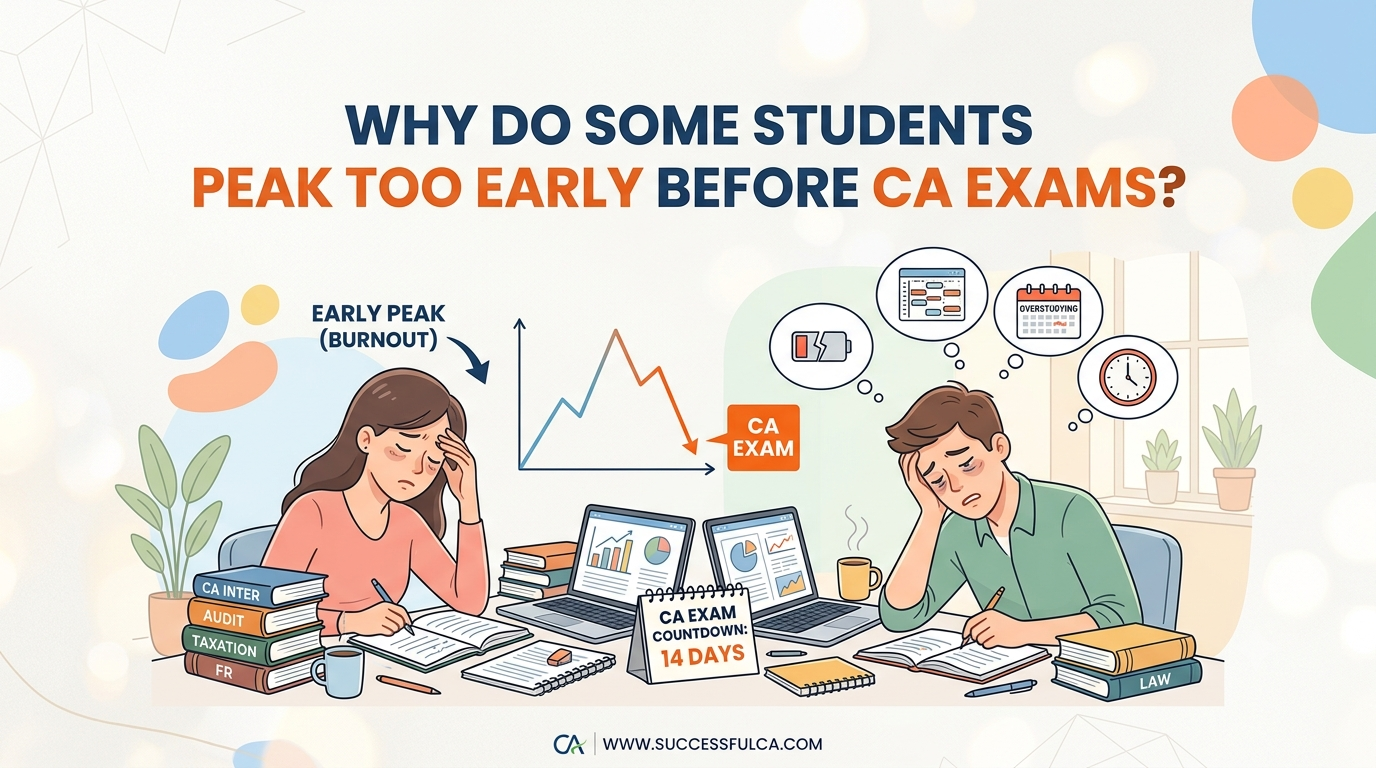
Table of Content
- What Does “Peaking Too Early” Mean in CA Preparation?
- Why Does Early Peaking Happen?
- Studying Too Intensely Too Early
- The Better Approach: Build Intensity Gradually
- Giving Too Many Mock Tests Too Early
- Finishing Your First Revision Too Early
- The Three-Layer Revision Model
- Confusing Syllabus Completion With Preparation Completion
- Your Mock Scores Can Give You False Confidence
- Strong Early Performance Can Create Complacency
- Confidence Should Come From Evidence
- Overloading Yourself With Resources
- Use a Primary + Practice + Testing Model
- Ignoring Sleep Because “The Exam Is Near”
- Not Planning the Final 30 Days
- A Better Final-Month Strategy
- Not Understanding the Difference Between Training and Tapering
- How to Know If You Are Peaking Too Early
- What Should You Do If You Think You Have Peaked Too Early?
- Step 1: Reduce Unnecessary Intensity
- Step 2: Rebuild Your Revision Cycle
- Step 3: Change the Purpose of Your Tests
- The Right CA Mock Test Curve
- Don't Try to Score Your Highest Mock Marks Every Time
- Use Mock Tests as Feedback, Not Validation
- A Practical 8-Week Anti-Early-Peaking Strategy
- The Role of ICAI MTPs and RTPs
- Your Last 30 Days Should Not Look Like Your First 30 Days
- What Should You Stop Doing Before the Exam?
- A Simple “Peak at the Right Time” Formula
- How CA Foundation, Intermediate and Final Students Can Avoid Early Peaking
- A Daily Checklist for Maintaining Your Peak
- The Biggest Mindset Shift: Stop Trying to Feel “Ready”
- Final Thoughts
There is a strange pattern that many CA students experience.
A few months before the examination, everything seems to be going perfectly.
You are studying regularly.
Your syllabus is moving quickly.
You are solving questions.
Your mock-test scores are improving.
You are waking up early.
Your confidence is high.
You start thinking:
“This attempt is going to be different.”
Then the exam gets closer.
Suddenly, things change.
You are tired.
Revision feels slower.
Topics that seemed easy two months ago are difficult to recall.
Your mock scores stop improving—or start falling.
You feel less confident.
And the worst part?
You start wondering:
“What happened? I was doing so well.”
This is what we can call peaking too early.
It does not mean that your earlier preparation was bad. In fact, it may have been very good.
The problem is that your highest level of performance happened too far away from the actual examination.
For a CA student, the goal is not simply to perform well during preparation.
The goal is to build toward peak performance at the right time.
And that requires a different way of thinking about revision, mock tests, study hours, recovery and exam preparation.
What Does “Peaking Too Early” Mean in CA Preparation?
Peaking too early means reaching a high level of:
- Study intensity
- Mock-test performance
- Confidence
- Revision speed
- Concentration
- Productivity
well before the actual examination—and then failing to maintain that level until exam day.
For example:
|
Preparation Stage |
Student's Performance |
|
4 Months Before Exam |
Very High |
|
3 Months Before Exam |
Excellent |
|
2 Months Before Exam |
Good |
|
1 Month Before Exam |
Tired/Inconsistent |
|
Exam Week |
Mentally Exhausted |
This is not the performance curve you want.
Ideally, preparation should look more like:
|
Preparation Stage |
Desired Progress |
|
4 Months Before |
Build foundation |
|
3 Months Before |
Improve consistency |
|
2 Months Before |
Strong revision + testing |
|
1 Month Before |
High exam readiness |
|
Final Week |
Confidence + retention |
|
Exam Day |
Peak performance |
The difference is subtle but extremely important.
You don't want to peak when preparation starts feeling exciting. You want to peak when the examination begins.
Why Does Early Peaking Happen?
There is no single reason.
Usually, it is a combination of several habits.
The most common ones are:
- Starting with unsustainably high study hours
- Taking too many tests too early
- Finishing revision too far in advance
- Confusing syllabus completion with exam readiness
- Ignoring recovery and sleep
- Over-revising strong subjects
- Under-revising weak subjects
- Using all motivation at once
- Not planning the final month
- Treating mock-test scores as the final measure of preparation
Let's look at each one.
Studying Too Intensely Too Early
This is probably the most common problem.
A student gets serious four months before the exam.
They suddenly start studying:
12–14 hours every day.
For two weeks, everything feels fantastic.
They finish huge portions of the syllabus.
They solve hundreds of questions.
They give multiple tests.
They feel extremely productive.
Then the body and mind start asking for the energy that was borrowed from them.
The problem isn't hard work.
The problem is unsustainable hard work.
CA preparation is a long-duration effort.
If your preparation strategy requires maximum intensity from Day 1, what happens when you reach the final month?
You have nowhere to increase your effort.
The Better Approach: Build Intensity Gradually
Instead of:
100% → 100% → 100% → Exhaustion
try:
60% → 70% → 80% → 90% → Peak
Your study intensity should gradually increase as the exam approaches.
This doesn't mean you should study less when you are motivated.
It means you should avoid using your maximum sustainable capacity too early.
Giving Too Many Mock Tests Too Early
Mock tests are incredibly useful.
But timing matters.
ICAI itself positions Mock Test Papers as exam-like preparation tools and recommends attempting them under examination conditions to improve time management and confidence.
The mistake is not giving mocks.
The mistake is giving full-length mocks before your preparation is ready for them, repeatedly, and treating the score as the main objective.
Suppose you have completed only 50% of your syllabus.
You give a full mock.
You score 45%.
Then another.
You score 50%.
Then another.
You score 54%.
You feel great.
But what exactly have you measured?
Partly your exam ability.
Partly your incomplete syllabus.
Partly your familiarity with the test.
A better testing progression is:
Chapter Test → Sectional Test → Subject Test → Full-Length Mock
This allows testing intensity to increase with preparation.
Finishing Your First Revision Too Early
This sounds like a good problem.
But it can become one.
Suppose you finish your entire first revision three months before the exam.
You feel relieved.
You think:
“Now I only have to revise.”
But then life happens.
The first month passes.
Then another.
By the time the exam arrives, the material you revised three months ago may not feel as fresh as it did then.
Revision has a decay problem.
Information that is not actively recalled becomes harder to retrieve.
That is why ICAI's preparation guidance recommends revisiting concepts and provisions studied during the day and revising previously studied material before starting fresh topics.
The answer is not to postpone your first revision.
The answer is to build multiple layers of revision.
The Three-Layer Revision Model
A strong CA preparation cycle can look like this:
Revision 1 — Understanding
Goal:
“Do I understand the topic?”
Focus on:
- Concepts
- Provisions
- Illustrations
- Basic questions
Revision 2 — Retention
Goal:
“Can I recall it without looking?”
Focus on:
- Active recall
- ICAI questions
- RTP
- Previous questions
- Short notes
Revision 3 — Exam Readiness
Goal:
“Can I use it under time pressure?”
Focus on:
- MTPs
- Full-length tests
- Time management
- Answer writing
- Mistake correction
Now your first revision being completed early is no longer a problem.
It becomes the foundation for later revisions.
Confusing Syllabus Completion With Preparation Completion
This is one of the biggest psychological traps in CA exams.
You finish all chapters.
You tick everything off.
Then you think:
“My preparation is complete.”
But syllabus completion is only one milestone.
You still need:
- Revision
- Question practice
- Retention
- Mock tests
- RTP practice
- MTP practice
- Previous papers
- Time management
- Answer presentation
ICAI's Board of Studies provides a broader preparation ecosystem including Study Material, RTPs, MTPs, Suggested Answers, previous papers and practice resources—not merely a syllabus checklist.
So think of preparation in four levels:
|
Level |
Meaning |
|
Syllabus Completed |
You have studied the content |
|
Revised |
You have revisited it |
|
Practised |
You can solve questions |
|
Exam Ready |
You can perform under time pressure |
These are four different things.
Your Mock Scores Can Give You False Confidence
Imagine you take a mock three months before the exam.
You score 72.
You feel amazing.
You take another one.
You score 76.
Then 78.
Now you believe:
“I am completely ready.”
But are you?
Maybe the papers were easier.
Maybe the topics were fresh.
Maybe you had unlimited mental energy.
Maybe you were not balancing the pressure of multiple subjects.
Maybe you hadn't yet experienced the fatigue of final revision.
A mock score is a snapshot, not a prediction of your final result.
The real value of a mock is identifying:
- Weak concepts
- Time problems
- Presentation issues
- Question selection
- Repeated mistakes
- Exam stamina
Strong Early Performance Can Create Complacency
This is the psychological side of early peaking.
When preparation is going well, you naturally become confident.
Confidence is good.
But excessive confidence can quietly change your behaviour.
You start thinking:
“I already know this chapter.”
So you stop revising it.
“I scored well in Tax last time.”
So you reduce practice.
“I can solve this easily.”
So you don't practise under time pressure.
Slowly, preparation intensity drops.
The student doesn't feel unprepared.
They feel comfortable.
And comfort can be dangerous before a professional examination.
Confidence Should Come From Evidence
Instead of saying:
“I think I am ready.”
Ask:
Can I complete the paper?
Can I recall the important provisions?
Can I solve practical questions without seeing the solution?
Can I maintain accuracy for three hours?
Are my mock scores consistent?
Are my repeated mistakes disappearing?
These are measurable forms of confidence.
Overloading Yourself With Resources
Another reason students peak early is resource overload.
At the beginning of preparation, everything looks useful.
You collect:
- Multiple books
- Multiple teachers' notes
- Multiple test series
- YouTube videos
- Telegram PDFs
- Summary notes
- Question banks
- Revision charts
For the first few weeks, this feels productive.
Eventually, you have so much material that revision becomes difficult.
Your preparation becomes wider but not deeper.
ICAI itself provides a substantial official preparation ecosystem through its BoS Knowledge Portal, including study material, RTPs, MTPs, suggested answers, practice questions and other resources.
You don't need to consume everything available online.
You need a clear resource hierarchy.
Use a Primary + Practice + Testing Model
Primary Resource
ICAI Study Material and applicable official resources.
Practice Resources
RTPs, previous papers, suggested answers and relevant questions.
Testing Resource
ICAI MTPs plus a structured CA Exam Test Series where additional practice/evaluation is useful.
This prevents resource overload.
Ignoring Sleep Because “The Exam Is Near”
This is a classic mistake.
A student realises there are 45 days left.
They increase study hours.
Sleep drops from seven hours to five.
They feel productive.
But concentration decreases.
Recall becomes weaker.
Irritation increases.
The next day takes longer.
So they study even more.
It becomes a cycle:
Less Sleep → Lower Efficiency → More Study Hours → More Fatigue → Lower Efficiency
You don't want this cycle during the final month.
Your final month should be about high-quality performance, not simply maximum desk time.
Not Planning the Final 30 Days
This is perhaps the biggest structural mistake.
Students plan:
Month 1: Complete Syllabus
Month 2: Revise
Month 3: Revise Again
But they don't plan the last 30 days in detail.
That final month is where performance often changes dramatically.
You need to know:
- Which subjects will be revised first?
- Which weak areas need extra time?
- When will full-length tests happen?
- When will ICAI MTPs be attempted?
- When will RTPs be completed?
- When will previous papers be revised?
- When will the mistake notebook be reviewed?
Without this plan, the final month becomes chaotic.
A Better Final-Month Strategy
A practical framework can look like:
|
Time Before Exam |
Main Focus |
|
45–30 Days |
Revision + targeted practice |
|
30–20 Days |
Full tests + weak areas |
|
20–10 Days |
High-frequency revision + MTP/RTP |
|
Last 10 Days |
Final revision + mistakes + confidence |
|
Last 1–2 Days |
Light revision + rest |
The exact schedule will vary by CA level and exam timetable.
The principle is what matters:
Your preparation should become more exam-oriented as the exam approaches.
Not Understanding the Difference Between Training and Tapering
This concept is borrowed from athletic preparation, but it applies surprisingly well to CA exams.
An athlete does not necessarily train at maximum intensity on the day before a competition.
They gradually reduce workload while maintaining readiness.
CA students can use a similar principle.
Earlier Phase
Build knowledge.
Middle Phase
Build skill.
Final Phase
Build exam readiness.
Final Days
Maintain confidence and retention.
You don't want to reach the exam exhausted from trying to “cover everything one last time.”
You want to reach it feeling:
“I know what I know, I know how to attempt the paper, and I am ready to execute.”
How to Know If You Are Peaking Too Early
Watch for these warning signs.
Warning Sign 1
You are studying more than ever, but remembering less.
Warning Sign 2
Your mock scores were highest several months ago.
Warning Sign 3
You feel mentally tired whenever you open your books.
Warning Sign 4
You have completed many tests but haven't analysed them properly.
Warning Sign 5
You keep revising the same strong subjects because they feel comfortable.
Warning Sign 6
You haven't touched some weak chapters recently.
Warning Sign 7
Your sleep schedule is deteriorating.
Warning Sign 8
You are constantly changing your study plan.
Warning Sign 9
You feel anxious despite having “completed” the syllabus.
Warning Sign 10
You are trying to learn completely new material very close to the examination.
If several of these sound familiar, your preparation may need a reset rather than more intensity.
What Should You Do If You Think You Have Peaked Too Early?
Don't panic.
Early peaking is not irreversible.
You can rebuild your performance curve.
Start with three steps.
Step 1: Reduce Unnecessary Intensity
If you are studying 12–14 hours and burning out, don't assume you need 15 hours.
Instead, focus on productive hours.
Step 2: Rebuild Your Revision Cycle
Identify:
- What you revised recently
- What you haven't touched
- What you have forgotten
- What you can recall easily
Then create priority groups.
|
Category |
Action |
|
Strong + Fresh |
Quick revision |
|
Strong + Forgotten |
Active recall |
|
Weak + Practised |
Retest |
|
Weak + Unrevised |
High priority |
Step 3: Change the Purpose of Your Tests
Don't just chase high scores.
Use tests to answer:
What still breaks under pressure?
That could be:
- Time
- Accuracy
- Presentation
- Recall
- Question selection
- Specific chapters
Your next test should target those weaknesses.
The Right CA Mock Test Curve
Your mock tests should ideally evolve with your preparation.
Early Stage
Diagnostic
“Where am I?”
Middle Stage
Development
“What am I improving?”
Final Stage
Simulation
“Can I perform like the real exam?”
Last Phase
Confirmation
“Can I consistently execute?”
This is where a structured CA Exam Test Series can be useful.
The objective is not to produce one impressive score.
It is to build consistent exam performance.
Don't Try to Score Your Highest Mock Marks Every Time
This is an underrated point.
Suppose:
Mock 1 — 58
Mock 2 — 64
Mock 3 — 71
Mock 4 — 66
Students often become upset at Mock 4.
But perhaps Mock 4 was deliberately harder.
Maybe it exposed a weak area.
Maybe you ran out of time.
Maybe you learned something valuable.
A lower score is not necessarily regression.
Sometimes the most useful mock is the one that shows you a problem you didn't know existed.
Use Mock Tests as Feedback, Not Validation
There are two ways students approach tests.
Validation Mindset
“I hope I score high.”
Improvement Mindset
“I hope this test tells me what I need to fix.”
The second mindset is much healthier.
A good CA Exam Test Series should help you discover:
- Where you lose marks
- Which questions consume time
- Which topics need revision
- Whether presentation is improving
- Whether performance is becoming consistent
That information is far more valuable than a single number.
A Practical 8-Week Anti-Early-Peaking Strategy
If you have approximately eight weeks remaining, consider this structure.
|
Weeks |
Focus |
|
Week 8 |
Diagnose weak areas |
|
Week 7 |
Revision + targeted practice |
|
Week 6 |
Revision + sectional tests |
|
Week 5 |
Full-length tests begin |
|
Week 4 |
Full tests + weak-area revision |
|
Week 3 |
MTP/RTP + full-paper practice |
|
Week 2 |
High-frequency revision |
|
Week 1 |
Final revision + confidence |
The idea is simple:
Don't spend Week 8 doing exactly what you plan to do in Week 1.
Your strategy should evolve.
The Role of ICAI MTPs and RTPs
ICAI's Board of Studies provides MTPs and RTPs specifically as part of exam preparation. Its guidance recommends using RTP questions after a full revision and attempting MTPs under examination conditions to assess preparation, time management and confidence.
Use them strategically.
RTP
Use for:
- Revision
- Current updates
- Practice
- Identifying important areas
MTP
Use for:
- Exam simulation
- Time management
- Question selection
- Performance assessment
Previous Papers
Use for:
- Understanding question style
- Answer presentation
- Exam pattern familiarity
CA Exam Test Series
Use for:
- Additional exam-level practice
- Structured testing
- Repeated simulation
- Identifying trends in your performance
The resources should work together.
Your Last 30 Days Should Not Look Like Your First 30 Days
This is perhaps the biggest takeaway.
Your first 30 days may look like:
Learning → Notes → Questions
Your middle 30 days:
Revision → Questions → Tests
Your final 30 days:
Revision → MTP/RTP → Full Tests → Mistake Correction
If every month looks identical, your strategy probably isn't evolving enough.
What Should You Stop Doing Before the Exam?
Sometimes improving preparation means removing activities.
Consider reducing:
1. Excessive Note-Making
If your notes already exist, revise them.
2. Random YouTube Searching
Use videos only when you genuinely need conceptual help.
3. Comparing Mock Scores
Your preparation is personal.
4. Collecting New Material
More PDFs won't necessarily create more marks.
5. Repeatedly Revising Strong Topics
Maintain them, but prioritise weaknesses.
6. All-Nighters
They can destroy the next day's productivity.
7. Changing Your Strategy Every Few Days
Consistency matters.
A Simple “Peak at the Right Time” Formula
Think of your preparation like this:
Early Phase
Build the base.
Middle Phase
Increase practice.
Late Phase
Increase testing.
Final Phase
Increase recall and exam simulation.
Last Days
Reduce unnecessary workload and protect performance.
In short:
Build → Practise → Test → Correct → Simulate → Perform
That is much better than:
Study Everything → Burn Out → Panic → Revise Everything Again
How CA Foundation, Intermediate and Final Students Can Avoid Early Peaking
The basic principle is the same, but the implementation differs.
|
Level |
Main Risk |
Better Strategy |
|
CA Foundation |
Overconfidence after basic syllabus completion |
Regular recall + mixed practice |
|
CA Intermediate |
Uneven preparation across subjects |
Balanced revision + subject tests |
|
CA Final |
Exhaustion from excessive revision/testing |
Structured simulations + targeted revision |
At Foundation, focus on building strong fundamentals.
At Intermediate, monitor subject-wise consistency.
At Final, protect your energy because the volume and complexity of preparation can be substantial.
A Daily Checklist for Maintaining Your Peak
During the final preparation phase, ask yourself every evening:
☐ Did I revise something old today?
☐ Did I practise questions?
☐ Did I work on a weak area?
☐ Did I test my recall?
☐ Did I analyse any mistakes?
☐ Did I follow my planned study hours?
☐ Did I sleep adequately?
☐ Did today's work move me closer to exam readiness?
If most answers are yes, you're moving in the right direction.
The Biggest Mindset Shift: Stop Trying to Feel “Ready”
This sounds strange.
But waiting to feel ready can create anxiety.
Instead, create evidence.
You are ready when:
- Your revision cycle is under control.
- You can recall important concepts.
- You have practised enough questions.
- You have attempted realistic mocks.
- Your repeated mistakes are reducing.
- You can complete papers within time.
- You know how you will approach the exam.
Readiness is not an emotion.
It is a pattern of evidence.
Final Thoughts
Some CA students peak too early because they treat preparation like a sprint.
They become extremely disciplined for a few weeks.
They complete huge portions of the syllabus.
They give multiple tests.
Their scores rise.
Their confidence rises.
And then they struggle to maintain the same intensity.
The answer isn't to become less serious.
The answer is to become more strategic.
Your goal should not be to produce your best performance three months before the exam.
Your goal should be to use those three months to build the version of yourself that performs best when the actual paper is in front of you.
That means:
Don't burn all your energy early.
Don't confuse syllabus completion with readiness.
Don't use mock tests merely to chase scores.
Don't postpone revision.
Don't collect endless resources.
Don't sacrifice sleep to create the illusion of productivity.
Instead:
Build your preparation gradually.
Revise repeatedly.
Practise under realistic conditions.
Use ICAI's Study Material, RTPs, MTPs and previous papers intelligently. The BoS Knowledge Portal currently brings these resources together, along with other learning and assessment resources for CA students.
Use a structured CA Exam Test Series when you need additional exam-level practice and feedback.
And most importantly, watch your performance curve.
If you are performing well early, don't immediately conclude that you have already “made it.”
Ask:
“Can I maintain this performance until exam day?”
That's the real challenge.
Because the student who peaks early is not necessarily the best-prepared student.
The student who reaches the examination hall with fresh recall, controlled confidence, strong practice and the ability to execute under pressure is the one who has timed preparation correctly.
So don't aim to be at your maximum today.
Aim to be better tomorrow, stronger next month and at your best when the CA exam begins.
That is what smart preparation looks like.

FAQs
What does it mean to peak too early before CA exams?
Peaking too early means reaching a very high level of study intensity, confidence or mock-test performance well before the examination and then struggling to maintain that level until exam day.
Why do CA students lose performance near the exam?
Common reasons include burnout, excessive study hours, insufficient sleep, poor revision cycles, resource overload, lack of recovery and using too much intensity too early in preparation.
Is giving too many CA mock tests bad?
Mock tests are valuable, but their timing and purpose matter. Giving too many full-length tests before your preparation is ready can consume revision time and create unnecessary fatigue. Tests should be followed by proper analysis and correction.
How can I prevent burnout during CA preparation?
Use sustainable study hours, take planned breaks, protect your sleep, rotate subjects, avoid excessive resource collection and gradually increase exam-oriented practice as the examination approaches.
When should I start full-length CA mock tests?
Full-length mocks become most useful after substantial syllabus coverage and revision. Earlier in preparation, chapter-wise and sectional tests can be more appropriate. ICAI recommends attempting MTPs under examination conditions for exam readiness and time-management practice.
Should I revise the syllabus multiple times before the CA exam?
Multiple rounds of revision can be very useful, but each round should have a different purpose. The first can focus on understanding, the second on retention and practice, and later rounds on rapid recall and exam-oriented revision.
What should I do if my mock-test scores were high but are now falling?
Don't panic. Analyse whether the papers became harder, whether your revision has weakened, whether you are fatigued or whether a specific topic is causing the decline. Use the result diagnostically instead of treating one lower score as proof that your preparation is failing.
Is finishing the CA syllabus early always an advantage?
Finishing early can be a major advantage if you use the extra time for structured revision and practice. It can become a problem only when you stop revising or assume that completing the syllabus means you are completely exam-ready.
How can a CA Exam Test Series help prevent early peaking?
A structured CA Exam Test Series can provide a controlled progression from practice to full-length simulation. The important part is using test performance to identify weaknesses, improve time management and build consistency rather than simply chasing high scores.
What should I focus on during the final weeks before CA exams?
Focus on high-quality revision, weak areas, ICAI RTPs and MTPs, previous examination questions, realistic full-length practice and your mistake notebook. Avoid unnecessary new resources and protect your sleep and concentration so you can perform at your best on exam day.