What Skills Should Every CA Student Learn Before Articleship? A Complete Guide
Discover the essential skills every CA student should learn before articleship, including Excel, communication, accounting software, audit, taxation, professionalism, and workplace skills.
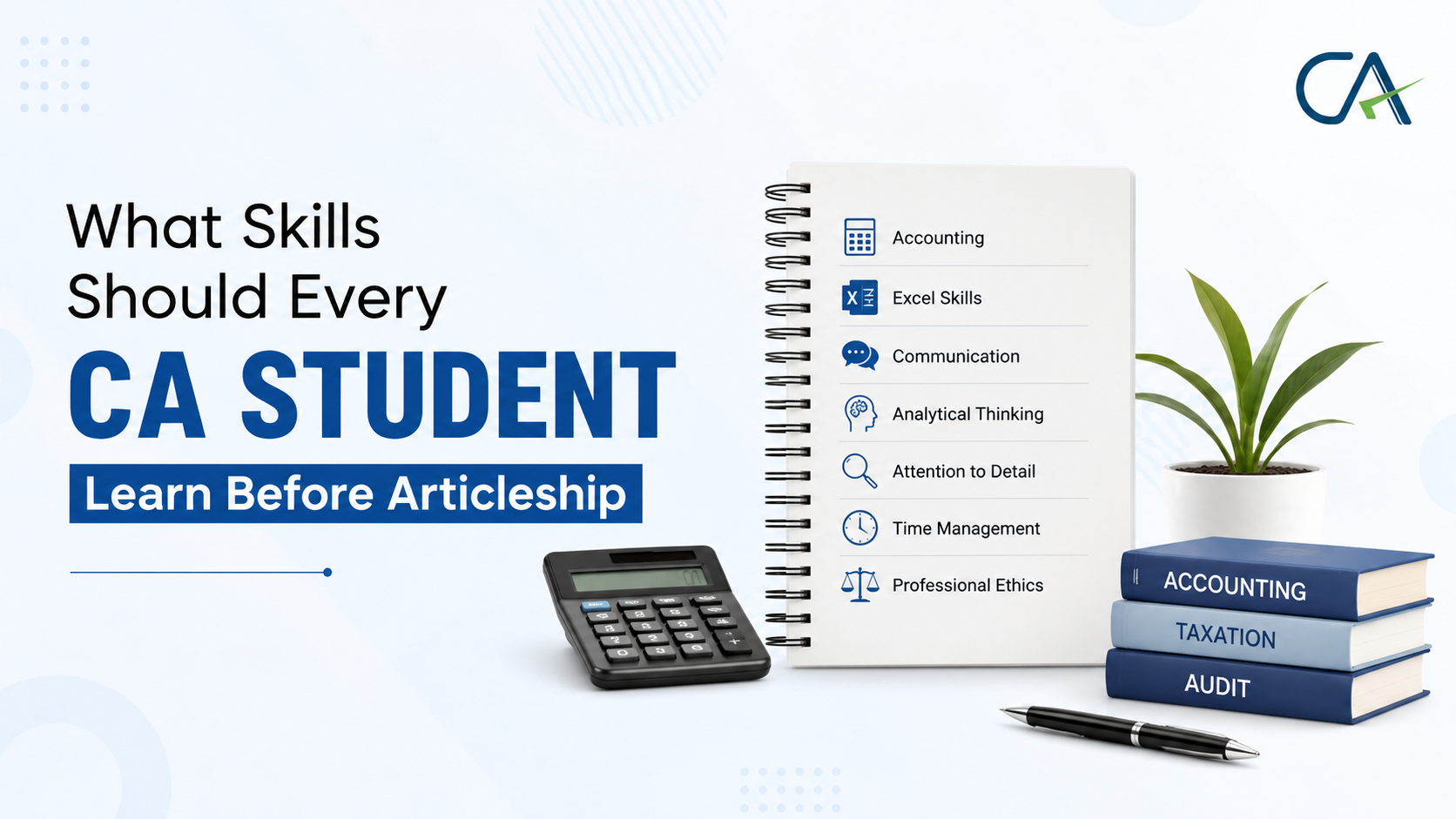
Table of Content
- Why Should CA Students Prepare Before Articleship?
- Microsoft Excel: The Most Important Practical Skill
- Professional Communication Skills
- Email Writing and Business Etiquette
- Basic Knowledge of Accounting Software
- Strong Fundamentals of Accounting
- Basic Understanding of Audit
- Basic Taxation Awareness
- Time Management and Deadline Discipline
- The Ability to Ask Questions
- Research and Problem-Solving Skills
- Attention to Detail
- Basic Data Analysis Skills
- Documentation and File Management
- Professional Behaviour and Workplace Etiquette
- Adaptability: The Skill Most Students Forget
- A Practical Skill Development Roadmap Before Articleship
- Skills That Will Give You an Extra Advantage During Articleship
- Common Mistakes CA Students Make Before Starting Articleship
- Final Thoughts: Prepare Yourself, But Do Not Be Afraid
Starting an articleship is one of the biggest transitions in a Chartered Accountancy student's journey.
Until this stage, most of your life revolves around lectures, books, coaching classes, assignments, mock tests, and examinations. You know what is expected from you. You attend classes, study a chapter, solve questions, revise, and prepare for exams.
Articleship changes that environment completely.
Suddenly, you are no longer just a student.
You become part of a professional workplace.
You may have to communicate with seniors, work on real client documents, use Excel extensively, understand accounting records, visit client offices, assist in audits, prepare working papers, handle deadlines, and learn things that may never have been explained in detail in your textbooks.
This is why many students experience a small culture shock during the first few months of articleship.
The truth is that no student is expected to know everything before joining a CA firm. Articleship itself is designed to provide practical exposure. However, students who enter articleship with a few essential skills often adapt faster, learn more, and create a better professional impression.
Preparing yourself before articleship can make a significant difference.
You do not need to become an expert in every area. But learning the right foundational skills can help you feel more confident when you enter your first professional workplace.
Why Should CA Students Prepare Before Articleship?
Many students believe they should simply join a firm and learn everything after starting their articleship.
There is nothing completely wrong with this approach. After all, articleship is a learning period.
However, imagine two students joining the same firm.
The first student has basic knowledge of Excel, professional communication, accounting software, and office etiquette.
The second student has never used advanced Excel functions, feels uncomfortable writing professional emails, and has no understanding of how workplace communication works.
Both students can learn.
But the first student may adapt faster and spend more time learning practical professional work instead of struggling with basic tools.
Preparing before articleship gives you three major advantages:
- You feel more confident in your first few weeks.
- You can understand practical work faster.
- You can focus on developing advanced professional knowledge.
The goal is not to become perfect before joining.
The goal is to avoid feeling completely unprepared.
Microsoft Excel: The Most Important Practical Skill
If there is one skill almost every CA student should seriously work on before articleship, it is Microsoft Excel.
Excel is used across almost every area of professional accounting and finance.
During articleship, you may use Excel for:
- Financial data analysis
- Audit working papers
- Bank reconciliations
- Ledger analysis
- GST calculations
- Tax computations
- Financial statements
- Client data cleaning
- MIS reports
- Sampling and data analysis
Many students know basic Excel functions but struggle when they receive a large client data file.
For example, knowing how to type numbers into a spreadsheet is very different from knowing how to analyse 20,000 rows of financial data efficiently.
Excel Skills You Should Learn
|
Basic Skills |
Intermediate Skills |
Advanced Useful Skills |
|
SUM |
VLOOKUP/XLOOKUP |
Pivot Tables |
|
AVERAGE |
IF Functions |
Power Query basics |
|
Formatting |
COUNTIF/SUMIF |
Data analysis |
|
Sorting |
Conditional Formatting |
Advanced filters |
|
Filtering |
Text Functions |
Dashboard basics |
|
Basic formulas |
Date Functions |
Data cleaning |
You do not need to master every advanced Excel feature before articleship.
But you should become comfortable with:
- Formulas
- Filters
- Sorting
- Lookup functions
- Pivot tables
- Conditional formatting
- Keyboard shortcuts
Excel skills can save hours of manual work.
And in a professional environment, speed matters.
Professional Communication Skills
Communication is often underestimated by CA students.
Many students believe technical knowledge is everything.
Technical knowledge is extremely important, but your ability to communicate that knowledge also matters.
During articleship, you may need to communicate with:
- Partners
- Managers
- Seniors
- Clients
- Company employees
- Government departments
- Other professionals
Good communication does not mean speaking perfect English with a foreign accent.
It means communicating clearly, professionally, and confidently.
For example, you should know how to:
- Ask questions respectfully
- Explain a problem clearly
- Write professional emails
- Provide work updates
- Speak to clients politely
- Understand instructions
- Report mistakes honestly
A simple skill like writing a proper email can create a strong first impression.
Example of Poor Communication
“Sir, work is not completed because data has not been received.”
Better Professional Communication
“Dear Sir, the work is currently pending as we are awaiting the required data from the client. I will proceed with the remaining work once the documents are received.”
The difference is small, but the professional impact is significant.
Email Writing and Business Etiquette
Professional email communication deserves separate attention.
During articleship, you may send emails to clients, seniors, managers, banks, vendors, and other organisations.
A professional email should be:
- Clear
- Short
- Respectful
- Grammatically understandable
- Properly structured
Before starting articleship, practise writing:
- Document request emails
- Follow-up emails
- Work update emails
- Leave requests
- Client communication emails
You should also understand basic email etiquette.
Important Email Practices
|
Do |
Avoid |
|
Use clear subject lines |
Sending blank subjects |
|
Keep messages professional |
Using casual chat language |
|
Proofread before sending |
Sending incomplete messages |
|
Mention attachments clearly |
Forgetting attachments |
|
Use proper greetings |
Using informal language with clients |
|
Reply on relevant threads |
Creating unnecessary email chains |
You do not need sophisticated vocabulary.
Simple and clear communication is always better than complicated language.
Basic Knowledge of Accounting Software
In college or coaching classes, accounting is often taught through journal entries, ledgers, and theoretical examples.
In real businesses, accounting happens through software.
Depending on the organisation, you may come across:
- Tally
- Busy
- Zoho Books
- SAP
- Oracle
- QuickBooks
- Other ERP systems
You do not need to learn every software before articleship.
But having basic familiarity with accounting software can be extremely helpful.
For Indian CA students, learning basic Tally concepts can be a good starting point.
Try to understand:
- Company creation
- Ledger creation
- Voucher entries
- Sales entries
- Purchase entries
- Payment entries
- Receipt entries
- Bank reconciliation
- GST entries
- Basic reports
Understanding how accounting transactions move through software will help you connect theoretical accounting concepts with real business records.
Strong Fundamentals of Accounting
Articleship can expose you to situations where textbook concepts suddenly become practical problems.
For example, you may be reviewing:
- Bank statements
- Sales invoices
- Purchase registers
- General ledgers
- Trial balances
- Fixed asset registers
- Financial statements
If your accounting fundamentals are weak, understanding these documents can become difficult.
Before articleship, revise the basics of:
- Journal entries
- Ledger posting
- Trial balance
- Depreciation
- Inventory
- Revenue recognition basics
- Provisions
- Outstanding expenses
- Prepaid expenses
- Bank reconciliation
- Financial statements
You do not need to memorise everything again.
But your basic accounting concepts should be strong enough to understand why a transaction is recorded in a particular way.
A good articleship experience becomes much easier when theory and practical work start connecting.
Basic Understanding of Audit
Many CA students join articleship without understanding what auditors actually do daily.
They imagine audit as simply checking invoices.
In reality, audit work involves much more.
Depending on your role and firm, you may work on:
- Vouching
- Verification
- Internal controls
- Audit documentation
- Working papers
- Sampling
- Ledger scrutiny
- Financial statement review
- Compliance checking
- Client communication
Before starting articleship, try to understand basic audit terminology.
Important Audit Concepts
|
Concept |
Basic Meaning |
|
Vouching |
Checking transactions with supporting documents |
|
Verification |
Confirming the existence and valuation of assets/liabilities |
|
Internal Control |
Processes designed to reduce errors and fraud |
|
Materiality |
Significance of an error or misstatement |
|
Audit Evidence |
Information supporting audit conclusions |
|
Working Papers |
Documentation prepared during audit work |
|
Sampling |
Testing selected transactions from a larger population |
You do not need practical audit experience before joining.
But understanding these basic concepts will help you learn faster once you start working.
Basic Taxation Awareness
Taxation is another area where practical exposure can be very different from classroom learning.
Depending on your firm, you may work with:
- Income Tax Returns
- TDS
- GST Returns
- Tax Audits
- Notices
- Assessments
- Tax computations
- Client documentation
Before articleship, develop basic awareness of the Indian taxation system.
Focus on understanding:
Direct Tax Basics
- PAN
- Income Tax Return
- TDS
- Advance Tax
- Basic heads of income
- Tax deductions
GST Basics
- GST registration
- Input Tax Credit
- GSTR-1
- GSTR-3B
- Tax invoices
- E-way bills
- GST reconciliations
You do not need to become a taxation expert.
The purpose is to recognise basic terminology when you encounter it in a professional setting.
Time Management and Deadline Discipline
Articleship teaches something that exam preparation cannot always teach: professional deadlines.
In exams, you manage your own schedule.
At work, someone else may depend on your work.
For example, your senior may need your audit file before a meeting. A client may be waiting for a report. A tax return may have a statutory deadline.
This means time management becomes a professional responsibility.
Before articleship, start developing habits such as:
- Making daily task lists
- Prioritising important work
- Estimating task completion time
- Avoiding unnecessary procrastination
- Updating seniors when work is delayed
One of the biggest mistakes new articles make is remaining silent when they cannot complete a task.
If you are facing difficulty, communicate early.
Do not wait until the deadline has already passed.
Simple Priority Framework
|
Priority |
Type of Work |
|
High |
Statutory deadlines and urgent client work |
|
Medium |
Important ongoing assignments |
|
Low |
Tasks without immediate deadlines |
This habit will benefit you throughout your professional career.
The Ability to Ask Questions
This may sound simple, but asking good questions is an important professional skill.
New articles sometimes make two opposite mistakes.
The first group asks nothing because they are afraid of looking inexperienced.
The second group asks questions without first trying to understand the task independently.
The ideal approach is somewhere in the middle.
Before asking a senior:
- Listen carefully to the instructions.
- Write down important points.
- Try to understand the task.
- Check available documents or previous files.
- Identify exactly where you are stuck.
- Ask a specific question.
Instead of asking:
“Sir, what should I do?”
Ask:
“I have completed the ledger scrutiny, but I am unsure whether this unusual transaction should be included in the exception report. Could you please guide me on the treatment?”
Specific questions show that you have already made an effort.
Seniors generally appreciate students who try to solve problems before asking for help.
Research and Problem-Solving Skills
Articleship is not a place where you will always receive step-by-step instructions.
Sometimes you may encounter something you have never studied before.
A client may have an unusual transaction.
A tax issue may arise.
An accounting treatment may be unclear.
This is where research skills become valuable.
Learn how to:
- Read professional material
- Search for relevant provisions
- Understand official guidance
- Compare information from reliable sources
- Analyse facts before reaching conclusions
However, be careful about blindly trusting everything available online.
Professional work requires reliable information.
Whenever possible, learn to refer to:
- ICAI resources
- Government portals
- Relevant Acts and Rules
- Official notifications
- Circulars
- Professional publications
A strong CA professional is not someone who knows every answer.
It is someone who knows how to find the correct answer.
Attention to Detail
In professional accounting and audit work, small mistakes can create large problems.
A misplaced decimal.
An incorrect date.
A missing document.
A wrong PAN number.
A formula error in Excel.
These mistakes may seem minor, but they can affect reports and client deliverables.
Develop the habit of reviewing your work.
Before submitting anything, check:
- Names
- Dates
- Numbers
- Formulas
- Attachments
- File names
- Calculations
Attention to detail does not mean becoming slow.
It means developing a systematic review process.
A good habit is to spend the last few minutes of every important task checking your work.
Basic Data Analysis Skills
Modern CA work increasingly involves large volumes of data.
Companies generate thousands of transactions.
Manually checking every transaction is often impossible.
This is why basic data analysis skills are becoming increasingly useful for CA students.
Learn how to identify:
- Duplicate transactions
- Unusual entries
- Large-value transactions
- Missing data
- Trend changes
- Exceptional patterns
Excel can help you perform basic analysis without learning complex programming.
For example, you can analyse:
- Monthly sales trends
- Expense fluctuations
- Vendor-wise transactions
- High-value payments
- Unusual journal entries
Students who understand data are often better positioned to handle modern audit and finance work.
Documentation and File Management
Professional firms handle large numbers of documents.
If you cannot organise files properly, you may waste significant time searching for information.
Learn basic file management practices.
For example:
Good File Naming
ABC_Company_Bank_Reconciliation_FY_2025_26.xlsx
Instead of:
final new latest final 2.xlsx
Use organised folders.
Example:
Client Name
- Financial Statements
- Bank Statements
- GST
- Income Tax
- Audit Working Papers
- Supporting Documents
Always save files in the correct location.
This sounds basic, but good documentation habits are extremely valuable in professional environments.
Professional Behaviour and Workplace Etiquette
Articleship is often your first experience in a professional office.
The way you behave matters.
Professionalism includes:
- Being punctual
- Dressing appropriately
- Respecting colleagues
- Maintaining confidentiality
- Responding professionally
- Accepting feedback
- Taking responsibility for mistakes
One important lesson is understanding that feedback is not always criticism.
A senior may return your working paper with multiple corrections.
That does not mean you are incapable.
It means you are learning.
Instead of feeling offended, ask:
“What can I improve next time?”
This mindset can significantly improve your articleship experience.
Adaptability: The Skill Most Students Forget
No two CA firms provide exactly the same articleship experience.
One student may spend most of their time in statutory audit.
Another may work in GST.
Someone else may work in internal audit, taxation, forensic accounting, or corporate finance.
Your role may also change during articleship.
This requires adaptability.
You may need to:
- Learn new software
- Work with different clients
- Travel for audits
- Handle new responsibilities
- Adjust to busy seasons
- Learn unfamiliar concepts quickly
Students who remain flexible generally gain more from articleship.
Do not think:
“This is not my favourite area, so I will not learn it.”
Instead, try to understand the practical value of every assignment.
Every exposure adds something to your professional understanding.
A Practical Skill Development Roadmap Before Articleship
If you have a few weeks or months before starting articleship, you can use the following roadmap.
|
Skill |
Suggested Learning Focus |
|
Excel |
Formulas, lookups, Pivot Tables, shortcuts |
|
Communication |
Professional speaking and workplace communication |
|
Email Writing |
Formal emails and client communication |
|
Accounting Software |
Basic Tally or similar software |
|
Accounting |
Revise core accounting fundamentals |
|
Audit |
Understand basic audit procedures |
|
Taxation |
Learn basic Income Tax and GST terminology |
|
Research |
Learn to use reliable professional sources |
|
Time Management |
Daily planning and deadline discipline |
|
Professionalism |
Workplace etiquette and responsibility |
You do not need to study all these skills simultaneously.
Choose two or three skills at a time.
Consistency is more valuable than trying to learn everything in one week.
Skills That Will Give You an Extra Advantage During Articleship
Once you have mastered the basics, consider learning some additional skills.
These are not mandatory, but they can provide a competitive advantage.
Advanced Skills Worth Exploring
- Advanced Excel
- Power BI basics
- Financial modelling
- Presentation skills
- Data visualisation
- Basic SQL
- AI productivity tools
- ERP system basics
- Business writing
The CA profession is evolving.
Technology is becoming increasingly important in audit, accounting, taxation, and finance.
Technical knowledge combined with digital skills can help future professionals stand out.
However, do not feel pressured to learn everything.
Build your foundation first.
Common Mistakes CA Students Make Before Starting Articleship
Here are some mistakes you should avoid.
1. Thinking Articleship Requires No Preparation
You will learn during articleship, but basic preparation can make your transition easier.
2. Ignoring Excel
Excel remains one of the most practical skills for accounting and audit professionals.
3. Focusing Only on Technical Knowledge
Communication, professionalism, and time management are equally important.
4. Being Afraid to Ask Questions
Ask questions after making a genuine effort to understand the problem.
5. Expecting to Know Everything Immediately
Articleship is a learning journey. Nobody expects a new article to know everything.
6. Avoiding New Types of Work
Try to gain exposure to different areas whenever possible.
7. Taking Feedback Personally
Corrections are part of professional growth.
Final Thoughts: Prepare Yourself, But Do Not Be Afraid
Starting an articleship can feel intimidating.
You may worry about whether you know enough.
You may wonder if your Excel skills are good enough.
You may feel nervous about speaking to clients or working under experienced professionals.
Almost every CA student experiences some version of this feeling.
The truth is simple.
You are not expected to enter articleship as a finished professional.
You are entering an articleship to become one.
But preparation can help you begin with confidence.
Start with Excel.
Improve your communication.
Understand professional email writing.
Revise your accounting fundamentals.
Learn the basics of audit and taxation.
Develop discipline and professionalism.
Most importantly, develop the willingness to learn.
Your articleship experience will teach you things that cannot always be learned from books.
You will make mistakes.
You will receive corrections.
You may struggle with your first client assignment.
But gradually, you will start understanding how businesses work beyond textbook examples.
That is the real value of articleship.
At Studycaller, we believe that preparing for a professional career should involve more than simply passing examinations. CA students should also prepare themselves for the practical environment that comes after the classroom.
The skills you develop before articleship may seem small today.
But when you walk into your first professional workplace with confidence, know how to analyse an Excel sheet, write a proper email, organise documents, and communicate professionally, you will realise how valuable those skills really are.
Prepare yourself.
Stay curious.
Ask questions.
Keep learning.
And remember that articleship is not about proving that you already know everything.
It is about building the foundation for the professional you want to become.

FAQs
What skills should a CA student learn before an articleship?
Every CA student should learn basic Excel, professional communication, email writing, accounting software, accounting fundamentals, audit basics, taxation awareness, time management, research skills, and workplace professionalism before articleship.
Is Excel necessary for CA articleship?
Yes, Excel is one of the most important practical skills for CA articleship. It is commonly used for audit working papers, financial analysis, reconciliations, taxation calculations, and data analysis.
Which Excel skills are useful for CA articles?
CA students should learn formulas, VLOOKUP or XLOOKUP, IF functions, SUMIF, COUNTIF, Pivot Tables, filtering, sorting, conditional formatting, and useful keyboard shortcuts.
Should I learn Tally before starting an articleship?
Learning basic Tally can be helpful, especially for understanding practical accounting entries and financial reports. However, it is not mandatory because different firms and clients may use different accounting software.
How can I improve communication skills before articleship?
Practise speaking clearly, writing professional emails, explaining concepts, asking questions properly, and communicating respectfully with seniors and clients.
Do I need practical audit knowledge before joining an articleship?
You do not need practical experience, but understanding basic concepts such as vouching, verification, internal controls, audit evidence, working papers, and sampling can help you learn faster.
What should I know about GST before articleship?
Students should understand basic GST concepts such as registration, GST returns, input tax credit, tax invoices, GSTR-1, GSTR-3B, and GST reconciliation.
How important are professional skills during CA articleship?
Professional skills are extremely important because articleship involves working with seniors, managers, clients, and professional teams. Communication, punctuality, responsibility, and workplace etiquette can significantly affect your professional growth.
Can I learn all articleship skills after joining a CA firm?
Yes, articleship itself is designed for practical learning. However, learning basic skills before joining can help you adapt faster and feel more confident in the workplace.
What is the most important mindset for a CA student before articleship?
The most important mindset is the willingness to learn. You do not need to know everything before joining an articleship, but you should be curious, adaptable, open to feedback, and willing to continuously improve.