What Should My Daily CA Preparation Checklist Look Like?
Wondering what to study every day for CA exams? Follow this practical daily CA preparation checklist covering revision, practice, mock tests, and exam readiness.

Table of Content
- Why Do CA Students Need a Daily Preparation Checklist?
- The 5-Part Daily CA Preparation Checklist
- Your Ideal Daily CA Preparation Checklist
- A Practical Daily CA Study Schedule
- The 90-Minute Rule for CA Preparation
- What Should I Study First in the Morning?
- Daily Revision Is Non-Negotiable
- Don't Just Read — Use Active Recall
- How Many Questions Should You Solve Every Day?
- Your Daily ICAI Resource Checklist
- Where Should a CA Exam Test Series Fit Into Your Daily Routine?
- The Daily Mistake Analysis Checklist
- Your Daily CA Preparation Checklist During Syllabus Completion
- Your Daily Checklist During First Revision
- Your Daily Checklist During Final Revision
- CA Foundation Daily Checklist
- CA Intermediate Daily Checklist
- CA Final Daily Checklist
- What Should My Last 2 Hours of the Day Look Like?
- The 10-Minute Night Review
- What If You Miss Your Daily Targets?
- Don't Build a Timetable You Cannot Follow
- Your Weekly CA Preparation Checklist
- The Ultimate Daily CA Preparation Checklist
- Monday
- Study
- Revision
- Testing
- Analysis
- Night
- Final Thoughts: Your Checklist Should Make CA Preparation Simpler
Preparing for the CA exam can sometimes feel like you are studying all day but still not doing enough.
You finish one chapter, and another one is waiting.
You revise a topic in the morning and forget half of it by the evening.
You solve questions, but then realise you have not revised the theory.
You plan to take a mock test, but the syllabus is still incomplete.
And then there is that familiar feeling at night:
“I studied for 10 hours today, but what did I actually accomplish?”
If you have felt this way, you are not alone.
The problem is usually not a lack of hard work. The problem is that your day does not have a clear system.
A good CA preparation routine should not simply tell you to “study 10–12 hours.”
It should tell you what needs to happen during those hours.
That is where a daily CA preparation checklist becomes useful.
Instead of starting every morning by asking, “What should I study today?”, you already know the important things that need to be completed.
A good daily checklist should cover five areas:
Learning + Revision + Question Practice + Testing + Analysis
If these five things are happening consistently, your preparation is moving in the right direction.
Why Do CA Students Need a Daily Preparation Checklist?
CA preparation is a long journey.
When the exam is several months away, it is easy to feel that there is plenty of time.
Then suddenly you are three weeks away from the exam and realise that some chapters have been revised only once, some have never been tested and your mock test performance is inconsistent.
A checklist prevents this from happening.
It gives your day a clear purpose.
Instead of writing:
“Study Accounts”
write:
“Revise AS topic + solve 25 questions + analyse mistakes + revise yesterday's concepts.”
The second target is measurable.
You know exactly when the task is complete.
ICAI's own preparation guidance has emphasised daily and weekly goals, regular revision, past examination practice and mock tests as part of disciplined exam preparation.
The 5-Part Daily CA Preparation Checklist
Before getting into the timetable, understand the five things that should ideally appear in your daily routine.
|
Area |
Daily Question |
|
Learning |
What new concept will I complete? |
|
Revision |
What will I revise today? |
|
Practice |
Which questions will I solve? |
|
Testing |
What will I test myself on? |
|
Analysis |
What did I get wrong and why? |
You do not necessarily need to spend equal time on all five.
Their importance changes according to your preparation stage.
During syllabus completion, learning may take more time.
During final revision, testing and recall become much more important.
Your Ideal Daily CA Preparation Checklist
Here is a practical checklist you can use every day.
Morning Checklist
☐ Start at a fixed time
☐ Avoid checking social media immediately after waking up
☐ Review today's targets
☐ Revise yesterday's important concepts
☐ Start with your highest-priority subject
Study Checklist
☐ Complete planned topic/chapter
☐ Make short revision notes where required
☐ Solve relevant ICAI questions
☐ Mark doubts
☐ Practise difficult questions
Revision Checklist
☐ Revise yesterday's topics
☐ Revise formulas/provisions/standards
☐ Recall important concepts without looking at notes
☐ Review your mistake notebook
Testing Checklist
☐ Attempt MCQs/topic test/sectional test/full-length test as scheduled
☐ Follow a time limit
☐ Attempt without notes
☐ Check performance honestly
Night Checklist
☐ Analyse what was completed
☐ Identify incomplete tasks
☐ Record mistakes
☐ Plan tomorrow
☐ Do a quick recall of today's learning
This is much more useful than simply writing “Study 12 hours.”
A Practical Daily CA Study Schedule
There is no single timetable that works for every student.
A full-time student may have 10–12 productive hours available, while a college-going or working student may have only 5–7.
The important thing is not the number of hours.
It is the quality and consistency of those hours.
Here is a sample full-time schedule:
|
Time |
Activity |
|
7:00 – 7:30 AM |
Wake up + freshen up |
|
7:30 – 8:00 AM |
Quick revision/recall |
|
8:00 – 10:30 AM |
Deep Study Session 1 |
|
10:30 – 11:00 AM |
Break |
|
11:00 AM – 1:30 PM |
Deep Study Session 2 |
|
1:30 – 2:30 PM |
Lunch + rest |
|
2:30 – 4:30 PM |
Question Practice |
|
4:30 – 5:00 PM |
Break |
|
5:00 – 7:00 PM |
Subject 2 / Revision |
|
7:00 – 8:00 PM |
Dinner/Break |
|
8:00 – 9:30 PM |
Test/MCQs/Answer Writing |
|
9:30 – 10:00 PM |
Test analysis + planning |
|
10:00 PM onwards |
Light revision/relaxation |
You do not have to copy these timings exactly.
If you are naturally more productive at night, shift the schedule.
The goal is to create a routine you can actually follow.
The 90-Minute Rule for CA Preparation
Instead of sitting with a book for four hours and continuously getting distracted, try dividing your day into focused blocks.
For example:
90 minutes study + 10–15 minutes break
During the 90-minute session:
- Keep your phone away
- Study one clearly defined topic
- Avoid switching subjects
- Write down doubts instead of immediately searching everything
- Keep a measurable target
For example:
Bad target:
“Study Tax.”
Better target:
“Complete residential status + solve ICAI illustrations + attempt 15 practice questions.”
The second target gives your brain a finish line.
What Should I Study First in the Morning?
This is one of those small decisions that can make your day much easier.
Use your freshest hours for your most demanding work.
For many students, this could be:
- Accounts
- Costing
- Tax
- Financial Reporting
- Advanced Financial Management
- Difficult practical chapters
But if you are stronger in practical subjects and weaker in theory, you may prefer to use the morning for theory.
There is no universal rule.
The correct question is:
“When am I mentally strongest, and which subject needs that attention?”
Your timetable should be built around your actual performance, not someone else's routine.
Daily Revision Is Non-Negotiable
One of the biggest CA preparation mistakes is studying something once and moving on.
You may feel that you understood a chapter perfectly today.
Ask yourself the same question five days later.
You may be surprised.
That is why daily recall matters.
ICAI's preparation guidance specifically recommends revisiting concepts/provisions studied during the day and reviewing them before starting fresh topics, as part of improving retention.
A simple revision cycle can look like this:
Day 1
Learn the topic.
Day 2
Quickly recall it.
Day 4
Revise important points.
Day 7
Test yourself.
Day 15
Quick revision.
Before Exam
Final recall.
This does not mean rereading the entire chapter every time.
Use:
- Short notes
- Marked questions
- Formulas
- Provisions
- Charts
- Flashcards
- Mistake lists
- Active recall
Don't Just Read — Use Active Recall
There is a major difference between reading something and remembering it.
Suppose you read a Law chapter for two hours.
Close the book.
Can you explain the main provisions without looking?
If not, you probably need more active recall.
Try this:
Read → Close Book → Recall → Write → Check
For theory subjects, this can be extremely effective.
For practical subjects:
Understand → Solve → Check → Redo Without Solution
Your daily checklist should therefore include at least one activity where you have to retrieve information from memory.
How Many Questions Should You Solve Every Day?
Again, there is no magic number.
The number depends on:
- Subject
- Difficulty
- Preparation stage
- Available time
- Type of question
For example:
|
Subject Type |
Better Daily Target |
|
Practical Subject |
Quality problems + timed practice |
|
Theory Subject |
Recall + answer writing |
|
MCQ-Based Practice |
Timed MCQ sets |
|
Weak Subject |
Targeted questions |
|
Strong Subject |
Maintenance + selected questions |
Do not chase a number like “100 questions daily” if it causes careless practice.
Ten difficult questions understood properly can be more valuable than fifty questions solved mechanically.
Your Daily ICAI Resource Checklist
Your preparation should stay anchored to reliable resources.
The ICAI BoS ecosystem provides students access to study material, RTPs, MTPs, suggested answers, MCQ practice, case-study resources and other academic material.
Depending on your preparation stage, your daily checklist may include:
☐ ICAI Study Material
☐ Relevant illustrations
☐ Previous examination questions
☐ RTP questions
☐ MTP questions
☐ Suggested Answers
☐ MCQ practice
☐ Your own short notes
☐ Mistake notebook
You don't need to use every resource every day.
That would become another source of stress.
Use the resource that matches your current goal.
Where Should a CA Exam Test Series Fit Into Your Daily Routine?
This is where many students make a mistake.
They think a test series is something to use only in the final month.
It doesn't have to be.
Testing can happen at multiple levels.
Early Preparation
Use:
Chapter Tests
Middle Preparation
Use:
Sectional/Subject Tests
First Revision
Use:
Full-Syllabus Subject Tests
Final Revision
Use:
Full-Length Mock Tests
Last-Mile Preparation
Use:
ICAI MTPs + RTPs + Previous Papers + Selected Full-Length Tests
ICAI itself describes mock tests as a way to assess preparation and practise under examination conditions, particularly for time management and confidence.
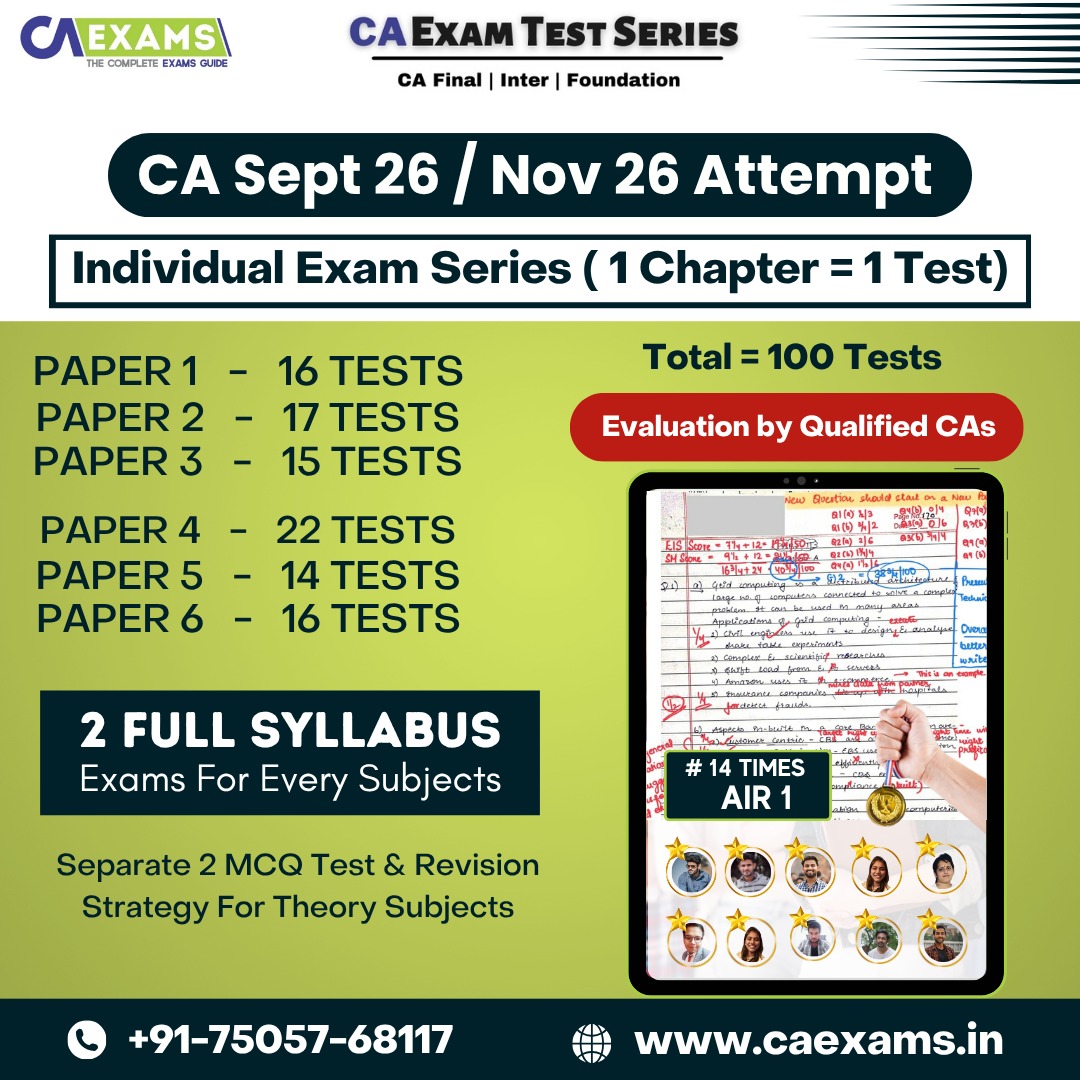
A structured CA Exam Test Series can therefore become part of your preparation cycle rather than a last-minute activity.
The Daily Mistake Analysis Checklist
This is probably the most ignored part of CA preparation.
Students solve a test.
They see the marks.
Then they move on.
Don't.
After every test, ask:
☐ Which questions were wrong?
☐ Why were they wrong?
☐ Was the concept unclear?
☐ Did I forget something?
☐ Was it a calculation error?
☐ Did I misunderstand the question?
☐ Did I run out of time?
☐ Was the presentation weak?
☐ Have I made this mistake before?
☐ What will I do differently next time?
Maintain a simple mistake tracker.
|
Date |
Subject |
Mistake |
Reason |
Corrective Action |
|
1 Sept |
Tax |
Wrong provision |
Recall issue |
Revise provision |
|
3 Sept |
Accounts |
Calculation error |
Carelessness |
Recheck working |
|
5 Sept |
Law |
Lost marks |
Poor structure |
Practise answer format |
|
7 Sept |
Costing |
Time shortage |
Slow solving |
Timed practice |
After a few weeks, this becomes one of the most valuable documents in your preparation.
Your Daily CA Preparation Checklist During Syllabus Completion
When you are still completing the syllabus, your priorities should be:
Concepts > Questions > Revision > Testing
A typical day might look like:
Session 1
New chapter/concept
Session 2
Continue chapter + ICAI questions
Session 3
Second subject
Session 4
Practice questions
Night
Revision of everything studied
Your checklist:
☐ New topic completed
☐ Questions practised
☐ Previous topic revised
☐ Doubts marked
☐ Short notes updated
☐ 20–30 minutes recall
☐ Tomorrow's targets prepared
Do not overload yourself with full-length tests at this stage.
Your Daily Checklist During First Revision
The priorities change.
Now you should move toward:
Revision > Practice > Testing > Analysis
A good day might include:
- Subject 1 revision
- Subject 1 questions
- Subject 2 revision
- Subject 2 questions
- Short test
- Mistake analysis
- Night recall
At this stage, ask yourself:
“Can I reproduce this without looking at the book?”
That is a much better test of preparation than simply reading the chapter again.
Your Daily Checklist During Final Revision
The final stage is completely different.
You should not be trying to learn everything from scratch.
Your focus should be:
☐ Important concepts
☐ Weak chapters
☐ Formulas
☐ Provisions
☐ Amendments
☐ RTPs
☐ MTPs
☐ Previous papers
☐ Mock tests
☐ Mistake notebook
☐ Time management
The final weeks should increasingly resemble the actual examination.
CA Foundation Daily Checklist
Foundation students should focus on building a strong base.
A practical checklist:
☐ Complete planned concept
☐ Solve relevant questions
☐ Practise MCQs where applicable
☐ Revise yesterday's topic
☐ Review formulas
☐ Attempt a short timed test
☐ Analyse wrong answers
☐ Update weak-topic list
Do not compare your study hours with Intermediate or Final students.
Your syllabus and learning requirements are different.
CA Intermediate Daily Checklist
For Intermediate students, balance is extremely important.
A daily checklist could include:
☐ Practical subject practice
☐ Theory subject revision
☐ ICAI questions
☐ Previous questions
☐ Short test/MCQs
☐ Formula/provision revision
☐ Mistake analysis
☐ One weak topic
☐ One strong topic maintenance
If preparing both groups, avoid spending an entire day on only one subject repeatedly.
Your schedule needs rotation.
CA Final Daily Checklist
At Final level, the checklist should become more exam-oriented.
☐ Revise concepts
☐ Practise application-based questions
☐ Solve case studies
☐ Practise answer presentation
☐ Review amendments
☐ Solve selected ICAI questions
☐ Attempt timed questions
☐ Analyse mistakes
☐ Revise weak areas
☐ Track mock performance
At this level, quality of practice matters enormously.
What Should My Last 2 Hours of the Day Look Like?
Do not use your final two hours for heavy new learning if your concentration is already low.
Instead:
First 45 Minutes
Revise today's important concepts.
Next 30 Minutes
Formula/provision/quick-note revision.
Final 30–45 Minutes
Recall without looking at the material.
Then spend a few minutes preparing tomorrow's targets.
This simple habit can make your next morning much easier.
You won't wake up wondering where to start.
The 10-Minute Night Review
Before ending your study day, ask yourself:
1. What did I complete today?
Be honest.
2. What did I not complete?
Don't hide incomplete tasks from yourself.
3. What did I learn?
Write 2–3 key points.
4. What mistakes did I make?
Record them.
5. What is tomorrow's most important task?
Choose one.
This takes about ten minutes.
But it prevents your preparation from becoming directionless.
What If You Miss Your Daily Targets?
This happens.
You planned to complete three chapters.
You completed one.
Maybe you were tired.
Maybe the chapter was harder than expected.
Maybe something unexpected happened.
Do not destroy the next day trying to compensate.
One of the worst habits in CA preparation is creating a huge “backlog punishment” timetable.
Instead:
Shift the unfinished task forward.
Keep one buffer block in your weekly plan.
Remember:
A missed day is a problem. A missed day followed by three wasted days is a bigger problem.
Get back into the routine as quickly as possible.
Don't Build a Timetable You Cannot Follow
A timetable looks impressive when you write it.
But the real test is whether you can follow it on Day 7.
If your schedule says:
- 14 hours study
- 5 subjects
- 200 questions
- 3 tests
- 2 revisions
every day, it may look ambitious.
It may also collapse within three days.
A practical timetable should have:
- Realistic study hours
- Breaks
- Revision
- Practice
- Testing
- Buffer time
- Sleep
A consistent 8 focused hours can be far more valuable than 12 distracted hours.
Your Weekly CA Preparation Checklist
Daily checklists are useful, but you also need a weekly review.
Every Sunday, ask:
☐ Did I complete my weekly targets?
☐ Which subject received the least attention?
☐ Which topics are still weak?
☐ How many questions did I practise?
☐ How many tests did I attempt?
☐ What was my test performance?
☐ Did my accuracy improve?
☐ Did I complete my planned revision?
☐ What needs to move to next week?
Use this simple weekly scorecard:
|
Area |
Target |
Actual |
|
Study Hours |
50 |
46 |
|
Revision Sessions |
7 |
6 |
|
Practice Sessions |
7 |
7 |
|
Tests |
2 |
2 |
|
Mock Analysis |
2 |
2 |
|
Weak Topics Fixed |
5 |
4 |
This gives you a much clearer picture of your preparation than simply counting study hours.
The Ultimate Daily CA Preparation Checklist
If you want one simple checklist that you can save or print, use this:
Morning
☐ Wake up on time
☐ Review today's targets
☐ Revise yesterday's concepts
☐ Start with the highest-priority topic
Study
☐ Complete planned topic
☐ Solve ICAI questions
☐ Practise difficult questions
☐ Mark doubts
Revision
☐ Revise old topics
☐ Recall without notes
☐ Revise formulas/provisions
☐ Review mistake notebook
Testing
☐ Attempt scheduled test
☐ Follow time limit
☐ Avoid notes during test
☐ Check answers honestly
Analysis
☐ Record mistakes
☐ Identify why each mistake happened
☐ Revise weak areas
☐ Note improvement points
Night
☐ Review today's achievements
☐ Complete pending priority task
☐ Prepare tomorrow's plan
☐ Quick recall
☐ Sleep properly
Final Thoughts: Your Checklist Should Make CA Preparation Simpler
CA preparation is not about having the most beautiful timetable.
It is not about studying for the longest number of hours.
And it certainly isn't about ticking 20 boxes just so you can say that you had a productive day.
The purpose of a daily checklist is much simpler:
It should make sure that the important things happen consistently.
You study.
You revise.
You practise.
You test yourself.
You analyse mistakes.
Then you repeat.
That cycle is what gradually turns preparation into exam readiness.
ICAI's own resources already give students a strong foundation through study material, RTPs, MTPs, suggested answers, MCQ practice and other revision resources. The role of your personal routine is to make sure you use those resources at the right stage instead of trying to consume everything at once.
And when you add a structured CA Exam Test Series, don't look at it as just another set of question papers.
Use it to answer important questions:
Am I improving?
Am I becoming faster?
Am I making fewer mistakes?
Can I complete the paper?
Are my answers getting better?
If the answer keeps moving toward “yes,” your preparation is working.
So tomorrow morning, don't start with:
“How many hours should I study today?”
Start with:
“What are the five things I must complete today to become better prepared for my CA exam?”
That small change in thinking can make your preparation far more focused.
Because in CA exams, consistency usually beats intensity.
You don't need a perfect day every day.
You need enough good days, repeated consistently, until exam day arrives.

FAQs
What should a daily CA preparation checklist include?
A daily CA preparation checklist should ideally include new learning, revision, question practice, testing, mistake analysis and planning for the next day. The exact balance depends on whether you are completing the syllabus, revising or preparing for the final exam.
How many hours should I study for CA exams every day?
There is no fixed number that works for everyone. Full-time students may study for longer, while college-going or working students may have fewer hours. Focus on productive study rather than simply counting hours.
Should I revise every day during CA preparation?
Yes. Daily revision is extremely useful for retention. Even a short recall session of previously studied concepts can help prevent topics from being forgotten.
Should I solve questions every day for CA exams?
Yes, especially for practical subjects. Theory students should also practise writing answers, recalling provisions and solving relevant ICAI questions rather than relying entirely on reading.
When should I start a CA Exam Test Series?
You can start with chapter or topic tests while completing the syllabus and gradually move to subject-wise and full-length tests as your preparation improves. Full-length mocks become particularly important during revision and the final preparation phase.
How should I use ICAI MTPs and RTPs in my daily preparation?
Use them according to your preparation stage. RTPs are especially useful during revision, while MTPs can be used as timed examination practice. ICAI also provides these resources through its Board of Studies ecosystem.
What should I do if I cannot complete my daily CA study targets?
Do not panic or create an unrealistic backlog for the next day. Identify the most important unfinished task, move it forward and adjust your schedule. Consistency is more important than completing every planned task perfectly.
Should CA Foundation, Intermediate and Final students follow the same daily routine?
No. The basic structure can remain similar, but the content should change. Foundation students need more focus on fundamentals and accuracy, Intermediate students need balanced subject and group preparation, and Final students need greater emphasis on application, presentation and exam simulation.
Is a CA study timetable more important than a daily checklist?
They serve different purposes. A timetable tells you when you will study, while a checklist tells you what must actually get done. Using both together can make preparation more structured.
How can a CA Exam Test Series help with daily preparation?
A structured test series can provide regular testing, time-management practice, exam simulation and performance feedback. The biggest benefit comes when you analyse each test, identify mistakes and use those findings to plan your next revision and practice sessions.