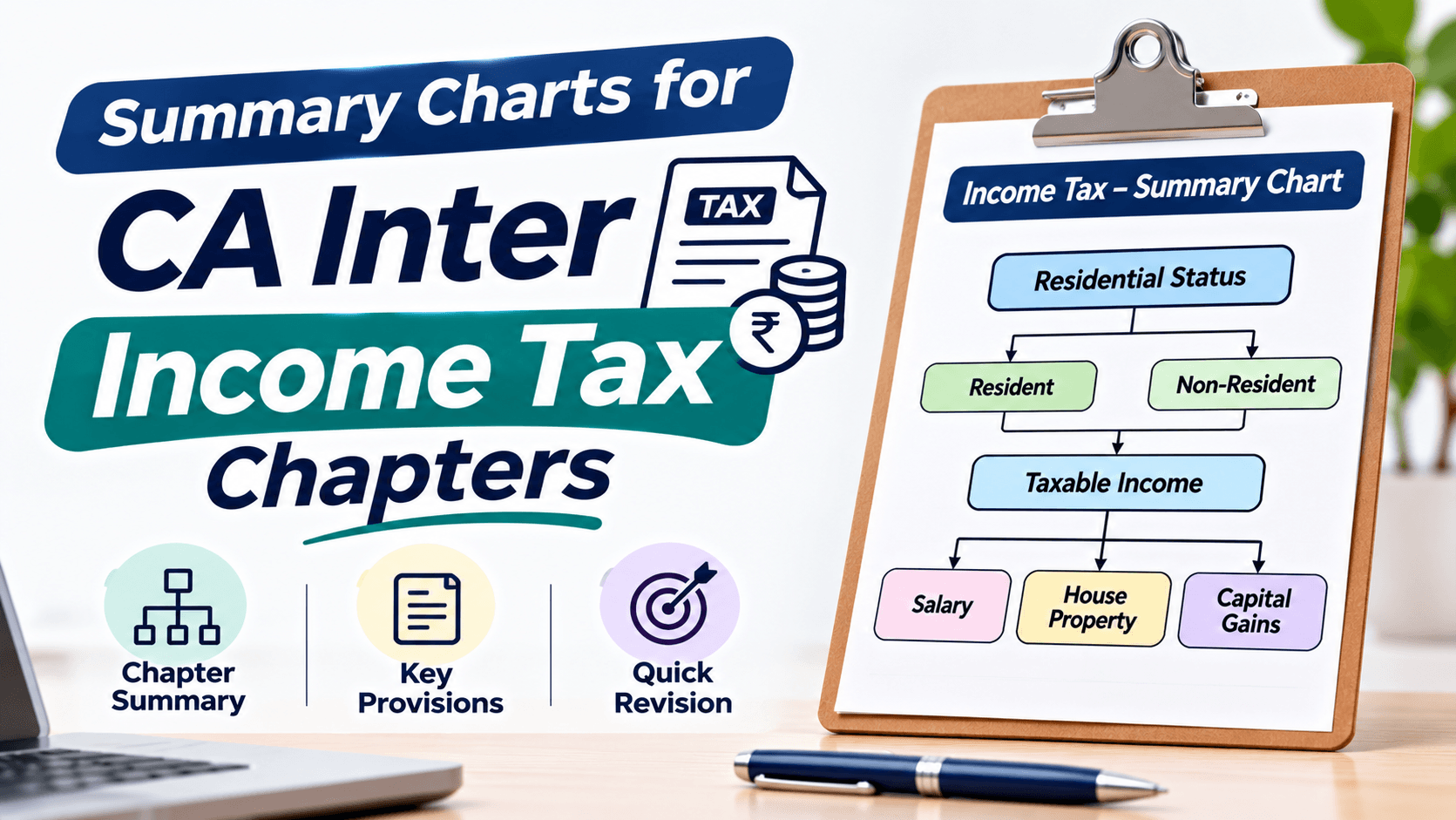
Summary Charts for CA Inter Income Tax Chapters
Revise CA Inter Income Tax with chapter summary charts, provision checklists, comparison tables and question-led practice. Organise your tax revision with Studycaller
In this article(9 sections)ShowHide
Income Tax revision can become confusing when provisions, definitions, conditions and exceptions appear across different chapters. Summary charts help organise those details into a structure that is easier to scan and test. They are especially helpful when each chart shows the rule, its conditions and the facts that affect application.
Tax provisions and applicable rates can be updated, so do not rely on an undated chart without checking it. Use the current prescribed study material and official updates relevant to your CA Intermediate attempt, and practise applying provisions to questions.
Organise Each Chapter Around Its Core Questions
Begin each chapter chart with a few questions: what is the topic about, when does the provision apply, what conditions matter, what exceptions should be checked, and how is the result calculated or presented? This structure keeps the chart focused on problem-solving rather than collecting disconnected facts.
Use the exact terminology and framework in your prescribed material. A short summary should preserve legal and tax distinctions that affect the answer. If one chapter includes several different rules, split the chart into smaller sections rather than forcing everything into a single crowded page.
Create Provision and Condition Checklists
For each provision, record the key conditions and the information a question must provide for you to apply it. A checklist can remind you to check eligibility, relevant dates, thresholds or exceptions where these are part of the prescribed rule. Do not treat the checklist as a substitute for reading the facts carefully.
Add only the checks that are relevant to the topic and current syllabus. When you make a mistake in practice, identify whether a missing condition caused it and update the chart with a concise prompt. This makes your revision material responsive to actual learning gaps.
Use Comparison Charts for Easily Confused Rules
Where two rules look similar, put them in parallel columns and compare the circumstances, conditions, treatment and exceptions. Include a short example or question cue if that helps you distinguish them. Use the comparison to practise choosing the right rule from the facts presented.
Do not memorise the table without understanding why the distinctions exist. After reviewing it, cover one column and explain the rule in your own words. Then attempt a mixed question to confirm that you can recognise the relevant treatment without being told the chapter.
Summarise Calculation Steps Clearly
For numerical topics, show the order in which the relevant figures are identified, adjustments are applied and the result is calculated. Keep assumptions and working labels clear. If the treatment depends on a condition, show where that decision affects the calculation.
A worked example can accompany the chart, but avoid turning the summary into a long solution manual. Keep one representative illustration and refer to your question practice for variations. Rework the example without looking to check whether you can reproduce the method.
Mark Rates, Limits and Dates for Verification
Tax-related notes should make time-sensitive details easy to identify. Clearly mark rates, limits, dates and other items that must be verified for the relevant assessment year or examination attempt. Never assume a number from an older chart remains applicable.
Before final revision, check these details against official and prescribed materials. If a value changes, update every related chart and worked example. A consistent date or source note helps you avoid mixing current rules with figures remembered from previous attempts.
Build a Chapter Summary Chart
| Chart area | What to include | Revision question |
|---|---|---|
| Core rule | Short statement of the provision | Can I explain it accurately? |
| Conditions | Key requirements and facts | Which facts decide applicability? |
| Exceptions | Relevant exclusions or special cases | What could change the treatment? |
| Calculation steps | Order of computation or adjustments | Can I reproduce the steps? |
| Update check | Rates, limits, dates and source | Is this valid for my attempt? |
Use the following structure to prepare a chart for any Income Tax chapter. It is a template rather than a statement of current tax law; fill it using the applicable prescribed content and verify any time-sensitive details.
Practise With Mixed Tax Questions
Chapter-wise practice helps you learn a rule, while mixed questions help you identify which rule applies when the topic is not stated. Attempt a question independently, note the facts that drove your choice and then check your answer against the prescribed solution.
When you make an error, classify it as rule recall, condition missed, wrong method, calculation or interpretation. Revisit the chart only for the specific gap and then solve another question. This keeps revision targeted and helps prevent the same mistake from recurring.
Keep Charts Short and Consistent
Use the same headings across chapters where possible: core rule, conditions, exceptions, calculation or application, and common errors. Consistent structure makes charts easier to compare and faster to revise. Leave enough space for the important distinctions instead of reducing font size to fit every detail.
Avoid maintaining multiple versions of the same chart without a clear reason. Keep one active version, mark the source and last-checked date, and remove outdated material from your final revision folder. If your prescribed material changes, update the chart before using it again.
Combine Studycaller Practice With Revision
Studycaller can be part of a planned cycle of summary review, question practice and error correction. Use the results of practice to identify chapters that need another revision session, and make sure the questions and notes correspond to your current syllabus.
A chart is valuable when it helps you reach the correct rule and apply it accurately. Keep testing recall, review mistakes and verify current tax provisions instead of assuming that reading the summary several times guarantees readiness.
CA Inter Income tax notes
Free notes from the Studycaller library, picked for this article.
 Summary
CA Inter · Taxation
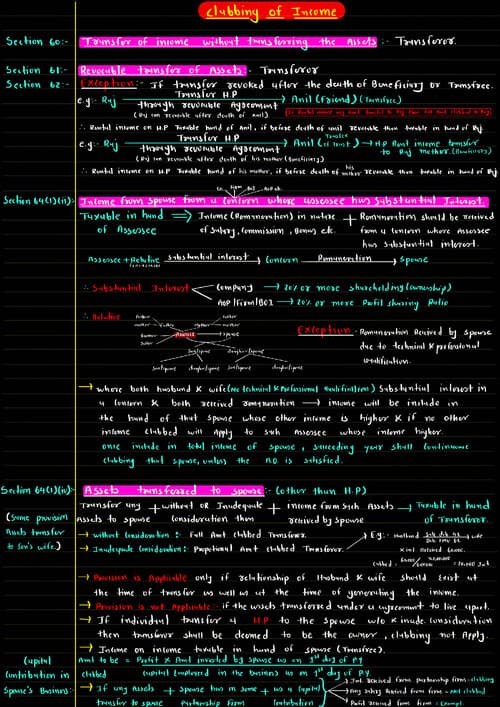
Clubbing of Income - Handwritten Notes on Sections 60 to 64 (Income Tax)
Jay JaiswalLikes 1Views 12.3k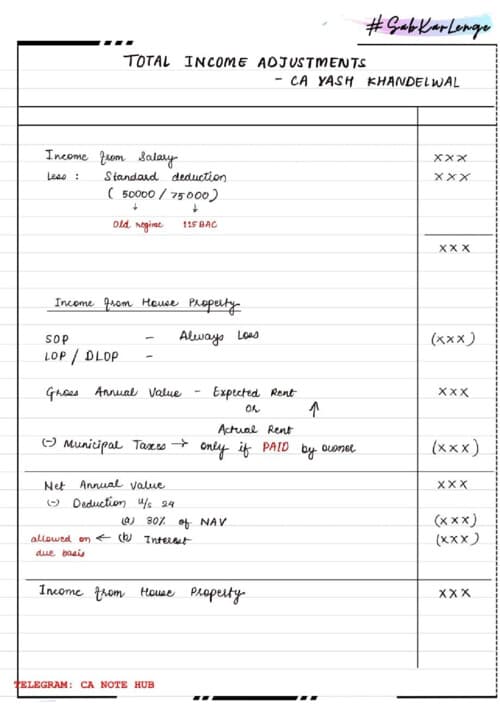 Charts
CA Inter · Other Stuff
Total Income Adjustments Chart By CA Yash Khandelwal
CA NOTE HUBViews 4k Summary
CA Inter · Taxation
VIVITSU Taxation Reviewer (Part - 1B) Contains Only Income Tax (IT) Other than Heads of Income & Residence With Index
Monish KannaLikes 17Views 20.3k Summary
CA Inter · Taxation
Taxation Reviewer With RTP, MTP and PYP Questions for CA Inter
Monish KannaLikes 16Views 20.9k
Frequently asked questions
What should CA Inter Income Tax summary charts include?
Include the core rule, relevant conditions, exceptions, calculation steps and common errors. Mark any rates, limits or dates that require verification for the applicable examination attempt.
Can I prepare for Income Tax using charts only?
No. Charts support quick revision but cannot replace full conceptual study, current prescribed material and question practice. Use them to recall a rule and then apply it to exam-style questions.
How do I remember Income Tax provisions?
Organise provisions by topic, use concise condition checklists and practise retrieving the rule from memory. Revisit difficult topics after a gap and solve questions that require you to apply the provision.
Should I include tax rates and limits in my charts?
You can include them if they are relevant to your syllabus, but mark them for verification. Check the current prescribed material and official updates before using any time-sensitive figures.
How can I avoid confusing similar tax provisions?
Create comparison tables showing when each rule applies, its conditions and exceptions. Then practise mixed questions so you learn to select the correct provision from the facts.
What is the best way to revise numerical tax topics?
Use a clear step-by-step calculation layout, practise a representative example and reattempt it without looking. Review which adjustment or condition affects each stage of the computation.
How often should I revise summary charts?
Review charts in short sessions throughout your preparation and revisit difficult topics more often. Combine recall with questions so you can check whether you can apply the information, not just recognise it.
How should I update old Income Tax notes?
Check them against the applicable syllabus and official prescribed material. Update affected rates, limits, dates and examples, and remove outdated versions from your active revision folder.
Can Studycaller help with CA Inter Income Tax revision?
Studycaller can be used within a structured revision routine alongside relevant practice and error review. Make sure the materials you use are appropriate for your current CA Intermediate syllabus.
What should I do in the final days before the Taxation exam?
Review concise charts, verify time-sensitive details, practise selected mixed questions and revisit recurring errors. Avoid relying on unverified old notes or trying to replace all your preparation with last-minute summaries.