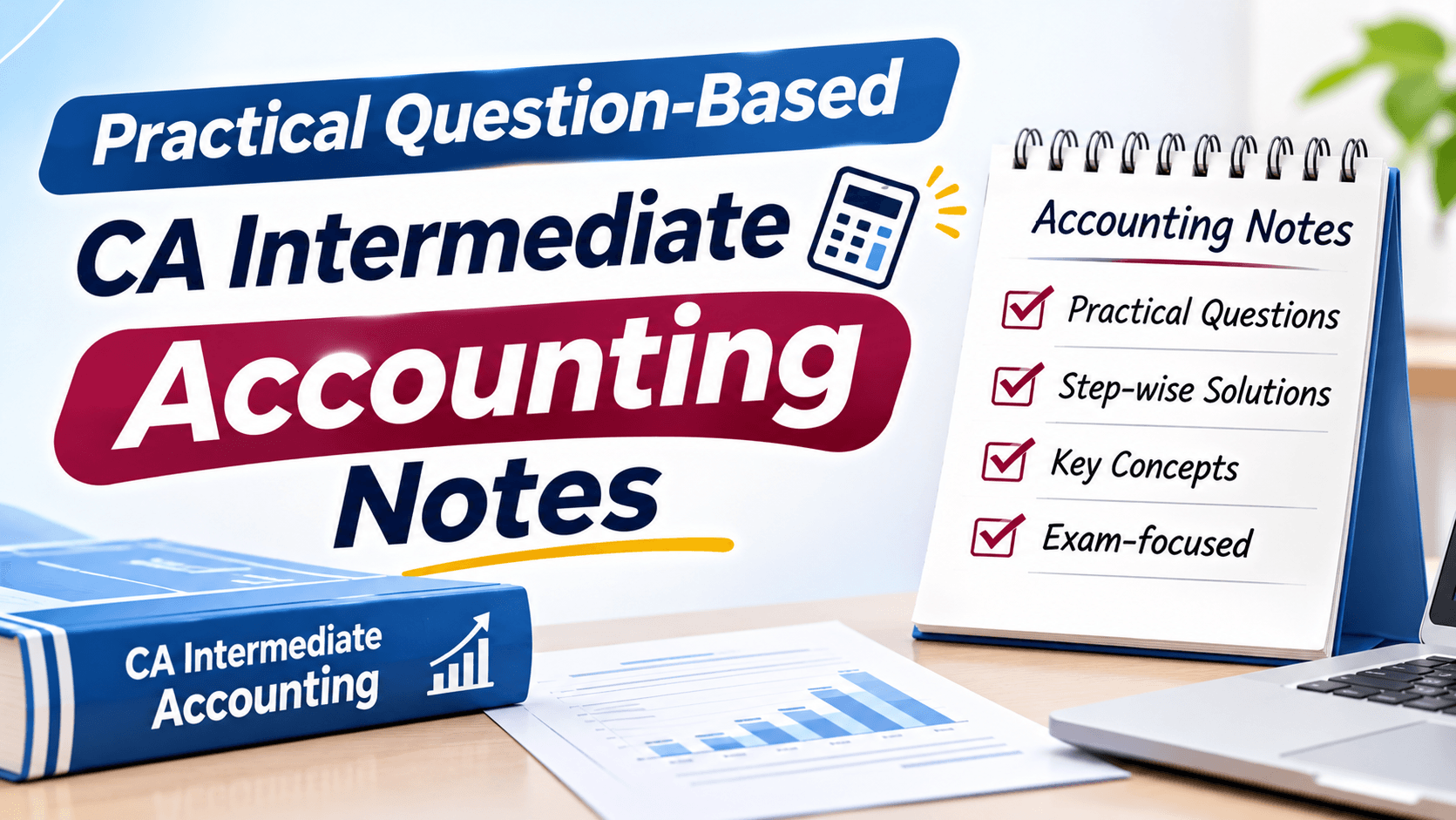
Practical Question-Based CA Intermediate Accounting Notes
Make CA Intermediate Accounting revision practical with question-led notes, stepwise workings, adjustment checklists and an error log. Explore a structured approach…
In this article(9 sections)ShowHide
Accounting becomes easier to revise when notes show how a concept is used in a question. Long theory summaries may help with understanding, but students also need to recognise adjustments, organise workings and check the final presentation. Question-based notes connect the rule to the steps required to solve a problem.
Build these notes from the current prescribed study material and your own practice. The exact topics and accounting requirements can vary by examination attempt, so verify the applicable syllabus and standards before relying on a prepared summary.
Start With the Concept Behind Each Question
For every major topic, begin with a short explanation of the accounting principle and the situation in which it applies. Then attach a representative question that demonstrates the process. This helps you understand why a step is required instead of copying a solution mechanically.
Write down the information that signals the topic and the adjustments that need attention. When you encounter a new question, compare its facts with your notes and decide which parts of the method are relevant. Avoid assuming every question follows the same pattern.
Record the Solution in Clear Stages
Break a solution into stages such as identifying relevant information, recording adjustments, preparing workings, passing entries where required and presenting the final answer. The sequence will vary by question type, but a consistent layout makes it easier to follow your own logic.
Label every working and cross-reference it to the final figure. If a number is carried forward from another calculation, make the connection visible. Clear workings help you locate mistakes and make your solution easier to review against the suggested answer.
Make an Adjustment Checklist
Create a checklist of the adjustments that commonly arise in the topics you are studying. For each item, note what needs to be checked and where it affects the calculation or presentation. Treat the checklist as a prompt to read the question carefully, not as a substitute for understanding the facts.
Add an item only when it is relevant to your prescribed syllabus or when practice shows that you repeatedly overlook it. Too many generic prompts can make a checklist hard to use. Keep it specific, concise and easy to scan before attempting a question.
Use Worked Examples as Learning Tools
When reviewing a worked example, first attempt the question yourself or predict the next step before reading the solution. Then compare the logic, workings and presentation. This makes the example an active learning exercise instead of a page you recognise but cannot reproduce.
For a difficult problem, annotate why each adjustment is made and which fact supports it. Remove the annotations during later revision and solve the question again from a clean page. If you still need the notes for every step, revisit the underlying concept.
Build Topic-Wise Question Notes
Organise notes around question patterns rather than collecting solutions in an unstructured folder. Give each pattern a title, a brief method, a representative problem and a list of common errors. Add variations when a change in facts alters the treatment or the final presentation.
Do not copy every practice question in full. Keep a reference to the source and record the learning point, especially when the question is repetitive. Reserve detailed solutions for examples that teach a new method or expose an error you are likely to repeat.
Use a Sample Question Review Table
| Question review field | What to record | Why it helps |
|---|---|---|
| Topic and pattern | The concept tested | Builds recognition across questions |
| Key adjustment | Fact that changes the treatment | Reduces missed information |
| Working sequence | Main calculation steps | Makes the solution reproducible |
| Error found | Specific reason for lost marks | Targets revision efficiently |
| Reattempt date | When to solve it again | Checks lasting understanding |
After solving a question, record what it tested, which step was difficult and what you need to do differently next time. The following template can be used for any topic and should be adapted to your own recurring mistakes.
Review Errors Before Reattempting
Classify mistakes as misunderstanding the rule, missing an adjustment, incorrect calculation, weak working format or misreading the requirement. Write the correction in one or two lines and schedule a reattempt after a gap. This shows whether you have fixed the cause rather than memorised the answer.
When the same error appears repeatedly, update your notes with a warning or checklist item. If the error is conceptual, go back to the relevant lesson or standard. If it is a checking issue, introduce a deliberate final review of figures, labels and cross-references.
Practise Mixed and Timed Questions
Topic-wise practice is useful while learning, but mixed questions help you recognise which accounting method applies without being told the chapter. Once your accuracy is stable, practise within a time limit and review whether you spent too long on any one adjustment.
Do not judge progress only by the number of questions completed. Track accuracy, time, the type of errors and whether you can solve a similar question later. A smaller set with thoughtful correction can be more valuable than a large set that you never review.
Connect Notes With Studycaller Practice
Studycaller can be included in your routine as a source of structured exam-style practice where relevant. Use practice results to choose which question patterns deserve another attempt, and keep your notes focused on the syllabus and areas that need improvement.
Before the examination, use your own short methods and error notes to revise. Verify accounting standards, syllabus coverage and any applicable updates using the official prescribed material for your attempt. Avoid depending on an old solution simply because it matches a familiar question.
CA Inter Accounting standards notes
Free notes from the Studycaller library, picked for this article.
 Handwritten
CA Inter · Advanced Accounting
CA Inter May24 Adv account ✔️Revenue based accounting standards ✔️ Other accounting standards
Sakshi KhandveLikes 7Views 9k Detailed Notes
CA Inter · Advanced Accounting
Advanced Accounting Reviewer Part 1 Accounting Standards With Index CA Inter
Monish KannaLikes 12Views 15.7k Summary
CA Inter · Advanced Accounting
CA - INTERMEDIATE JK SHAH : ADVANCED ACCOUNTING NOTES ACCOUNTING STANDARDS PART : 2
PriyadharshiniLikes 7Views 12.5k Summary
CA Inter · Advanced Accounting
CA - INTERMEDIATE JK SHAH : ADVANCE ACCOUNTING NOTES Accounting Standards Part : 1
PriyadharshiniLikes 7Views 8.6k
Frequently asked questions
What are question-based CA Intermediate Accounting notes?
They are concise notes built around question patterns, key adjustments, solution steps and common mistakes. They connect accounting concepts to the practical work required to solve exam-style problems.
Should I write every Accounting solution in my notes?
No. Keep representative solutions that explain a method or a recurring difficulty. For repetitive questions, record the key learning point and source rather than copying every page.
How can I improve the presentation of Accounting answers?
Use clear headings, labelled workings, visible calculations and consistent cross-references. Follow the format required by the question and make sure the final figures can be traced to the supporting workings.
How do I remember adjustments in Accounting questions?
Create topic-specific checklists and practise identifying adjustments from question facts. After each attempt, note the adjustment you missed and reattempt a similar question later.
Are solved examples enough for CA Inter Accounting?
Solved examples are helpful for learning, but independent practice is essential. Attempt questions without looking at the solution and check whether you can reproduce the method and explain the key steps.
How should I review an incorrect Accounting answer?
Identify whether the error came from a concept, adjustment, calculation, presentation or reading issue. Correct the cause, record a short reminder and reattempt a related question after a gap.
When should I begin mixed-question practice?
Start with topic-wise questions while learning a method, then add mixed sets once you understand the main concepts. Mixed practice helps you choose the correct approach independently.
How can I manage time in Accounting papers?
Practise with realistic time limits after developing accuracy. Review which steps take longest, keep workings organised and avoid spending too much time on a single difficult adjustment.
Can Studycaller support CA Intermediate Accounting practice?
Studycaller can be part of a planned practice cycle when you use relevant exam-style questions and review your mistakes. Match all resources to the current syllabus and prescribed material.
What should my Accounting notes look like before the exam?
They should be concise and easy to scan, with core methods, representative question patterns, adjustment prompts and recurring errors. Use them for revision, not as a replacement for solving questions.