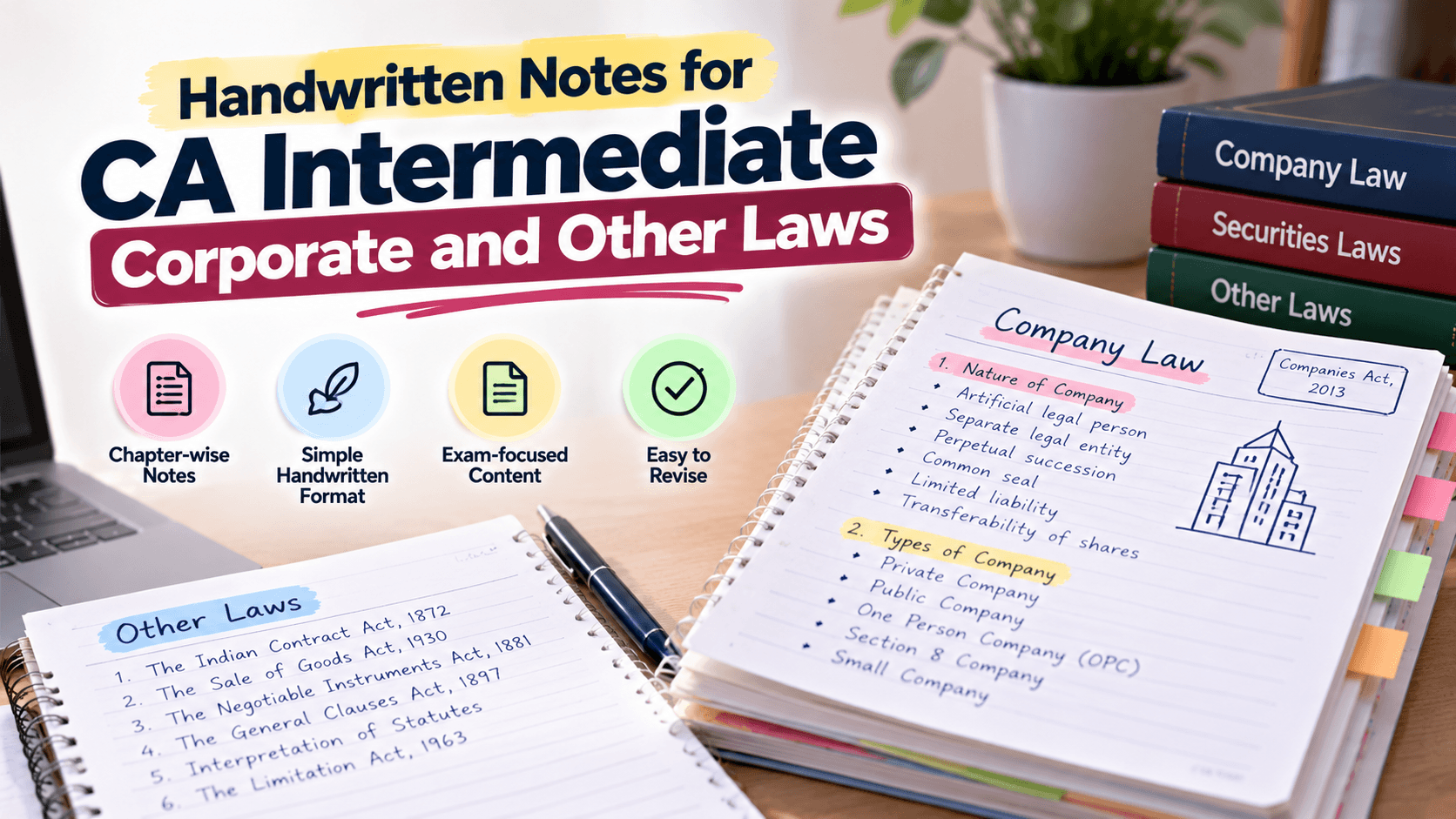
Handwritten Notes for CA Intermediate Corporate and Other Laws
Use handwritten CA Intermediate Corporate and Other Laws notes to revise provisions, definitions, exceptions and answer structure while keeping preparation aligned with…
In this article(10 sections)ShowHide
Corporate and Other Laws can feel demanding because students must understand provisions and recall them accurately while writing clear answers. Reading the same pages repeatedly is not always enough, particularly when several sections use similar terms or contain different exceptions.
Handwritten notes can make revision more focused when they summarise the provision, its conditions and the key words that should appear in an answer. Prepare them from current prescribed material and check them regularly against the syllabus for your examination attempt.
Why handwritten Law notes can help
Writing a provision in your own words requires you to decide which parts matter most. A concise page can bring together a definition, the general rule, conditions, exceptions and a short illustration. This is especially useful during revision, when you need to retrieve the structure of a provision quickly.
Handwritten notes also make it easy to add personal reminders in the margin. Mark a confusing distinction, a section you repeatedly forget or a phrase that should be used carefully in an examination answer. The goal is not to create attractive pages; it is to create pages that improve recall.
What to include in Corporate Laws notes
Organise notes chapter by chapter in the same sequence as the applicable study material. For each provision, record the subject, the rule, the conditions for applying it, relevant exceptions and any time limits or thresholds included in the current syllabus. Check figures and limits rather than relying on memories from an older attempt.
Use a consistent template: provision or concept; meaning in simple language; essential requirements; exception or qualification; and a small example. If a provision has multiple steps, write them as a numbered sequence. If two provisions are easy to confuse, place them side by side and note the precise difference.
How to summarise Other Laws
Other Laws can include rules from different legal areas, so keep each topic distinct and avoid blending definitions from separate Acts. For each topic, identify the purpose of the law, relevant terms, the rule and the situation in which it applies. Record details required by the syllabus for your examination attempt.
Use headings that match official topic names. This makes it easier to cross-check your notes and find missing coverage. Where a topic involves a process or legal consequence, write the steps in order and use a brief hypothetical example to test your understanding.
Writing notes that support exam answers
Law answers should be direct and logically organised. A useful structure is to identify the issue, state the relevant legal principle, apply the facts where the question gives a situation, and present a clear conclusion. Your notes can include this structure as a reminder without attempting to write a complete model answer for every possible question.
Pay attention to important legal terms. Replacing a precise word with a loose synonym can change the meaning of a provision. Keep key phrases close to the official material and use your own explanation to show understanding. For case-based questions, practise connecting facts to the rule instead of simply reproducing a paragraph.
A practical method for making handwritten notes
Read a short portion of the chapter and identify its main idea. Close the book and write the rule from memory, then reopen the source to check accuracy. Add missing conditions or exceptions in a different mark so you can see what you failed to recall.
Keep each page focused on one main concept. Use tables for comparisons, flowcharts for procedures and small boxes for exceptions. Avoid copying long passages word for word. If a topic requires detailed explanation, make a concept page and a shorter last-minute revision sheet.
How to revise provisions and definitions
Use active recall instead of only rereading. Cover the notes and try to explain the provision aloud or write its main elements on a blank page. Then compare your answer with the source and correct omissions. Repeat this process after increasing intervals, such as the next day, later in the week and during the next revision cycle.
Flashcards can be useful for definitions, conditions and distinctions, but they should not replace full-question practice. Legal questions often require you to identify which rule applies to a set of facts. Combine quick recall exercises with written answers so that knowledge transfers to examination conditions.
Keep amendments and syllabus changes under control
Law content may change through amendments, notifications or changes to prescribed material. Write the attempt or version date on your notes and maintain a small update log. Before the examination, verify applicable amendments and coverage through official ICAI announcements and material prescribed for your attempt.
Do not merge new information into old notes without marking the change. A clear update marker helps you distinguish the earlier rule from the rule applicable to your exam. If a point is uncertain, check the official source or ask a qualified teacher rather than relying on an unverified summary.
A weekly revision plan for CA Inter Law
Allocate separate sessions for learning new provisions, recalling completed topics and writing answers. At the end of each chapter, attempt questions without looking at the notes. Review answers that are technically right but poorly structured or missing a condition, as well as incorrect answers.
Once a week, revise a mix of older and newer chapters. Before a mock test, review your error log, key distinctions and frequently forgotten conditions. After the test, add useful corrections to your notes rather than rewriting the entire chapter.
Using Studycaller in your Law preparation
Studycaller can be part of a structured revision plan alongside prescribed study material and written practice. Use revision support to identify topics that need more work, then return to the official source to confirm the legal position and syllabus coverage.
Measure progress by how accurately you can recall and apply provisions, not by how many pages you have written. A compact set of dependable notes is more valuable than a large notebook that is difficult to revise.
Common mistakes to avoid
Avoid writing entire sections without understanding them, skipping exceptions, using outdated notes and assuming that reading a provision guarantees recall. Do not ignore answer presentation: a correct point can lose impact if the conclusion is unclear or the answer does not address the facts.
Do not make notes so brief that they omit the conditions needed to apply the rule. Keep enough detail to distinguish the general principle from exceptions and qualifications.
CA Inter Company law notes
Free notes from the Studycaller library, picked for this article.
 Charts
CA Inter · Corporate and Other Laws
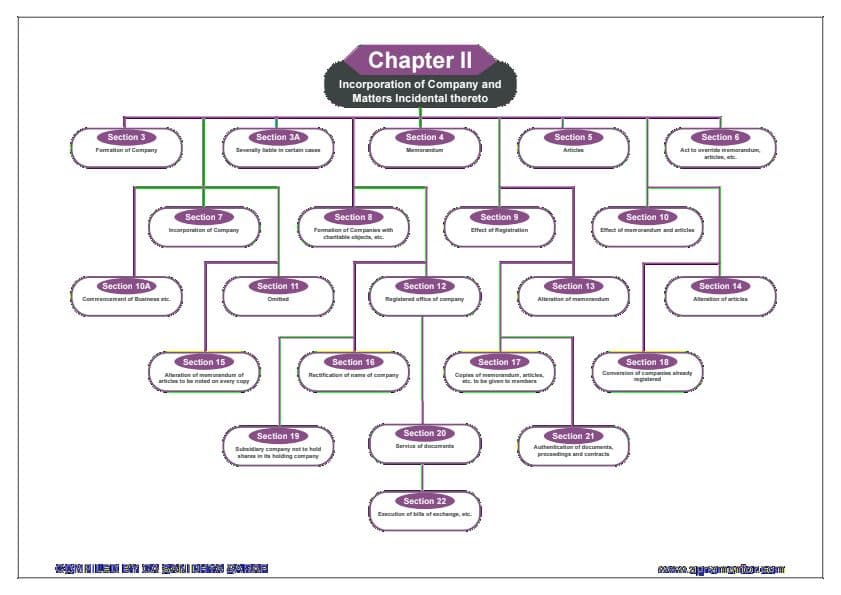
Inter LAW - Company Law section list
Mayur VisanaLikes 2Views 7.7k Questions
CA Inter · Corporate and Other Laws
Important questions for company law.
BeeeLikes 7Views 15.4k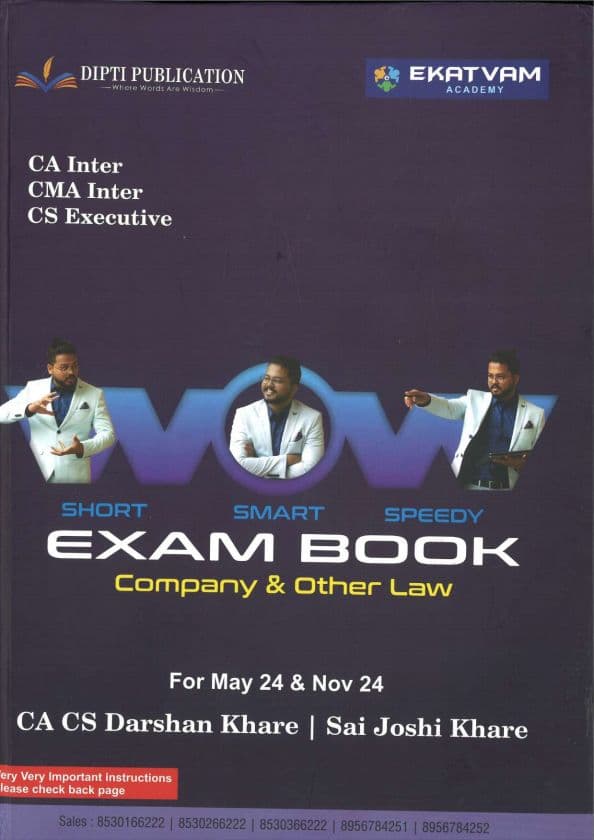 Summary
CA Inter · Corporate and Other Laws
WOW EXAM BOOK [Company & Other Law] By Darshan Khare Sir
chandresh guptaLikes 7Views 8.7k Amendments
CA Inter · Corporate and Other Laws
Companies Act, 2013 Preliminary Chapter Notes by CA Shubham Singhal
Yashwanth K.JLikes 6Views 12.4k
Frequently asked questions
Are handwritten notes useful for CA Intermediate Law?
Yes. They can simplify revision when they preserve key legal terms, conditions, exceptions and answer structure.
Should I copy sections of the Act word for word?
Focus on essential legal wording and explain the meaning clearly. Copying long passages without understanding is inefficient.
How should I organise Corporate Laws notes?
Follow the current chapter order and use a consistent format for the rule, conditions, exceptions and examples.
How can I remember legal provisions for longer?
Use active recall, spaced revision and written practice instead of relying only on repeated reading.
Do I need separate notes for Other Laws?
Keeping topics separate helps prevent definitions and rules from different laws becoming mixed up.
How do I write better Law answers?
Identify the issue, state the relevant principle, apply it to the facts and give a direct conclusion.
Should old CA Inter Law notes be used?
Use them only after checking the applicable syllabus, amendments and official material for your attempt.
How often should I update my Law notes?
Review them whenever official updates apply and do a complete accuracy check before final revision.
Are flowcharts useful for Law?
Yes, for procedures and multi-step processes, while definitions and exceptions may be clearer in tables or short lists.
How can Studycaller support Law revision?
Use Studycaller within an organised practice routine and verify legal details against the current official material.